Introduction
Global energy investment is set to exceed $3 trillion in 2024, with $2 trillion dedicated to clean energy technologies and infrastructure alone — a historic milestone showing how renewable power, grids, and storage now outpace total spending on oil, gas, and coal. In India alone, the push toward 500 GW of non-fossil capacity by 2030 means C&I businesses and energy investors are deploying capital at a pace that demands rigorous asset oversight. Managing these assets well is no longer a back-office concern. C&I businesses and energy investors face a direct trade-off: keep assets running reliably while cutting costs, improving efficiency, and meeting sustainability targets — all at the same time.
This guide breaks down what Energy Asset Management (EAM) is, its core components, measurable benefits, and how to apply it. Whether you're managing a multi-state renewable portfolio across Indian DISCOMs or evaluating asset-level ROI on a new solar PPA, EAM is the framework that turns capital-heavy infrastructure into consistent, well-governed returns.
TLDR
- EAM covers the full lifecycle of energy assets — monitoring, maintenance, optimization, and retirement
- Covers power plants, solar installations, wind turbines, battery storage, transmission lines, and associated software infrastructure
- Core components: lifecycle management, predictive maintenance, performance monitoring, risk management, and financial planning
- Reduces downtime, cuts costs, improves decision-making, and supports sustainability and regulatory compliance
- For renewable assets, EAM also addresses weather-driven output variability and yield analysis
What Is Energy Asset Management (EAM)?
Energy Asset Management (EAM) is the strategic, data-driven approach to managing the physical and digital assets that generate, transmit, store, or consume energy — spanning the full asset lifecycle from procurement to retirement. Unlike general energy management, which focuses on consumption behavior and procurement strategy, EAM zeroes in on asset-level optimisation: performance, maintenance, and lifecycle value.
What "energy assets" includes:
- Power generation plants (thermal, hydro, nuclear)
- Solar panels and wind turbines
- Battery storage systems
- Transmission and distribution lines
- Substations and grid infrastructure
- Associated software and control systems
EAM success is measured through specific KPIs that define what "good" asset management looks like in practice:
| KPI | Definition | Application |
|---|---|---|
| Performance Ratio (PR) | Ratio of measured yield to reference yield at Standard Test Conditions | Measures overall PV plant efficiency; typically temperature-corrected to reduce seasonal variations |
| Availability (Time/Energy) | Percentage of time or expected energy a plant generates electricity, excluding force majeure | Contractually binding metric in O&M and EPC contracts; evaluated at inverter level |
| Capacity Factor (CUF) | Ratio of actual annual output to output at rated capacity for an entire year | Ranges from 10-20% for PV systems; higher for systems with trackers and high DC:AC ratios |
| Mean Time Between Failures (MTBF) | Expected operating time between two consecutive failures | Describes predicted elapsed time between repairable failures of mechanical/electronic systems |

EAM vs. APM — What's the Difference?
Asset Performance Management (APM) is a subset of EAM focused on real-time performance analytics, predictive insights, and condition monitoring. According to Gartner's 2025 Market Guide, APM encompasses data ingestion, connectivity, predictive forecasting, and reliability-centered maintenance, using AI, IoT, and analytics to optimise equipment performance and predict failures.
EAM is broader, covering procurement, inventory, work orders, and full lifecycle processes. The two aren't siloed — APM systems push and pull data into EAM platforms to generate work orders, manage spare parts, and reduce downtime. By 2027, Gartner predicts 20% of asset-intensive organisations will leverage APM as a module within a larger EAM suite.
The 5 Core Components of Energy Asset Management
Component 1 — Asset Lifecycle Management
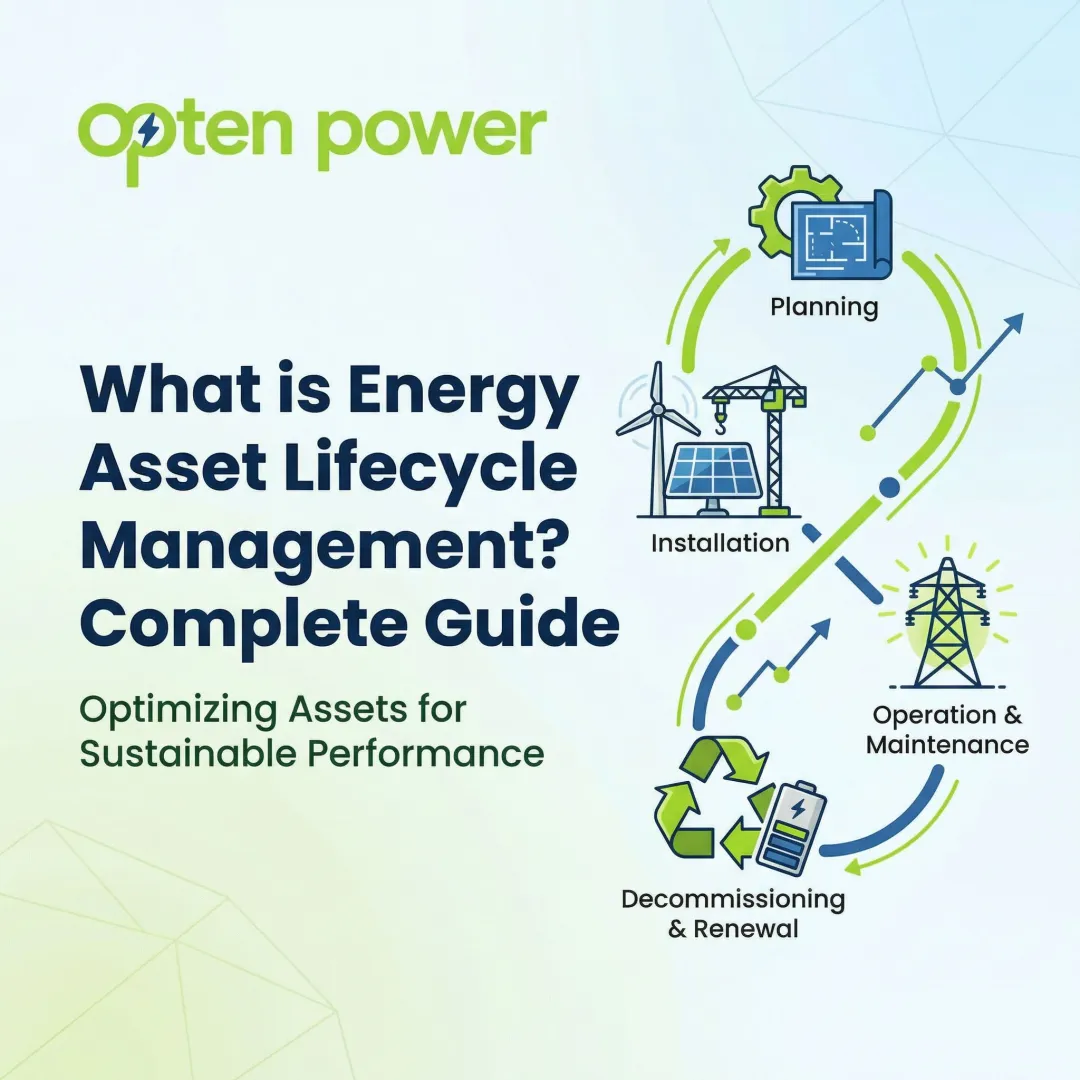
Every energy asset passes through distinct phases: planning, acquisition, commissioning, operation, maintenance, and decommissioning. EAM provides the framework to optimize value at each stage, including decisions on when to upgrade versus retire an asset. Capital is allocated more efficiently when each phase has defined criteria — and assets consistently deliver stronger returns when lifecycle decisions are data-driven rather than reactive.
Component 2 — Predictive and Preventive Maintenance
Preventive maintenance follows scheduled upkeep to avoid wear and tear, while predictive maintenance (PdM) uses real-time sensor data and analytics to anticipate failures before they occur.
According to Siemens' 2024 research, implementing PdM delivers:
- 50% reduction in unplanned downtime
- 40% reduction in maintenance costs
- 85% improvement in downtime forecasting accuracy
- 55% increase in labor productivity
- Up to 50% extension in asset life expectancy

With PdM in place, organizations schedule repairs during planned outages rather than scrambling after emergency breakdowns — shifting maintenance from a cost center into a strategic discipline.
Component 3 — Performance Monitoring
Continuous, real-time monitoring via IoT sensors and dashboards allows asset managers to detect underperformance early, track efficiency losses, and benchmark assets against industry standards. Modern monitoring systems generate enormous volumes of data — a single wind farm with 20-30 sensors per turbine can produce approximately 0.2 GB of raw data per turbine per day when sampled every second.
Turning that volume into decisions requires analytical capability across three areas:
- Signal filtering: separating meaningful anomalies from background noise
- Trend detection: identifying gradual degradation before it becomes failure
- Benchmarking: comparing asset output against design parameters and industry norms
Without these capabilities, monitoring infrastructure generates reports — not insights.
Component 4 — Risk Management
EAM helps mitigate a range of risks that threaten asset performance and financial returns:
- Equipment failure and unplanned downtime
- Regulatory non-compliance and penalties
- Cybersecurity threats to digital infrastructure
- Extreme weather events and climate impacts
- Market price volatility affecting revenue
Risk management includes both probabilistic modeling (forecasting likelihood and impact) and physical/financial mitigation strategies (insurance, hedging, redundancy design).
Component 5 — Financial and Regulatory Optimization
EAM connects asset decisions to financial outcomes by optimizing capital expenditure (capex), reducing operational expenditure (opex), ensuring compliance with environmental and grid regulations, and improving return on investment across the asset portfolio. In practice, this means every maintenance call, upgrade decision, or compliance filing ties back to a measurable impact on portfolio returns.
For businesses in India's renewable energy market, financial and regulatory optimization also extends into procurement — where real-time DISCOM tariff intelligence and portfolio-level dashboards, like those available on Opten Power's marketplace, help align asset performance data with live trading and compliance decisions across 16 states.
Key Benefits of Energy Asset Management
Benefit 1 — Reduced Downtime and Operational Efficiency
A well-implemented EAM program keeps assets performing at or near peak capacity, reducing unplanned breakdowns and associated revenue loss. The numbers make the case clearly:
- Unplanned outages cost industrial businesses USD 125,000 per hour globally
- Indian industrial businesses lose approximately INR 7 million per hour to unplanned downtime
- A single major forced outage in a power plant can cost USD 500,000 to USD 2,000,000+ when factoring in lost generation revenue, emergency parts premiums, overtime labor, and grid penalty fees
The world's 500 largest companies lose approximately USD 1.4 trillion annually due to unplanned downtime — equivalent to 11% of their revenues.
Benefit 2 — Improved Decision-Making
EAM systems give asset managers access to consolidated performance data, maintenance histories, and financial metrics. This removes guesswork from three of the most consequential decisions asset managers face:
- Repair vs. replace: Based on condition data and remaining useful life estimates, not gut instinct
- Upgrade timing: Triggered by performance degradation trends, not reactive failures
- Capital prioritization: Ranked by actual asset condition, not budget cycles or loudest stakeholders
Benefit 3 — Cost Reduction Over the Asset Lifecycle
Better decisions naturally lead to lower costs. EAM's long-term savings — from avoided emergency repairs, extended asset life, and smarter capital allocation — consistently outpace the upfront investment in systems and processes:
- Proactive, planned repairs cost 4-5 times less than emergency reactive repairs on the same asset
- An identical repair that costs ₹5.4 lakh when planned can escalate to ₹2.17 crore as an emergency response
- Implementing condition monitoring reduces the need for replacement parts by up to 40%
- McKinsey research shows digital work management systems can reduce maintenance costs by 15-30%

For C&I businesses running energy-intensive operations, these savings compound significantly over a 20-25 year asset lifespan.
Benefit 4 — Sustainability and ESG Compliance
Cost savings and sustainability reinforce each other under EAM. Efficient, well-maintained assets produce more energy with fewer emissions — and for businesses under pressure to meet ESG targets or India's Renewable Purchase Obligation (RPO) mandates, EAM provides the tracking and reporting infrastructure to demonstrate compliance.
Solar panel lifecycle emissions are calculated by dividing total lifecycle GHG output by lifetime electricity generated (gCO2eq/kWh). Improving panel yield and uptime through active EAM directly lowers this figure — meaning the same asset produces cleaner power per unit over its lifetime.
For businesses with science-based emissions targets or investor ESG reporting requirements, this isn't just environmental housekeeping. It's quantified, auditable performance data that supports third-party verification.
EAM in Renewable Energy: Key Differences and Opportunities
Renewable energy assets like solar panels, wind turbines, and battery storage systems face unique challenges that traditional EAM frameworks were not designed for — particularly output variability driven by weather, geographic dispersion of assets, and dependence on grid curtailment conditions.
Renewable-specific EAM requirements:
- Weather-aware performance forecasting that accounts for seasonal and daily generation patterns
- Soiling and degradation tracking — dust and soiling cause 4-7% average global energy loss in solar PV systems, costing the industry billions in annual revenue globally
- Yield analysis against P50/P90 projections to assess whether assets are meeting expected generation targets
P50 and P90 represent exceedance probabilities for energy yield — P50 is the investor base case, while P90 and P99 stress-test financial models against poor weather years to verify debt serviceability.
India's renewable portfolio scale:
As of November 2025, India's total renewable energy installed capacity reached 253.96 GW, spanning:
- 132.85 GW solar
- 53.99 GW wind
- 50.35 GW large hydro
- 11.61 GW bio energy

For Indian C&I businesses and developers managing portfolios across multiple states, this scale makes centralised EAM tools — capable of tracking state-wise DISCOM conditions, yield performance, and regulatory changes — a practical necessity rather than a nice-to-have.
Common Challenges in EAM Implementation
Challenge 1 — Data Overload and Integration Complexity
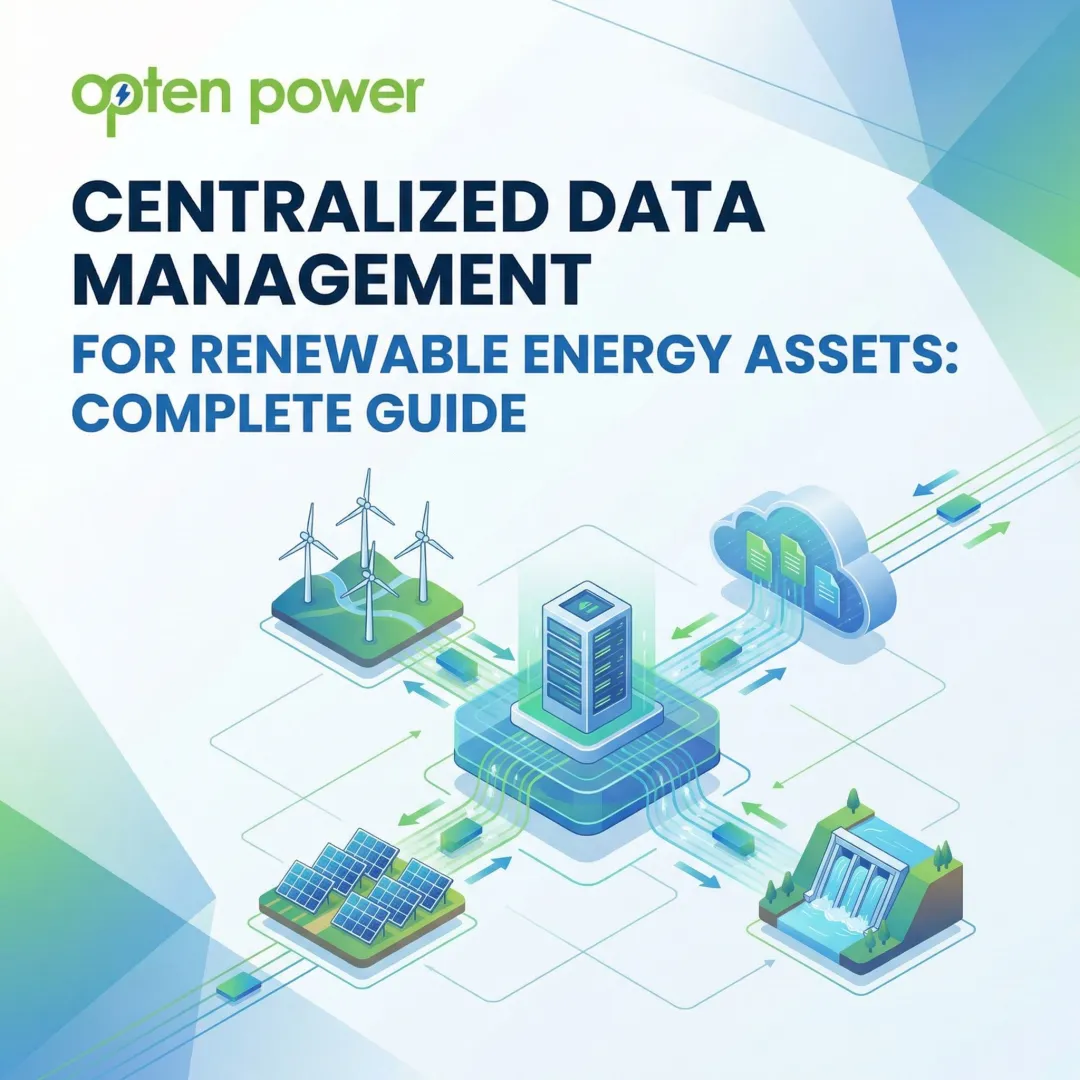
Modern EAM systems generate enormous volumes of data from sensors, SCADA systems, and maintenance logs. A modern wind farm generates approximately 0.2 GB of raw data per turbine per day. At enterprise scale, GE Power's APM solution streams 500,000 data records per second and ingests close to 20 billion machine-data records per day from sensors across 900 customer sites.
Without robust data management architecture and analytical capability, this data becomes noise rather than insight. This is a recurring pain point for businesses without dedicated asset management teams.
Challenge 2 — Aging Infrastructure and Legacy Systems
Much of the world's energy infrastructure was built before digital monitoring became standard. Integrating legacy assets into modern EAM platforms requires considerable upfront effort and cost. In India's power sector, legacy SCADA systems require multiprotocol gateways just to achieve basic interoperability. This adds complexity and cost before any EAM analytics can be deployed.
Older equipment may not deliver the same ROI from EAM investment as newer assets equipped with native digital monitoring capabilities.
Challenge 3 — Organizational Readiness and Skills Gap
EAM is not just a software deployment. It requires trained personnel who can interpret data, act on insights, and coordinate across operations, maintenance, finance, and compliance teams.
The readiness gap is well-documented. Over half of the current utility workforce has less than 10 years of experience, creating urgent demand for upskilling across three areas in particular:
- Data analytics — interpreting sensor outputs and predictive maintenance signals
- Cybersecurity — protecting operational technology networks as assets go online
- Distributed energy resource (DER) integration — managing solar, wind, and hybrid assets within unified platforms
46% of leaders identify skill gaps as a significant barrier to AI and digital adoption. In India specifically, the half-life of technical skills is now less than five years. When EAM programs underperform post-implementation, workforce readiness is usually the first place to look.
How to Build an EAM Strategy for Your Business
Step 1 — Asset Inventory and Baseline Assessment
An accurate asset inventory is the starting point every subsequent EAM decision depends on — lifecycle planning, risk prioritization, and capital allocation all trace back to it. Before deploying any system or process, document:
- Each asset's current condition and operational age
- Historical performance data and output trends
- Maintenance records and outstanding service obligations
- Associated contracts (PPAs, O&M agreements, warranties)

Step 2 — Define KPIs and Goals Aligned to Business Outcomes
Choose metrics that connect asset performance directly to business outcomes. Common EAM KPIs include uptime percentage, maintenance cost per unit of output, energy yield per asset, and carbon intensity. Goals should align with broader priorities:
- Cost reduction targets
- PPA commitments and revenue guarantees
- RPO/REC compliance and ESG reporting requirements
- Regulatory compliance obligations
Quantified targets — not just directional goals — make it possible to course-correct when performance drifts.
Step 3 — Choose the Right Tools and Partners
Evaluate platforms and advisory partners against four practical criteria: asset types managed, portfolio size, geographic spread, and integration requirements with existing financial or SCADA systems.
For businesses operating in India's renewable energy market, the right partner goes beyond monitoring. Platforms that combine procurement support, state-level regulatory intelligence, and portfolio-level oversight let asset managers connect operational performance with procurement and trading decisions in one workflow.
Opten Power's marketplace, for example, gives C&I businesses instant IRR and payback calculations alongside real-time DISCOM intelligence covering standardized landing prices across all states. A unified portfolio dashboard tracks renewable energy investments across 16 states, so asset decisions are grounded in current financial and regulatory data rather than estimates.
Frequently Asked Questions
What is energy asset management?
Energy Asset Management (EAM) is the strategic process of monitoring, maintaining, and optimizing energy-related physical and digital assets across their full lifecycle to maximize performance, reduce costs, and ensure regulatory compliance.
What is asset management in renewable energy?
Renewable energy asset management applies EAM principles specifically to solar, wind, and storage assets. It adds focus on weather-driven output variability, yield analysis against P50/P90 projections, and degradation tracking specific to renewable technologies.
What is the purpose of an asset management program?
An asset management program ensures assets deliver maximum value across their lifecycle by minimizing downtime, controlling costs, managing risk, and ensuring compliance.
What is the difference between EAM and APM?
EAM (Energy Asset Management) is the broader discipline covering full lifecycle processes — procurement, maintenance, work orders, and retirement. APM (Asset Performance Management) focuses specifically on real-time performance analytics and predictive insights. Most enterprise platforms today integrate both under a unified interface.
What are the 5 core components of asset management?
The five components are: asset lifecycle management, predictive and preventive maintenance, performance monitoring, risk management, and financial/regulatory optimization.
What is energy management in simple terms?
Energy management monitors and controls how energy is consumed and procured by an organization to reduce cost and waste. Energy asset management focuses on the physical assets that generate or deliver that energy, prioritizing lifecycle performance, reliability, and return on capital over energy flows alone.