
Introduction
Most facility managers are fighting two expensive battles at once — keeping critical assets running and controlling energy costs — but treating them as separate problems. That separation is costing real money. Unplanned equipment failures cost 3 to 5 times more than scheduled maintenance, while energy bills — often the single largest controllable expense in commercial and industrial operations — keep rising.
This guide walks you through the fundamentals of facilities management, the strategic role of asset management, why energy management has become FM's most consequential function, and how integrating both unlocks measurable cost savings. Facilities that connect asset lifecycle data with energy procurement decisions consistently reduce total cost of ownership — and this guide shows you how.
Key Takeaways
- FM integrates people, place, and process to improve productivity and cut costs
- Unplanned downtime costs 3–5x more than scheduled maintenance
- Energy can reach 65% of OpEx in data centres and exceeds 10% in heavy industries
- Corporate PPAs deliver up to 40% savings in high-tariff states
- Linking asset health data with energy procurement cuts total cost of ownership by 15–25%
What is Facilities Management?
Facilities management (FM) is the function that integrates people, place, and process to improve quality of life and productivity. ISO 41011:2017 formally defines it as "an organisational function which integrates people, place and process within the built environment." This definition matters because it positions FM as a strategic business enabler, not just a cost centre.
For large commercial and industrial operations—manufacturing plants, data centres, hospitals, steel plants—FM scope extends far beyond office building management. It covers complex machinery, continuous operations, regulatory compliance, and significant energy infrastructure, where a single equipment failure or energy spike can disrupt production across entire facilities.
India's FM market is expanding rapidly, projected to grow from US$2.6 billion in 2024 to US$6.7 billion by 2033 at an 11.1% CAGR—more than triple the global average growth rate. That growth is concentrated in specific service categories, which is where the Hard FM vs. Soft FM distinction becomes relevant.
Hard FM vs. Soft FM
FM divides into two categories:
Hard FM manages physical infrastructure:
- Maintaining HVAC systems
- Operating electrical systems and lighting
- Managing plumbing and fire safety
- Servicing machinery and structural systems
- Upkeeping building fabric
Soft FM delivers people-centric services:
- Providing cleaning and housekeeping
- Running security operations
- Managing catering
- Maintaining landscaping
- Handling waste management
In India, soft services account for 66.5% of the FM market. Yet hard services are growing faster at 8.37% CAGR, driven by two converging pressures: mandatory compliance under National Building Code fire safety mandates, and energy-saving retrofits pushed by Bureau of Energy Efficiency codes.
For heavy industries, that's where most cost-saving opportunities sit—in hard FM.
Asset Management in Facilities Management
Asset management is the strategic oversight of physical assets—HVAC units, machinery, electrical systems, production equipment—across their entire lifecycle from acquisition through disposal. Unlike reactive maintenance that responds to breakdowns, asset management is proactive and data-driven.
The financial logic is clear: unplanned downtime costs 3 to 5 times more than planned maintenance. Emergency repair costs escalate by 300-500% due to overtime, expedited shipping, and emergency contractors. In automotive manufacturing, unplanned downtime costs up to USD 2.3 million per hour. Running assets to failure is not a viable FM strategy for high-throughput industrial operations.
What Counts as a Facility Asset?
Assets worth tracking share three traits: significant monetary value, depreciation over time, and criticality to operations. In practice, these fall across three categories:
- HVAC systems, elevators, generators, and industrial machinery (high replacement cost, direct production impact)
- Electrical, plumbing, and fire safety infrastructure (compliance-critical, often invisible until failure)
- IT hardware and vehicles (operational continuity, moderate to high value)
Key Components of an Asset Management Strategy
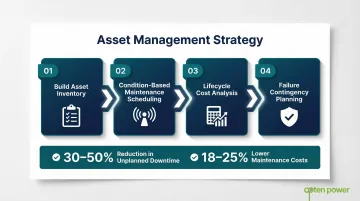
Build a complete asset inventory — Document make, model, condition, age, and location for every critical asset. This baseline makes lifecycle planning possible.
Schedule maintenance around condition data, not the calendar — Sensors monitor real-time performance and flag deviations before failure occurs, rather than servicing assets on fixed intervals regardless of actual wear.
Run lifecycle cost analysis — Weigh ongoing maintenance costs against replacement cost and energy inefficiency. The U.S. Department of Energy estimates annual maintenance costs for commercial centrifugal chillers at USD 45-50 per ton (U.S. benchmark; costs vary by equipment grade and location).
Plan for failure before it happens — Identify single points of failure across critical systems and develop contingency plans for each.
These four components work together — but technology is what makes the system scalable. IoT sensors and predictive maintenance platforms have fundamentally shifted how FM teams manage assets. Implementing predictive maintenance reduces unplanned downtime by 30-50% and cuts overall maintenance costs by 18-25%, with 95% of organisations reporting positive ROI.
Energy Management: FM's Biggest Cost Lever
Energy management belongs at the centre of any FM strategy because energy typically represents one of the largest controllable operating expenses. The share varies by sector:
- Data centres: Energy accounts for approximately 65% of operating expenses
- Hospitality: Energy typically accounts for 3-5% of total OpEx, but summer power bills reached ₹7,400 crore in 2024 amid heatwaves
- Manufacturing: Energy typically represents 1-10% of production costs, but in energy-intensive sectors (paper, iron and steel, cement), it often exceeds 10%
Buildings account for 37% of global energy and process-related CO₂ emissions, making energy management both a cost reduction and sustainability imperative.
The Components of an Effective Energy Management Plan
A structured energy management plan typically covers four areas:
- Audit baseline consumption across HVAC, lighting, and production machinery to pinpoint high-consumption assets
- Manage tariffs and procurement — understand DISCOM pricing, Open Access regulations, and when switching makes financial sense
- Schedule loads strategically to avoid peak tariff periods and reduce demand charges
- Integrate renewables through on-site solar/wind or off-site Corporate PPAs for long-term cost certainty
The Strategic Opportunity in Renewable Energy Procurement
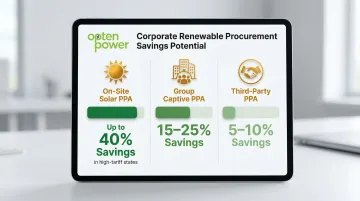
Of these, renewable procurement offers the most immediate and scalable cost lever. India's Green Energy Open Access framework allows C&I consumers with loads of 100 kW or more to procure renewable energy directly from generators. Corporate PPAs (Power Purchase Agreements) deliver significant savings:
| Procurement Model | Estimated Savings |
|---|---|
| On-site solar PPAs | Up to 40% in high-tariff states |
| Group captive PPAs | 15-25% |
| Third-party PPAs | 5-10% |
Source: Schneider Electric (2025)
States like Karnataka, Tamil Nadu, and Gujarat offer medium to high savings potential, making them prime targets for corporate renewable procurement. In 2025, India added 7.8 GW of solar open access capacity, bringing cumulative installed capacity above 30 GW.
How platforms simplify procurement: One practical challenge in renewable procurement is evaluating multiple developers, tariffs, and regulatory conditions simultaneously. Opten Power addresses this by giving FM teams access to 4+ GW of pre-vetted solar, wind, and hybrid capacity across 16 states on a single platform.
Teams can compare tariffs and IRR in real-time, run automated RFPs, and track their full energy portfolio from one dashboard. Standardised DISCOM landing prices across all states remove the guesswork when benchmarking against grid tariffs — so savings projections reflect actual costs, not estimates.
The sustainability dimension: For facilities with ESG commitments, transitioning to renewable energy via PPAs or on-site generation serves double duty — cutting carbon emissions while reducing energy spend. With BRSR disclosures now mandatory for listed companies in India, FM teams need procurement decisions that hold up to both financial and environmental scrutiny.
Integrating Asset and Energy Management for Maximum Efficiency
Asset management and energy management are deeply interconnected. Ageing or poorly maintained equipment consumes significantly more energy — an HVAC unit running with degraded components can draw 20-30% more power than a well-maintained equivalent.
Research on HVAC systems shows that incorrect refrigerant levels can lower efficiency by 5-20%, and improper installation can reduce efficiency by up to 30%. Poor maintenance strategies can reduce an asset's productive capacity by 5-20%, directly inflating energy consumption.
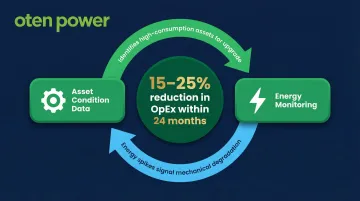
This integration creates a feedback loop with two compounding advantages:
- Asset condition data informs energy efficiency planning — identify high-consumption assets for replacement or upgrade
- Energy monitoring surfaces hidden performance issues — a sudden spike in energy draw signals mechanical degradation before failure occurs
The Business Case for Integration
When both functions are managed as one strategy, the compounding benefits include:
- Lower total cost of ownership — fewer emergency repairs combined with optimised energy spend. Companies deploying integrated facilities management solutions typically achieve a 15-25% reduction in operational expenditures within 24 months
- Better capital planning — replacement cycles informed by both condition data and energy inefficiency data, preventing premature replacements and avoiding running inefficient assets too long
- Improved regulatory compliance — energy efficiency norms and equipment safety standards handled within a single compliance framework
Not every facility needs equal emphasis on both functions. The right priority depends on where your biggest exposure lies:
When to prioritise one over the other:
- Ageing asset portfolios: Asset management takes the lead—focus on preventing failures
- High and growing energy bills: Energy procurement strategy (including renewable PPAs) becomes the priority
- New facilities or major expansions: Design both in from the start with a unified data model
Practical Steps to Build a Stronger FM Strategy
Step 1: Conduct a Joint Audit
Assess both the condition and energy performance of all major assets simultaneously. This creates a unified baseline that informs maintenance scheduling and energy procurement decisions together.
Data to capture:
- Asset age, condition, and maintenance history
- Energy consumption by asset and system
- Failure frequency and downtime costs
- Current grid tariff and consumption patterns
Step 2: Establish an Asset-Energy Performance Dashboard
Bring asset condition data, maintenance history, and energy consumption metrics into a single platform. At multi-site scale, spreadsheet tracking breaks down — missed maintenance windows and undetected energy spikes become expensive gaps. Integrated FM software or energy management platforms give you the visibility to act before problems compound.
Computerised Maintenance Management Systems (CMMS) are the fastest-growing FM software segment, with 16% CAGR projected from 2024 to 2029. CMMS delivers ROI in 30–90 days by automating preventive maintenance and reducing reactive repair costs.
Step 3: Build an Energy Procurement Roadmap
With asset visibility in place, you can make informed procurement decisions. Start by identifying which consumption loads are candidates for renewable energy sourcing — typically large, predictable loads in manufacturing, data centres, or 24×7 operations.
Evaluation steps:
- Check Open Access eligibility — most states require a minimum contracted load of 1 MW, though thresholds vary by state
- Compare PPA options (on-site solar, group captive, third-party)
- Calculate payback and IRR before committing
- Assess regulatory impact (wheeling charges, cross-subsidy surcharges)
Advisory platforms like Opten Power compress evaluation timelines significantly. An automated tender engine handles RFP creation, developer comparison, and contract finalisation — cutting the process by up to 50% compared to manual procurement.
Frequently Asked Questions
What is the meaning of facilities?
"Facilities" refers to the physical buildings, infrastructure, equipment, and supporting systems that enable an organisation to carry out its operations—offices, factories, warehouses, hospitals, and data centres are all examples.
What are examples of facilities?
Concrete examples across sectors include manufacturing plants, commercial office complexes, data centres, hospitals, hotels, warehouses, IT parks, and retail spaces. Each has distinct FM requirements depending on operational intensity.
What is the difference between asset management and facilities management?
Facilities management is the broader discipline covering all aspects of a building's operation—maintenance, safety, services, energy. Asset management is a specialised function within FM focused on optimising the lifecycle and ROI of individual physical assets.
How does energy management fit into facilities management?
Energy management is a core hard FM function responsible for monitoring, controlling, and reducing energy consumption across a facility. It includes tariff management, load optimisation, and increasingly, renewable energy procurement via PPAs or on-site generation.
How can industrial facilities reduce energy costs through FM practices?
Three primary levers drive energy cost reduction:
- Keep assets in optimal condition to prevent energy waste
- Shift loads away from peak tariff periods
- Procure long-term renewable power via Corporate PPAs to replace expensive grid power
What technology do facilities managers use to manage assets and energy?
Key tools include:
- CMMS (Computerised Maintenance Management Systems) for asset tracking and maintenance scheduling
- IoT sensors for real-time condition monitoring and consumption data
- Energy management platforms for tariff comparison, PPA procurement, and portfolio dashboards