Introduction
Indian C&I businesses face mounting pressure from two directions. On one side, fleet electrification is accelerating across logistics, manufacturing, and IT parks—driven by sustainability mandates and the promise of lower operating costs. On the other, grid electricity tariffs continue climbing, making charging those fleets increasingly expensive. Commercial and industrial consumers in Maharashtra pay ₹7.04/kWh, while Tamil Nadu charges ₹7.25/kWh—before demand charges and Time-of-Day penalties.
The core problem is capital. Installing solar and EV charging infrastructure together demands significant upfront investment. A mid-sized commercial solar plant costs ₹35,000–₹50,000 per kW, while a 100 kW DC fast charger runs approximately ₹13 lakh. Most businesses are unwilling or unable to commit this capital, leaving fleet electrification goals stalled.
The solar Power Purchase Agreement (PPA) offers a direct path forward: a third-party developer installs and operates the solar system, and your business pays for the electricity used at a rate below grid tariffs—no upfront capital required. This guide covers how solar PPAs work for EV charging, what the financials look like for C&I operations, and what to evaluate before signing.
Key Takeaways
- Solar PPAs let C&I businesses power EV charging stations without owning or financing the system
- Pay only for electricity consumed, at pre-agreed rates typically below standard grid tariffs
- PPA terms run 15–25 years with fixed or mildly escalating pricing for long-term cost visibility
- Supports fleet electrification, ESG compliance, and grid resilience simultaneously
- Real-time comparison of PPA developers, tariffs, and savings projections simplifies procurement decisions
What Is a Solar EV Charging PPA for C&I Businesses?
A Power Purchase Agreement (PPA) is a contract where a third-party developer finances, installs, owns, and maintains a solar energy system on or near your property. Your business agrees to purchase the electricity generated at a contractually fixed rate for the duration of the agreement (typically 15 to 25 years).
For EV charging, the model works like this: solar generation directly feeds on-site EV chargers (and general facility loads), meaning the energy powering your fleet comes from renewable capacity rather than expensive DISCOM (state electricity distribution company) supply. The solar output is consumed behind-the-meter, reducing grid dependence precisely when your vehicles need charging.
How PPAs Differ from Ownership and Leases
Under a PPA, your business carries:
- Zero upfront capital requirement
- No maintenance responsibility
- No ownership risk or depreciation liability
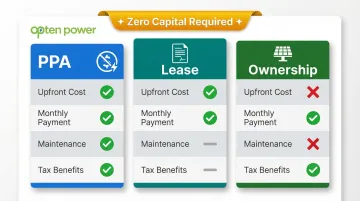
You are an energy buyer, not an asset owner. Monthly costs are usage-based — you pay per kWh consumed. Here's how the three models compare:
| Model | Upfront Cost | Monthly Payment | Maintenance | Tax Benefits |
|---|---|---|---|---|
| PPA | ₹0 | Per kWh consumed | Developer's responsibility | None (developer retains) |
| Lease | ₹0 | Fixed, regardless of output | Typically developer's | Limited |
| Ownership | Full installation cost | None (post-payback) | Your responsibility | Accelerated depreciation |
Why C&I Businesses Are Choosing Solar PPAs for EV Charging
Zero Upfront Capital Requirement
The developer bears 100% of installation, equipment, and permitting costs. For capital-intensive industries like steel, cement, or manufacturing—where capital allocation is tightly managed—this removes the single biggest barrier to fleet electrification.
Lower and More Predictable Energy Costs
Commercial and industrial tariffs in India have risen steadily over the past five years. Maharashtra's HT industry tariff stands at ₹7.04/kWh with ₹575/kVA demand charges, while Tamil Nadu charges ₹7.25/kWh plus ₹589/kVA.
PPAs lock in rates with modest annual escalations—typically 1.5–3%—set well below projected tariff growth. Over a 15–25 year contract, that gap compounds into substantial savings.
Time-of-Day (ToD) Penalty Avoidance
DISCOMs enforce Time-of-Day tariffs that penalize consumption during peak evening hours. Maharashtra imposes a +25% surcharge between 17:00 and 24:00 hours, while Tamil Nadu adds 25% during 06:00-10:00 and 18:00-22:00. Charging commercial EV fleets during these windows without a solar hedge exposes businesses to severe financial penalties.
Natural Alignment Between Solar Generation and EV Charging Patterns
Solar generation peaks between 9 AM and 5 PM—precisely when commercial fleets (delivery vehicles, company cars, campus buses) can be plugged in and charged. A well-sized solar PPA can cover the bulk of daytime charging load directly, cutting grid draw and keeping the fleet off expensive evening ToD windows.
ESG and Sustainability Commitments
Under a PPA, your business can claim Renewable Energy Certificates (RECs) generated by the solar system—a critical tool for meeting Science Based Targets and ESG disclosures. SEBI's BRSR Core mandates the top 1,000 listed entities to assure their renewable energy footprint, while the Science Based Targets initiative requires market-based Scope 2 accounting. Unlike some lease structures, PPAs typically transfer REC ownership to the buyer, providing verifiable proof of renewable consumption.
Grid Resilience and Backup Potential
When paired with battery storage as an add-on to the PPA structure, the solar + EV combination keeps operations running through grid outages. Storage absorbs excess solar during the day; EVs and batteries discharge to maintain essential loads—EV charging, critical machinery, or life-safety systems—when the grid goes down.
How Does a Solar EV Charging PPA Work?
Indian C&I businesses have two main structural options: on-site (behind-the-meter) and off-site (open access) solar PPAs. The right choice depends on available roof or ground space, load size, and state-level open access regulations.
On-site (Behind-the-Meter) Solar PPA
The developer installs solar panels on your facility's rooftop or available ground space. The system connects directly to your electrical infrastructure, feeding EV chargers and other loads before drawing from the grid.
How payment works:
- You pay the developer a per-unit rate only for solar electricity consumed
- Any shortfall is automatically supplemented by DISCOM supply
- No grid wheeling charges apply
- Simpler regulatory execution
This model works best when your facility has usable roof or ground space and your peak electricity demand falls during daylight hours — a common pattern for logistics, manufacturing, and commercial complexes.
Off-site (Open Access) Solar PPA
For businesses with limited roof space or very large EV charging loads, a remote solar project connected via the state grid under open access rules can supply power.
How open access works in India:
- The developer generates power at a distant plant
- The DISCOM network wheels that power to your facility
- You are credited or billed accordingly
- Wheeling and banking charges vary by state — evaluate these during procurement
The Ministry of Power's Green Energy Open Access Rules lowered the eligibility threshold from 1 MW to 100 kW, allowing mid-sized logistics hubs, IT parks, and hotels to access cheaper off-site solar power. The rules also allow aggregation of multiple connections to meet the 100 kW threshold.
Payment Mechanics
You pay the developer a per-kWh rate as specified in the PPA — typically with a fixed annual escalation of 1–3% — only for actual units consumed.
Simple illustration:
- PPA rate: ₹5.50/unit
- DISCOM rate: ₹7.25/unit
- Savings per unit: ₹1.75
- Monthly EV charging load: 10,000 units
- Monthly savings: ₹17,500
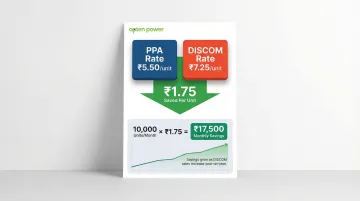
That gap between PPA and DISCOM rates is where the long-term value sits — and it grows as grid tariffs rise while your contracted rate stays anchored.
End-of-Term Options
At PPA expiry (typically after 15–25 years), you usually have three choices:
- Purchase the system at fair market value
- Renew the PPA on revised terms
- Request decommissioning — the developer removes the system at their cost
Nail down the purchase valuation method and decommissioning liability clauses before signing — these terms are far harder to renegotiate mid-contract.
Key PPA Terms C&I Buyers Must Negotiate
Pricing Structure and Escalation Clause
Distinguish between:
- Flat fixed rate for the entire term
- Rate with predetermined annual escalation (e.g., 2–3% per year)
Ensure the escalation percentage is contractually capped below the long-run expected growth in DISCOM tariffs. If it isn't, rising PPA rates can erase savings before the contract even expires.
Performance and Generation Guarantees
The developer should provide a minimum generation guarantee: a contractual commitment to produce at least a defined annual kWh output, typically benchmarked against the system's modeled P90 yield.
For EV charging operations, any generation shortfall means drawing more from the grid at full DISCOM tariffs to keep fleets charged. Contracts should specify how shortfalls are compensated — liquidated damages and make-whole payments are the two most common mechanisms.
Term Length, Early Exit, and Termination Provisions
PPA terms for C&I solar in India typically range from 15 to 25 years. Scrutinize early termination fee structures — developers typically calculate these as a multiple of remaining payments or a fixed penalty.
Align PPA tenure with:
- Your operational horizon for the facility
- Your EV fleet lifecycle
- Expected technology refresh cycles
Regulatory Compliance and Cost Allocation
Specify which party is responsible for:
- Obtaining open access approvals
- Net metering registrations
- DISCOM applications
- Handling state-specific wheeling and banking charges
State-level variations:
- Gujarat allows daily energy banking for solar between 7 AM and 6 PM and retained 4th place in solar open access additions in 2025
- Tamil Nadu sets a minimum demand requirement of 63 kVA, deviating from the standard 100 kW rule
- Uttar Pradesh requires an aggregate connection threshold of 150 kW, also deviating from central rules
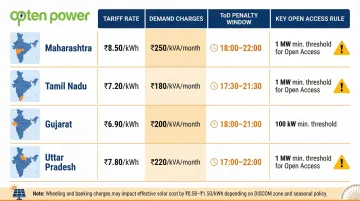
Misallocating these costs to the buyer — particularly wheeling and banking charges — can add ₹0.50–₹1.50/kWh to your effective landed cost, narrowing the PPA advantage materially.
Is a Solar EV Charging PPA the Right Model for Your Business?
The Ideal C&I Candidate
Businesses with significant daytime electricity consumption and a growing EV fleet are the clearest fits:
- IT parks
- Logistics hubs
- Hotels
- Hospitals
- Factories
- Warehouses
- Data centres
The model works best for organizations running Monday through Friday during daylight hours — solar generation and load align closely, maximizing self-consumption and reducing grid dependency.
Minimum Viable Scale
PPAs for C&I EV charging make financial sense above a certain load or project size. Two common scenarios:
- Mid-sized facilities (100 kW+): With the open access threshold now at 100 kW, these sites can participate directly in third-party PPAs.
- Smaller sites: Group captive structures or DISCOM green tariff schemes tend to work better here, offering similar cost benefits without the open access compliance burden.
When Outright Purchase May Be Preferable
If your business owns its property outright, has a strong balance sheet, and qualifies for tax benefits, purchasing the solar system directly can deliver higher long-term ROI. Under Section 32 of the Income Tax Act, solar power generating systems are eligible for 40% accelerated depreciation, allowing businesses to write off a large portion of capital expenditure in early years.
A PPA trades ownership upside for zero-capex convenience — a worthwhile exchange for many businesses, but not all. Running both scenarios through an IRR and payback analysis, factoring in depreciation benefits and your cost of capital, will clarify which structure favors your situation.
How to Procure a Solar EV Charging PPA in India
Step 1 — Assess Load and Site Suitability
Audit your current electricity consumption:
- Total facility load
- EV charging load separately
- Peak demand periods
Map available roof or ground space and confirm grid connection capacity. This forms the basis of any RFP issued to solar developers.
Step 2 — Compare PPA Developers and Tariff Offers Using Opten Power
Opten Power's marketplace gives C&I businesses access to 4+ GW of renewable capacity across 16 states, with real-time DISCOM intelligence and standardized landing prices. You can compare tariffs, savings projections, and IRR across multiple developers simultaneously.
The platform includes:
- Compares tariffs and savings across multiple developers in real time
- Calculates IRR and payback instantly to assess financial viability
- Issues RFPs and receives structured proposals through an automated Tender Engine
- Tracks generation, energy flows, and savings via a unified Portfolio Management Dashboard
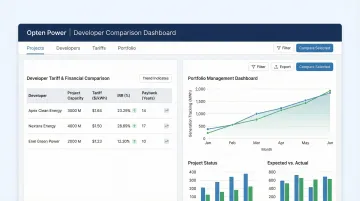
Businesses typically close deals up to 50% faster by standardizing commercial terms and eliminating negotiation delays.
Step 3 — Negotiate, Finalize, and Monitor
Once a developer is shortlisted, negotiate the key terms:
- Pricing and escalation structure
- Generation guarantees and shortfall compensation
- Regulatory responsibility allocation
- End-of-term options
After signing, the Portfolio Management Dashboard (set up in Step 2) gives you continuous visibility into generation performance and actual savings versus projections across the full PPA term.
Frequently Asked Questions
How long does a solar PPA last?
C&I solar PPAs typically run 15 to 25 years, with the exact term depending on project size, financing requirements of the developer, and your operational planning horizon. Longer terms generally allow developers to offer lower per-unit rates.
Is it better to buy solar or go with a PPA?
Outright purchase gives full ownership, higher long-run ROI, and tax benefits like 40% accelerated depreciation in India, but requires significant capex. A PPA delivers immediate savings with zero upfront investment — for businesses prioritizing cash flow over upfront capex, a PPA is typically the stronger fit.
What types of C&I businesses benefit most from solar EV charging PPAs?
Daytime-heavy consumers with growing EV fleets—IT parks, logistics and warehousing companies, manufacturing units, hotels, hospitals, and data centres—benefit most, since their load profile aligns with peak solar generation hours.
Can a single solar PPA cover both the facility's general electricity needs and EV charging loads?
Yes, a behind-the-meter solar PPA typically supplies power to all facility loads including EV chargers from the same system. Smart energy management software can be integrated to optimize charging schedules relative to solar output.
What happens to the solar system when the PPA term ends?
You typically have three options: purchase the system at fair market value, renew the agreement on renegotiated terms, or have the developer remove the system at no cost to you (subject to contract terms). Negotiate which options are available before signing.