Introduction
Commercial and industrial (C&I) businesses across India are grappling with an escalating energy cost crisis. Cash-strapped distribution companies (DISCOMs) are passing revenue shortfalls directly to C&I consumers—Tamil Nadu hiked FY26 industrial tariffs to ₹7.5/kWh and commercial tariffs to ₹9.4/kWh, while Karnataka raised select commercial and industrial tariffs by 10 to 95 paise per unit. For energy-intensive sectors like cement (where power accounts for 30-35% of total costs) and steel (consuming 23% of total annual industrial energy), these increases directly threaten operational viability.
For C&I buyers facing this pressure, Power Purchase Agreements (PPAs) offer a direct path to cost certainty. Businesses can lock in long-term tariffs, cut energy expenses, and meet sustainability targets without deploying upfront capital.
This guide covers how PPAs work, the structures available under India's regulatory framework, key contract terms to understand, and how to assess whether a PPA fits your organization's energy profile.
Key Takeaways
- A PPA is a long-term contract where a developer builds and operates a renewable energy system and sells electricity to your business at a pre-agreed rate
- Zero upfront capital required — the developer funds 100% of installation costs, recovered through electricity payments across a 10–25 year term
- Delivers cost savings of 20–40% below grid rates, price predictability, and financing that stays off your balance sheet
- Best suited for energy-intensive operations like manufacturing, data centers, IT parks, and commercial complexes aiming to cut costs and meet sustainability goals
- Comes with long contract terms (10–25 years) and limited early exit options — worth factoring in before signing
What Is a Power Purchase Agreement and How Does It Work?
A Power Purchase Agreement (PPA) is a long-term contract between an electricity generator (the developer) and a buyer—called the "offtaker." The offtaker, typically a business, government entity, or utility, purchases power at a pre-negotiated rate for a fixed contract duration.
How the Core Mechanism Works
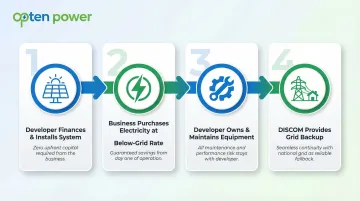
- A renewable energy developer finances, designs, and installs the solar, wind, or hybrid system on or near your premises
- Your business purchases the electricity output at a rate typically below the prevailing grid/DISCOM tariff
- The developer owns and maintains the equipment throughout the contract term—you carry no responsibility for repairs, performance, or system upkeep
- The local DISCOM handles grid interconnection and provides backup supply whenever renewable generation falls short
Key Parties Involved
- Offtaker — the business or entity purchasing and consuming the electricity
- Developer — owns, operates, and maintains the renewable energy system throughout the contract
- Special Purpose Entity (SPE) — a dedicated legal entity through which investors or lenders back the project
- DISCOM — the distribution company managing grid interconnection and backup supply
Pricing Structure
The PPA rate is set as a fixed tariff (₹/kWh) below the retail grid rate, often with a built-in annual escalator (typically 1–5%) to account for operation and maintenance costs and efficiency degradation. At contract end, you may extend the term, purchase the system at fair market value, or have it removed—automatic ownership transfer does not occur.
Ownership and What It Means for Your Business
The developer retains full ownership of the equipment for the entire contract term. As the offtaker, you cannot claim tax incentives, depreciation benefits, or government subsidies reserved for asset owners—these belong to the developer. This is a key trade-off to factor into your procurement decision.
Types of Power Purchase Agreements
Physical (Onsite) PPA
A physical or onsite PPA involves installing the renewable energy system directly on your premises—rooftop solar panels or ground-mounted arrays. Electricity is consumed directly by your facility, with excess generation fed back to the grid through net metering arrangements.
Best for: Manufacturing units, warehouses, and commercial complexes with predictable daytime energy consumption and available rooftop or land space.
Virtual (Offsite) PPA
A virtual or synthetic PPA (vPPA) is a financial contract where the buyer and the renewable project are not co-located. The developer sells power to the grid at the prevailing market price; a financial settlement—known as a contract for differences or fixed-for-floating swap—then compensates the buyer based on the difference between the agreed strike price and the spot market price.
Regulatory update: The Central Electricity Regulatory Commission (CERC) officially recognized vPPAs in May 2025 as Non-Transferable Specific Delivery (NTSD) contracts. Renewable Energy Certificates (RECs) generated are transferred to the consumer for Renewable Consumption Obligation (RCO) compliance and cannot be traded.
Best for: Businesses seeking energy price hedges and access to larger-scale renewable capacity without physical installation constraints.
Corporate PPA
A corporate PPA is a direct agreement between a private company (not a utility) and a renewable energy developer. Businesses use it to procure clean energy directly, meet ESG targets, and secure predictable long-term pricing outside the utility grid.
Prevalence: India added 7.8 GW of solar open access capacity in 2025, with Karnataka, Maharashtra, and Rajasthan accounting for over 62% of installations. Large C&I consumers—IT parks, data centers, and manufacturing units—are driving most of this growth, drawn by open access rules that make direct procurement viable at scale.
Best for: Large enterprises and C&I buyers that want direct renewable sourcing, green credentials, and insulation from grid tariff volatility.
Key Elements of a PPA Contract
Pricing and Escalation
How pricing is determined:
- The agreed tariff (₹/kWh) is benchmarked below the prevailing utility rate
- Wind-solar hybrid PPAs discovered in 2024 auctions ranged between ₹3.15/kWh and ₹3.65/kWh
- Escalation clauses typically include a fixed annual percentage increase (1-5%)
Compare the escalator to expected grid tariff trends before signing. If grid rates rise slower than your PPA escalator, you could end up paying above market rate in later years.
Contract Duration and End-of-Term Options
Typical durations:
- Offsite/utility-scale projects: 25 years from the scheduled commencement date
- Onsite/rooftop systems: 12-15 years
End-of-term options:
- Contract renewal - Extend the agreement at renegotiated terms
- System purchase - Buy the equipment at fair market value
- Equipment removal - The developer removes the system at no cost to you
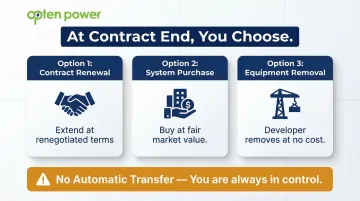
Important: Automatic ownership transfer does NOT occur. You must actively exercise one of these options.
Performance Guarantees and Output Terms
Developers typically guarantee a minimum annual energy output (kWh). If generation falls short, the developer compensates you.
Two common structures:
- Pay-as-Produced PPAs - You take all generated power; output varies with weather conditions
- Baseload PPAs - Developer guarantees a fixed delivery level, requiring energy storage or backup generation
Penalties for underperformance: If generation falls short, the developer pays penalties at 1.5x the shortfall value, calculated at the PPA tariff.
Renewable Energy Certificates (RECs) and Incentives
Who retains RECs?
Typically, the developer/owner retains RECs unless explicitly transferred to you in the contract. Under vPPAs, RECs are automatically transferred to the consumer for RCO compliance and are extinguished upon use—they cannot be traded.
If you're claiming renewable energy goals for ESG reporting or regulatory compliance, ensure REC transfer is explicitly documented in your contract.
Tax incentives: Since you don't own the system, you generally cannot claim direct government tax incentives such as accelerated depreciation—these benefits remain with the developer.
Exit Clauses and Early Termination
PPAs are binding long-term contracts, and early termination typically triggers substantial penalties.
What to look for:
- Buyout provisions - Can you purchase the system early at a predetermined formula?
- Change-of-control clauses - What happens if your business is sold or merged?
- Developer default - What protections exist if the developer goes out of business or sells the project?
Review exit clauses carefully before signing. Encashment of Performance Bank Guarantees (PBG) on a per-day, proportionate basis is standard for developer failures to commence supply.
Advantages and Disadvantages of a PPA
Key Advantages
- No upfront capital expenditure: The developer funds 100% of installation costs, making renewable energy accessible without touching your capital budget. Payments are treated as operating expenses (opex), keeping the arrangement off your balance sheet.
- Cost savings and price predictability: PPA rates are typically lower than retail/grid tariffs from day one. In Gujarat, C&I consumers save up to ₹0.84/kWh — nearly 20% of the DISCOM tariff at 11 kV through captive and group captive solar projects. A locked-in escalator also shields you from unpredictable grid price spikes.
- Zero O&M burden: The developer handles all system operation, maintenance, performance monitoring, and repairs. You pay for the electricity you consume — nothing more.
Key Disadvantages
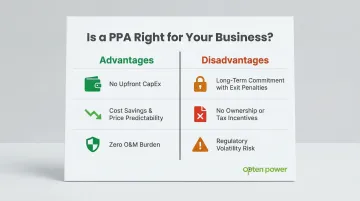
- Long-term commitment and limited flexibility: Contracts run 10–25 years and are difficult to exit without penalties. If grid rates fall faster than anticipated, the escalator clause can push your effective PPA rate above market. In Q4 2025, savings in Punjab and Tamil Nadu turned negative under the third-party model due to rising PPA tariffs and open access charges.
- No ownership of the system or incentives: You cannot claim tax credits, depreciation benefits, or government incentives — those stay with the developer. RECs are also typically retained unless you negotiate otherwise upfront.
- Regulatory volatility: State-level policy shifts can erode savings quickly. Telangana, for instance, reintroduced additional surcharges for open access consumers shortly after removing them, undermining landed cost projections.
When a PPA Makes Sense — and How to Get Started
Business Profiles Best Suited for a PPA
Ideal candidates:
- Energy-intensive operations with high, consistent electricity consumption: manufacturing, data centers, hospitals, IT parks, steel, cement, textiles
- Organizations lacking capital for direct renewable asset ownership but seeking cost reduction
- Businesses with sustainability commitments or regulatory pressure to source green energy
- Companies in favorable regulatory states where open access and third-party PPA regulations support cost-effective renewable procurement
Regulatory context: Karnataka (24%), Maharashtra (20%), and Rajasthan (18%) led solar open access capacity additions in 2025, reflecting favorable state-level policies.
What to Evaluate Before Signing
Compare tariffs and projected savings:
- Obtain PPA tariff quotes from multiple developers
- Compare against current and projected grid costs over the contract term
- Factor in the escalation clause's impact on long-term savings
Scrutinize contract terms:
- Performance guarantees and compensation for shortfalls
- Exit provisions and buyout options
- REC ownership and transfer rights
- Change-of-control and developer default protections
Understand regulatory costs:
Cross-Subsidy Surcharges (CSS) and Additional Surcharges (AS) account for 40-50% of the landed tariff for C&I consumers using third-party renewable energy open access. The group captive model is preferred because it legally exempts buyers from CSS and AS under the Electricity Act 2003.
Seek independent regulatory analysis to understand DISCOM charges, open access applicability, and transmission costs in your state.
Streamlining PPA Procurement
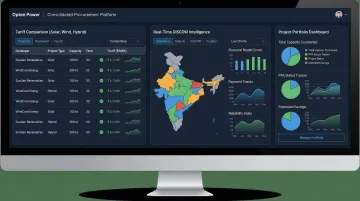
Navigating regulatory costs, developer comparisons, and contract terms simultaneously is where many C&I buyers lose time and money. Opten Power addresses this by consolidating the procurement process across 4+ GW of renewable projects — solar, wind, and hybrid — spanning 16 states. Key capabilities include:
- Real-time tariff comparison across multiple developers, with savings and ROI calculated in one place
- Automated RFPs and pre-approved contracts that cut deal timelines by up to 50%
- Real-time DISCOM intelligence with standardized landing prices across all states, so you can validate true savings potential before committing
Frequently Asked Questions
What is a power purchase agreement (PPA) and how does it work?
A PPA is a long-term contract between a business (offtaker) and a renewable energy developer. The developer installs and owns the system; your business pays a pre-agreed per-unit electricity rate—typically lower than the grid tariff—for the contract duration.
How much do power purchase agreements (PPAs) cost and how are they priced?
PPA pricing is set as a fixed tariff (₹/kWh) below the prevailing grid rate, often with an annual escalation clause of 1–5%. The exact rate depends on project type, location, system size, and contract duration. Always compare multiple developer quotes to ensure competitive pricing.
How long do power purchase agreements (PPAs) typically last?
PPAs typically range from 10 to 25 years for utility-scale projects and 6 to 15 years for distributed/onsite projects. The duration is negotiated based on the developer's financing needs and your preference for cost certainty.
What does 'corporate PPA' mean and what types of PPAs are there?
A corporate PPA is a direct agreement between a private company and a renewable developer, bypassing the utility. The three main types are physical/onsite PPAs (system on your premises), virtual/offsite PPAs (a financial hedge with no physical delivery), and sleeved PPAs (routed through the grid)—each differing in where power is generated and how payments are structured.
How can a customer exit or terminate a solar PPA?
Early termination is possible but typically incurs significant penalties or buyout fees stipulated in the contract. Some agreements allow you to purchase the system at fair market value as an exit route. Review exit clauses carefully before signing.
What is PPA management?
PPA management covers ongoing monitoring and administration after signing: tracking generation against guaranteed output, validating invoices, resolving performance issues with the developer, and watching for regulatory or tariff changes that affect contract economics.