Introduction
Commercial and industrial businesses across India face a familiar dilemma: rising energy costs are squeezing margins, yet the capital expenditure required for solar installations—estimated at ₹50,000 per kW—remains a significant barrier. For a 1 MW rooftop system, that translates to ₹5 crore upfront. Meanwhile, DISCOM tariffs continue climbing, with Maharashtra's HT Commercial tariff reaching ₹14.03/kVAh for FY 2025-26.
Zero-upfront financing options—solar leases and Power Purchase Agreements (PPAs)—solve this problem for C&I users. Both let businesses go solar without tying up capital, but they differ fundamentally in payment structure, risk allocation, and long-term financial impact.
Choosing the wrong structure can affect your energy savings and cash flow across a 20-25 year contract. This article breaks down how each model works, where they diverge, and which one fits your business's energy consumption pattern and financial priorities.
Key Takeaways
- Solar leases charge a fixed monthly fee for using solar equipment, regardless of actual generation
- PPAs charge per kWh of electricity produced, directly linking costs to system output
- Both are third-party ownership models — the developer owns, operates, and captures all tax and regulatory incentives
- PPAs tie your bill to actual output, keeping developers accountable; leases lock in a flat payment regardless of performance
- Choose a lease for billing simplicity; choose a PPA if system performance should drive what you pay
Solar Lease vs. Solar PPA: Quick Comparison
| Dimension | Solar Lease | Solar PPA |
|---|---|---|
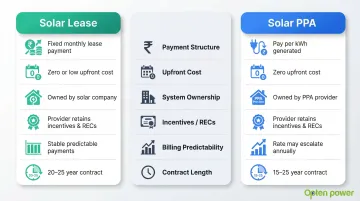
| Payment Structure | Fixed monthly fee regardless of generation | Per-kWh rate tied to actual output |
| Upfront Cost | Zero (optional down payment for lower rates) | Zero (optional down payment for lower rates) |
| System Ownership | Developer owns system | Developer owns system |
| Who Claims Incentives/RECs | Developer claims tax benefits, RECs, depreciation | Developer claims tax benefits, RECs, depreciation |
| Billing Predictability | High—same payment every month | Variable—fluctuates with seasonal generation |
| Typical Contract Length | 10–25 years | 10–25 years (SECI standard: 25 years) |
Contract Terms and Escalators
Some agreements allow optional down payments in exchange for lower ongoing rates. For PPAs, SECI standard contracts specify a 25-year term from the Commercial Operations Date.
Annual escalator clauses—typically 1–3% per year—are common in both models, but the effect plays out differently. In a lease, the escalator raises your fixed monthly fee. In a PPA, it raises your per-kWh rate, meaning bill fluctuation reflects both seasonal generation swings and rate increases at the same time.
What is a Solar Lease?
A solar lease is a financing arrangement where a business pays a fixed periodic fee—usually monthly—to use solar panels installed on its premises by a third-party developer, who retains ownership of the system throughout the contract period.
Financial Mechanics:
The fixed payment is calculated based on the system's estimated annual energy output, so you pay the same amount regardless of how much the system actually generates in a given month. With outright ownership, you capture 100% of the generation value and absorb 100% of the performance risk. Under a lease, that equation shifts entirely to the developer.
Key Benefits for C&I Businesses:
- Avoids the ₹50,000/kW upfront capital outlay with zero equipment ownership cost
- Fixed monthly payments simplify multi-year financial planning and internal budget approvals
- The developer handles all repairs, cleaning, and upkeep — no operational burden on your facilities team
Main Drawbacks:
- RECs, tax incentives, and the 40% accelerated depreciation under Section 32 of the Income Tax Act all flow to the developer, not your business
- If output drops due to shading, soiling, or equipment issues, you still pay the full lease amount
- When the system overperforms, the developer captures that value — your business sees no additional benefit
When a Solar Lease Makes Sense
Despite the drawbacks, leases suit specific operational profiles well. They work best for:
- Warehouses, manufacturing units, and commercial complexes where CFOs need cost certainty across multi-year horizons
- Facilities teams without the bandwidth to track kWh output or manage performance reporting month-to-month
- Businesses where a predictable line-item expense simplifies internal approvals and capital allocation decisions
The fixed payment structure is a feature, not a limitation, for operations that value simplicity over maximizing solar returns.
What is a Solar PPA?
A Power Purchase Agreement (PPA) is a contract where a solar developer installs, owns, and operates a solar system on a business's premises, and the business agrees to purchase the electricity generated at a pre-agreed rate per kWh— typically below local DISCOM tariff rates.
Payment Mechanics:
Monthly bills fluctuate based on actual solar generation: higher in peak sunlight months (March–May), lower during monsoon or winter (July–September). You pay only for what the panels produce, making it inherently performance-linked.
Grid Dependency:
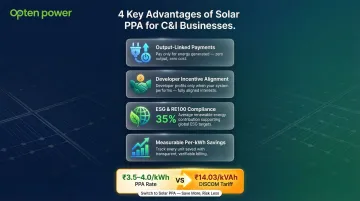
The PPA doesn't eliminate grid dependency. The business continues to draw supplementary power from the grid at standard utility rates for any consumption the solar system doesn't cover. Rooftop OPEX PPA tariffs typically fall in the ₹3.5–4.0/kWh range, compared to Maharashtra's HT Commercial tariff of ₹14.03/kVAh — a difference that adds up quickly at scale.
Key Advantages for C&I Businesses:
- Payments tied directly to output push developers to maximize uptime — underperformance means a lower bill for you
- Aligns developer incentives with system performance, transferring generation risk away from the business
- Supports ESG and RE100 commitments; PPAs deliver 35% of renewable electricity procured by RE100 members in India
- Per-kWh billing makes it straightforward to measure actual savings against grid costs
Procurement Support:
Platforms like Opten Power allow C&I businesses to compare PPA offers from multiple solar developers in real-time, evaluating per-kWh rates, projected savings, and financial metrics across 16 states. This helps businesses negotiate stronger terms and avoid overpaying.
Use Cases of a Solar PPA
PPAs are the stronger fit for:
- Energy-intensive businesses with 24/7 operations — data centers, hospitals, steel plants, and process industries where energy costs are a major operational expenditure
- Organizations with variable consumption — facilities where production-linked billing ties energy costs directly to actual output
- Businesses with performance monitoring capabilities — teams that can track generation data and hold developers accountable for output
Real-World Impact:
Equinix commissioned a 26.4 MWp Group Captive Solar project in Maharashtra under a long-term PPA with CleanMax, expected to generate 41.4 million kWh annually and reduce carbon emissions by over 30,000 tonnes of CO₂ each year. For manufacturing units and IT parks, the economics are equally compelling: utility-scale PPA tariffs can reach ₹2.56–2.57/kWh against HT Industrial tariffs of ₹8.68/kVAh in Maharashtra.
Solar Lease vs. Solar PPA: Which is Better for Your Business?
The right structure depends on how your business manages billing predictability, energy monitoring, and production risk. Three factors typically drive the decision:
1. Billing Preference: Fixed vs. Variable
- Choose a lease if you need a predictable monthly expense that doesn't fluctuate with seasonal generation
- Choose a PPA if you want billing accountability tied to actual output and can accommodate variable monthly costs
2. Production Risk Allocation
- In a lease, the business pays the same fee even if the system underproduces — you absorb the output risk
- In a PPA, underproduction means a lower bill — the developer bears more performance pressure
This distinction matters most for large industrial consumers whose savings projections underpin investment decisions.
3. Internal Monitoring Capabilities
- Choose a lease if your priority is operational simplicity with no need to track monthly generation data
- Choose a PPA if your business has high, variable energy consumption and can monitor performance metrics
Financial Comparison Over Contract Term
Annual savings typically converge between the two options over a full year, because leases are priced based on expected annual production. However, PPAs may deliver greater transparency for businesses with seasonal energy demand variation.
Market Trends
India's C&I solar segment is expanding fast — context that shapes how both structures are being adopted across industries:
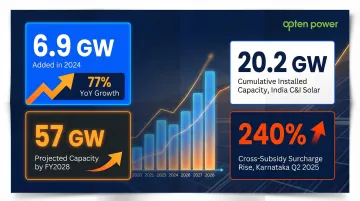
- India added 6.9 GW of solar open access capacity in 2024 — a 77% year-over-year increase — bringing cumulative installed capacity to 20.2 GW
- C&I renewable energy capacity is projected to reach 57 GW by fiscal 2028
- Group captive models are accelerating installations, largely because they're often exempt from cross-subsidy surcharges
- In Karnataka, cross-subsidy charges rose 240% quarter-over-quarter in Q2 2025, making the captive exemption especially valuable
Conclusion
Solar leases suit businesses valuing payment predictability and simplicity, while PPAs suit those wanting performance-linked billing with greater output transparency. Both eliminate upfront capital requirements and offload maintenance to the developer.
For C&I businesses in India, the decision comes down to comparing developer offers side-by-side—tariff rates, escalation terms, and state-specific DISCOM landing prices all affect whether a deal actually saves money. Opten Power makes that comparison straightforward across 16 states, with real-time savings analysis and pre-approved contracts that help businesses move from evaluation to signed deal faster.
Frequently Asked Questions
What is the difference between a solar PPA and a solar lease?
A solar lease involves a fixed monthly payment for using the solar equipment, while a PPA charges per kWh of electricity actually produced. Both are third-party ownership models where the developer owns the system, handles maintenance, and claims associated tax incentives and RECs.
How does a solar lease work?
A developer installs and owns solar panels on your premises; you pay a fixed monthly fee for the equipment, regardless of how much power it produces. This provides billing predictability but means your cost doesn't fall during low-production months.
Is a solar PPA cheaper than owning solar?
Owning solar outright typically delivers higher long-term savings, particularly given India's 40% accelerated depreciation benefit available for solar assets. However, a PPA requires zero upfront capital—making it more accessible for businesses that want immediate savings without tying up ₹50,000/kW in capital expenditure.
How long do PPAs typically last?
Most commercial solar PPAs run for 10 to 25 years; SECI standard agreements typically specify 25-year terms. The final duration is negotiated based on project size, tariff rate, and the developer's financing structure.
Is a solar PPA better than a solar lease?
PPAs suit businesses that want billing tied to actual output and can track system performance — common in manufacturing, data centres, and process industries with consistent load profiles. Leases work better for businesses that prefer a flat, predictable expense with no production monitoring. If your facility runs high daytime loads, a PPA will almost always deliver better value.
Is it worth it to buy out a solar lease?
Buying out a lease can make sense if the buyout price is lower than the remaining payments and the system still has a long useful life. Compare the buyout cost against ownership benefits like the 40% depreciation claim and elimination of ongoing lease fees to determine financial viability.