Introduction
Industrial and commercial businesses across India are paying far more for electricity than necessary. Rising DISCOM tariffs, unpredictable pricing, and missed opportunities in renewable procurement are eroding margins across manufacturing, steel, cement, data centres, and IT parks. According to research from the Institute for Energy Economics and Financial Analysis (IEEFA), the regulatory landscape has shifted dramatically in recent years, opening cost-saving pathways for C&I consumers.
Those pathways have turned power procurement from a passive utility function into a strategic business decision. As India's open access and renewable energy framework expands, businesses can now choose how, from whom, and at what price they source electricity — and the difference between a good decision and a poor one can run into crores annually.
What Is Power Generation Procurement?
Power generation procurement is the process by which commercial and industrial consumers identify, evaluate, and contract for electricity supply. Instead of defaulting to DISCOM grid rates, businesses choose how, from whom, and at what price they source power.
India's Hybrid Power Market Structure
Unlike fully deregulated Western markets, India operates a hybrid structure. Consumers can procure power through:
- DISCOM tariffs (regulated retail supply)
- Open access (intra-state and inter-state)
- Captive and group captive generation
- Power exchanges (IEX, PXIL)
- Bilateral corporate PPAs
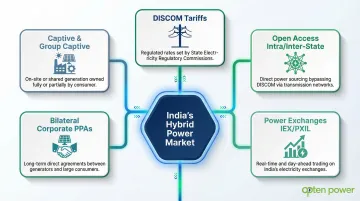
Each route has different economics, regulatory requirements, and risk profiles. The Electricity Act 2003 provides the statutory foundation, with Section 42 mandating that State Commissions introduce open access for consumers above specified thresholds.
Procurement vs. Energy Management
These two functions serve distinct purposes:
| Focus | Financial Impact | |
|---|---|---|
| Procurement | Securing supply at optimal cost and terms | High — directly cuts per-unit cost |
| Energy Management | Reducing consumption inefficiencies | Moderate — depends on usage patterns |
For large consumers, procurement decisions carry the greater financial weight. A manufacturing unit paying ₹10/unit through DISCOM tariffs can reduce costs to ₹6–7/unit through the right procurement route, translating to crores in annual savings.
Types of Power Procurement in India
DISCOM Grid Supply
DISCOM tariff supply remains the default procurement route—power supplied by the state distribution company at regulated tariffs. While it requires no contract negotiation, this is typically the most expensive option for high-consumption industrial users.
Key characteristics:
- No procurement process required
- Cross-subsidy surcharges embedded in tariff
- No pricing flexibility
- Rates determined by State Electricity Regulatory Commissions (SERCs)
- Annual tariff escalation averaging 5-8%
For businesses consuming above 100 kW, DISCOM supply often represents a missed opportunity for cost optimization. Open access and bilateral contracts offer structured alternatives worth evaluating.
Open Access Procurement
Open access grants consumers the right to procure power from generators or traders through the transmission and distribution network, bypassing the DISCOM for the energy commodity. The Green Energy Open Access Rules 2022 lowered eligibility from 1 MW to 100 kW contracted demand, opening this route to mid-sized C&I buyers who previously fell below the threshold.
Cost components:
- Wheeling charges (use of distribution network)
- Transmission charges (ISTS or InSTS)
- Cross-subsidy surcharge (CSS) — capped at 20% of applicable tariff
- Additional surcharge (AS) — for stranded DISCOM costs
- Banking charges (typically 8% in-kind for stored renewable energy)
- SLDC scheduling charges
The net landed cost after all charges determines viability. State-level variations are significant—some states have restrictive CSS policies that erode savings, while others offer favourable frameworks for renewable open access.
Corporate Power Purchase Agreements (PPAs)
Corporate PPAs are long-term bilateral contracts (typically 15–25 years) between a C&I buyer and a renewable energy developer for solar, wind, or hybrid power supply.
Two primary structures:
- On-site PPAs: Generator installed at consumer premises
- Off-site/third-party PPAs: Power wheeled through open access from remote location
Corporate PPAs offer fixed tariffs over the contract term, protecting against DISCOM tariff inflation. Businesses can achieve savings of ₹3-5 per unit compared to grid tariffs, depending on state regulations and project specifics. The fixed-price structure gives finance teams a predictable energy cost baseline for multi-year budgeting.
Group Captive Power Plants (GCPP)
The group captive model allows multiple consumers to co-own at least 26% equity in a generating plant and consume at least 51% of its output. This structure attracts significant exemptions from CSS and AS, making it one of the most cost-effective routes for heavy industrial consumers.
Key requirements per Electricity Rules 2005:
- Minimum 26% collective equity ownership by captive users
- Minimum 51% collective consumption of generated power
- The 2026 amendments shifted from strict proportionality to collective compliance, providing greater flexibility
Group captive delivers the highest savings potential—₹3-5 per unit with strong IRRs—but requires upfront equity commitment and long-term consumption obligations.
Power Exchange Trading
India's power exchanges (IEX/PXIL) offer short-term procurement through day-ahead market (DAM), term-ahead market (TAM), and green day-ahead market (GDAM). Suited for buyers with consumption flexibility or those seeking short-term volumes without long-term commitments.
Characteristics:
- Price discovery through competitive bidding
- Market volatility based on demand-supply dynamics
- No long-term contract obligations
- Real-time market (RTM) for immediate procurement
Exchange trading is best used alongside a base load PPA—it covers demand spikes and seasonal variability without locking in volume at fixed rates across the full contract term.
The Power Procurement Process: Step by Step
Step 1 — Load and Consumption Analysis
Before approaching suppliers, conduct a thorough audit of:
- Annual consumption (in kWh/MWh)
- Contracted demand (in kW/MW)
- Load factor and load curve (peak vs. off-peak timing)
- Existing tariff category and per-unit cost
This baseline determines which procurement routes are viable and what volume to procure. Most Indian states require a minimum contracted demand of 100 kW for green energy open access, though conventional open access thresholds vary (often 1 MW).
Step 2 — Route Selection and Regulatory Check
Evaluate which procurement models are permissible under your state's regulations. SERC rules vary significantly—some states impose high CSS rates that erode open access savings, while others offer favourable frameworks.
Key regulatory checks:
- State-specific CSS and AS rates
- Banking provisions and settlement periods
- Third-party sale permissions
- Grid connectivity requirements and timelines
Verify these before committing to a route. What works in Maharashtra may be unviable in Karnataka — state-level due diligence is non-negotiable before signing anything.
Step 3 — Issuing RFPs and Inviting Developer Bids
Issue a structured Request for Proposal (RFP) to renewable developers or power traders, specifying:
- Project type (solar/wind/hybrid)
- Capacity requirement
- Delivery point
- Contract duration
- Performance requirements
Opten Power's Automated Tender Engine speeds up this step by letting businesses issue RFPs to multiple developers at once using modular templates. Pre-screened bids come back faster, cutting weeks off a process that often stalls at this stage.
Step 4 — Bid Evaluation and Techno-Commercial Analysis
Evaluate bids on multiple dimensions:
- Landed cost: Not just quoted tariff, but all-in cost after open access charges
- IRR and payback period: Financial returns over contract life
- Developer track record: Execution capability and past project performance
- Financial health: Balance sheet strength and access to financing
- Grid connectivity: Approvals and timelines for commissioning
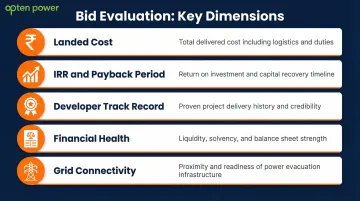
Real-time comparison across multiple developers — with standardised landed price calculations across DISCOMs — lets procurement teams spot the true cost gap between bids, not just the headline tariff.
Step 5 — Contract Negotiation and Execution
Negotiate PPA or supply agreement terms covering:
- Tariff and escalation clauses (if any)
- Payment security mechanisms
- Grid curtailment risk allocation
- Metering and billing arrangements
- Force majeure and termination provisions
- Dispute resolution mechanisms
Once finalised, obtain regulatory approvals:
- Open access approval from SLDC/RLDC
- Wheeling agreement with DISCOM
- Grid connectivity approval from STU/CTU
Key Factors to Evaluate Before Signing a Power Contract
Landed Cost vs. Headline Tariff
The quoted per-unit tariff from a developer is not your true cost. Calculate the all-in landed cost including:
- Quoted energy tariff
- Wheeling charges (typically ₹0.50-1.50/unit)
- Transmission charges (₹0.20-0.80/unit)
- Cross-subsidy surcharge (varies by state, capped at 20% of tariff)
- Banking charges (if applicable)
- Losses (typically 3-5%)
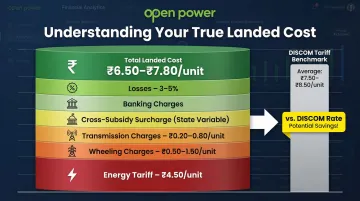
A ₹4.50/unit quoted tariff might result in a ₹6.20/unit landed cost after all charges—still competitive against a ₹8.50/unit DISCOM tariff, but the gap is narrower than it appears.
Contract Duration and Price Escalation
Long-term contracts (20-25 years) offer lower tariffs but higher commitment. Short-term contracts provide flexibility but less price certainty. Most renewable PPAs offer fixed tariffs over the term—valuable protection against DISCOM tariff inflation, which typically escalates 5-8% annually.
A fixed ₹5/unit PPA tariff looks modest today. When DISCOM tariffs climb from ₹8/unit to ₹12/unit over a decade, that same contract saves you ₹7/unit—nearly 58% off your grid rate.
Developer Credibility and Project Readiness
Watch for these common failure points:
- Developer delays in commissioning
- Land acquisition issues
- Financing gaps
- Grid connectivity delays
Key due diligence checkpoints:
- Project commissioning timelines and milestones
- Land status and approvals
- Grid connectivity approvals
- Developer's balance sheet strength
- EPC capability and track record
A lower tariff from an unproven developer may cost more if the project is delayed 12-18 months, since every additional month at DISCOM rates erodes the savings you projected at signing.
Common Challenges in Power Procurement — and How to Navigate Them
Regulatory Complexity and State-Level Variability
India's power procurement landscape is governed by a patchwork of central policies and state regulations. CSS rates, banking provisions, third-party sale permissions, and open access thresholds differ across 16+ active states. Businesses operating across multiple states face compounded complexity.
What works: Maintain up-to-date state-level regulatory intelligence through platforms that standardise and regularly update landing prices and policy data across states. What works in Gujarat may not work in Tamil Nadu — procurement strategies must be state-specific.
Information Asymmetry Between Buyers and Developers
Most C&I buyers lack access to real-time developer pricing, available capacity, and project pipeline data. This information gap makes it difficult to negotiate from an informed position, often resulting in overpayment and weaker contract terms.
What to do: Centralised marketplaces with transparent, real-time capacity listings and tariff benchmarks address this gap. When you can compare offerings from multiple developers simultaneously, you negotiate from strength.
Long Procurement Timelines and Manual Processes
Traditional power procurement — sending individual RFPs, manually aggregating bids, conducting bilateral negotiations — can take 6–18 months. Delayed procurement means continued exposure to higher grid tariffs, with each month of delay translating to thousands in unnecessary costs.
Automated RFP tools and pre-approved contract templates cut this timeline substantially. The right platform delivers:
- 50% faster deal closure through automated bid aggregation and RFP management
- Pre-approved contract templates that skip weeks of legal back-and-forth
- Immediate transition to lower-cost renewable supply instead of waiting quarters
How Opten Power Simplifies Power Procurement for Indian Businesses
Opten Power is India's unified clean energy marketplace for C&I buyers. The platform connects businesses with solar, wind, and hybrid projects spanning 4+ GW of capacity across 16 states, sourced from India's top power producers.
Core procurement tools:
- Automated Tender Engine: Issue RFPs to multiple developers simultaneously using modular templates, then receive and compare structured bids in one place.
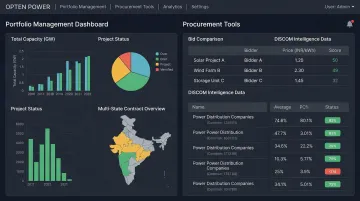
- Real-Time Discom Intelligence: Access standardised, regularly updated landing prices across all states—no months of manual research, no cost surprises.
- Instant Analysis Tools: Run IRR, payback, and regulatory analysis in seconds to evaluate any procurement option with confidence.
- Portfolio Management Dashboard: Monitor all renewable energy contracts and investments from a single view—critical for enterprises managing multi-site energy portfolios across states.
Frequently Asked Questions
What does power procurement mean?
Power procurement is how businesses actively source and secure their electricity supply. Rather than passively accepting power from the local utility at default tariff rates, companies choose their suppliers, procurement routes (grid, open access, PPA, or exchange), and contract terms.
What is the process of power procurement?
The process runs from assessing your consumption and load profile, through identifying eligible routes, issuing RFPs, and evaluating bids on landed cost. Final steps cover contract negotiation and obtaining regulatory approvals from SLDC/RLDC and DISCOM.
What are the 4 types of procurement?
In the Indian power sector, the major procurement types are DISCOM grid supply, open access (short/medium/long-term), captive/group captive generation, and power exchange trading—each suited to different consumer sizes, risk appetites, and sustainability goals.
What are the 5 P's of procurement?
The 5 P's—Price, Process, People, Policy, Performance—translate directly to power procurement: landed tariff analysis, RFP and contract execution methodology, developer evaluation, state-level regulatory compliance, and delivery commitments covering uptime and grid reliability.
What does procurement mean in simple words?
Procurement simply means obtaining something you need. For power, that translates to finding and buying electricity for your business at the best possible price, terms, and reliability from the right supplier or generation source.