Introduction
Electricity is one of the largest operating expenses for commercial and industrial (C&I) businesses in India — accounting for 30–40% of costs in energy-intensive sectors like solar manufacturing and roughly 30% of production costs in cement.
Yet most procurement decisions happen reactively — triggered at contract expiry, with no clear strategy in place.
This guide walks through procurement routes, contract structures, and risk management so you can shift from reactive spending to deliberate energy strategy.
Primary pain points:
- Unpredictable tariff hikes from state DISCOMs (electricity distribution companies)
- No clear visibility into available renewable energy options
- Slow, opaque procurement processes with little negotiating leverage
- Leaving 30–40% in potential cost savings on the table
Key Takeaways
- Electricity procurement is a strategic decision, not just a utility bill to pay
- Indian businesses have multiple procurement routes beyond DISCOM supply
- Contract structure depends on your risk tolerance and consumption profile
- A structured RFP process can cut procurement time by up to 50% and reduce overall cost
- Regulatory compliance (RPO, Open Access approvals) is non-negotiable
What Is Business Electricity Procurement?
Business electricity procurement is the process by which a commercial or industrial entity identifies, evaluates, and secures electricity supply from available sources — whether the state DISCOM, an independent power producer via Open Access, or a renewable developer through a PPA — to meet operational needs at optimized cost, reliability, and sustainability.
In India's context, procurement is now inseparable from the energy transition. Businesses are making deliberate choices about energy source, contract tenure, and carbon footprint — not simply chasing the lowest tariff. That distinction matters: procurement is about what you buy and from whom, while energy efficiency is about how much you consume.
What Does "Commercial Procurement" Mean in the Energy Context?
Commercial procurement is the structured process by which a business — not a residential consumer — sources its energy supply. It covers the full decision cycle, not just signing a contract:
- Vendor selection — identifying and comparing DISCOM, IPP, or renewable developers
- Contract negotiation — securing favorable tariff structures and tenure terms
- Risk assessment — evaluating price volatility, grid reliability, and regulatory exposure
- Ongoing management — monitoring supply, compliance, and performance over time
This is far more involved than accepting a default utility tariff.
India's Electricity Procurement Landscape: Know Your Options
Indian C&I businesses have four main electricity procurement routes:
- DISCOM supply at regulated tariffs
- Open Access — third-party or group captive
- Corporate Power Purchase Agreements (PPAs) directly with generators
- Captive generation (on-site solar, rooftop)
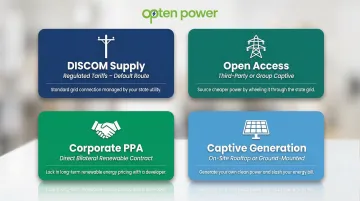
Most medium-to-large businesses use a combination of these routes to optimize cost and reliability.
DISCOM Supply
DISCOM supply is the default route: regulated tariffs set by State Electricity Regulatory Commissions (SERCs), typically higher for HT (high-tension) industrial consumers. While reliable, DISCOM rates have seen consistent annual increases in most states.
Recent tariff trends across major industrial states:
- Maharashtra: HT Industry (EHV) tariff increased from ₹6.73/kVAh in FY 2024-25 to ₹9.50/unit for FY 2026-27
- Tamil Nadu: Industrial tariff rose 3.4% to ₹7.50/kWh for FY 2025-26, with demand charges climbing to ₹608/kVA/month
- Rajasthan: Large industrials under HT-5 pay ₹6.50/kWh with fixed charges of ₹380/kVA/month for FY 2026-27
At this rate of escalation, staying on DISCOM supply alone puts businesses at a structural cost disadvantage year after year.
Open Access (Third-Party and Group Captive)
Open Access is the mechanism under the Electricity Act, 2003 that allows consumers above a certain contracted load (typically 1 MW) to procure power from generators other than their DISCOM, using the grid for wheeling.
Two types:
- Third-party Open Access: Buying from an independent generator
- Group captive: Co-owning 26%+ equity in a generation asset
Applicable charges vary significantly by state: wheeling, transmission, cross-subsidy surcharge (CSS), and banking charges. This makes state-level intelligence critical.
Recent regulatory changes:
The Green Energy Open Access Rules, 2022 reduced the threshold to 100 kW contracted load for renewable energy procurement, opening the route to mid-size businesses previously locked out by the 1 MW threshold.
State-specific charge examples (FY 2026-27):
| State | CSS (₹/kWh) | Additional Surcharge (₹/kWh) | Wheeling Charges (₹/kWh) |
|---|---|---|---|
| Maharashtra | 1.79 | 1.36 | 0.60 |
| Tamil Nadu | 1.99 | — | 1.04 |
| Rajasthan | 1.48 | 0.50 | 0.69 (11 kV) / 0.09 (33 kV) |
Net landed costs in Q4 2025 ranged from ₹5.00/kWh in states like Odisha to ₹8.40/kWh in Maharashtra, highlighting massive state-level variation.
Corporate Power Purchase Agreements (PPAs)
Corporate PPAs are long-term bilateral contracts (typically 10-25 years) between a business (offtaker) and a renewable energy developer, guaranteeing a fixed or indexed tariff for solar, wind, or hybrid power. Solar PPAs deliver 25-40% cost savings versus grid power after accounting for Open Access charges — a meaningful buffer against annual DISCOM tariff hikes.
Recent benchmark tariffs:
- Solar: CERC approved ₹2.59-2.60/kWh for NTPC's 1,500 MW ISTS-connected projects
- Wind: SECI Tranche-XIX auction discovered ₹3.67-3.69/kWh
- Hybrid: CERC approved ₹3.35-3.36/kWh for 1,200 MW wind-solar projects
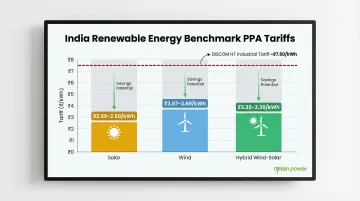
Opten Power's marketplace gives businesses access to 4+ GW of renewable projects across solar, wind, and hybrid, with real-time comparison of PPA offers from developers across 16 states. Automated RFPs and pre-approved contracts help close deals up to 50% faster.
Captive Generation
On-site captive generation (rooftop solar, ground-mounted behind-the-meter) is a complementary strategy, not a standalone replacement. It reduces dependence on the grid but requires capital investment.
India added 3.2 GW of rooftop solar in 2024, with C&I consumers accounting for about 60% of installed capacity. That share reflects how well rooftop solar fits facilities with consistent daytime loads.
It works best for:
- Facilities with high daytime electricity consumption
- Sites with available rooftop or ground-mounted space
- Businesses looking to offset peak-hour grid draws without full grid independence
How to Build a Business Electricity Procurement Strategy
Most businesses treat electricity procurement as a one-off vendor decision. The ones that consistently cut costs and meet ESG targets treat it as a structured, repeatable process — with five distinct phases.
Step 1: Audit Your Energy Profile
Gather 12-24 months of consumption data:
- Monthly units consumed (kWh)
- Maximum demand in kW/kVA
- Load patterns (peak vs. off-peak, seasonal variation)
- Contracted load vs. actual demand
- Upcoming capacity changes (new lines, expansions, electrification)
This data is the foundation of every procurement decision.
Step 2: Define Your Procurement Objectives
Three key objective categories guide your strategy:
Cost optimization — What percentage reduction in per-unit cost is the target? Typical savings range from 25-40% versus DISCOM tariffs.
Sustainability — Are there board-level ESG commitments, RE100 pledges, or green certification requirements? India's RPO targets mandate 29.91% renewable energy for FY 2024-25, rising to 43.33% by FY 2029-30.
Reliability — What is your tolerance for supply interruptions? Are backup arrangements needed?
Objectives determine which procurement route and contract type is appropriate.
Step 3: Evaluate State-Specific Regulatory Costs
Open Access economics differ dramatically across states due to varying wheeling charges, transmission losses, cross-subsidy surcharges, and banking regulations.
Get standardized, updated DISCOM landing prices across states before comparing PPA or Open Access offers. Opten Power's Real-Time DISCOM Intelligence platform aggregates these costs in one place, giving you accurate net landed cost figures across states without manual data gathering.
Step 4: Run a Competitive RFP Process
A structured Request for Proposal (RFP) produces better pricing than direct bilateral negotiations.
Key steps:
- Define technical specifications (capacity, technology, location preferences)
- Qualify developers (track record, financial stability, project pipeline)
- Issue standardized bid documents
- Set evaluation criteria (levelized tariff, developer credentials, commissioning timeline, force majeure terms)
Automated RFP tools can cut procurement cycle time by up to 50%, compressing weeks of back-and-forth into days.
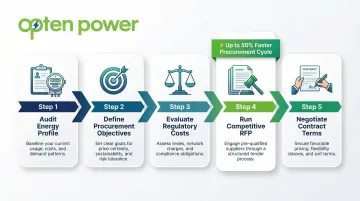
Step 5: Negotiate and Finalize Contract Terms
Critical contract parameters to review before signing:
- Tariff escalation clauses (fixed vs. indexed)
- Deemed generation provisions (penalties for under-offtake)
- Change-in-law protections (regulatory shifts)
- Payment security mechanisms (letters of credit, bank guarantees)
- Termination and exit penalties
- Grid connectivity responsibilities
Deemed generation and change-in-law clauses in particular have caught Indian C&I buyers off-guard — review these with a procurement advisor before signing.
Types of Electricity Contracts: What to Choose and When
The "right" contract depends on your risk appetite, consumption stability, cash flow, and strategic horizon.
Fixed-Rate Contracts
Fixed-rate contracts lock in a per-unit tariff for the contract duration (1-5 years for retail supply, 10-25 years for PPAs).
Key benefit: Budget certainty
Key risk: If market rates fall, you're locked in at a higher price
Best suited for: Businesses with stable consumption profiles that prioritize predictability over optimization
Variable / Indexed Contracts
Variable-rate contracts track an index (for example, IEX Day-Ahead Market spot prices or a SERC-approved formula).
Benefit: Capture savings when market prices drop. IEX Day-Ahead Market prices fell 13.7% year-on-year to ₹3.86/kWh in FY 2025-26.
Risk: Exposure to price spikes. FY 2023-24 saw 14.94% volatility in Day-Ahead Market prices.
Best suited for: Businesses with flexible load management capability or sophisticated energy teams
Long-Term PPAs
Long-term PPAs are the gold standard for large industrials seeking to lock in renewable energy at below-DISCOM rates for 15-25 years.
Structure:
- Fixed or slightly escalating tariff
- Developer builds and owns the plant
- Business is the offtaker
Benefit: Locks in below-market renewable tariffs for decades while satisfying Renewable Purchase Obligations (RPO) and supporting sustainability reporting.
Best suited for: Large C&I consumers with predictable baseload demand and a long planning horizon
Short-Term and Spot Market Procurement
Short-term contracts (1 month to 1 year) and power exchange (IEX/PXIL) spot procurement are tactical tools to fill gaps or capture low-price windows.
Short-term power market comprised about 12.5% of total electricity generated in India in FY 2023-24.
Best suited for: Businesses managing variable load, handling seasonal demand peaks, or bridging gaps between long-term contract transitions
Risk: Spot prices can spike sharply during supply crunches — short-term procurement works best as a tactical layer within a broader strategy, not as a standalone approach.
Managing Electricity Procurement Risks
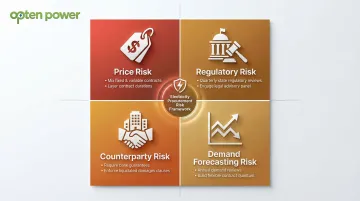
Electricity procurement exposes businesses to four distinct risk types — and each one can derail cost savings or supply continuity if left unmanaged. Understanding how they interact is the first step toward building a resilient procurement strategy.
Price Risk
Hedging strategies:
- Mix fixed and variable procurement
- Layer contracts of different durations
- Diversify across multiple developers and technologies
Regulatory Risk
Price risk is only one dimension. Regulatory changes — particularly at the state level — can alter the economics of signed agreements with little warning. Open Access rules, cross-subsidy surcharges, and RPO obligations have all shifted materially in recent years.
Recent example:
In December 2024, the Karnataka High Court struck down the central Green Energy Open Access Rules, 2022, creating uncertainty for projects under development. Previously, KERC reduced the banking period from one year to six months, then to a monthly period, severely disrupting long-term financial planning.
Mitigation: Build regulatory monitoring into your procurement calendar — quarterly state-level reviews and standing legal advisory relationships are a practical minimum for C&I buyers with active PPAs.
Counterparty and Project Delivery Risk
Regulatory exposure aside, the deal itself carries risk. Developer delays or defaults can leave contracted capacity stranded — and penalty recovery is only as strong as the safeguards you build upfront.
Key safeguards:
- Performance bank guarantees
- Liquidated damages clauses
- Due diligence on developer track record and project status
Demand Forecasting Risk
Even well-structured contracts can underperform if your demand forecast is off. Over-contracting triggers deemed generation penalties; under-contracting leaves you scrambling to cover capacity gaps at spot rates.
Recommendation: Annual procurement reviews and contract structures that allow flexibility in contracted quantum as business needs evolve.
Frequently Asked Questions
What does commercial procurement mean?
Commercial procurement in the energy sector refers to the structured process by which a business sources electricity supply — covering vendor identification, price negotiation, contract execution, and ongoing management — rather than defaulting to the state utility tariff.
What is the difference between Open Access and DISCOM supply for businesses?
DISCOM supply is the default regulated tariff route via the state utility. Open Access allows eligible consumers (typically 1 MW+ contracted load) to buy power directly from third-party generators. They use the grid for wheeling, often achieving a lower net cost even after applicable charges.
What is a Corporate PPA and how can it reduce electricity costs?
A Corporate PPA is a long-term bilateral contract with a renewable energy developer at a fixed or indexed tariff, typically below the prevailing DISCOM rate. It locks in cost certainty for the contract tenure, meets sustainability goals, and commonly delivers 25–40% savings versus grid power.
When should a business consider switching from DISCOM to Open Access?
Evaluate Open Access when:
- Contracted load exceeds the state threshold (commonly 1 MW)
- DISCOM tariffs are rising faster than Open Access net landed costs
- Consumption is stable and high enough to justify the transaction and compliance effort
What are the key risks in long-term electricity procurement contracts?
Key risks include:
- Tariff escalation clauses that erode savings over time
- Project commissioning delays by the developer
- Regulatory changes affecting Open Access charges
- Demand forecast mismatches that trigger deemed generation penalties
How often should a business review its electricity procurement strategy?
Review your strategy annually at minimum, triggered by contract expiry windows, significant changes in consumption, new state regulatory notifications, or shifts in sustainability commitments — whichever comes first.