Introduction
Renewable energy procurement is the structured process through which commercial and industrial (C&I) businesses identify, evaluate, contract, and manage renewable energy supply — from external generators or their own assets. For manufacturers, data centres, steel plants, IT parks, hospitals, and other high-consumption facilities across India, getting this right directly affects operating costs, compliance status, and investor confidence.
Several pressures are pushing C&I buyers to move beyond grid dependency:
- Grid tariffs from state DISCOMs have risen steadily, eroding cost competitiveness
- Renewable Purchase Obligation (RPO) targets carry real penalties for non-compliance
- ESG commitments are under increasing scrutiny from investors and global customers
- Long-term renewable contracts offer a credible path to locking in predictable energy costs
This guide covers the main procurement methods available to C&I buyers in India, how the process works end-to-end, what factors shape the decision, and where businesses typically go wrong.
Key Takeaways
- C&I businesses can source renewable power through PPAs, captive projects, RECs, or rooftop solar — each route carries different costs and compliance requirements
- Indian buyers have four primary models: open access PPAs, captive/group captive structures, RECs, and rooftop solar
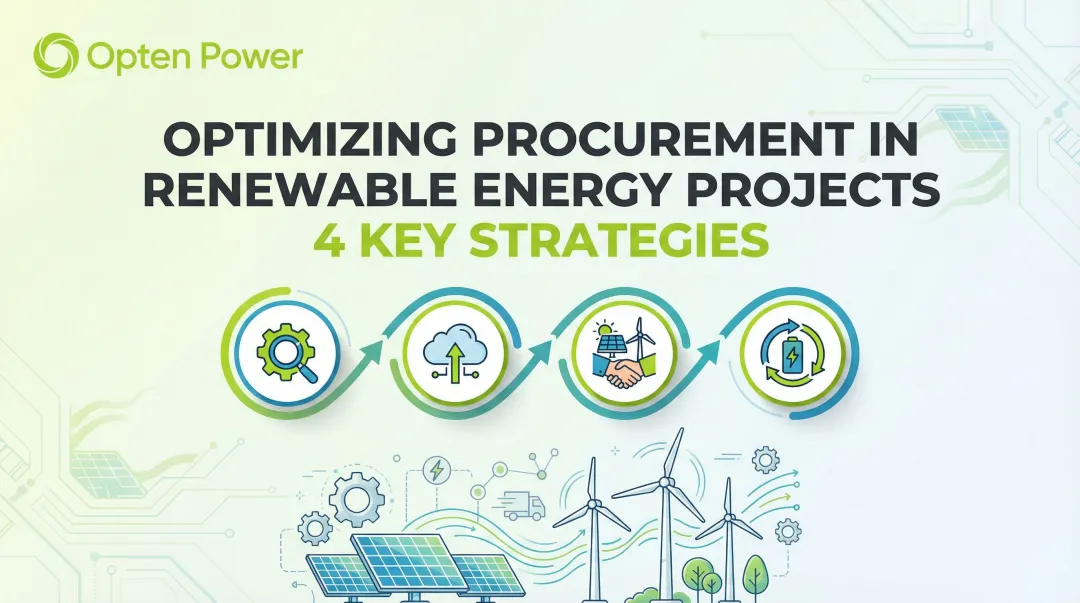
- Procurement follows five stages: energy audit, goal-setting, RFP issuance, bid evaluation, and contract execution
- DISCOM regulations, wheeling charges, banking rules, and RPO norms vary by state — they determine which model fits your load profile
- Skipping structured evaluation exposes buyers to hidden charges, unfavorable terms, and failed compliance claims
What Is Renewable Energy Procurement and Why Does It Matter for C&I Buyers?
Renewable energy procurement is the structured process of sourcing electricity from solar, wind, hybrid, or other non-fossil fuel sources through a formal commercial arrangement. Unlike simply receiving grid power, which carries no guarantee of clean generation, procurement ties you to a specific generating asset or ownership of Renewable Energy Certificates (RECs).
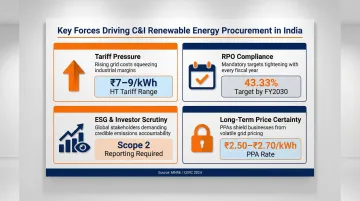
For C&I buyers across India, the case for active procurement has never been stronger. Four forces are driving urgency:
- Tariff pressure: HT industrial tariffs across major states have reached ₹7.00–₹9.00/kWh (Maharashtra: ₹8.12/kVAh, Tamil Nadu: ₹7.25/kWh, Karnataka: ₹7.40/kWh), inflated by cross-subsidization of agricultural and residential consumers.
- RPO compliance deadlines: The Ministry of Power has set a 43.33% RPO trajectory by FY2030. DISCOMs, captive users, and open access consumers must meet minimum renewable purchase obligations or face penalties under the Energy Conservation Act.
- ESG and investor scrutiny: Scope 2 emissions reporting now demands verifiable procurement. A general grid purchase labeled "green" does not satisfy investor or regulatory standards without REC ownership or a direct asset link.
- Long-term price certainty: Renewable PPAs lock in energy costs for 10–25 years. Utility-scale solar tariffs have stabilized around ₹2.50–₹2.70/kWh, while landed open access PPAs typically range from ₹3.50–₹5.50/kWh, offering meaningful savings against volatile grid supply.
Yet most C&I buyers encounter the same friction points: navigating state-specific open access rules, comparing developer proposals on equal terms, and ensuring contracts hold up under scrutiny. This guide addresses each of those gaps.
Renewable Energy Procurement Methods
There is no single best method. Each suits a different buyer profile based on consumption level, location, risk appetite, contract horizon, and whether the buyer wants to own an asset or simply purchase output.
Open Access Power Purchase Agreement (PPA)
Under an open access PPA, a C&I buyer signs a long-term contract (typically 15–25 years) directly with a renewable energy developer. Power is generated at an offsite solar or wind plant and wheeled to the buyer's premises through the state transmission or distribution network.
Key characteristics:
- Buyer pays the developer a fixed tariff (the PPA rate) plus applicable grid charges
- Grid charges include wheeling, transmission, banking, and cross-subsidy surcharge (CSS)
- Most common and cost-effective route for high-consumption C&I buyers
- Can reduce energy costs significantly versus DISCOM supply
Critical caveat: Base PPA tariffs look attractive at ₹2.50–₹2.70/kWh, but state-level charges can erode savings sharply. Cross-subsidy surcharge alone ranges from ₹1.36/kWh (Gujarat) to ₹1.92/kWh (Tamil Nadu) for HT Industry consumers.
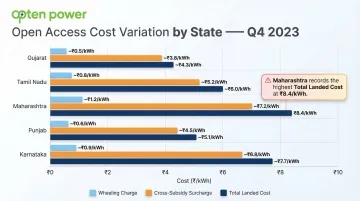
In Q4 2023, net landed open access costs ranged from under ₹5/kWh to ₹8.4/kWh across states. In Punjab and Tamil Nadu, net savings turned negative due to rising charges — a risk buyers must model before signing.
Captive and Group Captive Generation
In the captive model, a C&I buyer holds a minimum 26% equity stake in a dedicated renewable project and consumes at least 51% of its output — qualifying for exemption from cross-subsidy surcharges and certain grid charges that apply to open access PPAs.
The group captive variant pools equity from multiple buyers in a single project, making it viable for mid-scale consumers who cannot fund a dedicated plant. Group captive offers:
- Exemption from CSS and Additional Surcharge (AS) under the Electricity Act
- Per-unit savings of ₹3–5 compared to open access PPAs
- Regulatory benefits including wheeling charge exemptions
- Shortest deployment time among ownership models
Recent regulatory amendments also confirmed that consumption by a subsidiary or holding company counts as captive consumption, which opens the model to large conglomerates managing energy across multiple entities.
Renewable Energy Certificates (RECs)
RECs are market-based instruments where 1 REC equals 1 MWh of electricity generated from a certified renewable source. Purchasing RECs lets a company claim environmental benefits and meet RPO obligations without changing its physical power supply.
Advantages:
- Lowest-cost and easiest entry point into renewable procurement
- Valid for RPO compliance under Indian regulations
- No infrastructure or long-term contract required
Limitations:
- Does not provide electricity price stability
- Lacks additionality (meaning no direct link to new renewable capacity being built)
- Increasingly scrutinized under ESG disclosure frameworks
- GHG Protocol Scope 2 and RE100 criteria require direct contractual links to specific generation
- Unbundled REC purchases are challenged by institutional investors as insufficient evidence of genuine decarbonization
For context on scale: during 2022–23, 82.50 lakh RECs were transacted in India. Prices stabilized around ₹1,000/MWh after CERC removed floor and forbearance price controls in December 2022. For buyers whose ESG commitments require demonstrable impact, RECs alone are often insufficient.
Rooftop and Onsite Solar
Onsite solar (rooftop or ground-mounted on owned or leased land) lets a buyer generate and consume power directly, eliminating grid charges on self-generated units.
Three deployment models are common:
- CAPEX purchase — buyer owns and operates the system
- Operating lease — developer owns, buyer leases
- RESCO model — developer owns and maintains; buyer pays a fixed per-unit tariff
Rooftop solar works best for buyers with adequate roof or land area and stable daytime consumption. C&I consumers drive 70–80% of India's 10.9 GW cumulative rooftop capacity (as of July 2023). That said, it is rarely sufficient as a standalone solution for 24x7 high-load operations — an 18.5 MWp rooftop plant at a Pune manufacturing facility, for instance, covers only around 30% of annual demand.
Utility Green Tariff
For buyers that cannot manage long-term contracts or equity structures, some state DISCOMs offer green tariff products — a designated rate to source a share of supply from renewables already in the utility's portfolio.
The trade-off is control. Green tariffs offer:
- Simple administration with no procurement or developer management required
- No choice over technology, project location, or tariff structure beyond DISCOM terms
- Limited availability — not uniformly offered across Indian states
- No long-term price certainty or additionality claims
How Renewable Energy Procurement Works: A Step-by-Step Process
Renewable energy procurement follows a structured sequence — from internal energy assessment through to long-term contract management. Each stage builds on the last, and gaps in the process are where most procurement failures originate.
Step 1: Energy Audit and Load Assessment
Before approaching any developer or issuing any tender, the buyer must:
- Map total energy consumption (units per month, peak demand, load factor)
- Identify consumption patterns across shifts and seasons
- Determine which facilities or meters are eligible for open access based on state-specific sanctioned load thresholds (typically 1 MW, or 100 kW under Green Energy Open Access Rules)
This assessment determines the feasible procurement size and method. A buyer without clear load profiling cannot accurately size a PPA or evaluate technology options.
Step 2: Define Procurement Goals and Select the Appropriate Method
The buyer must set clear objectives:
- Primary goal: Cost reduction, RPO compliance, ESG reporting, or energy security
- Consumption profile: 24x7 load (industrial) vs. daytime peak (commercial)
- Capital availability: Willingness to invest equity vs. preference for off-balance-sheet solutions
- Risk appetite: Long-term fixed contracts vs. shorter flexible arrangements
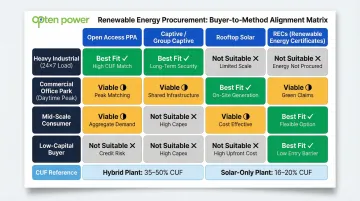
A heavy industrial unit with 24x7 load will have different optimal routes than a commercial office park with peak daytime consumption. For example, steel and cement plants may benefit from hybrid solar-wind projects with higher capacity utilization factors (the proportion of time the plant runs at full output — 35–50% for hybrid vs. 16–20% for standalone solar), while warehouses and IT parks may prioritize rooftop solar or third-party open access PPAs.
Step 3: Issue a Request for Proposal (RFP) or Energy Tender
The buyer (or their advisor) prepares a detailed RFP specifying:
- Load profile and consumption forecast
- Desired contract term (10, 15, 20, or 25 years)
- Required technology (solar/wind/hybrid)
- Delivery point and interconnection requirements
- Commercial terms (payment security, change-in-law provisions, force majeure)
This document is shared with pre-qualified renewable developers who respond with tariff quotes and technical proposals.
Automation advantage: Platforms like Opten Power offer an Automated Tender Engine with modular RFP templates and pre-approved contract structures across Capex, Group-Capex, and Third-Party Open Access models. Buyers can issue tenders, receive comparable bids, and close deals up to 50% faster from discovery to contract finalization.
Step 4: Evaluate Bids, Compare Developers, and Negotiate Terms
Bid evaluation goes beyond headline tariff. Buyers must assess each bid across five dimensions:
- Total landed cost: PPA tariff plus all applicable grid charges by state
- Developer track record: commissioning timelines and operational performance history
- Technology quality: panel efficiency, inverter specifications, O&M provisions
- Payment security: bank guarantees and escrow arrangements
- Contract robustness: force majeure, curtailment, change-in-law, and exit clauses
Financial modeling of IRR and payback under different tariff scenarios is essential before committing to a counterparty.
A low quoted tariff from an under-resourced developer with no ready project carries far higher execution risk than a slightly higher tariff from a proven IPP with land acquisition completed, grid connectivity approval, and financing already in place.
With the right developer identified, execution can begin.
Step 5: Contract Execution, Regulatory Approvals, and Ongoing Monitoring
After selecting a developer, the buyer executes the PPA alongside regulatory filings for:
- Open access approval from the state electricity regulatory commission
- Connectivity agreements with the DISCOM
- Banking arrangements for surplus units
Post-commissioning, the buyer must:
- Monitor generation versus contracted output
- Track REC issuance and retirement
- Manage banking of surplus units (ensuring credits don't expire unused)
- Ensure RPO compliance across each state of operation
A portfolio management dashboard—such as the one offered by Opten Power—enables buyers with multiple sites or contracts to track all these variables from a single interface, providing complete visibility and control over their renewable energy portfolio.
Key Factors That Affect Your Renewable Energy Procurement Decision
State-Level Regulatory Complexity
The single biggest variable in Indian RE procurement is state-level regulatory complexity. Open access charges (wheeling, transmission, scheduling, CSS, AS) vary significantly from state to state and can erode the cost advantage of a PPA if not correctly modeled.
Example variation:
- Wheeling charges: Tamil Nadu charges ₹1.04/kWh for HT consumers, while Gujarat charges ₹1.32/kWh
- Cross-subsidy surcharge: Ranges from ₹1.36/kWh (Gujarat) to ₹1.92/kWh (Tamil Nadu)
- Total landed cost impact: In Q4 2023, Maharashtra reported the highest landed cost at ₹8.4/kWh, while some states achieved costs below ₹5/kWh
Buyers must obtain current, state-specific landing price data before committing to any route. Platforms that aggregate standardized landing prices across all states make these comparisons faster and reduce the risk of costly miscalculations. Once you have accurate landed cost data, the next critical variable is your contract structure.
Contract Term and Tariff Structure
Long-term PPAs (15–25 years):
- Lock in a low fixed tariff
- Provide maximum cost certainty
- Require strong counterparty creditworthiness
- Need robust exit/change-in-law clauses
Shorter contracts (5–10 years):
- Offer flexibility to adapt to changing business needs
- Typically carry higher tariff rates
- Reduce long-term counterparty risk
Buyers should model both scenarios against their own projected growth and energy requirements. A rapidly expanding business may prefer shorter contracts to retain flexibility, while a stable industrial operation may prioritize long-term price certainty.
Technology Selection
Technology selection directly affects the buyer's ability to match generation to load:
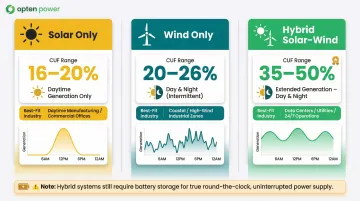
Solar-only:
- Generates only during daytime (6-8 hours)
- CUF of 16-20%
- Best for daytime-heavy consumption (offices, commercial complexes, warehouses)
Wind-only:
- Higher generation during monsoon and at night
- CUF of 20-26%
- Suitable for 24x7 operations with flexible load management
Hybrid solar-wind:
- Complementary generation profiles
- CUF of 35-50%
- Better round-the-clock supply coverage
- Particularly important for industries with 24x7 operations (steel, cement, data centres)
Hybrids reduce generation variability and improve transmission utilization — but they do not provide firm, round-the-clock (RTC) power without energy storage. Buyers with continuous load requirements should account for this gap when evaluating technology options.
Developer Quality and Project Readiness
Developer quality and project readiness are commonly overlooked risk factors. Buyers should evaluate:
| Factor | Lower Risk | Higher Risk |
|---|---|---|
| Land acquisition | Completed | In progress |
| Grid connectivity approval | Obtained | Pending |
| Financing arrangements | In place | Conditional |
| Track record | Multiple operational projects | First-time developer |
| Construction capability | In-house EPC | Fully outsourced |
A low quoted tariff from an under-resourced developer with no ready project carries far higher execution risk than a slightly higher tariff from a proven IPP. Delays in commissioning can result in continued reliance on expensive grid power, eroding the financial benefits of the PPA.
Common Mistakes and Misconceptions in Renewable Energy Procurement
Comparing PPA Tariffs Without Accounting for Full Landed Cost
The most common misconception is comparing PPA tariffs from different states or developers without accounting for the full landed cost (all grid charges, banking fees, scheduling charges). A tariff that appears 20% cheaper than grid supply may deliver negligible savings or even a net cost increase once state-level surcharges are applied.
Example: A solar PPA quoted at ₹2.60/kWh appears attractive compared to a grid tariff of ₹7.50/kWh. However, after adding CSS (₹1.92/kWh), wheeling (₹1.04/kWh), and other charges, the landed cost reaches ₹5.80/kWh—reducing savings from ₹4.90/kWh to ₹1.70/kWh and extending payback periods significantly.
Verify standardized, state-specific landing price data before shortlisting developers.
Skipping the Energy Audit and Load Profiling Stage
Buyers who proceed directly to developer conversations without a clear picture of their consumption profile frequently sign PPAs for:
- Wrong capacity (oversized or undersized)
- Wrong technology (solar for 24x7 load, wind for daytime-only consumption)
- Wrong delivery structure (open access when captive would be more cost-effective)
The result is either chronic shortfall—forcing expensive grid top-up purchases—or chronic surplus, where banking credits accumulate and expire unused.
Assuming RECs Alone Satisfy ESG Disclosure Requirements
Frameworks such as GHG Protocol Scope 2 and RE100 now require buyers to demonstrate a direct contractual link to specific generation sources. Blanket REC purchases without temporal or geographic specificity are being challenged by institutional investors and rating agencies as insufficient evidence of genuine decarbonization.
Key requirements from leading frameworks:
- RE100: Favors long-term, project-specific contracting from recently commissioned projects over one-time unbundled EAC purchases
- GHG Protocol Scope 2: Requires contractual instruments to meet eight Quality Criteria to qualify as a reliable data source under the market-based method
Before finalizing any REC-based strategy, confirm it satisfies the specific criteria of the disclosure framework your business reports against.
Frequently Asked Questions
What is the renewable energy procurement process?
The renewable energy procurement process covers everything from assessing energy needs and selecting a procurement method (PPA, captive, or RECs) to issuing a tender, evaluating bids, and executing a contract. It also includes obtaining regulatory approvals and monitoring ongoing performance and compliance.
What are energy procurement services?
Energy procurement services are advisory or platform-based services that help businesses identify the right procurement route, access developer quotes, manage tendering and negotiation, handle regulatory filings, and track contracted energy performance. They reduce the burden on buyers who lack in-house expertise to navigate India's complex regulatory and commercial landscape.
What is an energy tender?
An energy tender (or RFP) is a formal document issued by a buyer to pre-qualified renewable energy developers, specifying the buyer's load profile, desired contract term, technology preferences, delivery terms, and commercial requirements. Developers respond with tariff bids and technical proposals that the buyer then evaluates and negotiates.
What are the three types of tendering?
The three common types are open tendering (any qualified developer can bid), limited or selective tendering (only pre-screened developers are invited), and single-source tendering (direct negotiation with one developer, typically when that developer already holds a suitable project or prior relationship).
Is it worth using an energy broker?
For C&I buyers without in-house expertise in PPA structuring, DISCOM regulations, or developer evaluation, a broker or advisory platform is worth considering. Verify that the advisor offers transparent, unbiased developer and tariff comparisons rather than favouring a preferred counterparty — technology-enabled marketplaces with real-time pricing data tend to be more objective.
What is green energy procurement?
Green energy procurement means sourcing electricity from renewable sources — solar, wind, or hydropower — through a formal arrangement that provides verifiable environmental attributes such as RECs. Unlike general energy procurement, the buyer is specifically targeting clean energy to meet RPO obligations, sustainability targets, or ESG reporting requirements.