Introduction
Indian commercial and industrial buyers face mounting pressure to secure long-term, cost-stable renewable energy. Steel plants, data centres, hospitals, and IT parks all confront the same strategic question: how do you lock in clean power at a predictable price for the next two decades?
Wind PPAs and Geothermal PPAs represent two structurally different answers. Wind offers immediate cost savings and wide availability across India's windy states. Geothermal delivers uninterrupted 24×7 baseload power — but it remains commercially unavailable in India and commands a steep premium globally. That urgency to choose is real: corporations worldwide signed a record 46 GW of renewable contracts in 2023, with businesses racing to lock in supply before costs climb further.
Your choice affects energy cost stability, supply reliability, and contract risk across a 15–25 year horizon. This guide breaks down both PPA types across the factors that matter most to Indian C&I buyers: pricing structures, availability, grid reliability, and where each option realistically fits your load profile.
Key Takeaways
- Wind PPAs offer fixed-rate power that is mature, widely available, and cost-competitive across India
- Geothermal PPAs deliver 24×7 baseload output, but are commercially unavailable in India today
- Wind beats geothermal on cost and accessibility for Indian C&I buyers; geothermal wins on consistency where it exists
- Your best fit depends on load profile, geography, and grid reliability needs
- For most Indian businesses, wind or wind-hybrid PPAs deliver better ROI and faster procurement timelines
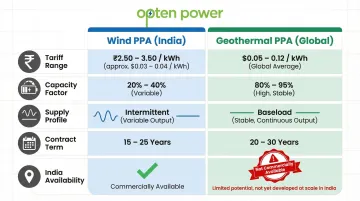
Wind PPA vs. Geothermal PPA: Quick Comparison
Four metrics drive most procurement decisions: tariff, supply profile, capacity factor, and market availability. Here's how wind and geothermal compare on each.
Cost: Indian wind auction tariffs run ₹2.84–₹3.65/kWh and have trended downward as the market matures. Geothermal carries a ~₹2,460 premium per MWh over wind in comparable global markets, reflecting higher upfront project costs and geological risk.
Supply profile: Wind output is intermittent—generation fluctuates across the day and seasons. Geothermal delivers baseload 24×7 power regardless of weather, which maps directly to flat industrial load profiles.
Capacity factor: Wind projects typically generate at 25–35% capacity. Geothermal runs at 80–90%—roughly three times more firm power per MW installed.
India availability: Wind PPAs are commercially mature across 8+ states including Gujarat, Karnataka, Tamil Nadu, Rajasthan, and Andhra Pradesh. India added 3.4 GW of new wind capacity in 2024 alone. Geothermal has no operational commercial plants in India and remains in exploratory phases—making it inaccessible for current procurement.
| Metric | Wind PPA (India) | Geothermal PPA (Global) |
|---|---|---|
| Tariff Range | ₹2.84–₹3.65/kWh | ₹5.53–₹8.12/kWh |
| Capacity Factor | 25–35% | 80–90% |
| Supply Profile | Intermittent | Baseload 24×7 |
| Contract Term | 15–25 years | 20–25 years |
| India Availability | Mature market | Not commercially available |
What is a Wind PPA?
A Wind PPA is a long-term agreement between a commercial or industrial buyer and a wind energy developer. Under the contract, the buyer commits to purchasing electricity generated by a specific wind project at a pre-agreed tariff over a fixed term—typically 15 to 25 years.
This structure protects both parties: the developer secures revenue certainty to finance construction, while the buyer locks in future electricity costs—shielding operations from grid tariff escalation and volatile spot markets.
Core Business Benefits
- Fixed tariffs insulate you from DISCOM rate hikes—while grid tariffs rise 5–8% annually in many states, your Wind PPA rate stays constant, compounding savings over time
- Energy cost reductions of 30–40% below open-access grid rates directly improve operational margins for energy-intensive industries
- Measurable renewable consumption supports ESG reporting, carbon reduction targets, and sustainability commitments
Wind PPA Structures in India
Group Captive
- Buyer takes equity stake (minimum 26%) in the wind project
- Gains exemption from Cross-Subsidy Surcharge and Additional Surcharge
- Must consume at least 51% of generated power
- Delivers lower landed tariffs—typically ₹3–5 per unit in savings
Third-Party / Open Access PPA
- No equity required—simpler execution
- Buyer purchases power under open access regulations
- Subject to Cross-Subsidy and Additional Surcharges, which reduce economic viability
- Suitable for buyers unable to commit equity capital
Use Cases of Wind PPA
Wind PPAs work best for C&I buyers with high daytime and evening load profiles. Manufacturing units, textile mills, cement plants, warehouses, and commercial complexes can absorb wind's variable generation patterns without requiring battery storage.
This load compatibility helps explain why wind PPAs dominate procurement in windy states. India's C&I open access market grew 90.4% between FY2023 and FY2024, reaching 18.7 GW cumulative capacity, with wind and hybrid projects accounting for a significant share.
States like Rajasthan, Gujarat, Tamil Nadu, Karnataka, and Andhra Pradesh host the majority of wind PPA activity due to strong wind resources and supportive regulatory frameworks.

Real-World Example: Tata Steel signed a 966 MW round-the-clock hybrid PPA with Tata Power Renewable Energy, structured as a Group Captive project with 26% equity investment. The project combines 379 MW solar and 587 MW wind to deliver firm renewable power, reducing Tata Steel's grid dependence and locking in energy costs for 25 years.
What is a Geothermal PPA?
A Geothermal PPA is a long-term power purchase agreement where a buyer contracts electricity from a geothermal power plant. Geothermal plants harness heat from beneath the Earth's surface to generate electricity continuously—making geothermal a baseload renewable source, unlike solar or wind.
Core Business Benefits
- Generates power 24×7 with no weather dependency, eliminating curtailment risk for flat-load operations like data centres, hospitals, and continuous-process industries
- Achieves 80–90% capacity factors globally, meaning near-constant output — a stability premium that round-the-clock buyers can justify
- Delivers predictable generation year-round, reducing reliance on backup power or storage compared to variable wind
Global Context and India Reality
Geothermal PPAs are active in the US (California, Nevada), Kenya (Olkaria), Indonesia, and Iceland—regions with accessible geothermal resources. In India, the Ministry of New and Renewable Energy notified the National Policy on Geothermal Energy in 2025, formally establishing a policy framework. India has identified geothermal resources in Ladakh (Puga Valley) and Chhattisgarh (Tattapani) but has no commercial geothermal power generation or PPAs available yet.
The Puga Valley project remains in exploratory drilling phases, with ONGC restarting operations in 2024 after a two-year pause. The initial target is 1 MW of pilot generation—far from commercial scale.
Use Cases of Geothermal PPA
Globally, geothermal PPAs suit operations that demand baseload 24×7 supply with zero tolerance for gaps: data centres, hospitals, continuous-process chemical plants, and fertiliser production facilities. In these cases, consistency outweighs cost.
Active Geothermal Markets:
- United States: California and Nevada host active markets — Clean Power Alliance holds 48 MW in geothermal PPAs with Fervo Energy across two contracts.
- East Africa: Kenya's Olkaria geothermal complex supports industrial and utility-scale PPAs.
- Iceland: Geothermal dominates the energy mix, with long-term contracts serving heavy industries.
For Indian Buyers: Geothermal PPAs are not currently actionable domestically. However, wind + battery storage hybrid PPAs can approximate the baseload firmness that geothermal provides elsewhere, offering 24×7 renewable supply without waiting for India's geothermal sector to mature.
Wind PPA vs. Geothermal PPA: Which is Right for Your Business?
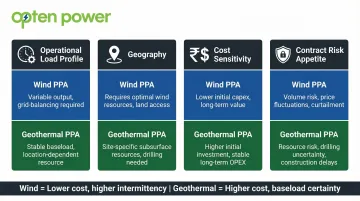
Your decision hinges on four critical factors:
1. Operational Load Profile
Do you need 24×7 firm power, or can you tolerate intermittent supply?
- Wind PPA: Best for operations with flexible or daytime-heavy loads that can absorb variable generation.
- Geothermal PPA: Best for operations requiring constant baseload power without interruption.
2. Geography
Are you located in a region with accessible wind or geothermal resources?
- Wind PPA: Available across 8+ Indian states with strong wind resources.
- Geothermal PPA: Only viable in geothermal-resource regions like California, Nevada, Kenya, or Iceland — not currently available in India.
3. Cost Sensitivity
Can you absorb a tariff premium in exchange for supply certainty?
- Wind PPA: Lower tariffs (₹2.84–₹3.65/kWh) deliver faster ROI and immediate cost savings.
- Geothermal PPA: Higher tariffs globally (approximately ₹5.53–₹8.12/kWh in INR-equivalent terms), justified only when baseload reliability is non-negotiable.
4. Contract Risk Appetite
Both PPAs lock you into 15–25 year commitments. Are you prepared to manage long-term supply risk?
- Wind PPA: Lower financial risk due to lower tariffs, but higher operational risk from intermittency.
- Geothermal PPA: Higher financial commitment, but near-zero operational risk from supply variability.
Recommendations for Indian C&I Buyers
Choose a Wind PPA if:
- You're a manufacturer, textile unit, warehouse, or commercial complex in Gujarat, Karnataka, Tamil Nadu, Rajasthan, or Andhra Pradesh
- Your load profile can absorb variable generation patterns
- You need the fastest cost savings and access to a mature contract pipeline
- You want to reduce energy costs by 30–40% versus grid tariffs
Choose Wind + Battery Hybrid if:
- You need firmer supply closer to baseload (data centres, hospitals, process industries)
- You operate 24×7 and cannot tolerate supply gaps
- You're willing to pay a moderate premium for storage-backed firm power
- Choose Geothermal PPA if:
- You operate in a geothermal-resource region (US, Kenya, Iceland)
- You run a data centre or hospital demanding near-100% uptime
- You can absorb higher tariffs for supply certainty and zero-curtailment profiles
- Long-term price stability matters more than minimizing upfront tariff rates
Compare Wind PPA Options Across 16 States
Once you've identified the right PPA type, the next step is comparing options. Opten Power's marketplace lets Indian C&I buyers compare Wind PPA tariffs, developer options, and real-time DISCOM landing prices across 16 states — replacing weeks of manual RFP work with instant IRR, payback, and regulatory analysis. The result: a clear, data-backed shortlist matched to your operations.
Real-World Examples
Indian C&I Wind PPA Case
Tata Power Renewable Energy commissioned a 198 MW wind energy project in Tamil Nadu under a Group Captive model to supply renewable power to Tata Steel. The project, structured with 26% equity investment from Tata Steel, delivers long-term cost stability and supports the steel manufacturer's decarbonization goals.
By locking in a fixed tariff for 25 years, Tata Steel shields itself from grid tariff volatility while reducing energy costs significantly compared to DISCOM rates.
Global Geothermal PPA Case
The University of Utah signed a 25-year PPA with Cyrq Energy to purchase 20 MW of geothermal power from the Soda Lake Field in Nevada. Since Fall 2019, more than half of the university's electricity (53.7%) comes from renewable energy thanks to this geothermal contract.
The university's challenge was securing 24×7 clean power to meet sustainability goals without compromising operational reliability. Geothermal's baseload profile and near-100% uptime delivered the certainty needed, justifying the premium over intermittent renewables.

Comparative Takeaway
Both cases make the tradeoffs concrete. Wind PPAs deliver faster ROI and lower tariffs in accessible markets. Geothermal PPAs deliver operational certainty where the resource exists. Your choice should follow your load profile and geographic reality — cost is only part of the equation.
For Indian buyers, Opten Power's marketplace lets you compare live wind PPA tariffs across 16 states, shortlist developers from 4+ GW of available capacity, and close deals faster with automated RFPs.
Conclusion
Wind PPAs are the clear near-term choice for Indian C&I businesses given cost competitiveness, commercial maturity, and geographic availability. Geothermal PPAs offer a compelling proposition for baseload-intensive buyers globally and may become relevant in India as the sector develops—but that timeline remains uncertain.
Both are long-term commitments. Before signing, evaluate:
- Load profile fit: Does your consumption pattern match the source's generation curve?
- DISCOM regulations: Are open access charges and banking rules favorable in your state?
- Contract structure: Are escalation caps, curtailment clauses, and exit terms clearly defined?
- Hybrid optionality: Can the agreement accommodate a wind-solar hybrid if baseload needs grow?
The right PPA structure—whether wind, hybrid, or eventually geothermal—shapes your energy costs, grid reliability, and sustainability commitments for the next 20+ years. Platforms like Opten Power allow Indian C&I buyers to compare wind and hybrid PPA tariffs across developers in real time, including state-level DISCOM landing prices, before committing to any structure.
Frequently Asked Questions
Which is better, geothermal or wind energy?
Neither is universally better. Wind is lower-cost and widely available but intermittent, while geothermal is a reliable baseload source with higher cost. The right choice depends on operational load requirements, geography, and cost priorities.
What is a Wind PPA and how does it work for businesses?
A Wind PPA is a long-term contract between a C&I buyer and a wind developer that fixes the power price for the contract term. It helps businesses avoid grid tariff escalation and reduce energy costs through a fixed, predictable renewable supply price.
Is geothermal energy commercially available in India for businesses?
No. India has no operational commercial geothermal power plants, so geothermal PPAs are not currently actionable for Indian C&I buyers, though geothermal resources have been identified for future development in Ladakh and Chhattisgarh.
What is a typical capacity factor for wind vs. geothermal power?
Wind capacity factors are typically 25–35% (intermittent) while geothermal runs at 80–90% (near-constant baseload), which directly affects how much firm power a buyer receives under each PPA type.
How long is a typical Wind PPA contract in India?
Wind PPAs in India typically run for 15–25 years. This fixed tariff shields buyers from grid price volatility and supports long-term energy cost planning.
Can a Wind PPA replace baseload power needs for 24×7 operations?
A standalone wind PPA may not meet 24×7 demand due to intermittency. However, wind + battery hybrid PPAs or a blended renewable portfolio can approximate baseload supply for round-the-clock operations like data centres and hospitals.