Introduction
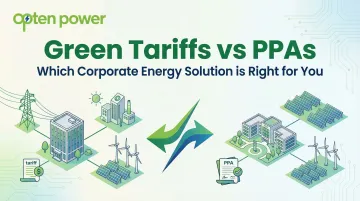
Grid electricity now costs over ₹7/kWh in most Indian states — and sustainability mandates aren't easing. For C&I buyers, two procurement paths dominate the response: green tariffs through DISCOMs and direct corporate PPAs with renewable developers. Both deliver cleaner energy, yet the commercial and operational trade-offs differ vastly.
Selecting the wrong structure can lock you into inflexible contracts, higher landed costs, or stranded energy risk — particularly for large industrial consumers with 24×7 load profiles navigating open access regulations in states like Maharashtra, Tamil Nadu, or Rajasthan.
For a steel plant in UP or a data centre in Karnataka, a ₹0.50–1/kWh misstep translates to crores in annual losses.
This article breaks down both options — how they work, their core differences, and a situational guide to help C&I buyers decide which path fits their scale, risk appetite, and sustainability goals.
Key Takeaways
- Green tariffs are utility-managed RE programs where DISCOMs procure renewable energy on your behalf — minimal complexity, limited control
- Corporate PPAs are direct long-term contracts with developers offering price certainty, customization, and 30–40% cost savings
- Green tariffs suit businesses that want hassle-free RE without navigating open access, wheeling charges, or developer negotiations
- PPAs suit large consumers (2–5 MW+) with stable loads who need locked-in tariffs and direct ESG additionality claims
- Your decision hinges on load size, state open access feasibility, internal bandwidth, and ESG urgency
Green Tariffs vs Corporate PPAs: Quick Comparison
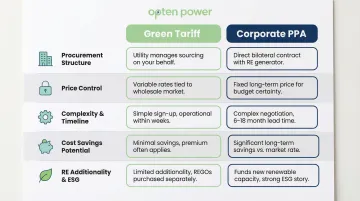
| Factor | Green Tariff | Corporate PPA |
|---|---|---|
| Procurement structure | Utility-regulated, routed through DISCOM | Bilateral contract directly between buyer and developer |
| Price control | Regulated pricing subject to state tariff revisions | Negotiated fixed or indexed price locked for 10–25 years |
| Complexity & timeline | Minimal internal effort; no open access filings needed | Involves RFP process, regulatory approvals, and due diligence |
| Cost savings potential | Modest savings over conventional grid supply | Up to 30–40% savings vs. DISCOM tariffs over contract life |
| RE additionality & ESG | May lack direct project-level traceability | Stronger Scope 2 claims with project-level attribution |
What is a Green Tariff?
A green tariff is a regulated rate schedule offered by a DISCOM or state utility. It allows commercial and industrial consumers to source part or all of their electricity from renewable energy projects procured by the utility — with the utility handling procurement, balancing, and delivery. The consumer pays a separate tariff or a premium over conventional power.
Two Common Forms in India
- Bundled green tariff — RE is blended into grid supply and tracked via Renewable Energy Certificates (RECs)
- Dedicated green tariff programs — notified by state electricity regulatory commissions (SERCs), tying the consumer to a specific RE project portfolio managed by the DISCOM
State regulators set these premiums individually, and FY2025-26 rates vary considerably across India:
| State | Green Tariff Premium |
|---|---|
| Maharashtra | ₹0.25/kWh |
| Uttar Pradesh (HV consumers) | ₹0.34/kWh |
| Karnataka | ₹0.50/kWh |
| Gujarat | ₹0.75/kWh |
| Andhra Pradesh | ₹0.75/kWh |
Core Operational Benefits
- No open access approvals needed
- No banking, wheeling, or scheduling complexity
- No direct developer relationship to manage
- Ideal for mid-sized commercial consumers—IT parks, hospitals, hotels—lacking in-house energy procurement teams
Limitations
- Tariffs are subject to DISCOM and regulatory revisions, making long-term cost predictability difficult
- Visibility into which specific RE project supplies your power is often limited
- Consumers have little say over project location, technology type, or delivery terms
Use Cases of Green Tariffs
Green tariffs fit best for medium-sized commercial consumers—warehouses, commercial complexes, hotels—in states where open access charges (cross-subsidy surcharge, wheeling, transmission charges) make direct PPAs commercially unviable.
Industries where green tariffs dominate:
- Retail chains with distributed locations
- Institutional buyers needing standardized solutions
- Office buildings below 1 MW contracted demand
- SMEs with sustainability reporting obligations but unable to commit to multi-year bilateral contracts
1 MW minimum load: Most states require at least 1 MW load to qualify for open access. If you're below this threshold, green tariffs provide your primary route to renewable energy.
India's cumulative solar open access capacity exceeded 30 GW as of December 2025, but many smaller consumers remain locked out by these minimum load requirements. For them, green tariffs are the most direct path to RE compliance today.
What is a Corporate PPA?
A corporate PPA is a long-term bilateral power purchase agreement between a C&I buyer and an Independent Power Producer (IPP) or renewable energy developer, typically structured under open access provisions of the Electricity Act 2003. The buyer agrees to purchase a fixed or variable quantum of energy at a negotiated tariff for 10–25 years, either through physical delivery (open access) or via a group captive structure.
Two Primary PPA Structures in India
Open Access PPA: Power is wheeled from the generator to the consumer's premises via state or inter-state transmission networks. You pay wheeling charges, cross-subsidy surcharge (CSS), and additional surcharge (AS).
Group Captive PPA: The consumer holds a minimum 26% equity stake in the generating project and consumes at least 51% of its output. This structure carries significant cost advantages by reducing or eliminating surcharge liabilities.
Cost Mechanics
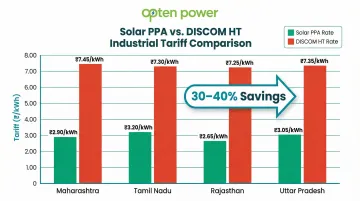
PPA tariffs are typically fixed at ₹X/kWh at signing with a predefined escalation (or zero escalation for solar), insulating the buyer from DISCOM tariff hikes over the contract period. In 2025-2026, indicative solar PPA tariffs ranged from ₹2.50/kWh to ₹3.36/kWh for wind-solar hybrid projects.
Compare this to DISCOM HT industrial tariffs:
- Maharashtra: ₹7.48/kWh
- Tamil Nadu: ₹7.25/kWh
- Rajasthan: ₹7.30/kWh
- Uttar Pradesh: ₹7.10/kWh
That gap translates to 30–40% savings over the contract life for most C&I buyers.
Procurement and Execution Complexity
Reaching those savings requires navigating a multi-step procurement process: running an RFP, evaluating developer bids, negotiating contract terms, securing open access approval from the SLDC or CERC, and managing scheduling and banking arrangements on an ongoing basis.
Platforms like Opten Power reduce this complexity with automated RFP templates, pre-vetted developer bids across 4+ GW of capacity, and real-time IRR and payback analysis — most buyers on the platform close deals roughly 50% faster than through traditional procurement.
Key Benefits for Large C&I Consumers
- Price certainty over 10–25 years
- Direct Scope 2 emissions attribution for ESG reporting
- Potential RPO compliance fulfillment
- Zero capital investment when structured as third-party PPA
Use Cases of Corporate PPAs
Corporate PPAs fit best for heavy industrial consumers with predictable 24×7 or two-shift loads above 1–5 MW. Typical buyers include:
- Steel, cement, and fertiliser conglomerates running continuous operations
- Textile mills and large manufacturing units on two-shift schedules
- Data centres requiring firm, round-the-clock power supply
- IT parks and process industries with high load factors
For these buyers, even a ₹0.50–1/kWh reduction in landed cost translates to crores in annual savings.
Group captive PPAs are particularly well-suited for process industries and manufacturing clusters that can pool their equity and consumption with other buyers to meet the 26%/51% requirement—lowering individual surcharge exposure.
Real-world example: Tata Steel entered into an agreement with Tata Power Renewable Energy Ltd. to source 379 MW of captive renewable power, targeting savings of 50 million tons of carbon emissions over 25 years. The deal shows how a structured long-term PPA can serve both cost reduction and decarbonisation targets simultaneously.
Tata Steel's approach is far from an outlier. India added 7.8 GW of solar open access capacity in 2025 alone, with Karnataka accounting for over 24% of new installations, followed by Maharashtra and Rajasthan — reflecting the growing cost competitiveness of corporate PPAs for large C&I buyers across sectors.
Green Tariffs vs Corporate PPAs: Which One Is Right for You?
The right choice hinges on five factors:
- Annual energy consumption and load profile
- State-level open access regulatory environment (OA charges vary significantly)
- Internal capacity to manage procurement and compliance
- Required speed of procurement
- Depth of ESG/sustainability commitments
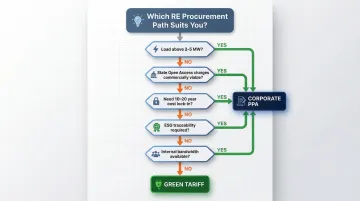
Choose a Green Tariff If:
- Your contracted demand is below 1 MW
- Your state has high open access surcharges that erode PPA economics (e.g., Punjab, Tamil Nadu)
- You operate in multiple small locations and want a standardized solution
- You need quick procurement without a lengthy RFP cycle
- You lack internal bandwidth to manage developer negotiations and regulatory filings
Choose a Corporate PPA If:
- You're a large C&I consumer with stable load above 2–5 MW
- Your state's open access framework is commercially viable (low CSS/AS)
- You need 10–20 year cost predictability for budget planning
- You want traceable renewable energy with direct additionality for CDP or GHG Protocol reporting
- You have the internal capacity (or platform support) to manage RFPs and regulatory approvals
The Hybrid Approach
Some large enterprises with multi-state operations use green tariffs for locations where open access is cost-prohibitive and PPAs for their highest-load facilities—balancing procurement simplicity with cost optimization across their energy portfolio.
In Q4 2025, rising PPA tariffs driven by ALMM/DCR module mandates—combined with high open access charges—pushed third-party OA savings into negative territory in states like Punjab and Tamil Nadu. State-specific cost modeling isn't optional; it's what separates a sound procurement decision from an expensive one.
For eligible buyers, group captive models offer a third path worth considering. Exempt from CSS and AS charges, they are often the most cost-effective PPA structure available—particularly in states like UP and Maharashtra, where CSS rates run ₹1.36–₹1.82/kWh. The 26% equity / 51% consumption requirement shields buyers from volatile regulatory levies that can erode savings under standard open access arrangements.
Conclusion
There is no universally superior option. Green tariffs offer simplicity and accessibility; corporate PPAs offer depth, cost savings, and ESG credibility. For most large Indian industrial consumers with significant energy loads, a well-structured PPA will deliver substantially better long-term economics. For smaller or more distributed operations, green tariffs provide a practical, low-friction entry into renewable energy procurement.
Before committing to either route, assess your load profile, your state's DISCOM tariff structure, and the contract tenure you can realistically support. Those three factors will determine which option actually saves you money.
For organizations ready to run that analysis, Opten Power's marketplace provides real-time DISCOM pricing, developer comparisons across 16 states, and automated RFPs — so you can benchmark, negotiate, and close a corporate PPA deal with clear cost and regulatory visibility from the start.
Frequently Asked Questions
What is the difference between a green tariff and a PPA?
A green tariff is a utility-managed program where the DISCOM procures and delivers renewable energy under a regulated tariff. A PPA is a direct contract between the consumer and a renewable developer, offering more price control and ESG traceability but requiring greater procurement involvement.
What is a green PPA?
A green PPA is a power purchase agreement for renewable energy where the buyer receives both the electricity and associated renewable energy certificates (RECs). This enables verifiable clean energy claims for Scope 2 reporting under frameworks like the GHG Protocol.
What is a PPA tariff?
A PPA tariff is the negotiated per-unit price (₹/kWh) at which the corporate buyer agrees to purchase power from the renewable energy developer over the contract term. It's typically fixed or includes a predefined escalation, protecting buyers from grid tariff volatility.
What does a green tariff mean?
Under a green tariff, large commercial and industrial consumers pay for renewable-sourced electricity through either a premium over standard grid rates or a dedicated tariff notified by the state regulator. The utility or DISCOM manages procurement and delivery — the consumer opts in through a regulated rate schedule.
What is the difference between EPC and PPA?
An EPC (Engineering, Procurement, and Construction) contract is an agreement to build a power project — covering design, procurement, and commissioning. A PPA is a revenue contract to buy or sell the electricity that project generates.