Introduction
India is racing toward an ambitious target: 500 GW of installed electricity capacity from non-fossil sources by 2030. As of March 2026, the country had already achieved 283.46 GW of non-fossil fuel capacity. For commercial and industrial (C&I) businesses — from manufacturing plants and data centres to warehouses and textile mills — this transition carries real financial stakes.
Choosing the right renewable energy source is complicated. Solar, wind, hydro, and hybrid systems each carry different cost structures, reliability profiles, and procurement models. Picking the wrong option can mean higher-than-expected electricity bills, continued grid dependency, or missed Renewable Purchase Obligation (RPO) compliance targets.
This guide compares solar, wind, hydro, and geothermal energy head-to-head, with a focus on energy-intensive C&I operations across India's 16+ states. We cover costs, reliability, scalability, and procurement strategies — so you can identify the renewable mix that delivers the lowest landed cost and the strongest fit for your operations.
Key Takeaways
- Solar power offers the lowest cost per unit and broadest geographic fit, making it the default starting point for C&I procurement
- Wind energy runs around the clock but is viable only in select high-wind states: Tamil Nadu, Gujarat, Rajasthan, Karnataka, and Maharashtra
- Hydro and geothermal provide reliable baseload power but are largely inaccessible for direct C&I procurement in India
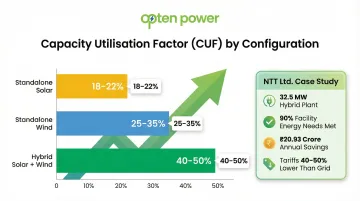
- Hybrid solar-wind systems hit 40–50% capacity utilisation factors, making them well-suited for 24x7 heavy industries
- Most C&I operations benefit most from procuring a blended source mix through Corporate PPAs
Solar vs. Other Renewables: At a Glance
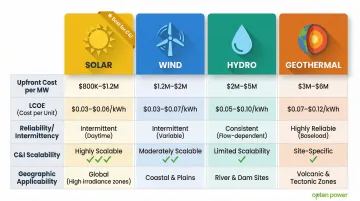
| Dimension | Solar | Wind | Hydro | Geothermal |
|---|---|---|---|---|
| Upfront Cost | ₹3.5-4 crore/MW | ₹5.5-6.5 crore/MW | Very high (dam infrastructure) | Very high (drilling, infrastructure) |
| LCOE (Cost per Unit) | ₹0.038/kWh | ₹0.048/kWh | ₹0.045-0.060/kWh | Not commercially viable in India |
| Reliability/Intermittency | Daytime only; weather-dependent | 24x7 in high-wind zones; seasonal variation | 24x7 baseload; monsoon-dependent | 24x7 baseload |
| Scalability for C&I | Highly scalable (100 kW to 100+ MW) | Scalable (>5 MW typically) | Not scalable for direct procurement | Not available for C&I procurement |
| Geographic Applicability | Universally applicable across 16+ states | High-wind states only (TN, GJ, RJ, KA, MH) | River/reservoir-dependent states | Negligible commercial resources in India |
Key Takeaway: Solar is the only renewable universally applicable across India for C&I procurement. Wind is competitive in select regions, while hydro and geothermal have no viable direct procurement pathway for most industrial buyers. Solar's intermittency constraint is increasingly managed through hybrid solar-wind configurations, which enable closer-to-round-the-clock renewable supply — a meaningful shift for industries with continuous power needs.
What is Solar Power?
Solar photovoltaic (PV) technology converts sunlight into DC electricity through semiconductor cells embedded in panels, which is then inverted to AC for industrial use. For C&I operations, solar energy is deployed in three main formats:
- Rooftop solar — installed on warehouse, factory, or commercial building roofs (typically 100 kW to 5 MW)
- Ground-mounted utility-scale farms — large solar installations on open land (5 MW to 100+ MW)
- Floating solar — panels installed on water bodies, increasingly common in India to conserve land
Core Benefits for C&I Operations
Falling costs have made solar the most price-competitive energy source for most C&I buyers. Solar LCOE in India now sits around ₹2.50–₹3.20/kWh — well below industrial grid tariffs that range from ₹6.25/kWh in Karnataka to ₹8.68/kVAh in Maharashtra. That gap translates to 40–50% savings on energy costs.
Solar also scales across the full C&I range — from 100 kW rooftop installations for small warehouses up to 100+ MW utility-scale farms for steel, cement, and large process industries. No other renewable source offers that span.
The core limitation: solar generates power only during daylight hours, and output dips on overcast days. For 24x7 operations, solar alone is insufficient — it needs battery storage or a wind complement. Hybrid configurations typically deliver better reliability and lower blended costs for continuous-demand businesses.
Use Cases of Solar for C&I
Solar works best where consumption peaks align with generation — daytime-heavy operations such as:
- Textiles and garment manufacturing
- Warehouses and logistics facilities
- Commercial complexes and IT parks
- Hospitals with high daytime loads
Kallam Textiles Ltd. in Andhra Pradesh illustrates the return available. Their 1,000 kW AC ground-mounted bifacial system achieved a CUF of 27.62% and estimated annual savings of ₹1 crore.
What Are Other Renewable Energy Sources?
Wind Energy
Wind turbines convert the kinetic energy of air currents into electricity. Unlike solar, wind turbines operate continuously — day and night — making wind a baseload-capable renewable when wind speeds are sufficient. In India, the highest wind potential is concentrated in Tamil Nadu, Gujarat, Rajasthan, Karnataka, and Maharashtra, which collectively account for the bulk of the country's 56.09 GW of installed wind capacity.
Operational Trade-offs vs. Solar for C&I:
- Wind requires significant open land and is not rooftop-installable
- Higher per-MW installation costs (₹5.5-6.5 crore/MW vs. ₹3.5-4 crore/MW for solar)
- Subject to wind speed variability (seasonal and daily)
- Wind LCOE in high-wind zones is ₹0.048/kWh, competitive with solar but still higher
Wind is best suited for heavy industries with 24x7 operations — steel, cement, textiles, and process industries that need round-the-clock power supply and can tolerate location constraints.
Hydro and Geothermal Energy
Beyond wind, two other renewable sources often appear in capacity planning discussions — though neither is accessible to most C&I buyers in India today.
Hydro: With conversion efficiency exceeding 90%, hydro is technically the most efficient renewable. The problem is access. As of March 2026, India had 51.41 GW of large hydro and 5.17 GW of small hydro capacity, but these are primarily state-controlled utilities. Location dependence, dam construction impacts, and limited direct procurement pathways make hydro an impractical option for most Indian C&I businesses.
Geothermal: Taps the Earth's internal heat for 24x7 baseload power with minimal emissions and a small physical footprint. For Indian C&I buyers, the picture is straightforward: while the Geological Survey of India (GSI) estimates 10 GW of theoretical potential across 381 hot springs, India has 0 MW of active commercial geothermal production today. Geothermal remains off the table for domestic energy procurement in the near term.
Hybrid (Solar + Wind) Systems
Hybrid renewable systems combine solar and wind energy — either co-located or grid-bundled — to produce power across a wider daily and seasonal window than either source alone. The key performance metric is Capacity Utilisation Factor (CUF):
- Standalone solar: 18-22% CUF in India
- Standalone wind: 25-35% CUF in high-wind zones
- Hybrid configurations: 40-50% CUF
This improvement in CUF drastically reduces cost per unit and improves energy availability for 24x7 industrial operations. For example, CleanMax's 32.5 MW wind-solar hybrid plant in Karnataka for NTT Ltd. met 90% of the facility's electricity needs, generating ₹20.93 crore in annual savings with tariffs 40-50% lower than grid rates.
Solar vs. Other Renewables: Which is Right for Your Business?
Decision Framework by Operation Type
1. Daytime-Heavy Operations (IT parks, warehouses, commercial complexes):
Standalone solar PPA is the most cost-effective and straightforward choice. These facilities consume the majority of their energy during business hours (8 AM to 8 PM), aligning perfectly with solar generation. Solar delivers the lowest LCOE and fastest payback (3-4 years).
2. 24x7 High-Load Industries (steel, cement, data centres, process industries):
Hybrid solar+wind PPA delivers the necessary CUF and cost stability. Continuous operations cannot afford supply gaps, making hybrid systems — which combine solar's daytime peak with wind's nighttime generation — the strongest fit.
3. Remote or Off-Grid Industrial Sites:
Wind or hybrid off-grid configurations with storage are often the only viable option. These installations eliminate grid dependency entirely, critical for locations with unreliable DISCOM supply or high wheeling charges.
Cost and ROI Comparison
Solar currently delivers the lowest LCOE among all renewable options in most Indian states, with payback periods that have shortened significantly due to falling panel costs and government incentives. Wind competes on cost only in high-wind zones.
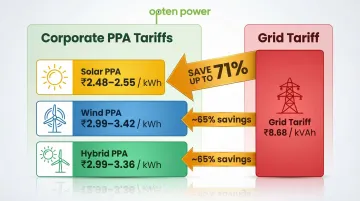
Current Corporate PPA Tariff Ranges:
- Solar PPA: ₹2.48 to ₹2.55/kWh
- Wind PPA: ₹2.99 to ₹3.42/kWh
- Hybrid PPA: ₹2.99 to ₹3.36/kWh
For a manufacturing unit in Maharashtra paying ₹8.68/kVAh grid tariff, a solar PPA at ₹2.50/kWh delivers a 71% cost reduction on energy charges. Wind and hybrid PPAs yield slightly smaller savings but compensate with superior reliability for 24x7 loads.
Reliability and Grid Stability
Solar alone cannot guarantee continuous supply. Wind alone is geographically limited. However, a hybrid PPA structured with the right source mix and banking provisions under DISCOM regulations can closely approximate baseload supply.
Indian DISCOM regulations on Open Access and RPO compliance also influence which source mix is feasible in a given state. Key regulatory factors affecting net savings include:
- Standby charges: Green Energy Open Access rules set these at 125% of the normal tariff
- Cross-subsidy surcharges: Capped at 20% of Average Cost of Supply
Opten Power's marketplace lets C&I buyers compare solar, wind, and hybrid project tariffs across 16 states in real-time — with instant IRR, payback, and regulatory analysis built in. With 4+ GW of available capacity, buyers can identify the right renewable mix for their specific load profile and state DISCOM rules before committing to a single project.
Final Situational Guidance
Neither solar nor wind is universally "better" — the decision depends on:
- Load profile: Daytime-heavy vs. 24x7 operations
- Geographic location: High-wind states favour wind; all states support solar
- Target savings percentage: Solar delivers deepest cost cuts; hybrid offers reliability premium
- Procurement model: Rooftop (Capex) vs. Open Access PPA (no upfront cost)
Most large C&I buyers benefit from a portfolio approach rather than a single-source commitment. A textile manufacturer might use rooftop solar for daytime loads and supplement with a wind PPA for evening shifts. A data centre might procure a hybrid PPA to ensure 24x7 supply at stable tariffs.
Conclusion
Solar power is the most broadly applicable, cost-effective starting point for C&I energy decarbonisation in India, but it is rarely the complete answer for heavy industries with round-the-clock energy needs. Wind and hybrid configurations add critical resilience and cost efficiency for operations that cannot afford supply gaps.
For most businesses, the real question is: what mix, at what tariff, in which state? Before committing to a procurement structure, map your energy load profile against what's actually available in your state.
Opten Power's marketplace lets C&I buyers compare solar, wind, and hybrid projects across 16 states — with real-time tariff data, automated RFPs, and access to 4+ GW of capacity — so procurement decisions rest on numbers, not assumptions.
Frequently Asked Questions
How does solar power compare to other renewable energy sources?
Solar offers the lowest LCOE and the widest geographic applicability across India. Wind offers 24x7 generation capability but is location-restricted. Hydro and geothermal provide reliable baseload but are not available for direct C&I procurement.
How much do plug-in solar panels cost?
For commercial and industrial applications in India, costs are better evaluated on a per-MW or per-unit energy basis (LCOE) rather than individual panel pricing. Corporate PPAs eliminate upfront capital expenditure entirely by shifting to a per-unit tariff model — making solar viable even without large capital budgets.
Can solar energy alone power a 24x7 industrial or commercial facility?
Solar alone cannot guarantee 24x7 supply due to its dependence on daylight. Industrial facilities with continuous operations typically pair solar with wind, battery storage, or grid banking arrangements under Open Access regulations to ensure uninterrupted power.
What is a hybrid renewable energy system?
A hybrid system combines two or more renewable sources — typically solar and wind — to produce power across a wider time window, achieving capacity utilisation factors of 40-50% compared to 18-22% for solar alone. This makes hybrid systems well-suited for heavy industries with continuous energy demands.
Which renewable energy source offers the best ROI for C&I buyers in India?
Solar currently delivers the lowest LCOE for most Indian states, making it the strongest ROI option for daytime-heavy operations. For 24x7 industrial loads, hybrid solar+wind PPAs typically offer superior long-term ROI by reducing grid dependency and stabilising energy costs.