Introduction: Andhra Pradesh Wind PPA – A Regulatory Snapshot
Andhra Pradesh's wind energy sector holds 44,229 MW of gross wind potential at 100-meter hub height — one of the largest untapped reserves in India, per MNRE and NIWE assessments. For C&I buyers aiming to cut energy costs or meet sustainability targets, the resource is there. The challenge is getting through the approvals.
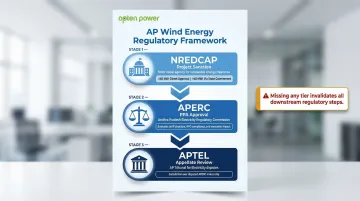
Wind PPAs in Andhra Pradesh run through three distinct regulatory bodies — NREDCAP, APERC, and APTEL — each governing a different project stage. Missing clearance from any one tier can delay a project by months or invalidate downstream agreements.
The stakes are rising. APERC's Regulation 5 of 2022 mandates a total Renewable Purchase Obligation (RPO) trajectory reaching 24% by FY27, while the Ministry of Power targets 43.33% by 2030. This regulatory pressure is driving stricter PPA scrutiny, sharper tariff negotiations, and evolving contractual requirements around energy storage and peak-hour delivery.
Key facts covered in this guide:
- NREDCAP sanctions wind projects up to 40 MW directly; larger capacity requires state government approval
- APERC approves all PPAs between generators and DISCOMs before power supply can begin
- Wind tariffs range from ₹2.49/unit (renewals) to ₹4.60/unit (wind-solar hybrid) depending on project type
- C&I buyers can access wind via utility PPAs, open-access routes (minimum 100 kW), or captive models
- APTEL's 2025 Guttaseema ruling sets COD as the synchronization date of the first unit, not the entire project
The Regulatory Architecture: NREDCAP, APERC, and APTEL
Andhra Pradesh's wind power sector operates under a three-tier regulatory structure, each governing a distinct stage of the project lifecycle.
The Three-Tier Framework
NREDCAP: The New & Renewable Energy Development Corporation of A.P. Ltd operates as the state nodal agency under G.O.Ms.No.9 dated 13.02.2015. NREDCAP serves as the single-window clearance agency for wind farm approvals up to 40 MW. Projects exceeding this threshold require NREDCAP's recommendation to the Government of Andhra Pradesh for final sanction. No wind farm can legally be established in the state without NREDCAP clearance.
APERC: The Andhra Pradesh Electricity Regulatory Commission derives its authority from Sections 61, 62, 63, 86(1)(b), and 86(1)(e) of the Electricity Act, 2003. APERC must approve all PPAs between generators and DISCOMs (APSPDCL and APEPDCL) before power supply can commence.
The Commission scrutinizes each PPA against:
APERC: The Andhra Pradesh Electricity Regulatory Commission derives its authority from Sections 61, 62, 63, 86(1)(b), and 86(1)(e) of the Electricity Act, 2003. APERC must approve all PPAs between generators and DISCOMs (APSPDCL and APEPDCL) before power supply can commence.
The Commission scrutinizes each PPA against:
- Tariff justification relative to CERC norms
- Procurement necessity and RPO compliance rationale
- Contract duration appropriateness
- Consumer financial impact
- Grid balancing mandates
APTEL: The Appellate Tribunal for Electricity exercises jurisdiction over APERC orders under Sections 110 and 111 of the Electricity Act, 2003. When APERC decisions are disputed by developers or DISCOMs, APTEL has authority to overturn or modify Commission rulings.
The Guttaseema Precedent: Redefining COD
In May 2025, APTEL delivered a landmark ruling in Appeal No.235 of 2022 that reshaped developer protections. APTEL overturned APERC's termination of a 60 MW PPA portion for Guttaseema Wind Energy, establishing that the synchronization date of the first unit constitutes the Commercial Operation Date (COD) for the entire non-conventional energy project.
This ruling protects developers from PPA termination when subsequent units face commissioning delays caused by DISCOM inaction. C&I buyers evaluating PPA termination risk — and developers structuring phased commissioning timelines — should factor this precedent into contract negotiations.
Why the Tier Sequence Matters
Missing clearance at any stage invalidates downstream steps. A developer cannot approach APERC for PPA approval without first securing NREDCAP sanction. Similarly, a DISCOM cannot legally procure power without APERC's PPA approval order. C&I buyers must verify that developers have completed each regulatory milestone before committing to long-term contracts.
NREDCAP: Getting Your Wind Project Sanctioned First
Application Requirements and Fees
Developers submit the prescribed application form to NREDCAP with an application fee of ₹25,000/MW (plus 18% GST). The submission package must include:
- Balance sheets for the last three years
- Net worth certificate
- Technical capability documents
- Detailed Project Report (DPR)
- Proof of site identification (either in NREDCAP-notified wind zones or backed by a NIWE wind data validation report for self-identified sites)
- Project profile covering location, wind resource data, capacity, turbine specifications, grid interface plan, cost breakdown, and means of finance
Sanction Fees and Performance Guarantees
After NREDCAP's Board evaluates and approves the proposal, the developer pays:
- Sanction fee: ₹1,50,000/MW (non-refundable) at agreement signing
- Performance Bank Guarantee: ₹2,00,000/MW for Revenue/Forest area sites; ₹1,00,000/MW for private land sites
- Completion timeline: Projects must be completed within 24 months from the agreement date
Capacity Thresholds
NREDCAP's Board directly approves projects up to 40 MW. Projects above 40 MW go to the state government for final clearance, with NREDCAP providing the formal recommendation — typically adding 4–8 weeks to the overall sanction timeline.
Grid Connectivity Requirement
After securing NREDCAP sanction, developers must approach AP Transco or the relevant DISCOM to arrange grid interface, energy metering, and safety compliance. This runs as a parallel workstream — starting it early, rather than waiting for NREDCAP sanction to close, can meaningfully compress the overall project timeline.
APERC: How Wind PPAs Are Approved in Andhra Pradesh
Who Initiates the Petition
Typically, the DISCOM (APSPDCL or APEPDCL) files a petition before APERC seeking approval for a PPA it has already negotiated with a developer. Private C&I buyers pursuing open-access arrangements may also require APERC scrutiny depending on the transaction structure.
APERC's Evaluation Criteria
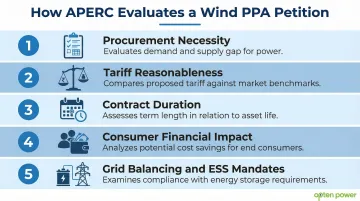
APERC evaluates each PPA petition against five criteria:
- Procurement necessity – Whether the state requires this power to meet its renewable purchase obligations under APERC regulations
- Tariff reasonableness – Whether the proposed rate holds up against CERC benchmarks and the Average Pooled Purchase Cost (APPC)
- Contract duration appropriateness – Typically 25 years for new projects; 15 years for renewals
- Consumer financial impact – Will this PPA increase tariffs for retail consumers?
- Grid balancing or energy storage mandates – Does the project require ESS for peak-hour supply?
Case Study: 400 MW Wind-Solar Hybrid Approval (May 2025)
In O.P. No. 91 of 2024, APERC approved four 100 MW wind-solar hybrid PPAs between APSPDCL and Axis Energy SPVs at ₹4.60/kWh for 25 years. However, APERC imposed strict conditions:
- Minimum 60% Capacity Utilization Factor (CUF) requirement
- Mandatory Energy Storage System (ESS) installation for two-hour peak-hour supply
- 90% contracted capacity availability during peak hours (5–9 AM and 7–11 PM)
- Penalty of 1.5x the PPA tariff for shortfalls
Public hearings drew objections from social activists and political representatives who argued ₹4.60/kWh was excessive against prevailing solar market rates of ₹2–2.50/kWh. For developers, this signals that tariff justification needs to be airtight before petitions reach the Commission.
What APERC Can Modify or Reject
APERC has authority to reshape PPA terms at multiple levels:
- Slash proposed tariffs: In the NALCO case (July 2025), APERC reduced the renewal tariff from ₹2.55/kWh to ₹2.49/kWh
- Reassign REC benefits: APERC stripped REC benefits from NALCO and directed them to the DISCOM to help meet RPO targets
- Impose new conditions: Such as ESS requirements or revised peak-hour definitions
- Mandate benefit-sharing: CDM benefits in the NALCO case were split 90:10 between developer and DISCOM
The Output: Commission Order
A successful APERC approval results in a Commission order that legally validates the PPA terms, sets the final tariff, and directs parties to execute or amend the agreement within a stipulated timeline — typically 30 days.
This order is the legal foundation enabling the DISCOM to pay the generator and the developer to begin commercial operations.
Key PPA Terms You Must Understand: Tariffs, Tenure, Banking, and CUF
Current Tariff Benchmarks in AP
Wind tariffs in Andhra Pradesh vary significantly by project type and vintage:
| Project Type | Tariff Range | Notes |
|---|---|---|
| Standalone wind (generic preferential) | ₹4.25–₹4.84/unit | With/without accelerated depreciation (AP Wind Policy 2015) |
| Wind-solar hybrid (new) | ₹4.60/unit | Axis Energy approval, 2025; requires 60% CUF and ESS |
| Legacy wind renewal | ₹2.49/unit | NALCO renewal, 2025; stripped of REC benefits |
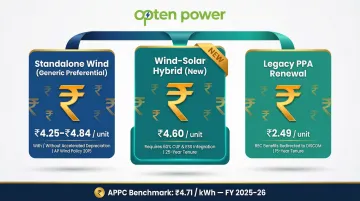
APERC curtailed these generic preferential tariffs in 2018. Today, tariffs are determined case-by-case, guided by CERC frameworks and the state's Average Pooled Purchase Cost (APPC), currently at ₹4.71/kWh for FY2025-26.
Banking Provisions
The AP Wind Power Policy 2015 permits 100% banking of energy across all 12 months, subject to a 2% banking charge (adjusted in kind) and specific drawal restrictions during peak months/hours.
In utility-scale PPAs, APERC draws a sharper line. The Axis Energy ruling established that energy injected between synchronization and COD is treated as deemed banked energy — with APSPDCL holding the option to purchase it at 50% of the APPC for that year.
Two distinctions C&I buyers should keep in mind:
- Captive/self-consumption: Full 100% banking applies under the 2015 policy
- DISCOM-facing arrangements: Pre-COD injections follow different commercial terms, priced at a discount to APPC
Capacity Utilization Factor (CUF) Requirements
Hybrid projects must maintain strict CUF thresholds. APERC mandated a minimum 60% CUF in the Axis Energy PPAs — missing this benchmark triggers penalties at 1.5× the PPA tariff.
For C&I open-access buyers, a developer's projected CUF directly affects energy reliability planning. Opten Power's platform provides real-time project availability data and capacity factor comparisons across developers, so buyers can evaluate delivery reliability before signing a PPA.
Contract Tenure Norms
APERC standardizes contract durations based on project status:
- New wind/hybrid projects: 25 years
- Legacy PPA renewals: 15 years
These tenure norms directly impact financial modeling, IRR calculations, and long-term energy cost planning for C&I buyers.
Recent Regulatory Rulings Reshaping AP Wind PPAs
APTEL's COD Ruling (May 2025)
The Guttaseema Wind Energy case established a critical developer protection. APTEL ruled that the COD for a non-conventional energy project is the synchronization date of the first unit, per Article 1.4 of the PPA.
Developers are now protected from PPA termination when unit-by-unit commissioning delays stem from DISCOM inaction — not developer default. This precedent reduces termination risk for phased wind projects and shifts accountability for synchronization delays squarely onto the utility.
Sharper Scrutiny of Legacy Renewals (NALCO Case, July 2025)
APERC's NALCO ruling signals a tougher stance on legacy PPA renewals:
- Reduced renewal tariff from ₹2.55/unit to ₹2.49/unit
- Stripped REC benefits from the generator and redirected them to the DISCOM
- Mandated CDM benefit sharing (90:10 between developer and DISCOM)
Legacy projects can no longer count on renewal terms matching their original PPA. APERC is now redirecting REC benefits to DISCOMs to help utilities meet escalating RPO targets — a shift developers should price into long-term project economics.
Banking and Peak-Hour Supply Evolution
APERC has redefined peak hours to reflect large-scale solar adoption shifting daytime demand patterns:
- New peak hours: 5–9 AM and 7–11 PM
- Availability mandate: Developers must guarantee 90% contracted capacity during these hours
- ESS requirement: Wind PPA structures now require developers to integrate energy storage to meet peak-hour delivery obligations
For C&I buyers, this adds a due diligence checkpoint: verify that prospective developers have committed to ESS integration and can demonstrate reliable delivery within the revised peak windows before signing.
What C&I Buyers Should Know Before Signing a Wind PPA in AP
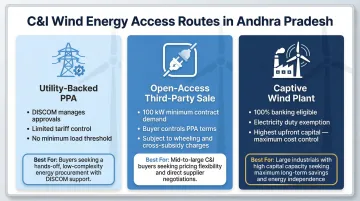
Three Entry Routes for C&I Buyers
1. Utility-backed PPAs: The DISCOM procures wind power and passes it to C&I consumers via tariff. The DISCOM handles all regulatory approvals, but buyers have limited control over tariff and contract terms.
2. Open-access third-party sale: Wind generators sell directly to C&I buyers subject to AP open-access regulations. Under the APERC Green Energy Open Access Regulation 2024, the minimum contract demand is 100 kW (no load limitation for captive consumers). Buyers pay wheeling charges, transmission charges, and cross-subsidy surcharge but gain direct control over PPA terms.
3. Captive wind plants: C&I entities set up wind farms for their own consumption. Eligible for 100% banking and electricity duty exemptions under AP Wind Policy 2015. This route requires the highest upfront capital but offers maximum long-term cost control.
Key Due Diligence Items Before Signing
Before committing to a wind PPA in Andhra Pradesh, verify:
- Valid NREDCAP sanction – Confirm the developer has secured project-level approval
- APERC PPA approval status or timeline – For DISCOM-backed PPAs, ensure the PPA has received Commission approval
- Site validation – Check whether the project site is in a notified wind zone or has a NIWE validation report
- Grid connectivity approval – Confirm AP Transco/DISCOM has approved grid interface
- COD definition clauses – Review contract language in light of the APTEL Guttaseema ruling to protect against termination risk
How Opten Power Supports Wind PPA Procurement in AP
Running these due diligence checks across multiple developers — while tracking shifting DISCOM tariffs and open-access charge revisions — adds significant procurement overhead. Opten Power's marketplace is built to consolidate that process for C&I buyers in AP.
The platform gives buyers:
- Visibility into available wind capacity across AP developers, updated in real time
- Standardized landing prices with DISCOM intelligence for accurate cost benchmarking
- Instant IRR and payback analysis to assess project economics before committing
- Modular RFP templates and pre-approved contract structures to reduce negotiation cycles
- 50% faster deal closure while staying aligned with AP's regulatory requirements
Opten Power covers 4+ GW of renewable capacity across 16 states, with wind and hybrid projects in Andhra Pradesh included — giving buyers a single point of access for procurement, benchmarking, and compliance checks.
Frequently Asked Questions
What is a PPA agreement for wind?
A wind PPA (Power Purchase Agreement) is a long-term contract between a wind energy generator and a buyer (DISCOM or C&I consumer) that fixes the price, volume, and delivery terms for wind-generated electricity, typically spanning 15–25 years. APERC must approve the PPA before commercial operations begin in Andhra Pradesh.
Which Andhra Pradesh regulator approves PPAs for 400 MW wind solar projects?
The Andhra Pradesh Electricity Regulatory Commission (APERC) is the statutory body that approves PPAs between DISCOMs and generators, including large-scale wind-solar hybrid projects. In May 2025, APERC approved the 400 MW Axis Energy wind-solar hybrid PPA at ₹4.6/kWh, demonstrating its authority over utility-scale renewable procurement.
What is NREDCAP's role in wind power projects in Andhra Pradesh?
NREDCAP (New & Renewable Energy Development Corporation of AP) is the state nodal agency for sanctioning wind farm projects. It grants project-level approvals up to 40 MW directly and routes higher-capacity projects to the state government. No PPA with a DISCOM is possible without NREDCAP sanction, making it the mandatory single-window clearance authority.
What tariff can a wind project expect under a PPA in Andhra Pradesh?
Tariffs vary by project type and vintage. The generic preferential tariff for standalone wind is ₹4.25–4.84/unit (with/without accelerated depreciation). Wind-solar hybrid PPAs have been approved at ₹4.60/unit, while legacy renewals have been set at ₹2.49/unit. Final tariffs are always determined by APERC based on CERC norms and prevailing APPC benchmarks.
What happens if a DISCOM refuses to synchronize a commissioned wind project?
Under the APTEL Guttaseema ruling (2025), a developer may seek deemed generation compensation if the DISCOM withholds synchronization approval after units are commissioned. The DISCOM cannot cite its own inaction to terminate the PPA, since COD is legally defined as the synchronization date of the first unit.
What is the difference between a wind PPA and a wind-solar hybrid PPA in AP?
A standalone wind PPA covers power from wind turbines only, while a wind-solar hybrid PPA combines both technologies at a single site for higher CUF (typically 60%+) and more stable supply. APERC increasingly favors hybrid PPAs and may mandate energy storage for peak-hour delivery obligations, as seen in the Axis Energy approval.