Introduction
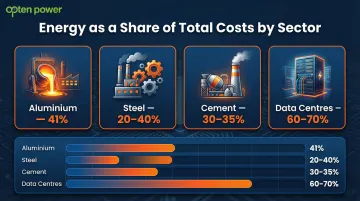
Energy costs for commercial and industrial (C&I) buyers in India have been climbing steadily, driven by DISCOM tariff hikes, cross-subsidy surcharges, and regulatory unpredictability. For energy-intensive sectors, that pressure is structural—not cyclical:
- Power constitutes 41% of total costs in aluminium production
- Energy accounts for 20-40% of steel manufacturing costs
- Fuel and power make up 30-35% of total costs in cement
- For data centres, energy expenses run 60-70% of operational costs
Corporate PPAs have become the preferred procurement mechanism for these buyers because of the specific, measurable financial and operational value they deliver. The sections below cover their structural advantages, the cost of avoiding them, and what makes them work in practice.
Key Takeaways
- Corporate PPAs lock in power at predetermined prices, eliminating dependence on volatile DISCOM tariffs
- Key advantages: predictable long-term costs, zero capital outlay with scalable capacity, and built-in ESG compliance
- Without a PPA, businesses face rising bills, reactive procurement decisions, and mounting RPO compliance exposure
- Early adoption compounds value—the sooner you lock rates, the greater the savings over 15–25 years
- Structured procurement—comparing developers and using platforms with real-time tariff visibility—maximises long-term value
What Is a Corporate PPA?
A corporate PPA (Power Purchase Agreement) is a long-term contract where a C&I energy buyer agrees to purchase electricity directly from a renewable energy developer at a fixed or pre-agreed escalating price, bypassing the standard DISCOM supply chain for that volume of power.
Two Common PPA Structures in India
- Physical PPAs: Deliver actual renewable electricity to your facility via open access. The developer manages generation while the state's open-access infrastructure handles transmission.
- Financial/Virtual PPAs: Settlement-based hedging instruments used in organised markets. No physical energy changes hands — the buyer captures the economic benefit of the renewable price difference along with associated RECs.
Of the two, physical open-access PPAs dominate among large Indian C&I consumers. This model converts electricity from a variable, uncontrollable cost into a predictable contract with known economics over a defined term.
Key Advantages of Corporate PPAs for C&I Buyers
The advantages below are grounded in operational and financial outcomes that C&I procurement, finance, and sustainability teams are actively measured on—not theoretical benefits.
Long-Term Energy Cost Certainty
Under a corporate PPA, the energy price is either fixed for the full term or locked to a pre-agreed annual escalation rate. This insulates the buyer from:
- Grid tariff increases
- Regulatory levies
- Fuel-price passthrough charges that affect DISCOM bills
How this works in practice:
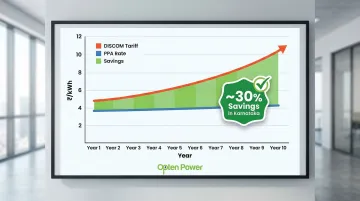
You pay the PPA rate per unit consumed from the contracted source. The gap between this rate and rising DISCOM tariffs becomes a direct, growing saving that compounds year-on-year as grid rates increase.
Historical data shows that grid tariffs increased by approximately 2% annually across key industrial states including Tamil Nadu, Maharashtra, Gujarat, Andhra Pradesh, Karnataka, and Uttar Pradesh. For context, open-access solar PPA landed costs in 2024 ranged between ₹4.3 and ₹7.4 per kWh, while many states' HT industrial tariffs exceeded ₹7 per unit.
C&I consumers in Karnataka, for example, save roughly 30% annually on electricity bills through open-access solar PPAs compared to DISCOM tariffs.
KPIs impacted:
- Energy cost per unit (₹/kWh)
- Electricity as percentage of total OPEX
- Annual energy budget variance
- IRR and payback period on energy procurement decisions
When this advantage matters most:
Heavy industries running continuous or 24x7 operations—steel plants, cement units, process industries, EV manufacturers, and data centres—where even small per-unit savings translate to crore-level annual differences at scale.
Zero Upfront Capital and Access to Utility-Scale Renewable Capacity
Under a corporate PPA, the developer finances, owns, builds, and operates the renewable energy project. The C&I buyer commits to purchasing the output at agreed rates but does not invest any capital in the power plant asset.
You get access to multi-megawatt solar, wind, or hybrid capacity—far exceeding what rooftop installations can deliver—without:
- Diverting capital from core business operations
- Taking construction or commissioning risk
- Ongoing O&M responsibility
Utility-scale solar projects in India typically require capital costs of ₹4.77-6.61 crore per MW, while wind projects range from ₹6.7-9.1 crore per MW. For mid-to-large manufacturers with constrained capex budgets or competing investment priorities, achieving substantial energy cost savings with zero capital deployment is more practical than direct ownership.
The C&I open-access market is scaling rapidly: India added 6.9 GW of solar open access capacity in 2024, a 77% increase over 2023. PPA marketplaces let C&I buyers compare developer tariffs, savings projections, and IRR across multiple projects at once, cutting the time from intent to contracted deal.
KPIs impacted:
- Capex avoidance (₹ crore)
- Project IRR from energy cost savings
- Payback period
- Procurement cycle time
- Energy volume coverage (% of total load met through renewables)
When this advantage matters most:
Medium-to-large industrial units with MW-scale energy requirements who cannot justify rooftop solar coverage for their full load, or who operate across multiple facilities—and for businesses where capital allocation is competitive and locking up funds in power assets is not strategically preferred.
ESG Compliance, RPO Fulfilment, and Brand Credibility
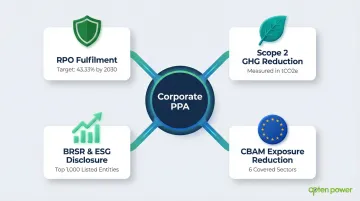
Corporate PPAs generate Renewable Energy Certificates (RECs) or I-RECs tied to every unit of clean energy consumed. These certificates directly support Scope 2 GHG reporting under the GHG Protocol market-based methodology and demonstrate verifiable renewable energy consumption.
PPAs address multiple compliance obligations at once:
- RPO Fulfilment: Satisfies Renewable Purchase Obligations mandated by state electricity regulators
- Carbon Cost Liability: Reduces exposure under evolving frameworks like CBAM for export-oriented businesses
- ESG Framework Alignment: Meets disclosure demands from investors, lenders, and global supply chain partners
The Ministry of Power has set national RPO targets escalating to 43.33% by 2030, up from 29.91% in 2024-25. Non-compliance attracts penalties under Section 26(3) of the Electricity Act. For large open-access consumers, RPO compliance is no longer optional—it's enforceable.
PPAs for new-build renewable projects support credible additionality claims—meaning the buyer is contributing to new clean energy capacity being added to the grid. This distinction is critical for SBTi-aligned targets, BRSR disclosures, and international ESG ratings.
SEBI mandates the top 1,000 listed entities in India to prepare BRSR reports, which require detailed Scope 2 GHG emissions disclosure. For export-oriented manufacturers, CBAM initially covers six sectors: iron and steel, aluminium, cement, fertilisers, electricity, and hydrogen. Steel and aluminium face Scope 1 scrutiny; cement and fertilisers face both Scope 1 and 2.
KPIs impacted:
- Scope 2 carbon emissions (market-based, tCO2e)
- RPO compliance percentage
- ESG disclosure ratings (BRSR, CDP, GRI)
- REC retirement volumes
- Sustainability-linked loan or bond eligibility
When this advantage matters most:
Listed enterprises preparing BRSR or CDP reports, exporters facing EU CBAM exposure, businesses with net-zero or SBTi commitments, and industries under active RPO enforcement—including textiles, IT parks, and commercial complexes where ESG performance is visible to customers and investors.
Taken together, these three advantages explain why corporate PPAs have become the default procurement model for C&I buyers looking to reduce energy costs, preserve capital, and meet compliance obligations without adding balance sheet risk.
What Happens When C&I Buyers Skip Corporate PPAs
C&I buyers who remain entirely on grid supply face escalating per-unit costs with no hedge mechanism. As DISCOM tariffs rise, energy OPEX increases proportionally—and there's no contract in place to absorb the impact.
Without a PPA, most large C&I buyers fall into reactive procurement cycles—renewing supply contracts annually or quarterly. The downstream effects compound quickly:
- No price visibility beyond the immediate term, making multi-year budget planning unreliable
- Constant re-procurement effort from the energy team with nothing to show for it
- Growing RPO shortfalls as renewable sourcing obligations accumulate without a structured plan
- Rising compliance costs each year as project pipelines tighten and pricing benchmarks grow harder to establish
- Reputational exposure in ESG disclosures when renewable procurement gaps can't be explained
Recent enforcement actions illustrate this risk—Maharashtra regulators ordered Amba River Coke Ltd. to meet a shortfall of 70.852 million units by FY26—a signal that regulators are moving from guidance to penalty.
How to Get the Most Value from a Corporate PPA
PPA value is maximised when procurement is treated as a strategic decision supported by structured market intelligence—not a one-time vendor negotiation.
In practice, this means:
- Comparing tariffs, savings projections, and contract terms from multiple developers before committing
- Using real-time DISCOM landing price data to validate true savings against grid costs
- Running IRR and payback analysis against actual load profiles before signing
C&I buyers with multiple PPAs across facilities — or renewals due at different points — need a consolidated view of contracted rates, generation performance, and savings realisation. Reactive management after contracting erodes value; visibility has to be built into the procurement process itself.
What to Look for in a Procurement Platform
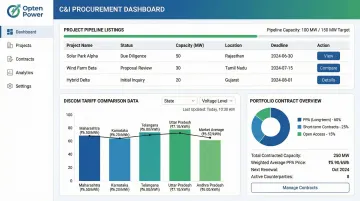
The right platform gives buyers access to a broad project pipeline alongside the analytical tools to compare options objectively. Opten Power, for instance, connects C&I buyers to 4+ GW of solar, wind, and hybrid projects across 16 states, with real-time DISCOM intelligence for standardised price comparisons.
Automated RFP tools on the platform reduce deal timelines by 50%, while a unified portfolio dashboard keeps all renewable energy contracts visible in one place — so procurement teams aren't tracking performance across disconnected spreadsheets or vendor reports.
Conclusion
Corporate PPAs have become standard procurement tools for C&I buyers in India because they solve three concrete problems at once: locked-in tariffs that protect margins over a long horizon, access to large-scale clean power without heavy upfront capital, and ESG and regulatory compliance that Indian industry can no longer defer.
These advantages compound over the contract term. As grid tariffs rise and compliance obligations tighten, the gap between buyers with locked-in renewable rates and those still on grid supply grows wider each year.
Moving from reactive grid dependency to strategic renewable procurement starts with knowing what's actually available: which capacity, at what tariff, and what the savings look like for your load profile. That's the specific problem Opten Power's marketplace solves for C&I buyers across 16 states.
Frequently Asked Questions
What is a PPA in C&I?
A C&I PPA (Power Purchase Agreement) is a long-term contract where a commercial or industrial energy buyer purchases electricity directly from a renewable energy developer at a pre-agreed price, typically through open access—bypassing standard DISCOM tariffs for that volume of power.
What does C&I stand for in energy?
C&I stands for Commercial and Industrial—referring to large-scale non-residential energy consumers such as manufacturers, data centres, hospitals, hotels, IT parks, and warehouses that have significant electricity loads and are eligible for open-access renewable energy procurement.
What is a C&I buyer?
A C&I buyer is a commercial or industrial organisation that purchases electricity at scale—typically above the open-access threshold set by state regulators. Rather than relying solely on the local DISCOM, these buyers procure power directly from generators or through PPAs.
What is the typical tenure of a corporate PPA in India?
Corporate PPAs in India typically run 15–25 years for utility-scale projects, with 10–15 year structures also available based on buyer and developer requirements. Longer tenures generally support lower tariff rates.
What is the difference between a physical PPA and a virtual PPA?
In a physical PPA the buyer receives actual renewable electricity at their facility via open access, while in a virtual (financial) PPA no physical energy changes hands—it is a financial settlement contract where the buyer receives the economic benefit of the renewable energy price difference and the associated RECs.
What are the main risks of a corporate PPA for a C&I buyer?
C&I buyers should account for three key risk areas before signing:
- Project development risk: construction delays or developer financing issues
- Contract complexity risk: long-term terms require thorough legal and commercial review
- Open-access regulatory risk: state-level policy shifts on wheeling charges or banking rules can erode actual savings