Introduction
Indian C&I businesses face a perfect storm: DISCOM electricity tariffs are climbing year after year, global supply chains are demanding ESG accountability, and RPO compliance penalties are no longer theoretical. The Madhya Pradesh Electricity Regulatory Commission recently imposed ₹8,00,000 in penalties on a central entity for eight years of RPO non-compliance—a signal that enforcement is catching up with policy. Renewable energy adoption is no longer optional.
Responding to these pressures requires more than installing solar panels or buying certificates. A corporate renewable energy strategy is a structured framework that aligns energy procurement with financial, sustainability, and operational goals. This guide walks through procurement options, strategy-building steps, execution, and performance reporting.
Key Takeaways
- A corporate renewable energy strategy covers procurement methods, financial modeling, goal-setting, and reporting
- Key options include Corporate PPAs, on-site solar, RECs, and Virtual PPAs—each with different cost, risk, and sustainability profiles
- Effective strategy requires aligning sustainability and finance teams around shared goals
- Structured RFPs, long-term financial models, and cross-team goal integration are core execution requirements
- Common barriers include unclear ROI, slow procurement timelines, and regulatory complexity — each solvable with structured processes
Why Indian Corporations Are Prioritizing Renewable Energy Now
Three forces are pushing Indian businesses toward renewables simultaneously — and none of them are slowing down. Commercial and industrial tariffs from DISCOMs continue to climb: the Madhya Pradesh Electricity Regulatory Commission approved higher tariffs across all consumer categories for FY 2026-27, and similar revisions are advancing in other states. India's national target of 500 GW of non-fossil fuel capacity by 2030 is reinforcing this with regulatory momentum that C&I buyers cannot ignore.
RPO compliance is the second pressure point. State regulators are enforcing obligations more strictly than ever, and non-compliance carries real financial penalties. Beyond avoiding fines, long-term Corporate PPAs offer a direct business case: locking in predictable energy costs against volatile grid tariffs. For energy-intensive industries — steel, cement, textiles, and data centres — that price hedge compounds significantly over a 10–25 year agreement.
The third driver is ESG accountability. As of early 2026, 445 Indian businesses have set or committed to Science Based Targets, and over 15 Indian-headquartered companies are RE100 members — who currently source 39% of their electricity from renewables in India. Global supply chains and institutional investors increasingly require verifiable renewable commitments. For corporates without a documented strategy, the reputational and procurement risk is growing harder to ignore.
Corporate Renewable Energy Procurement Options Explained
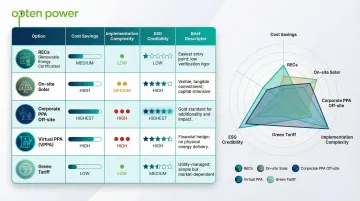
There is no single "right" procurement approach. The best option depends on your energy load profile, risk appetite, capital availability, and sustainability goals. Here are the main options:
Renewable Energy Certificates (RECs)
RECs are the quickest to implement. Companies purchase certificates representing 1 MWh of renewable generation separately from the electricity itself. In early 2026, REC clearing prices on the Indian Energy Exchange and Power Exchange India Limited hovered between ₹333 and ₹360 per certificate.
Key limitation: RECs alone do not demonstrate "additionality"—they don't prove the company directly caused new renewable capacity to be built, which matters for credible ESG reporting.
On-site Solar (Captive Generation)
On-site solar (rooftop or ground-mounted captive plants) generates renewable energy directly at your facility, eliminating transmission and distribution costs. Three models are available:
- Ownership: High upfront CapEx, company owns RECs
- Lease: No upfront cost, pay monthly
- On-site PPA: Developer builds and owns, company buys output
Best for: Warehouses, factories, and IT parks with large roof or land area. On-site solar delivers predictable generation during business hours, a payback period of 3–4 years, and minimal ongoing maintenance.
Corporate Power Purchase Agreements (PPAs) — Off-site
Off-site Corporate PPAs are the most impactful procurement tool for large C&I buyers. These are long-term contracts (typically 15–25 years) with a renewable energy developer to purchase power at a fixed or pre-agreed tariff. Open access rules in India enable this model, allowing buyers to source power from remote renewable projects.
Locking in rates below prevailing DISCOM tariffs is the primary financial draw—though cost advantages are narrowing. In Q4 2025, net landed open access costs ranged from less than ₹5/kWh to ₹8.4/kWh in high-charge states like Maharashtra.
To navigate that variability, Opten Power allows C&I buyers to compare Corporate PPA offers from India's top power producers across 4+ GW of available solar, wind, and hybrid capacity across 16 states—with real-time IRR, payback, and regulatory analysis provided instantly.
Virtual PPAs (Financial PPAs)
VPPAs are financial contracts where the company doesn't physically receive the electricity. Instead, the price difference between the contracted rate and market price is settled financially. In December 2025, the Central Electricity Regulatory Commission notified Guidelines for Virtual Power Purchase Agreements. These establish VPPAs as non-tradable bilateral financial contracts with a minimum one-year duration.
VPPAs remain more common in deregulated Western markets, but the 2025 CERC guidelines make them increasingly relevant for multinationals managing Scope 2 emissions across India operations.
Green Tariff / Utility Green Supply
Green tariffs are utility-offered programs where companies pay a premium to source grid power labeled as renewable. Maharashtra recently slashed its Green Tariff to ₹0.25/kWh for FY26-FY30, making it a highly attractive alternative to complex physical PPAs for immediate Scope 2 claims.
Limitations: Lower additionality, limited availability across Indian states, and less flexibility than direct PPAs.
Each of these options sits at a different point on the cost-complexity-credibility spectrum—understanding that trade-off is what makes an effective procurement strategy.
Building Your Corporate Renewable Energy Strategy: A Step-by-Step Framework
Step 1 — Baseline Your Energy Footprint
Before selecting a procurement approach, audit your current energy consumption by site, load profile (peak vs. baseload), and DISCOM zone. Energy-intensive industries with 24x7 operations (steel plants, data centres, hospitals) have different procurement needs than seasonal or daytime loads (warehouses, commercial complexes).
This baseline also informs Scope 2 emissions reporting. The GHG Protocol Scope 2 Guidance mandates "dual reporting" for companies operating in markets with contractual instruments like India:
- Location-based method: Emissions calculated using the grid average emission factor
- Market-based method: Emissions reflect specific procurement choices, such as PPAs or RECs
Step 2 — Define Your Renewable Energy Goal
Goals must be specific (e.g., "source 50% of electricity from renewables by 2030") and aligned with both corporate sustainability commitments and financial targets. Distinguish between goals that prioritize:
- Cost savings: Focus on near-term, low-risk savings
- Credible emissions reduction (additionality): Requires procurement that demonstrates new renewable capacity was built
- RPO compliance: Driven by regulatory obligations
Each leads to a different procurement strategy.
Step 3 — Evaluate Procurement Options Against Financial and Risk Parameters
Model the financial impact of each option—including long-term price forecasts, weighted average cost of capital (WACC), basis risk (for PPAs), and contract term implications. Key inputs to model include:
- Long-term tariff forecasts and grid price trajectories
- WACC and internal hurdle rates
- Basis risk exposure for PPAs
- Contract term and exit clause implications
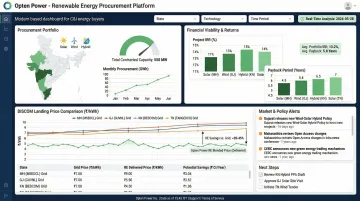
Include finance and treasury teams early, not just sustainability teams, to build a business case that clears internal approval thresholds. Platforms like Opten Power can accelerate this step by delivering real-time DISCOM intelligence, standardized landing prices across states, and instant IRR and payback calculations across multiple developer offers.
Step 4 — Run a Structured RFP Process
Renewable energy procurement, especially for Corporate PPAs, requires a formal RFP process different from standard energy purchasing. Key elements include:
- Defining delivery terms
- Open access route (interstate vs. intrastate)
- Wheeling charges
- Banking provisions
- Contract structure
Without a structured RFP, companies often receive non-comparable bids, leading to poor decisions. Opten Power's Automated Tender Engine addresses this with modular RFP templates, structured bid collection from multiple developers, and pre-approved contract templates—cutting deal closure time by up to 50%.
Step 5 — Secure Internal Alignment and an Executive Sponsor
Successful renewable strategies require buy-in from multiple internal teams—procurement, legal, finance, accounting, CSR/sustainability, and the board. Appoint an executive sponsor early to maintain momentum, resolve budget conflicts, and signal organizational commitment. Timing stakeholder engagement incorrectly (too early or too late) is a common reason renewable programs stall.
Timing stakeholder engagement incorrectly (too early or too late) is a common reason renewable programs stall. With alignment secured, the focus shifts to executing your chosen procurement structure and tracking performance over time.
Executing, Tracking, and Reporting Your Renewable Energy Progress
Execution — Financial Modeling and Contract Management
Once a procurement approach is selected, build detailed financial models projecting costs, savings, and risks across the full contract term (often 15–25 years). For Corporate PPAs, this includes modeling open access charges, wheeling tariffs, DISCOM cross-subsidy surcharges, and any regulatory changes—all of which affect the net savings calculation.
Ongoing contract management—not just signing—is critical to capturing intended value. That gap is visible at scale: as of late 2025, over 45 GW of renewable capacity holding grid connectivity had stalled because long-term PPAs remained unsigned, largely due to slow tariff adoption and approval processes at state distribution companies.
Reporting Frameworks and Credible Claims
Companies reporting renewable energy usage must meet specific credibility standards:
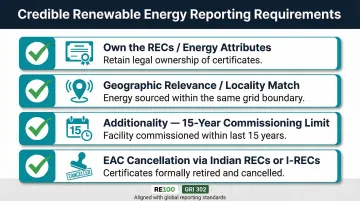
- Owning the RECs/attributes associated with the generation
- Ensuring geographic relevance (locality)
- Demonstrating additionality where required by frameworks like RE100 or GRI
The RE100 Technical Criteria requires that renewable electricity procurement observe a 15-year commissioning or re-powering date limit to ensure additionality. RE100 also requires the cancellation of Energy Attribute Certificates (EACs) in markets where they are in common use—which explicitly includes India, via Indian RECs or I-RECs.
For ESG disclosures, GRI 302 (Energy) requires organizations to report energy consumption by source, distinguishing between renewable and non-renewable inputs.
Indian companies can align with global reporting standards while meeting domestic RPO requirements by ensuring green attributes stay exclusively with them—not double-counted by DISCOMs for their own RPO fulfillment—whether through a Green Tariff or owned RECs.
Integration Across Business Operations
Renewable energy strategy cannot sit only with the energy or sustainability team. Effective integration spans multiple functions:
- Financial reporting — Scope 2 emissions accounting and cost variance tracking
- Procurement policies — embedding renewable sourcing criteria in vendor and capex decisions
- Investor communications — disclosing progress against science-based targets
- Internal alignment — building cross-functional buy-in so sustainability commitments hold across business units
Portfolio Monitoring and Continuous Optimization
Once multiple renewable contracts or assets are in place, companies need a unified view of their portfolio—tracking actual generation vs. contract commitments, cost savings realized vs. projected, and remaining contract obligations. A portfolio management dashboard enables businesses to monitor all renewable energy investments from a single platform, making ongoing optimization and reporting far more manageable.
Common Barriers to Corporate Renewable Energy Adoption and How to Overcome Them
Barrier 1: Unclear or Unapproved Business Cases
Many renewable projects fail to launch internally because the financial model doesn't meet corporate hurdle rates or because sustainability and finance teams are not aligned. The fix is to sequence procurement starting with near-term, low-risk savings (such as on-site solar on a lease or PPA model) before layering in longer-term commitments like 25-year off-site PPAs.
A practical three-stage approach works well for most organizations:
- Start with energy efficiency measures to reduce baseline consumption
- Layer in cost-saving options like onsite solar or community solar
- Add complex instruments like VPPAs once the foundation is in place
Barrier 2: Regulatory Complexity and State-Level Variation
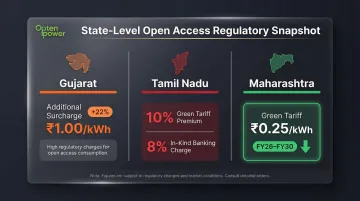
In India, renewable energy procurement is governed by a patchwork of state-specific open access regulations, DISCOM policies, banking rules, and RPO frameworks that vary significantly. For example:
- Gujarat increased its Additional Surcharge by 22% to ₹1.00/kWh
- Tamil Nadu introduced a 10% premium for Green Tariff and an 8% in-kind banking charge
- Maharashtra slashed its Green Tariff to ₹0.25/kWh for FY26–FY30
This complexity often causes procurement delays or poorly structured deals. Platforms that track real-time DISCOM landing prices and regulatory changes across states help procurement teams evaluate options accurately — without waiting on consultants or sifting through state commission orders manually.
Barrier 3: Slow and Fragmented Procurement Processes
Traditional renewable energy procurement involves manual RFPs, multiple developer conversations, non-standardized contracts, and long negotiation cycles. Automated RFP tools with pre-approved contract templates solve this directly — collecting structured bids from multiple developers, aligning on contract terms faster, and cutting the time from discovery to deal closure by up to 50%.
Frequently Asked Questions
What is the corporate renewable energy scheme?
A corporate renewable energy strategy is a structured framework through which businesses plan, procure, and manage their transition to renewable energy sources. It covers goal-setting, procurement options (PPAs, RECs, on-site solar), financial modeling, and sustainability reporting.
What are the main types of corporate renewable energy procurement?
The four key options are Renewable Energy Certificates (RECs), on-site solar (captive), off-site Corporate PPAs, and Virtual PPAs. In India, physical open-access PPAs and captive solar are the most widely used routes, with Virtual PPAs less common due to regulatory structure.
What is a Corporate PPA and how does it benefit businesses?
A Corporate Power Purchase Agreement is a long-term contract with a renewable developer to buy power at a fixed tariff, offering cost savings against prevailing DISCOM tariffs, long-term price certainty, and credible sustainability credentials.
How long does it take to implement a corporate renewable energy strategy?
The timeline varies by approach. On-site solar PPAs can close in weeks to months, while off-site Corporate PPAs typically take 6–18 months from RFP to contract execution, depending on regulatory approvals, capacity availability, and internal alignment.
What is the difference between on-site and off-site renewable energy procurement?
On-site procurement means generating renewable energy at the company's own facility (e.g., rooftop solar), while off-site procurement involves sourcing power from a remote renewable project via open access or a PPA. Off-site routes typically offer greater scale; on-site suits facilities with sufficient rooftop area and lower load requirements.
How do companies report renewable energy usage for ESG and RPO compliance?
Companies must retain the renewable energy attributes (RECs) from their procurement, ensure geographic and vintage compliance with reporting frameworks (GRI, RE100), and meet state-specific RPO obligations. Market-based Scope 2 reporting is only credible when backed by valid, retired RECs matched to the correct period and geography.