Introduction
Indian businesses are facing mounting regulatory and commercial pressure to demonstrate environmental accountability. Listed companies in the top 1,000 by market capitalisation must now file the Business Responsibility and Sustainability Report (BRSR) under SEBI regulations, with BRSR Core assurance being phased in for the top 250 entities from FY 2024-25.
Beyond regulatory mandates, global supply chain partners and investors are demanding verifiable proof of renewable energy use — particularly in energy-intensive sectors like manufacturing, steel, cement, and data centres.
Renewable Energy Certificates (RECs) have emerged as the primary instrument for substantiating these claims in ESG reports. Without properly retired RECs, even businesses already using renewable power cannot make credible green energy claims or report reduced Scope 2 emissions under internationally recognised frameworks.
This guide explains how certified renewable energy instruments work, why they're mandatory for audit-grade ESG reporting, and how Indian businesses can procure and retire them effectively.
Key Takeaways
- RECs represent the environmental attributes of 1 MWh of renewable electricity — the basis for any credible green power claim
- Under the GHG Protocol's market-based method, retiring RECs matching your electricity consumption allows reporting zero Scope 2 emissions
- Procurement options include RPO compliance markets, I-RECs for voluntary reporting, and Corporate PPAs with bundled environmental attributes
- Proper retirement in a recognised registry prevents double-counting and ensures audit-grade ESG reporting
- BRSR-compliant companies must document renewable energy use with verifiable, certified evidence
What Is Certified Renewable Energy for ESG Reporting?
Understanding Renewable Energy Certificates
When a renewable energy facility generates 1 MWh of electricity and delivers it to the grid, two distinct products are created: the physical electricity itself and the environmental attributes of that generation. A Renewable Energy Certificate (REC) captures these environmental attributes in a tradable, trackable instrument.
Under CERC REC Regulations 2022, one domestic Indian REC represents 1 MWh of renewable electricity. Similarly, the I-REC Standard defines 1 I-REC(E) as 1 MWh of renewable generation. Both carry the same fundamental principle: they certify that renewable energy was generated and delivered to the grid.
Why Certification Matters
Because electricity on a shared grid is physically indistinguishable by source, RECs are the only accepted mechanism to assign and prove renewable energy ownership. Without a certified, retired REC, a company cannot make credible green power claims — even if renewable energy is flowing through the grid.
SEBI has issued strict guidance on preventing greenwashing in green debt securities, defining it as making unsubstantiated or misleading sustainability claims. Certified RECs provide the audit trail that distinguishes legitimate renewable energy use from unverifiable marketing claims.
Key Data Attributes in a REC
That audit trail depends on the structured data each REC carries. These attributes are what ESG auditors verify when assessing Scope 2 emission claims:
- Source type — solar, wind, hydro, or biomass
- Generation location — state and facility name
- Vintage — the month and year of generation
- Unique serial number — prevents duplication
- Registry — the platform where the REC is tracked and retired
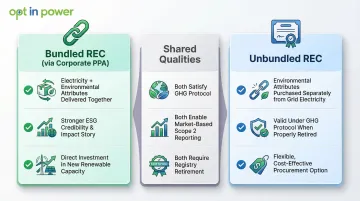
Bundled vs. Unbundled RECs
The GHG Protocol Scope 2 Guidance recognises two types of renewable energy procurement:
| Type | How It Works | ESG Standing |
|---|---|---|
| Bundled REC | Sold with associated electricity via a Corporate PPA — buyer receives physical power and environmental attributes together | Strong: demonstrates direct financial support for new renewable capacity |
| Unbundled REC | Purchased separately from grid electricity — buyer claims environmental attributes of renewable generation elsewhere | Valid: accepted under GHG Protocol when properly retired |
Both instruments satisfy ESG reporting requirements. Bundled RECs through PPAs carry more weight because they demonstrate direct investment in renewable energy development, not just attribute procurement.
Indian and International Registry Landscape
Two primary registry systems operate in India:
| Registry Type | Operating Body | Purpose |
|---|---|---|
| Domestic REC | NLDC/POSOCO via recregistryindia.nic.in | Compliance with RPO obligations |
| I-REC Standard | ICX Private Limited (India Issuer) via evident.app | International ESG frameworks (CDP, GRI, SBTi) |
For companies reporting to international frameworks or responding to global supply chain requirements, I-RECs are the preferred instrument. The I-REC Standard operates in over 60 countries, providing a globally recognised certification system.
How Certified RECs Fit into GHG Protocol and ESG Frameworks
Understanding Scope 2 Emissions
The GHG Protocol divides corporate emissions into three scopes. For most commercial and industrial businesses — especially energy-intensive operations like manufacturing plants, data centres, and IT parks — Scope 2 (purchased electricity) represents the largest and most actionable share of their carbon footprint.
Scope 2 emissions can be calculated using two methods:
- Location-based method: Uses the average emissions factor of the regional grid. This reflects the carbon intensity of the electricity grid where you operate, regardless of your specific procurement choices.
- Market-based method: Reflects your specific energy procurement choices. When you retire RECs matching your electricity consumption, you can report market-based Scope 2 emissions based on the renewable energy attributes you've purchased.
RECs enable the market-based method. When you retire enough RECs to match your annual electricity consumption, you can report market-based Scope 2 emissions as zero.
GHG Protocol Quality Criteria for RECs
Not all RECs qualify for Scope 2 reporting. The GHG Protocol establishes eight Scope 2 Quality Criteria that RECs must meet:
- Market boundary matching — RECs must be sourced from the same country or grid region where electricity is consumed. CDP explicitly states that national borders define the market boundary for India, meaning RECs generated outside India cannot cover Indian electricity consumption
- Vintage matching — REC generation year should align with the reporting year. CDP recommends a 21-month window: certificates generated within six months prior to the reporting year, during the reporting year, or within three months following
- No double-counting — RECs must be retired in the company's name in a recognised registry, creating an auditable record that prevents multiple parties from claiming the same renewable generation
- Unique tracking — Each REC must have a unique serial number and be tracked through issuance to retirement
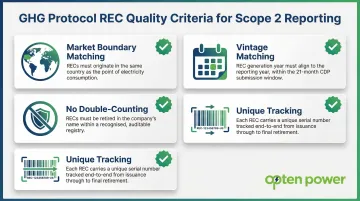
Meeting these criteria matters because the GHG Protocol also mandates "dual reporting" — companies in markets with contractual instruments must report Scope 2 emissions using both methods:
Dual Reporting Requirement
- Location-based figure — shows the grid average emissions
- Market-based figure — shows your specific procurement choices
This dual reporting provides transparency. Stakeholders can see both the carbon intensity of your local grid and the impact of your renewable energy procurement decisions.
RECs in ESG Frameworks Beyond GHG Protocol
Certified RECs support the 'E' in ESG across multiple reporting frameworks:
BRSR (Business Responsibility and Sustainability Report): SEBI's Annexure I BRSR Core format requires companies to disclose energy consumed through renewable sources as a percentage of total energy. While SEBI doesn't explicitly mandate specific REC types, the framework requires verifiable data subject to reasonable assurance.
GRI 302 (Energy): Requires reporting total electricity consumption and fuel consumption from renewable sources, which RECs substantiate.
CDP Climate Disclosures: Explicitly accepts both Indian RECs and I-RECs as valid tracking instruments for Scope 2 market-based reporting.
Science-Based Targets initiative (SBTi): Allows RECs to reduce Scope 2 market-based emissions, provided they meet market boundary and quality criteria.
RECs vs. Carbon Offsets: Critical Distinction
RECs and carbon offsets are not interchangeable. The GHG Protocol makes this explicit:
RECs represent 1 MWh of renewable electricity generation and address Scope 2 (purchased electricity) emissions using the market-based method.
Carbon offsets represent 1 metric tonne of CO₂ avoided or removed and can address Scope 1, 2, or 3 emissions. They compensate for emissions rather than representing renewable electricity attributes.
A MWh of renewable generation can produce either an energy attribute certificate or an offset credit — never both. Substituting offsets for RECs to claim renewable electricity use violates GHG Protocol guidelines — a distinction auditors and CDP reviewers flag routinely during ESG disclosures.
Types of Certified Renewable Energy Instruments Available in India
Compliance RECs (RPO Market)
India's Renewable Purchase Obligation (RPO) requires electricity distribution companies and large open-access consumers to source a mandated percentage of power from renewable sources. Domestic RECs issued under SERC regulations fulfil this compliance requirement.
The Ministry of Power notified national RPO targets through 2029-30:
| Year | Wind RPO | Hydro RPO | Distributed RE | Other RE | Total RPO |
|---|---|---|---|---|---|
| 2024-25 | 0.67% | 0.38% | 1.50% | 27.35% | 29.91% |
| 2025-26 | 1.45% | 1.22% | 2.10% | 28.24% | 33.01% |
| 2029-30 | 3.48% | 1.33% | 4.50% | 34.02% | 43.33% |
These compliance RECs are traded through power exchanges (IEX and PXIL) and tracked through the POSOCO registry. They satisfy domestic regulatory obligations — but for businesses reporting to global ESG frameworks, they often fall short of what international standards require.
Voluntary RECs: I-RECs and International Instruments
Where compliance RECs stop, I-RECs begin. These voluntary market instruments allow Indian renewable generators to issue certificates that Indian businesses can retire for international ESG disclosures. The I-REC Standard operates in over 60 countries, providing globally recognised certification.
ICX Private Limited, a subsidiary of the Indian Energy Exchange, serves as the local I-REC(E) Issuer in India. I-RECs are increasingly required by global supply chains and multinational parent companies reporting under GHG Protocol, CDP, and SBTi.
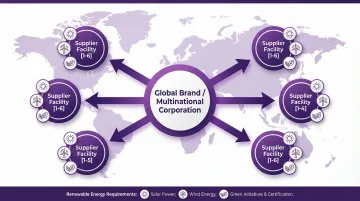
For Indian manufacturers supplying to companies like Apple (which mandates 100% renewable electricity across its supply chain by 2030) or H&M Group (targeting 50% renewable electricity in supply chain manufacturing by 2030), I-RECs provide the internationally recognised certification these buyers require.
Corporate PPAs with Bundled RECs
A Corporate Power Purchase Agreement (PPA) is a long-term contract directly between an industrial buyer and a renewable energy developer. Both the electricity and the RECs are bundled together in a single transaction.
PPAs offer several advantages:
- Cut energy costs by up to 40% compared to DISCOM tariffs — typically the most economical route for large C&I consumers
- Carry stronger credibility than unbundled RECs, as bundled instruments are viewed as more robust renewable claims
- Lock in long-term price certainty, protecting against grid tariff volatility
- Directly finance new renewable energy development, strengthening additionality claims
For businesses looking to act on these advantages, Opten Power's marketplace lets Indian C&I buyers compare Corporate PPA options spanning 4+ GW of solar, wind, and hybrid projects across 16 states — with real-time tariff comparisons and automated RFP tools that close deals 50% faster.
Step-by-Step: How to Obtain Certified Renewable Energy for Your Business
Step 1: Measure Your Electricity Baseline
Calculate total electricity consumption (in MWh) across all facilities for the reporting year. This forms your Scope 2 inventory baseline and determines the volume of RECs needed.
Gather electricity bills across all facilities and sum total consumption. The REC volume you need scales directly with your coverage target:
- 100% renewable: RECs needed = total annual MWh consumption
- Partial coverage (for example, 50%): calculate the proportional MWh volume accordingly
Step 2: Choose Your Procurement Route
Three primary routes are available, each suited to different consumption profiles and ESG timelines:
- Unbundled I-RECs (registry or broker): Fastest path to certification. Purchase directly through the I-REC registry or authorised brokers without changing your electricity supply. Best for businesses needing immediate ESG coverage.
- Corporate PPA with bundled RECs: Long-term contract with a renewable developer that packages electricity delivery with environmental attributes. Delivers price certainty, potential cost savings, and the strongest renewable claim. Suited to large C&I consumers with stable demand.
- Open-access renewable power: Direct procurement of renewable electricity where state regulations permit, though applicable surcharges apply. Offers flexibility for businesses in supportive regulatory environments.
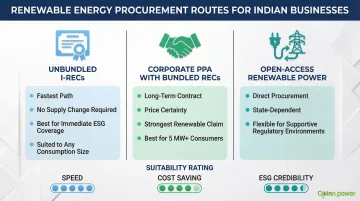
Your consumption volume is the most practical starting filter. Businesses exceeding 5 MW typically find Corporate PPAs most cost-effective; smaller consumers or those with urgent reporting deadlines often start with unbundled I-RECs.
Platforms like Opten Power enable businesses to compare options across all three routes, with real-time tariff comparisons, instant IRR and payback calculations, and automated RFP tools that cut deal timelines significantly.
Step 3: Retire RECs in Your Name
Retirement is the critical, non-negotiable step. The REC must be retired (cancelled) in your company's name within a recognised registry — either the I-REC registry via evident.app or the POSOCO registry for domestic RECs.
Retirement prevents double-counting and creates the auditable paper trail ESG auditors require. The retirement certificate must explicitly state:
- Company name (as the beneficial owner)
- MWh volume retired
- Vintage year (generation period)
- Renewable source type (solar, wind, etc.)
- Unique serial numbers of retired RECs
Without formal retirement documentation, you cannot make valid renewable energy claims in ESG reports, regardless of whether RECs were purchased.
Step 4: Disclose in Your ESG Report
Your ESG report should clearly state:
- Number of RECs retired (in MWh)
- Registry used (I-REC or POSOCO)
- Vintage year (matching reporting period)
- Renewable source type breakdown (solar, wind, hybrid)
- Market-based Scope 2 emissions figure (calculated using retired RECs)
- Location-based Scope 2 emissions figure (for dual reporting)
Auditors will cross-check retirement records in the registry against reported figures. Keep retirement certificates, procurement contracts, and consumption records organised in one place — auditors will request all three.
Strategic Business Benefits and Common Pitfalls
Business Benefits
Certified renewable energy procurement delivers three concrete advantages for Indian businesses:
- Green finance access: India's sustainable debt market hit ₹55.9 billion by end of 2024 — a 186% increase since 2021. Sustainability-linked loans from banks and development finance institutions require demonstrable ESG performance, and retiring RECs directly improves the Scope 2 scores used in credit assessments. Recent deals include AdaniConneX's ₹875 million sustainability-linked loan and Tata Power's ₹320 million facility tied to renewable additions.
- Supply chain positioning: Global buyers are pushing Scope 3 requirements onto Indian suppliers. Apple mandates 100% renewable electricity across its manufacturing supply chain by 2030; H&M Group targets 50% by 2030 and 100% by 2040. For manufacturers in textiles, automotive, and electronics, certified renewable procurement is increasingly a contract requirement, not a differentiator.
- Investor and auditor credibility: Transparent ESG data backed by retired RECs strengthens investor relations. As BRSR Core assurance expands to India's top 1,000 listed entities by FY 2026-27, third-party verification of renewable energy claims shifts from best practice to legal obligation.
Common Pitfalls
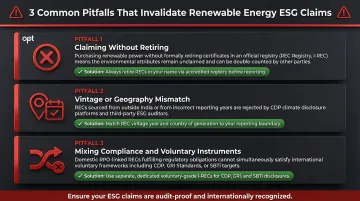
Three errors consistently undermine otherwise credible renewable energy claims:
Claiming without retiring RECs — Buying renewable electricity from the grid or installing rooftop solar does not automatically create a valid ESG claim. Under SEBI's greenwashing guidance, the environmental attributes must be formally retired in your company's name. Without that, the same attributes can be claimed by others.
Vintage or geography mismatches — RECs generated outside India cannot cover Indian electricity consumption under GHG Protocol quality criteria, and RECs from 2020 cannot cover 2024 consumption. CDP and third-party auditors will reject claims that fail these matching requirements, invalidating your entire Scope 2 market-based calculation.
Mixing compliance and voluntary instruments — Domestic RPO RECs satisfy regulatory obligations but often fall short of international ESG framework requirements. Companies reporting to CDP, GRI, or SBTi — or responding to global supply chain questionnaires — typically need I-RECs to ensure the claim holds up internationally.
Frequently Asked Questions
How to obtain a renewable energy certificate?
In India, RECs can be obtained through the domestic REC market via power exchanges (IEX or PXIL) under SERC regulations, or through the I-REC registry for internationally recognised certificates. Corporate PPAs with renewable developers also generate bundled RECs as part of the electricity supply contract.
What is ESG in renewable energy?
ESG in renewable energy refers to how a company's use of certified renewable power addresses the Environmental pillar of ESG — specifically by reducing Scope 2 emissions using instruments like RECs that are verifiable, reportable, and auditable under frameworks such as GHG Protocol and GRI.
Are RECs worth it?
For companies with mandatory ESG disclosure obligations (such as BRSR for listed companies) or supply chain pressure from global buyers, RECs offer a cost-effective, immediate way to substantiate renewable energy claims. Pair them with direct procurement options like PPAs for a more complete strategy.
What is the difference between RECs and carbon offsets?
RECs represent 1 MWh of renewable electricity generation and address Scope 2 (purchased electricity) emissions under the market-based method. Carbon offsets represent 1 metric tonne of CO₂ avoided or removed and can address Scope 1, 2, or 3 emissions. The two instruments are not interchangeable.
Can RECs reduce my Scope 2 emissions to zero?
Yes — under the GHG Protocol's market-based method, retiring RECs matched to your total annual consumption (by volume, vintage, and market boundary) lets you report market-based Scope 2 emissions as zero. The location-based figure must still be disclosed separately under dual reporting.
What are I-RECs and how are they used in India?
I-RECs are issued under the I-REC Standard, a globally recognised framework operational in 50+ countries, including India. They are the preferred instrument for Indian businesses reporting to international frameworks like CDP, GRI, or SBTi, given their tracking and retirement in an internationally accepted registry.