The energy landscape in India has fundamentally changed. Under the country's open access framework, businesses now have real choices: negotiating directly with renewable developers, accessing competitive power markets, or structuring group captive arrangements that can reduce costs by up to 40%. This blog walks you through the fundamentals of energy procurement — the structured process of planning, negotiating, and contracting your electricity supply — so you can make smarter, more strategic energy decisions.
TLDR:
- Energy procurement is the strategic process of sourcing and contracting electricity supply, not just paying utility bills
- India's open access framework gives C&I buyers real alternatives to expensive DISCOM tariffs
- The procurement process includes auditing consumption, monitoring markets, issuing RFPs, and comparing supplier offers
- Contract types range from fixed-price certainty to index-based flexibility and long-term corporate PPAs
- Digital marketplaces like Opten Power enable real-time comparison of 4+ GW of renewable capacity across 16 states
What Is Energy Procurement and Why Does It Matter?
Energy procurement is the structured process by which businesses plan, negotiate, and contract for their electricity and fuel supply. It's fundamentally different from passively paying a utility bill each month — procurement is an active, strategic function that treats energy as a negotiable commodity rather than a fixed cost.
For C&I businesses, unmanaged energy spend creates three major problems:
- Overpaying for power — Without competitive procurement, you accept whatever tariff your DISCOM sets, which is typically the most expensive option for medium-to-large consumers
- Budget unpredictability — DISCOM tariffs fluctuate with regulatory revisions, fuel costs, and cross-subsidy adjustments, making financial planning difficult
- Missed savings opportunities — Businesses that don't actively procure miss out on renewable PPAs, group captive models, and open access arrangements that can deliver 20-40% savings
According to industry research, energy costs represent 15-25% of total operating expenses for industrial businesses in sectors like steel, cement, textiles, and chemicals. For a mid-sized manufacturer spending ₹10 crore annually on electricity, a 30% reduction through strategic procurement translates to ₹3 crore in annual savings — capital that can fund expansion, R&D, or improved margins.
The Indian Context: From DISCOM Dependency to Competitive Procurement
India's electricity sector has transformed since the Electricity Act, 2003 established the legal framework for open access. This legislation granted consumers and generators the right to use transmission and distribution networks, breaking the DISCOM monopoly on power supply.
The Green Energy Open Access (GEOA) Rules, 2022 accelerated this shift by reducing the eligibility threshold from 1 MW to just 100 kW — opening renewable procurement to thousands of mid-sized C&I consumers previously excluded from the market. For captive consumers, there is no load limitation at all.
Today, Indian C&I buyers can choose from three primary procurement pathways:
- Open access — Purchase power from third-party generators using the DISCOM's distribution network
- Group captive — Co-invest in a renewable project with other consumers and receive power at cost
- Third-party PPAs — Contract directly with a renewable developer for long-term supply
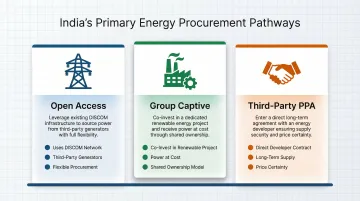
Procurement has moved well beyond utility administration. It now directly shapes competitiveness, sustainability credentials, and profitability.
Energy Procurement vs. Energy Management
While related, these are distinct functions:
| Energy Procurement | Energy Management | |
|---|---|---|
| Focus | Sourcing and contracting supply | Consumption efficiency |
| Activities | Selecting suppliers, negotiating tariffs, managing compliance | Optimizing equipment, reducing peak demand, automating monitoring |
| Core question | Where do we buy power, at what price, and under what terms? | How do we use less energy, and use it more efficiently? |
Procurement must come first. Even the most efficient facility overpays if locked into an uncompetitive supply contract.
How the Energy Procurement Process Works
Effective energy procurement follows a structured, five-stage process. Each stage builds on the last — moving from understanding your consumption to locking in contracts that actually hold up as regulations shift.
Step 1 — Audit and Understand Your Consumption
Procurement begins with a thorough analysis of your load profile: when you use energy, how much you consume, and how usage varies by season, day, and hour. Suppliers price contracts based on your consumption patterns, so understanding your profile is essential to securing competitive rates.
Key data points to collect:
- Monthly consumption (kWh) — Total units consumed each month for the past 12-24 months
- Peak demand (kW) — Your highest recorded demand, which drives capacity charges
- Load factor — The ratio of average to peak demand, indicating how consistently you use power
- Time-of-use patterns — Whether consumption is concentrated during peak hours or distributed evenly
Businesses with high, consistent load factors (manufacturing plants running 24/7) typically secure better rates than those with spiky, unpredictable consumption (commercial complexes with weekend closures).
Step 2 — Monitor Market Drivers
Electricity prices shift constantly — driven by fuel supply forecasts, grid infrastructure changes, regulatory policy, seasonal demand, and weather events. Businesses must either track these drivers themselves or work with a market-aware advisor.
Key market factors to monitor:
- Fuel costs — Coal, natural gas, and renewable energy certificate (REC) prices
- Regulatory changes — SERC tariff orders, cross-subsidy surcharge revisions, banking rule updates
- Seasonal demand cycles — Monsoon impacts on hydro availability, summer cooling loads
- Grid constraints — Transmission congestion, curtailment risks in high-renewable states
For example, the Karnataka High Court recently ruled that the Central Government lacks authority to frame open access rules, reaffirming state-level regulatory control. Such rulings directly impact procurement viability and must be factored into contract decisions.
Step 3 — Define Objectives and Risk Tolerance
Every procurement decision involves a trade-off between price certainty and cost flexibility. Organizations must define their priorities before approaching suppliers:
- Can you tolerate monthly tariff fluctuations, or do you need fixed pricing for financial planning?
- Do ESG commitments require a minimum percentage of renewable supply?
- Can you shift load during high-price periods, or do you need 24/7 baseload supply?
- Are you willing to accept price volatility in exchange for potential savings, or does your operation demand certainty?
A data centre with 24/7 uptime requirements and strict budget forecasts will prioritize fixed-price certainty. A textile mill with flexible shift scheduling might prefer index-based contracts that allow load shifting during low-price hours.
Step 4 — Issue RFPs and Compare Supplier Quotes
The request-for-proposal (RFP) process invites competitive bids from multiple suppliers or developers. The key is comparing quotes on a like-for-like basis — same contract terms, same regulatory charges included — to avoid hidden costs.
Critical elements to standardize across bids:
- Contract duration — 1 year, 3 years, 10 years, or 25 years
- Price structure — Fixed, indexed, or hybrid
- Regulatory pass-throughs — Are wheeling charges, cross-subsidy surcharges, and transmission costs included or extra?
- Banking provisions — Can you bank surplus generation, and at what cost?
- Exit clauses — What are the penalties for early termination or under-consumption?
Without standardized RFPs, you may compare a ₹4.50/unit quote that excludes ₹1.20 in surcharges against a ₹5.20/unit all-inclusive offer — and end up choosing the more expensive option.
Step 5 — Contract, Implement, and Review
Signing a contract is not the end of procurement — it's the beginning of contract management. Businesses should:
- Monitor actual vs. contracted consumption — under-consumption can trigger penalties; over-consumption may require spot market purchases at higher rates
- Track regulatory changes — SERC open access charge revisions can materially impact landed costs mid-contract
- Review contracts before renewal — auto-rollover clauses often lock you into unfavourable rates; proactive review 6-12 months before expiry ensures competitive renewal terms
The businesses that consistently pay less for energy aren't just better negotiators — they treat every contract expiry as a new opportunity to reassess the market and renegotiate from a position of data.
Key Energy Procurement Contract Types
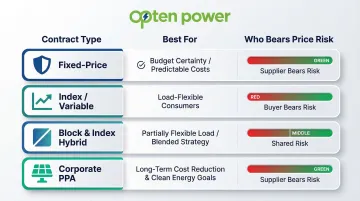
The four main contract structures in energy procurement differ primarily in how price risk is shared between buyer and supplier. Understanding each helps you match the right structure to your consumption profile and risk appetite.
| Contract Type | Best For | Who Bears Price Risk |
|---|---|---|
| Fixed-Price | Budget certainty | Supplier |
| Index/Variable | Load-flexible consumers | Buyer |
| Block & Index (Hybrid) | Partially flexible load | Shared |
| Corporate PPA | Long-term cost reduction + clean energy | Largely Supplier |
Fixed-Price Contracts
The business pays a set rate per unit for the entire contract duration — typically 1-3 years for conventional power, 10-25 years for renewable PPAs. This structure suits organizations that prioritize budget certainty and want full protection from market volatility. If market prices rise, you're protected; if they fall, you don't benefit.
Example: A hospital contracts for power at ₹5.00/unit for three years. Even if DISCOM tariffs rise to ₹6.50/unit in year two, the hospital continues paying ₹5.00.
Index/Variable-Price Contracts
The price tracks a market index — such as IEX spot rates or fuel price indices — and adjusts monthly or quarterly. This works best for large consumers who can actively shift load during peak pricing windows to capture lower rates. The buyer absorbs 100% of price risk: you benefit when prices fall but pay more when they rise.
Example: An aluminium smelter with flexible production scheduling purchases power indexed to IEX day-ahead prices, running at full capacity during low-price overnight hours and reducing load during peak afternoon pricing.
Block & Index (Hybrid) Contracts
A portion of supply (typically 60-80%) is purchased at a fixed rate, while the remainder floats with market prices. Risk is shared: you gain budget certainty for baseload while retaining upside exposure for flexible load. This suits businesses with partially predictable but adjustable consumption.
Example: A cement plant contracts 70% of its consumption at ₹4.80/unit fixed and 30% indexed to market rates, capitalizing on low off-peak prices for discretionary grinding operations.
Corporate Power Purchase Agreements (PPAs)
A Corporate PPA is a long-term direct contract between a business and a renewable energy developer — typically 10-25 years for solar or wind projects. It's the preferred structure for Indian C&I businesses seeking tariff stability alongside clean energy credentials.
Corporate PPAs deliver significant cost advantages. Research shows that renewable PPAs in India can deliver savings of 20-40% versus DISCOM tariffs, particularly in states with high commercial and industrial tariffs. For a manufacturer currently paying ₹7.50/unit to the DISCOM, a solar PPA at ₹4.50/unit represents a 40% reduction — translating to ₹3 crore in annual savings for a 1 MW consumer.
PPAs also provide a hedge against regulatory tariff increases, as the contracted rate remains fixed while DISCOM tariffs typically rise 5-8% annually.
Building Your Energy Procurement Strategy
A procurement strategy is a living plan — one that aligns your sourcing decisions with current business realities and adapts as those realities shift.
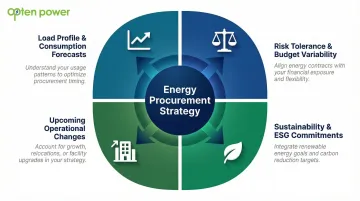
Every effective strategy accounts for four key inputs:
1. Load profile and consumption forecasts: Historical usage patterns and projected growth. A business planning a 30% capacity expansion next year cannot lock into a fixed-volume contract based on current consumption.
2. Risk tolerance and budget variability limits: How much month-to-month tariff fluctuation can your finance team absorb? Organizations with tight cash flow may prioritize certainty even if it means paying a small premium over variable pricing.
3. Upcoming operational changes: Plant expansions, new facilities, equipment upgrades, or production shifts directly affect energy requirements. A three-year fixed contract offers savings but creates inflexibility if operations change mid-term.
4. Sustainability and ESG commitments: If your organization has RPO compliance obligations or has committed to 50% renewable energy by 2026, your procurement strategy must prioritize renewable PPAs and group captive structures over conventional power, even where the immediate cost difference is marginal.
Aligning Contract Duration with Business Planning Cycles
Contract duration creates a fundamental trade-off between price stability and operational flexibility:
- Longer contracts (10-25 years): Maximize savings and price certainty but reduce flexibility. Best for stable operations with predictable long-term demand.
- Medium contracts (3-5 years): Balance savings and flexibility. Suitable for businesses with moderate growth expectations.
- Shorter contracts (1-2 years): Prioritize flexibility over maximum savings. Ideal for businesses in transition or facing regulatory uncertainty.
A pharmaceutical company planning a major facility upgrade in three years should avoid locking into a 10-year fixed-volume PPA today, as the contract may not align with post-upgrade consumption patterns.
Integrating Demand-Side Measures
Demand-side measures directly affect how much supply you need to procure. Common examples include:
- Energy efficiency projects that reduce baseline consumption
- Rooftop solar that offsets daytime grid draw
- Demand response programs that shift or shed peak load
If you plan to reduce peak load by 20% through efficiency upgrades, structure your supply contract to capture that saving rather than locking in previous consumption volumes. Installing rooftop solar that covers 30% of daytime load, for instance, drops your open access requirement from 1 MW to 700 kW. Your PPA should reflect this reduced offtake — otherwise you're paying for power you don't need.
Three Ways Businesses Can Buy Energy in India
Indian C&I buyers have three primary channels for sourcing electricity, each with distinct advantages and limitations.
Option 1 — Default DISCOM Supply
Staying with your state distribution company is the path of least resistance but typically the most expensive option for medium-to-large consumers.
- No procurement effort required — power is supplied automatically
- Tariffs are not customized to your consumption profile
- Rates fluctuate with regulatory revisions, often increasing 5-8% annually
- Zero room for negotiation or contract customization
Best for: Small consumers (below 100 kW) for whom open access administrative burden outweighs potential savings, or businesses in states where open access surcharges make alternatives uneconomical.
Typical cost: ₹6.50-₹10.00/unit for C&I consumers in most states.
Option 2 — Energy Brokers and Consultants
Brokers source quotes from multiple suppliers on your behalf, saving time and drawing on market relationships.
What brokers do well:
- Reduce procurement workload by handling RFP creation, bid collection, and negotiation
- Provide access to supplier networks and market intelligence
- Close deals faster through established supplier relationships
Where brokers fall short:
- Fees are often embedded invisibly in the quoted price, making true cost comparison difficult
- Incentive misalignment means brokers may prioritize higher-commission suppliers over lowest-cost options
- Limited transparency into actual supplier pricing vs. broker markup
Best practice: Always ask for transparent, disaggregated pricing showing base tariff, regulatory charges, and broker fees separately.
Option 3 — Digital Energy Marketplaces
Platforms like Opten Power allow businesses to directly compare offers from multiple renewable developers in real time, accessing 4+ GW of available capacity across solar, wind, and hybrid projects in 16 states.
How it works:
- Register and enter consumption details — Provide your load profile, location, and energy requirements
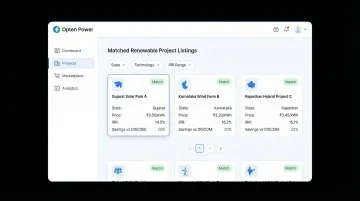
- Receive matched project offers — The platform's algorithm surfaces relevant renewable projects with transparent pricing, including DISCOM landing costs and regulatory charges
- Compare and contract — Automated RFPs and pre-approved contract templates accelerate deal closure, with instant financial analysis showing IRR, payback period, and savings vs. DISCOM baseline
Key advantages over brokers and DISCOM supply:
- Shows exactly what you're paying for power, wheeling, surcharges, and banking — no hidden markups
- Closes deals faster using automated RFPs and pre-approved contract templates
- Lets you compare multiple developers and technologies side by side
- Updates DISCOM tariffs and regulatory charges across all states in real time
For C&I buyers without a dedicated energy team, this removes the single biggest barrier to switching: not knowing whether a quoted price is actually competitive.
The Role of Technology in Modern Energy Procurement
Data and analytics tools have transformed procurement from a periodic, gut-feel decision into a continuous, evidence-based process.
Modern procurement platforms provide:
- Utility bill analysis — Automated parsing of complex DISCOM bills to identify overcharges, incorrect tariff classifications, and penalty fees
- Interval meter data — Granular consumption tracking that reveals load patterns, peak demand drivers, and efficiency opportunities
- Real-time market pricing — Live power exchange rates, fuel price indices, and renewable certificate (REC) values
- Regulatory charge tracking — Automated monitoring of SERC tariff orders, surcharge revisions, and banking rule changes across multiple states
AI-Powered Procurement Tools
AI-driven platforms automate RFP creation, flag market opportunities, model contract scenarios (IRR, payback, savings vs. baseline), and generate regulatory analysis instantly. This reduces the time and expertise required to make confident procurement decisions.
For example, Opten Power's automated tender engine creates, distributes, and manages RFPs using modular templates, enabling structured bid collection from multiple developers with automated evaluation. The platform's real-time DISCOM intelligence tracks standardized landing prices across all states, while instant financial modelling calculates IRR, payback period, and savings vs. DISCOM baseline for every project.
This means businesses no longer need to maintain in-house energy market expertise or engage expensive consultants to run a rigorous procurement process — the platform handles the analysis, so teams can focus on the decision.
Frequently Asked Questions
What is the meaning of energy procurement?
Energy procurement is the strategic process businesses use to source, negotiate, and contract their electricity or fuel supply — turning energy from a passive utility expense into an actively managed cost centre with measurable financial impact.
What is the energy procurement process?
The process typically covers these core steps:
- Audit consumption patterns and baseline costs
- Monitor market conditions and regulatory changes
- Define cost, risk, and sustainability objectives
- Issue RFPs to multiple suppliers and compare offers on a like-for-like basis
- Contract with the best option and monitor performance against terms
What is the energy procurement strategy?
An energy procurement strategy is a plan that aligns a business's energy sourcing decisions with its cost targets, risk tolerance, operational requirements, and sustainability goals. It covers which contract types to pursue, how to balance price certainty against flexibility, and how demand-side efficiency measures connect with supply-side contracting.
What is electricity procurement?
Electricity procurement specifically refers to the process of sourcing and contracting electrical power supply. In the Indian context, this includes choosing between DISCOM supply, open access from third-party generators, group captive arrangements, or direct PPAs with renewable developers — each with distinct pricing, regulatory, and operational implications.
What is AI-powered procurement?
AI-powered procurement uses algorithms and real-time data to automate RFP creation, model pricing scenarios, and flag cost-saving opportunities. These tools analyse consumption patterns, market conditions, and regulatory frameworks to recommend optimal contract structures — cutting deal timelines significantly and removing the guesswork from contracting decisions.
What are 5 strategies for energy management?
Five core strategies for effective energy management:
- Structured procurement — secure competitive supply contracts through RFPs and PPAs
- Demand reduction — manage loads to minimise consumption during peak tariff hours
- On-site renewable generation — reduce grid dependency with captive solar or wind
- Energy efficiency upgrades — optimise equipment performance to lower baseline consumption
- Real-time monitoring — track consumption data to identify waste and act quickly