Introduction
Grid tariffs for high-consumption commercial and industrial consumers can exceed ₹10/kWh, and that number keeps climbing. Add persistent reliability issues, costly interruptions, and tightening Renewable Purchase Obligation (RPO) targets from the Ministry of Power — and the pressure on energy-intensive industries is real.
For asset-heavy sectors like steel, cement, and textiles — where capital is tied up in core operations — funding a solar installation outright simply isn't viable.
A Solar Power Purchase Agreement (PPA) cuts through that constraint. Under a PPA, a renewable energy developer finances, installs, owns, and operates a solar system on behalf of a business. The business simply buys the electricity generated at a pre-agreed tariff, typically 30-40% lower than DISCOM rates, without committing upfront capital.
Despite frequent discussion in India's renewable energy sector, solar PPAs remain poorly understood at the contractual and operational level. Businesses confuse PPA types, miscalculate savings by ignoring state-level open access charges, or sign agreements without grasping their regulatory obligations — all mistakes that can wipe out projected savings entirely.
This guide covers how solar PPAs work in India, the key contract terms to scrutinize, state-specific regulatory considerations, and how to evaluate whether a PPA genuinely delivers value for your business.
Key Takeaways
- A solar PPA lets Indian businesses access solar energy at a fixed, reduced tariff with zero upfront investment—the developer owns, operates, and maintains the system
- PPA terms typically run 15–25 years, with tariffs locked in or subject to pre-agreed annual escalation (2–5%)
- Choose from three structures—on-site captive, group captive, or third-party open access—each carrying distinct regulatory requirements and cost profiles
- Best suited for high-consumption C&I users—manufacturers, data centres, IT parks, hospitals—targeting both cost reduction and ESG compliance
- Key risks include open access charges, DISCOM surcharges (which can erode 20–40% of projected savings), and state-level regulatory variability
What Is a Solar PPA?
A Solar Power Purchase Agreement is a financial and legal contract between a renewable energy developer and a commercial or industrial buyer. The developer installs and operates the solar asset; the buyer purchases its electricity output at a fixed tariff — typically over a 15 to 25 year term.
What the agreement governs:
- Electricity price per unit (₹/kWh)
- Contracted capacity (MW)
- Contract tenure (years)
- Performance guarantees and generation targets
- Escalation clauses
- Termination conditions and exit provisions
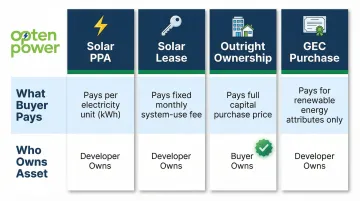
These terms set a PPA apart from other structures that look similar on the surface but work very differently in practice:
| Structure | What the buyer pays for | Who owns the asset |
|---|---|---|
| Solar PPA | Electricity units consumed | Developer |
| Solar lease | Use of the system itself | Developer |
| Outright ownership | Capital purchase of the asset | Buyer |
| GEC purchase | Renewable attributes only (no physical power) | Developer |
Why Solar PPAs Are Used in India
Economic Driver: Grid Tariff Arbitrage
Indian grid tariffs for C&I consumers rank among the highest globally due to cross-subsidisation policies. High Tension (HT) industrial tariffs in Maharashtra, for example, averaged ₹10.50/kWh for FY 2025-26, while recent SECI solar auctions discovered tariffs as low as ₹2.56–₹2.57/kWh. After open access charges, solar PPAs still deliver 25–40% cost savings versus grid power.
Zero-Capex Advantage
C&I businesses avoid the capital outlay, depreciation burden, and operations & maintenance (O&M) responsibility of owning a solar plant. For capital-intensive industries—steel, cement, textiles—this matters most: liquidity stays in core operations, not energy infrastructure.
RPO Compliance
India's RPO framework mandates that large consumers meet a rising share of electricity from renewables—43.33% by FY 2029-30, up from 29.91% in FY 2024-25. Entering a solar PPA directly helps fulfil these targets and avoid penalties for non-compliance.
Risk Transfer
Under a PPA, the developer carries all operational risk:
- Bears technology risk, generation risk, and O&M costs for the full contract term
- Absorbs performance shortfalls without passing costs to the buyer
- Buyers lock in predictable energy costs without exposure to fuel-price swings or O&M responsibilities
Real-World Adoption: The HUL-Brookfield Example
Hindustan Unilever Limited (HUL) partnered with Brookfield to establish a 45 MW off-site solar park in Bikaner, Rajasthan. The project supplies renewable electricity to 32 sites across 15 states under the Group Captive Open Access scheme, with HUL holding a 27.73% equity stake in the SPV.
HUL projects roughly 25% savings over 20 years. The project also benefits from a 100% waiver on Inter-State Transmission System (ISTS) charges—available for projects commissioned by June 30, 2025.
How a Solar PPA Works in India
High-level flow:
A C&I buyer identifies its energy demand profile → selects a PPA structure and developer → negotiates tariff and contract terms → the developer builds the solar plant → power is wheeled or consumed on-site → buyer pays per unit generated at the contracted rate for the full tenor.
Two critical financial variables:
- Contracted tariff (₹/kWh): The per-unit price agreed upfront
- Escalation clause: Fixed-price PPAs lock in the tariff for the full tenure — no annual increases. Escalating-price PPAs start lower but rise 2–5% each year, increasing total cost over time.
Step 1: Needs Assessment, Developer Sourcing, and Tariff Benchmarking
The buyer establishes its energy consumption profile and determines the viable PPA structure (on-site vs. open access). Key inputs include:
- Annual energy consumption (units)
- Load factor and peak demand
- Grid connectivity and open access eligibility
Buyers then issue an RFP or approach developers directly for tariff quotes.
This discovery process can be time-consuming when done manually. Platforms like Opten Power let buyers compare real-time tariffs, IRR estimates, and developer proposals across multiple counterparties in 16 states simultaneously — compressing weeks of outreach into a single workflow.
Step 2: Contract Negotiation, Regulatory Approvals, and Financial Close
Key negotiation points:
- Tariff and tenure
- Capacity guarantee and performance penalties
- Curtailment provisions
- Force majeure clauses
- Exit and termination conditions
For open access PPAs, buyers must secure approvals from the relevant State Electricity Regulatory Commission (SERC) and/or distribution licensee. Securing these approvals is a key milestone before financial close.
Step 3: System Commissioning, Energy Delivery, and Ongoing Billing
Post-commissioning, the developer generates solar power and energy is metered at the injection point. It is then wheeled to the buyer's premises (or consumed on-site), with monthly invoices issued based on actual generation at the contracted tariff.
What happens during:
- Shortfalls trigger developer penalties or grid top-up, depending on contract terms
- Surpluses are handled under state-specific banking regulations
Types of Solar PPAs in India
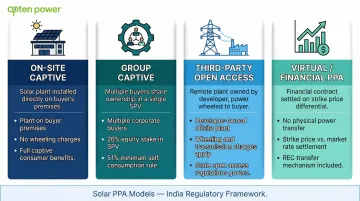
PPA type matters in India because the regulatory framework, applicable charges, and ownership structure vary significantly. The four main structures below cover the full spectrum — from on-site installations to purely financial instruments — each with distinct implications for cost, compliance, and project control.
On-Site Captive Solar PPA
The solar plant is installed on the buyer's own premises (rooftop or ground-mounted). Power is consumed directly without wheeling through the grid. The buyer qualifies as a captive consumer under the Electricity Act, 2003, reducing exposure to open access charges and DISCOM surcharges.
This structure works best for facilities with large roof or land areas relative to their power consumption.
Group Captive Solar PPA
Multiple C&I buyers collectively fund at least 26% of equity in a Special Purpose Vehicle (SPV) that owns the solar plant. The group must consume at least 51% of generation, with each member's consumption proportional to their ownership share (within ±10% variation) — a requirement confirmed by the Supreme Court's 2023 ruling in Dakshin Gujarat Vij Co. Ltd. v. Gayatri Shakti Paper & Board Ltd.
Key advantages:
- Allows buyers without sufficient on-site space to pool together
- Access to captive benefits including cross-subsidy surcharge exemptions under the Electricity Act
- JSW Steel procures 958 MW of wind and solar power via group captive SPVs
Third-Party Open Access Solar PPA
The solar plant is owned entirely by an independent developer at a remote location. Power is wheeled to the buyer through the state transmission network under open access regulations.
Key considerations:
- Buyers do not need to hold equity in the project
- Exposed to open access charges: wheeling, transmission, cross-subsidy surcharge, additional surcharge
- In Maharashtra, open access charges accounted for 51% of landed costs for third-party projects in Q3 2024
Virtual or Financial PPA (Emerging)
A financial instrument where the buyer agrees to pay or receive the difference between the contracted strike price and the market power price. The renewable generator sells electricity through power exchanges, and RECs are transferred directly to the consumer for RCO/RPO compliance. CERC issued formal guidelines for VPPAs in December 2024, classifying them as non-transferable, bilateral OTC contracts. The structure is still nascent in India and not yet mainstream.
Key Factors That Affect Solar PPA Terms in India
State-Level Regulatory and Tariff Variability
Open access charges, DISCOM cross-subsidy surcharges, banking regulations, and RPO credit eligibility differ significantly across India's states. In some states, open access charges can erode 30–50% of potential savings.
Examples:
- Maharashtra (FY 2025-26): Cross-Subsidy Surcharge (CSS) for HT-Industry is ₹2.11/kWh; wheeling charges are ₹0.95/kWh
- Tamil Nadu: TNERC approved an additional surcharge of ₹0.10/kWh for open access consumers effective April 2025
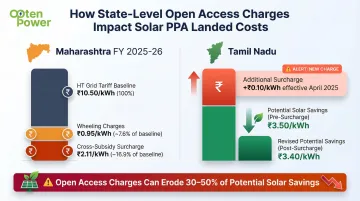
Buyers must evaluate net effective tariff before signing. Opten Power's real-time DISCOM intelligence tool provides standardised, updated landing prices across all states, so buyers can compare costs accurately before committing.
Contracted Capacity vs. Actual Consumption Matching
If the buyer over-contracts relative to actual demand, they pay for unconsumed units. If under-contracted, they remain on expensive grid power for a large share of consumption. Load forecasting accuracy over a 15–25 year horizon requires curtailment and ramp-up provisions built into the contract.
Developer Creditworthiness and Project Delivery Risk
Unlike buyer-side demand risk, developer risk sits on the supply side — and it spans the entire contract tenor. The developer owns and operates the asset throughout, so their financial health, track record, and bankability are critical to evaluate upfront.
A financially weak developer can expose buyers to:
- Delayed commissioning beyond agreed timelines
- Output falling short of contracted capacity guarantees
- Mid-tenor default, leaving the buyer without power and facing grid tariff costs
Common Misconceptions About Solar PPAs in India
Several assumptions lead C&I buyers to sign unfavorable agreements — or miss the fine print that determines real-world outcomes. Here are three that come up most often.
"A Solar PPA Always Saves Money vs. Grid Power"
Reality: Net savings depend on the all-in landed cost, which includes open access charges, wheeling charges, cross-subsidy surcharge, and transmission losses. In states with high surcharges, the effective PPA cost can approach or exceed DISCOM rates. A tariff comparison without these add-ons is incomplete.
"PPAs Are Flexible and Easy to Exit"
Reality: PPAs are long-term, legally binding contracts. Termination penalties are significant — often calculated as the present value of all remaining contracted payments. Buyers who sign without load-growth visibility or exit clauses risk being locked into agreements that no longer match their operations.
"Any Solar PPA Automatically Qualifies for RPO Compliance"
Reality: RPO credit eligibility depends on several factors:
- PPA structure (captive vs. open access)
- Whether Renewable Energy Certificates (RECs) are issued
- State-specific SERC recognition of the project
CERC REC Regulations (2022) explicitly state that certificates issued to captive stations for self-consumption are not eligible for sale. Verify RPO credit treatment in the contract and confirm with your state regulator before signing.
Frequently Asked Questions
What is the cost of solar PPA in India?
Solar PPA tariffs range from ₹2.56–₹2.57/kWh for utility-scale projects to ₹4.3–₹7.4/kWh for third-party open access models. The all-in landed cost shifts state to state based on wheeling charges, surcharges, and local DISCOM policies.
What is a solar power purchase agreement (PPA)?
A solar PPA is a long-term contract between a developer and a buyer where the developer installs and operates the solar system and the buyer purchases the electricity at a pre-agreed tariff. No upfront capital is required from the buyer.
What is a 25-year PPA?
A 25-year PPA locks in tariff and supply terms for the full contract period — common for utility-scale and large C&I projects in India. It offers maximum price certainty, but developer bankability and exit provisions deserve close scrutiny before signing.
Is PPA solar cheaper than owning?
Outright ownership generates greater long-term savings and the buyer captures all upside. A PPA trades some savings for zero capex and zero O&M risk. The right choice depends on the buyer's capital availability, risk appetite, and operational focus.
Are solar power purchase agreements worth it?
PPAs make strong sense for high-consumption C&I buyers in states with high grid tariffs and manageable open access charges. Evaluate the all-in landed cost, regulatory environment, and developer track record thoroughly before signing.
What is the difference between IPP and PPA?
An IPP (Independent Power Producer) is an entity that develops and owns power generation assets. A PPA is the contract through which an IPP sells that power to a buyer — the IPP is the seller, the PPA is the governing agreement.