Introduction
India added 6.1 GW of solar open access capacity in just the first nine months of 2025 — a 13% year-on-year increase that reflects a clear shift in how businesses power themselves. Across manufacturing, data centers, and heavy industry, companies are choosing renewable energy not just to meet sustainability targets, but to lock in long-term cost advantages.
Yet the opportunity is harder to act on than it looks. State-specific regulations vary widely, DISCOM charges can shift the landed cost of power by ₹1–2/unit between states, and comparing developer proposals without standardized data is time-consuming and opaque.
This guide breaks down your procurement options, explains what drives the true cost of renewable power, and shows how C&I buyers are structuring deals that deliver both savings and emissions reductions.
Key Takeaways
- Clean energy procurement enables businesses to source power directly from renewable generators through PPAs, open access, and group captive models
- Drivers include ESG mandates, long-term cost savings of up to 40%, and supply chain decarbonization pressure from global buyers
- Regulatory complexity, developer fragmentation, and internal expertise gaps are the primary barriers — each addressable through structured digital procurement platforms
- India's renewable energy market spans 16 states with mechanisms tailored to different consumption profiles and capital appetites
- Digital marketplaces now simplify and accelerate procurement through real-time tariff intelligence and automated tender management
What Is Clean Energy Procurement and Why Does It Matter
Clean energy procurement is the process by which businesses directly source electricity from renewable energy sources — solar, wind, or hybrid — rather than relying solely on conventional grid power from DISCOMs. This differs from simply buying Renewable Energy Certificates (RECs), which represent renewable attributes but don't involve physical power delivery.
Direct procurement matters for three reasons:
- Price stability: Locks in long-term energy costs, shielding your business from fossil fuel volatility. MSEDCL's Fuel Adjustment Charges for HT-Industrial consumers ranged from 15 paise/unit to 135 paise/unit between April 2022 and March 2023 — swings that devastate budgets.
- Emissions reduction: Directly addresses Scope 2 emissions (purchased electricity) and increasingly influences Scope 3 (supply chain emissions).
- Cost competitiveness: Renewable energy now matches or undercuts conventional grid power in many Indian states, delivering ROI alongside environmental benefits.
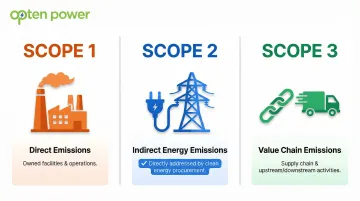
Understanding Emissions Scopes
Corporate climate strategies target three emissions categories:
- Scope 1: Direct emissions from owned facilities
- Scope 2: Indirect emissions from purchased electricity (directly addressed by clean energy procurement)
- Scope 3: Supply chain and value chain emissions (influenced when suppliers adopt clean energy)
The Clean Energy Procurement Academy (CEPA)
The Clean Energy Procurement Academy is a global initiative backed by Apple, Nike, Amazon, Meta, PepsiCo, and REI Co-op through the Clean Energy Buyers Institute. CEPA has conducted in-person trainings across India, China, Vietnam, Indonesia, and South Korea, targeting supply chain companies. Its Digital Academy — launched in Q1 2025 — covers GHG accounting, PPAs, procurement options, and local regulations.
Global brands are now pushing their Indian suppliers to adopt clean energy directly. For manufacturers in textiles, electronics, or auto-components, clean energy procurement is rapidly becoming a supplier qualification criterion — not just an environmental initiative.
India's Policy Context
India's regulatory environment increasingly mandates renewable adoption. The National Action Plan on Climate Change and Renewable Purchase Obligations (RPO) create compliance requirements for many C&I buyers. The Ministry of Power mandates total RPO to reach 43.33% by FY 2029-30, with a new 4.0% Energy Storage Obligation (85% of which must be sourced from renewables). These are binding obligations, not aspirational targets — making clean energy procurement both a strategic and compliance imperative.
Why Are Corporations Increasing Renewable Energy Purchases
ESG and Sustainability Reporting Pressure
445 Indian businesses have committed to Science-Based Targets (SBTi), with 91% reporting positive impacts. Investors, regulators, and customers demand measurable emissions reductions. Publicly listed companies and export-oriented manufacturers face intense scrutiny on Scope 2 emissions — and clean energy procurement provides the documented reductions that satisfy both regulators and institutional investors.
Cost Economics: Renewable Energy Is Now Cheaper
Solar and wind are now cheaper than grid power across much of India. Corporate PPAs and open access arrangements can deliver savings of up to 40% against DISCOM tariffs for heavy industrial consumers. Three factors drive the economics:
- Fixed pricing: Long-term PPAs eliminate exposure to fuel surcharge volatility
- Predictable budgets: No more quarterly DISCOM rate shocks
- Direct savings: Per-unit costs often ₹3-5 lower than grid tariffs in many procurement models
Unlike grid power, where fossil fuel pass-through charges create unpredictable costs, renewable PPAs offer stable tariffs over 15-25 year terms.
Supply Chain Decarbonization Pressure
Global corporations like Apple, Amazon, and Nike — all CEPA backers — are actively pushing Indian suppliers to adopt clean energy. For manufacturers serving global supply chains, clean energy adoption is becoming a supplier qualification criterion. Vendors that can't provide verifiable Scope 3 reductions risk losing contracts to those who can.
Brand Value and Market Differentiation
According to SBTi's impact research, companies with verified climate targets report improvements across reputation (95%), strategic cohesion (80%), investor confidence (76%), and competitive positioning (67%). Clean energy procurement directly supports ESG ratings, green financing eligibility, and relationships with sustainability-conscious B2B buyers.
Regulatory Tailwinds in India
Policy enablers are accelerating adoption:
- Open access liberalisation expanding across states
- Must-run status for renewables ensuring priority dispatch
- State-level green tariff programs simplifying procurement
- Banking and wheeling regulations improving economics
For C&I buyers, these frameworks have materially reduced both the cost and complexity of moving off DISCOM supply — making now an opportune moment to lock in long-term renewable contracts before tariff windows tighten further.
Clean Energy Procurement Mechanisms for Businesses in India
Open Access Power Purchase Agreements (PPAs)
Open access PPAs allow C&I buyers to sign long-term contracts directly with renewable energy developers. These can be structured as:
- Captive: On-site generation exclusively for your facility
- Group Captive: Multiple businesses co-own a project and share power at cost
- Third-Party Open Access: Off-site generation delivered through the grid without ownership
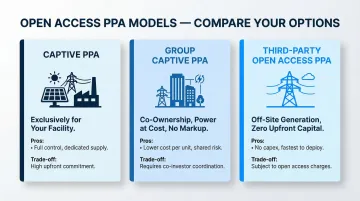
Critical consideration: State-specific DISCOM charges — wheeling, banking, and cross-subsidy surcharge — vary widely and significantly affect economics. A PPA with a headline tariff of ₹4.00/unit might land at ₹5.50/unit after regulatory charges in one state, but ₹4.80/unit in another.
Group Captive Arrangements
Group captive is often the most cost-efficient route for medium-to-large industrial consumers. Multiple businesses pool demand to co-own a renewable project, procuring power at cost with no retailer markup. Benefits include:
- Regulatory benefits and wheeling charge exemptions
- Per-unit savings of ₹3-5 compared to grid tariffs
- High IRRs with minimal capital risk
- Shortest deployment timelines
Indian electricity rules require minimum equity ownership (typically 26%) to qualify for captive benefits, but this structure delivers the best economics for businesses with consistent baseload demand.
Renewable Energy Certificates (RECs) and Green Tariffs
RECs and green tariffs are lighter-touch options for companies unable to commit to direct PPAs:
- RECs: Tradable certificates representing renewable attributes, useful for RPO compliance
- Green Tariffs: DISCOM-offered renewable power at premium rates
These mechanisms satisfy compliance and reporting requirements but don't offer the same cost savings as direct PPAs. They're best suited for businesses testing renewable procurement before committing to long-term contracts.
Choosing the Right Mechanism
The right mechanism depends on your consumption pattern, location, and financial priorities. Key factors to evaluate:
- Operations running 24×7? Group captive delivers the strongest economics for consistent baseload demand
- State of operation: Regulatory charges vary dramatically — run a state-specific DISCOM analysis before comparing headline tariffs
- Grid reliability needs: Hybrid (solar + wind) or grid-backed PPAs suit industries that can't tolerate supply gaps
- Capital position: Third-party open access requires zero upfront capital; group captive requires minimum 26% equity
- Risk tolerance on duration: Longer contracts (20-25 years) lock in lower tariffs but demand confident long-term planning
Barriers to Clean Energy Procurement — and How Businesses Can Overcome Them
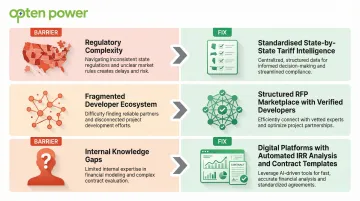
Regulatory and State-Specific Complexity
Each Indian state has different open access charges, banking policies, and net metering rules. Multi-state procurement becomes particularly difficult when you can't determine the true "landing price" after all DISCOM charges. A tariff that looks competitive in Karnataka may be uneconomical in Maharashtra once cross-subsidy surcharges and wheeling charges are applied.
The fix: Access standardised, up-to-date state-by-state tariff intelligence before signing agreements. Real-time DISCOM data showing true landed costs — not just headline tariffs — prevents costly mispricing before contracts are signed.
Fragmented Developer Ecosystem and Lack of Transparency
Most businesses have no structured way to compare renewable developers, evaluate project credibility, or benchmark pricing. This leads to:
- Prolonged procurement cycles (12-18 months in some cases)
- Suboptimal deal terms due to limited negotiating leverage
- Risk of selecting unreliable developers without proper due diligence
What works: Structured RFP processes and marketplace platforms that bring multiple verified developers to a single negotiation table. Comparing tariffs, project specifications, and developer credentials side-by-side accelerates decisions and improves contract terms.
That negotiating clarity matters even more when internal teams lack the expertise to evaluate what they're signing.
Internal Knowledge Gaps and Procurement Readiness
Many industrial companies — particularly in textiles, cement, or fertilisers — lack in-house expertise in energy procurement. Teams accustomed to buying power from DISCOMs struggle with:
- Understanding PPA structures and associated risks
- Evaluating IRR and payback calculations
- State regulations and compliance requirements
- Managing RFP processes and contract negotiations
Build or borrow the expertise: Seek advisory support or digital platforms that automate the heavy lifting. Tools that deliver instant IRR analysis, regulatory impact assessments, and pre-approved contract templates remove the need for deep in-house knowledge — letting procurement teams move faster without getting it wrong.
How Technology and Platforms Are Accelerating Clean Energy Procurement
Digital procurement platforms are transforming how businesses buy renewable energy. Instead of bilateral negotiations with a single developer over months, technology now enables real-time comparison of tariffs, project specs, IRR calculations, and regulatory impacts across multiple developers.
Key platform capabilities:
- Access standardised DISCOM charges and true landed costs across states — not just headline tariffs
- Evaluate pricing, credentials, and project details across multiple developers simultaneously
- Generate instant IRR, payback, and ROI calculations without manual modelling
- Create and manage RFPs using template-driven tender workflows
- Accelerate deal closure with pre-approved PPA templates that reduce negotiation friction
Opten Power: India's Unified Clean Energy Marketplace
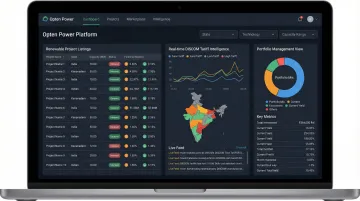
Opten Power enables C&I buyers to access 4+ GW of verified renewable capacity across solar, wind, and hybrid projects in 16 states. The platform provides real-time DISCOM intelligence showing true landed energy costs — not just headline tariffs — ensuring buyers never overpay.
The automated tender engine lets businesses create and manage RFPs using pre-approved contract templates, closing deals up to 50% faster while maintaining complete portfolio visibility from a single dashboard. By consolidating project discovery, financial analysis, tender management, and contract execution in one place, Opten Power removes the fragmentation that drags out procurement cycles.
That kind of end-to-end integration reflects a broader shift happening across the industry.
The Broader Shift Toward Data-Driven Procurement
Portfolio management dashboards, automated compliance tracking, and real-time market pricing are making clean energy procurement as disciplined and transparent as any other strategic procurement category. Businesses can now:
- Monitor all renewable investments from a single interface
- Track contract performance and compliance obligations
- Compare live market pricing before renewals
- Generate instant financial scenarios for budget planning
This data-driven approach reduces dependence on external consultants and empowers internal teams to make confident procurement decisions backed by real-time intelligence.
Frequently Asked Questions
What is the Clean Energy Procurement Academy?
The Clean Energy Procurement Academy (CEPA) is a global initiative backed by Apple, Amazon, Nike, Meta, PepsiCo, and REI Co-op that provides training and educational resources to help supply chain companies adopt clean energy procurement in their markets.
Why are corporations increasing renewable energy purchases?
Three forces are driving the shift: ESG and investor pressure to cut Scope 2 emissions, the cost competitiveness of renewables versus grid power, and growing demands from global buyers for suppliers to demonstrate verifiable clean energy adoption.
Are there online clean energy procurement courses available?
Yes, CEPA launched its Digital Academy in Q1 2025 — initially in China and Vietnam — covering PPAs, GHG accounting, and navigating local regulations, with plans to expand globally.
What is a Power Purchase Agreement (PPA) and how does it work?
A PPA is a long-term contract where a business agrees to purchase electricity from a renewable energy developer at a fixed or pre-agreed tariff, typically for 15 to 25 years. The contracted rate is often lower than prevailing grid rates, providing cost certainty over the contract term.
What are the main barriers to clean energy procurement in India?
The three key challenges are complex and state-specific regulatory frameworks (including open access charges and banking rules), fragmented developer markets that make comparison difficult, and a lack of in-house procurement expertise among many C&I buyers.