Introduction
India's commercial and industrial (C&I) sector faces a fundamental energy challenge: the grid cannot reliably deliver 24x7 power to meet operational demands. In FY 2022-23 alone, India experienced 7,583 million units of energy not supplied and peak demand shortfalls of 8,657 MW. To fill these gaps, Indian firms still depend on diesel gensets—consuming 4% of the country's total diesel and gasoline supply—at marginal costs ranging from ₹17–₹42 per kWh.
Even when the grid is available, standalone renewables fall short. Solar plants run at capacity utilisation factors of just 16–20%; wind at 20–26%. Neither can serve continuous operations without massive battery storage investments. For energy-intensive industries, intermittency isn't just an inconvenience—it's a direct cost.
This article examines how hybrid renewable energy systems (HRES) solve that problem by combining complementary generation sources to deliver reliable, cost-effective, round-the-clock clean power. It covers why HRES is now a practical requirement for steel, cement, data centres, hospitals, and manufacturing operations across India.
Key Takeaways
- Hybrid systems combine 2+ renewable sources (solar-wind, solar-hydro, solar-biomass) to offset intermittency and improve reliability
- HRES delivers 35–50% plant load factors vs. 16–26% for standalone solar or wind
- India had 1.44 GW of wind-solar hybrid capacity as of December 2023; awarded capacity reached ~12 GW in H1 2024
- Shared infrastructure reduces LCOE by 7–8% compared to separate installations
- C&I buyers can access hybrid projects via captive ownership or third-party PPAs across 16 states
What Are Hybrid Renewable Energy Systems?
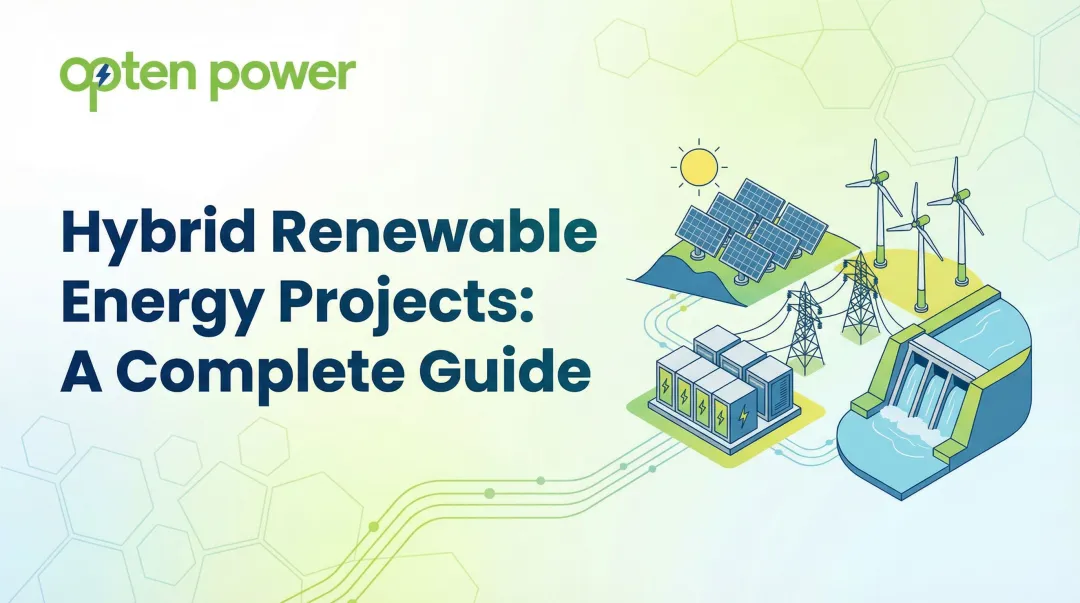
Hybrid renewable energy systems (HRES) are the deliberate combination of two or more renewable generation sources—with or without energy storage—to produce a more consistent and controllable electricity supply than any single source can deliver alone. In this context, "hybrid" refers exclusively to combining renewable technologies—not mixing renewables with fossil fuels.
The Intermittency Problem HRES Solves
Individual renewable sources are inherently variable. Solar PV generates power only during daylight hours. Wind output fluctuates by the hour based on weather, and run-of-river hydro depends on seasonal water flow. When combined strategically, their generation profiles offset each other's gaps—solar peaks during midday while wind often peaks at night, and dispatchable hydro or biomass fills remaining shortfalls. The result: higher reliability with a lower storage requirement.
In 2023, renewables reached 30% of global electricity generation for the first time, with the IEA forecasting this share will expand to 46% by 2030. For India—targeting 500 GW of renewable capacity by 2030—hybrid systems are central to this growth, enabling higher renewable penetration without compromising grid stability.
Grid-Connected vs. Off-Grid HRES
Two primary configurations exist:
- Grid-connected HRES: Export surplus power and draw from the grid during shortfalls. Ideal for industrial buyers under open access or group captive models who want to reduce grid dependency while maintaining backup.
- Off-grid (island) HRES: Must be fully self-sufficient and require energy storage. Suited for remote facilities, telecom towers, or captive industrial sites with no grid connection.
Foundational Renewable Technologies
HRES are built from five core technologies:
- Solar PV and solar thermal: mature, commercially scalable, with strong daytime generation
- Onshore wind: mature, scalable, often peaking at night or during monsoon
- Large hydro and pumped storage: mature, dispatchable, excellent for balancing
- Biomass: mature, controllable baseload from agricultural and forestry residues
- Geothermal and CSP: commercially deployed but geographically constrained
India's MNRE defines a wind-solar hybrid plant as one where the rated power capacity of one resource is at least 25% of the other, ensuring neither source is merely supplemental.
Key HRES Combinations: Solar-Wind, Solar-Hydro, and Beyond
Solar-Wind Hybrid: The Market Leader
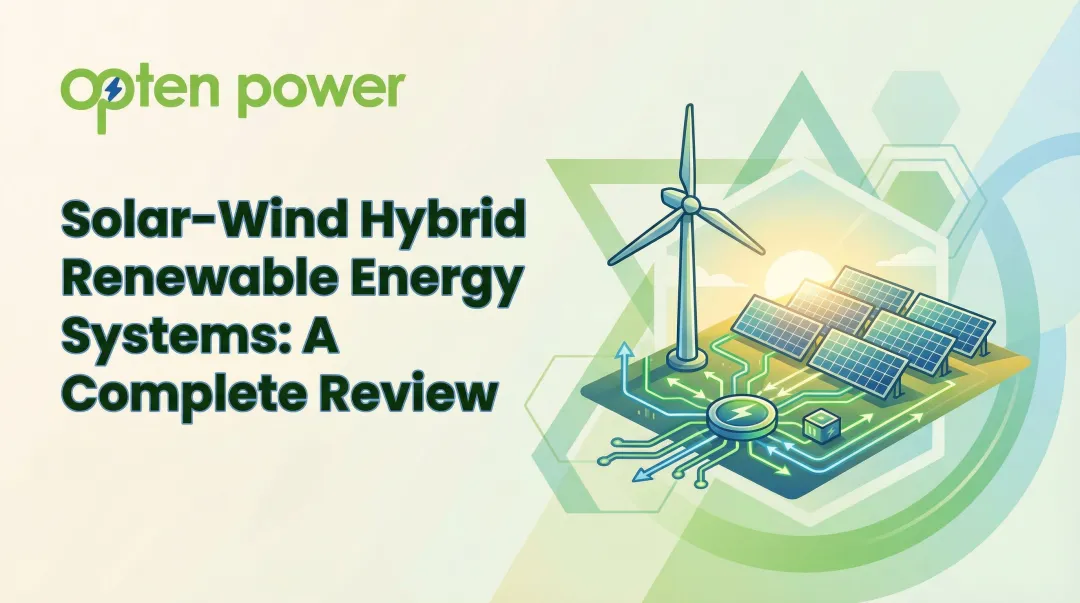
Solar-wind is the most commercially deployed HRES configuration globally and in India. As of December 2023, India had commissioned 1.44 GW of wind-solar hybrid capacity, with awarded capacity doubling from ~5 GW in 2023 to ~12 GW in H1 2024—representing 40% of total awarded renewable capacity.
Why it works:
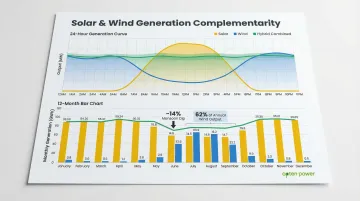
- Solar generation peaks during midday (10 AM–3 PM)
- Wind generation often peaks at night and during monsoon months
- Total solar PV generation decreases by ~14% during monsoon, while 62% of total wind energy is generated during the same period
- Combined, they create a more balanced generation curve across hours and seasons
Solar-Hydro Hybrid: Dispatchable Backup
Solar-hydro combinations leverage solar's strong daytime output while using hydropower as a controllable, fast-response backup. Two main configurations exist:
Pumped storage works by using surplus solar generation to pump water uphill into reservoirs during the day. When demand peaks or the sun sets, that stored water is released through turbines to generate power. India currently operates 4.76 GW of pumped hydro storage, with 3.36 GW in active pumping mode.
Floating solar on reservoirs co-locates panels directly on water bodies, maximising land use and reducing evaporation. Notable projects include:
- NTPC's 100 MW Ramagundam floating solar project (2022)
- NTPC's 25 MW Simhadri project (2021)
- SJVN's 90 MW Omkareshwar project (2024)
Solar-Biomass Hybrid: 24x7 Baseload
Biomass provides controllable, on-demand baseload that compensates for solar intermittency. This configuration is most practical where agricultural or forestry residues are available near industrial clusters.
Real-world example: The Termosolar Borges plant in Spain is a 22.5 MWe hybrid biomass-parabolic trough CSP plant commissioned in 2012. It operates 24x7 by firing biomass boilers at night and during overcast days, proving that 24x7 renewable output is commercially achievable.
Wind-Hydro and Wind-Biomass Hybrids
Wind-based pairings follow a similar logic to their solar equivalents — pair variable output with a firm, dispatchable source.
- Wind-hydro: Hydropower's fast-response regulation makes it an excellent complement to variable wind. The Gorona del Viento plant on El Hierro, Spain (commissioned 2015) pairs an 11.5 MW wind farm with an 11.3 MW pumped hydro system — and routinely achieves 100% renewable supply for the island.
- Wind-biomass: Biomass steps in as firm capacity when wind output drops, using the same dispatch logic as solar-biomass hybrids.
Geothermal-Based Hybrids: Limited but Viable
Geothermal-based HRES (solar-geothermal, wind-geothermal) are technically sound but see limited commercial deployment due to high upfront costs and site-specific resource requirements. The Stillwater project in Nevada combines geothermal binary systems with CSP and solar PV — one of few operational examples worldwide. Until drilling costs fall, geothermal hybrids will remain viable mainly in volcanically active regions.
Why HRES Are Critical for C&I Energy Buyers
Reliability for Continuous Operations
Industries with 24x7 operations—steel, cement, data centres, hospitals, process industries—cannot tolerate even brief supply interruptions. Downtime causes costly production losses, safety hazards, and quality issues.
A single renewable source cannot serve these buyers without substantial battery storage, which dramatically increases project costs. HRES reduces storage requirements through complementary generation profiles, delivering firm power at lower total system cost.
Superior Economics: Higher PLF, Lower LCOE
HRES delivers more consistent generation across the day and year, translating to measurably better economics:
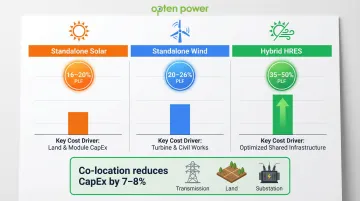
- Higher PLF: Combining wind and solar can increase PLF to 35–50%, versus 16–26% for standalone plants
- Lower capex per unit: Co-locating wind and solar reduces costs by 7–8% through shared land, transmission lines, substations, and interconnection hardware — Lazard's LCOE+ (2025) models 10% storage and 25% inverter cost synergies from colocation
- Better infrastructure utilisation: Hybrid systems maximise transmission capacity and minimise curtailment, reducing effective cost per unit of energy delivered
Energy Security and Tariff Predictability
The economics case is reinforced by what happens after signing: price certainty. C&I buyers procuring renewable power through long-term PPAs lock in tariffs for 15–25 years. The MoP's 2023 Tariff-Based Competitive Bidding Guidelines for Wind-Solar Hybrids confirm that hybridisation reduces variability, improves grid stability, and enhances project bankability.
This makes HRES-backed PPAs a more resilient hedge against rising DISCOM tariffs—particularly relevant as open access surcharges and cross-subsidy charges continue to climb.
Carbon and ESG Compliance
HRES enables higher renewable energy consumption across 24 hours, helping large manufacturers and exporters meet:
- Scope 2 emissions reduction targets under the GHG Protocol
- EU Carbon Border Adjustment Mechanism (CBAM) requirements — transitional reporting obligations began October 2023, with full financial enforcement from 2026
- SEBI's Business Responsibility and Sustainability Reporting (BRSR) mandates
- Customer-driven green supply chain requirements from global buyers
For exporters to Europe or multinationals with global sustainability commitments, HRES isn't optional—it's a competitive necessity.
Key Advantages and Limitations of HRES
Core Advantages
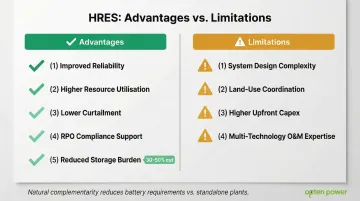
- Improved supply reliability: Complementary generation profiles reduce dependence on grid backup and diesel gensets
- Higher resource utilisation: Shared transmission, land, and O&M infrastructure lower per-unit costs
- Lower curtailment losses: Better matches generation with demand, reducing wasted energy
- Suitability for RPO compliance: Helps meet mandatory renewable purchase obligations through higher annual generation
- Reduced storage burden: Natural complementarity cuts battery requirements by 30–50% compared to standalone plants
Technical Limitations
- System design complexity: Sizing each component, managing dispatch logic, and balancing variable solar/wind with controllable hydro/biomass in real time requires sophisticated power management engineering
- Land-use coordination: Co-locating multiple technologies creates site conflicts — wind turbines need spacing, solar arrays need unobstructed exposure, and biomass plants need feedstock storage areas planned well in advance
Economic and Regulatory Constraints
Higher upfront capital costs than standalone plants, though lifecycle LCOE remains competitive
O&M demands expertise across solar, wind, hydro, or biomass — not a single-technology skill set
Banking and scheduling rules for hybrid energy vary significantly by state. For example:
Karnataka (2025): Monthly banking permitted with 8% in-kind banking charge; banked energy cannot be carried forward
Maharashtra (March 2026): Banked energy drawal restricted to same or lower tariff time block (solar-hour banked energy cannot be drawn during peak hours)
Buyers procuring hybrid power across multiple states need real-time visibility into each state's tariff rules — otherwise, savings projections built on one state's banking assumptions can fall short in another.
India's Hybrid Renewable Energy Policy Landscape
MNRE's National Wind-Solar Hybrid Policy
The Ministry of New and Renewable Energy issued the National Wind-Solar Hybrid Policy on May 14, 2018 (amended August 2018) to promote land and transmission infrastructure efficiency. Key provisions:
- Wind-solar hybrid plant definition: one resource must be at least 25% of the other's rated capacity
- Enables sharing of land, transmission, and grid connectivity
- Designed to improve infrastructure utilisation and reduce project costs
Hybrid Energy Auctions and Tariff Discovery
SECI and state DISCOMs have conducted dedicated hybrid energy tenders, driving tariffs lower through competitive bidding:
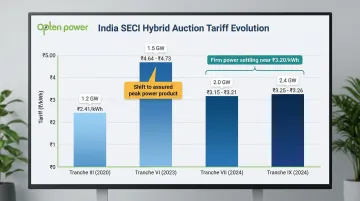
- Tranche III (2020): 1.2 GW auctioned; L1 tariff of ₹2.41/kWh
- Tranche VI (2023): 1.2 GW with assured peak power; tariffs of ₹4.64–₹4.73/kWh
- Tranche VII (2024): 900 MW; tariffs of ₹3.15–₹3.21/kWh
- Tranche IX (2024): 600 MW; tariffs of ₹3.25–₹3.26/kWh
The tariff rise from Tranche III to Tranche VI reflects a product shift — buyers moved from basic hybrid to assured peak power, which commands a premium. Tranches VII and IX show that even firm power products are now settling closer to ₹3.20/kWh as scale and competition grow.
Green Energy Open Access (GEOA) Rules
The MoP's GEOA Rules 2022 allow consumers with a contracted demand or sanctioned load of 100 kW or more to directly procure renewable power—including hybrid projects—from developers. Captive consumers face no upper capacity limit. Key provisions:
- Mandatory monthly banking permitted
- Unutilised surplus energy lapses at end of cycle in exchange for RECs
- State-specific banking charges and scheduling rules apply
RPO Targets for C&I Buyers
The MoP's October 2023 notification sets mandatory renewable purchase targets for obligated entities:
- FY 2024–25: 29.91% total renewable energy consumption
- FY 2029–30: 43.33% total renewable energy consumption
MNRE clarified in 2019 that the RPO contribution of hybrid plants is split by the actual installed capacity ratio of each source — meaning wind and solar components each count toward their respective RPO obligations proportionally.
Procuring Hybrid Renewable Energy: What C&I Buyers Should Know
Two Primary Procurement Pathways
Captive hybrid projects (ownership model): Higher upfront capital but maximum control. Best suited for large enterprises with strong balance sheets and long-term energy planning horizons. Offers complete asset ownership, depreciation benefits, and tax advantages.
Third-party PPAs: Asset-light, faster to deploy, and increasingly available as developer capacity grows. Zero upfront capital, no maintenance responsibilities, and flexible contract terms. Corporate PPAs structured against hybrid projects are particularly attractive because they can guarantee a higher share of renewable consumption on an annual or monthly basis.
Notable hybrid corporate PPAs:
- ACME Solar signed a 25-year PPA with SECI for a 190 MW ISTS-connected wind-solar hybrid project
- Tata Power Renewable Energy signed a PPA with Tata Power Mumbai for an 80 MW Firm and Dispatchable Renewable Energy (FDRE) project integrating solar, wind, and battery storage
- Google signed a PPA with Adani Green Energy for power from the Khavda solar-wind hybrid project in Gujarat
How Opten Power Simplifies Hybrid Project Access
Navigating hybrid procurement across 16 states — with varying banking rules, developer options, and project configurations — adds significant complexity to the buying decision. That's where a structured marketplace approach makes a measurable difference.
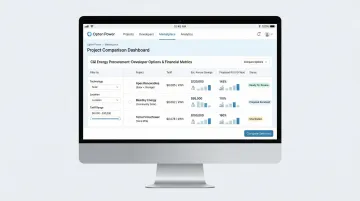
Opten Power gives C&I buyers direct access to 4+ GW of solar, wind, and hybrid projects from pre-vetted developers across 16 states. Key platform capabilities include:
- Real-time comparison of tariffs, savings, and ROI across multiple developers
- Instant IRR, payback, and regulatory analysis
- Automated RFPs and pre-approved contracts that cut deal timelines by 50%
Key Due-Diligence Factors
When evaluating a hybrid project, C&I buyers should scrutinise:
- Generation mix and complementarity: Does the solar-wind or solar-hydro ratio align with your consumption profile?
- Projected PLF and generation profile: Will the project deliver sufficient energy during your peak demand hours?
- State-specific banking and scheduling rules: Can you bank surplus solar energy for evening consumption, and at what cost?
- Grid connectivity and evacuation infrastructure: Is the project ISTS-connected or STOA-based? Are there transmission constraints?
- Developer track record: Does the developer have proven experience across both technology types in the hybrid configuration?
Frequently Asked Questions
What is a hybrid renewable energy system?
An HRES combines two or more renewable sources—such as solar and wind, or solar and hydro—to produce a more reliable and consistent electricity supply than a single source can deliver alone, often reducing the need for large battery storage.
What makes solar-wind hybrid the most popular HRES combination?
Solar peaks during daylight while wind often peaks at night or during monsoon months, meaning the two sources naturally cover each other's low-output periods across both daily and seasonal cycles, delivering higher overall plant load factors.
How does a hybrid renewable energy system help with grid stability?
By combining a variable source (solar or wind) with a more controllable source (hydro or biomass), HRES can smooth output fluctuations, reduce curtailment, and maintain frequency stability better than a purely variable renewable plant.
What are the main challenges in deploying hybrid renewable energy systems?
Higher project design and coordination complexity, multi-technology land and infrastructure requirements, and variability in state-level regulatory frameworks for hybrid energy banking and scheduling in India.
Is hybrid renewable energy suitable for industrial and commercial buyers in India?
Yes. HRES suits energy-intensive industries like data centres, steel, and cement because it delivers higher renewable energy fractions around the clock. It also supports ESG targets and offers more stable long-term tariffs through hybrid PPAs.
How can a C&I company in India access hybrid renewable energy projects?
C&I buyers can procure hybrid renewable energy through captive project ownership or third-party PPAs. Platforms like Opten Power let buyers compare live project availability and tariffs across developers and states in one place.