Introduction
For commercial and industrial energy consumers across India, the reliability gap represents a persistent threat to operations. Grid dependence exposes businesses to rising tariffs—Tamil Nadu's industrial rates recently climbed to ₹7.50/kWh—while diesel backup systems erode margins and sustainability targets. Standalone solar or wind installations offer partial relief, yet neither can independently deliver the 24x7 power supply that manufacturing plants, data centres, and hospitals require.
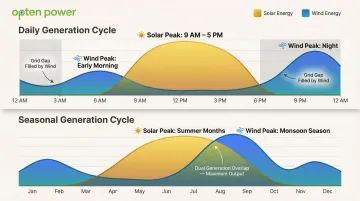
Solar-wind hybrid renewable energy systems address this challenge through complementarity. Solar panels generate peak power during daylight and summer months, while wind turbines produce maximum output at night, during monsoons, and in early morning hours. That seasonal and time-of-day offset fills generation gaps that neither source can cover alone — and does so without a proportional increase in battery storage costs.
For C&I buyers weighing procurement options, understanding how hybrid systems work — and where India's policy and capacity landscape stands — is now a practical necessity.
TLDR — Key Takeaways:
- Hybrid systems combine solar and wind to generate more consistent power than either source alone
- Core components include PV panels, wind turbines, MPPT controllers, battery banks, and inverters
- Reduced battery storage requirements lower lifecycle costs versus standalone systems
- Best suited for continuous-power industries: manufacturing, data centres, hospitals, and IT parks
- India's installed hybrid capacity reached 3.86 GW by March 2026, with 16+ states offering viable sites
What Is a Solar-Wind Hybrid Energy System and Why Does It Matter?
A Hybrid Renewable Energy System (HRES) integrates two or more renewable energy sources—in this case, solar photovoltaic (PV) panels and wind turbines—with energy storage to deliver more stable and continuous power output than either technology can provide independently. India's National Wind-Solar Hybrid Policy (2018) defines a qualifying hybrid plant as one where the rated capacity of one resource is at least 25% of the other.
The Complementarity Advantage
The core rationale for combining solar and wind is temporal and seasonal complementarity:
- Solar energy peaks during daytime hours (9 AM–5 PM) and summer months when irradiation is highest
- Wind energy peaks at night, during early morning hours, and throughout India's southwest summer monsoon and northeast winter monsoon seasons
This natural offset reduces overall supply gaps—and the effect is especially pronounced across India's geography. In coastal and peninsular regions, wind speeds strengthen during monsoon months precisely when solar irradiation declines, creating a balanced year-round generation profile.
Distinction From Standalone Systems
Standalone solar or wind systems face significant intermittency:
- Standalone solar requires large battery banks to store daytime generation for nighttime consumption
- Standalone wind requires backup storage for calm periods and seasonal lulls
- Hybrid systems reduce storage dependency because when one source underperforms, the other compensates
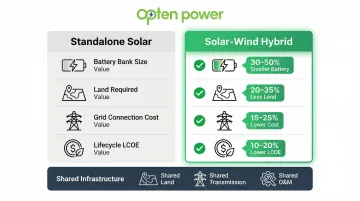
In many configurations, this can reduce battery bank size requirements by 30–50% compared to equivalent standalone systems, lowering capital costs and total lifecycle expenditure.
Key Components of a Solar-Wind Hybrid System
Solar PV Array
Solar photovoltaic panels convert sunlight into direct current (DC) electricity through semiconductor cells. Array size is determined by:
- Energy consumption requirements
- Site-specific solar irradiation data (kWh/m²/day)
- Available installation area
Three factors shape real-world performance:
- Higher operating temperatures reduce panel efficiency
- Optimal tilt angles maximize annual energy yield for the site's latitude
- Even partial shading can significantly cut total output
Typical commercial installations range from 100 kW to several MW, depending on load profiles.
Wind Turbine
Wind turbines convert kinetic wind energy into electrical energy. Commercial-scale installations typically use horizontal axis turbines with capacities ranging from 500 kW to 3 MW per unit.
Key selection factors include:
- Wind speed profile at hub height (typically 80–120 meters above ground level)
- Rated capacity, which determines energy yield at design wind speeds
- Cut-in speed: the minimum wind speed needed to begin generation (typically 3–4 m/s)
- Cut-out speed: the maximum safe operating limit (typically 20–25 m/s)
The National Institute of Wind Energy (NIWE) defines high-potential hybrid sites as those with a Wind Capacity Utilization Factor (CUF) above 35%.
Charge Controller (MPPT)
Maximum Power Point Tracking (MPPT) charge controllers manage power flow from both solar panels and wind turbines to the battery bank. Core functions include:
- Maximizing energy capture from each source as sunlight and wind conditions shift
- Preventing overcharging that would degrade battery banks
- Regulating voltage and current to match battery specifications
Modern MPPT controllers achieve conversion efficiencies of 95–98%.
Battery Bank / Energy Storage
Battery storage captures surplus energy during peak generation for use when output drops. Common technologies include:
- Lead-acid: Lower upfront cost, 5–7 year lifespan, depth of discharge limited to ~50%
- Lithium-ion: Higher upfront cost, 10–15 year lifespan, depth of discharge up to 80–90%
Hybrid systems require smaller battery banks than standalone systems because solar and wind fill each other's generation gaps. For a given load profile, hybrid battery capacity can be 30–50% smaller than standalone equivalents.
Inverter and Monitoring System
The inverter converts DC electricity from solar panels, wind turbines, and batteries into alternating current (AC) for industrial equipment and grid-compatible distribution. It works alongside a monitoring and control system that ties the entire hybrid plant together.
Modern control systems handle:
- Real-time performance tracking across solar, wind, batteries, and load demand
- Dispatch decisions that route power to load first, then battery charging, then grid export
- Dynamic adjustments based on weather forecasts and load patterns
- AI/ML-based optimization to maximize energy yield and reduce levelized cost of energy (LCOE)
How a Solar-Wind Hybrid System Works
Dual-Source Generation Cycle
During daylight hours, solar panels serve as the primary generation source, while wind turbines contribute based on wind availability. At night or on overcast days, wind turbines become the dominant source. The charge controller manages both inputs simultaneously:
- First priority: Meet real-time load demand
- Second priority: Charge battery bank to target state of charge
- Third priority: Export surplus to the grid (in grid-connected systems)
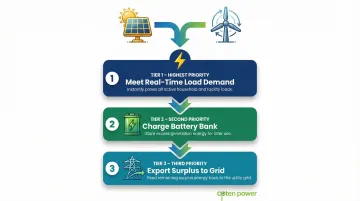
This priority hierarchy ensures continuous power availability — and it directly shapes how the battery bank operates in the next layer of the system.
Energy Storage and Dispatch Logic
The battery bank acts as a buffer between generation and consumption. When output exceeds demand, it charges. When demand outpaces generation, it discharges — covering the gap without grid intervention.
For C&I buyers, this dispatch logic has a measurable impact: hybrid systems typically deliver 80–95% renewable energy consumption, compared to 60–70% for standalone solar. That difference directly reduces grid dependence and diesel backup requirements.
Grid Interaction and Export
Grid-connected hybrid systems can:
- Feed surplus electricity back to the grid under net metering or banking arrangements
- Draw from the grid only when both generation and storage are insufficient
This differs from off-grid/standalone configurations, which rely entirely on battery banks and require larger storage capacity with more cautious capacity planning.
Recent state-level banking rule changes impact grid interaction economics. For example, Maharashtra's Time-of-Day (ToD) banking restrictions allow banked energy to be drawn only in the same or lower tariff time block, while Rajasthan now mandates Battery Energy Storage Systems (BESS) for new renewable energy projects over 5 MW.
Monitoring, Control, and Optimization
Automated control systems use real-time data to adjust operations dynamically:
- Weather forecasts: Predict solar irradiation and wind speed to optimize dispatch schedules
- Load patterns: Anticipate demand peaks to prioritize battery charging
- Battery state of charge: Prevent deep discharge cycles that shorten battery life
- Grid tariff signals: Time surplus exports to high-tariff periods under ToD structures
Advanced systems now apply machine learning to this data continuously. In practice, ML-driven dispatch has reduced LCOE by 5–10% in large hybrid projects by tightening the margin between generation forecasts and actual dispatch decisions — compounding savings across 20–25-year project lifetimes.
Advantages and Limitations of Solar-Wind Hybrid Systems
Advantages
Higher Energy Reliability
Combining two complementary sources significantly reduces the risk of extended generation gaps. According to the National Institute of Wind Energy, regions with a Wind CUF above 35% and Solar CUF above 20% achieve substantially higher combined capacity factors than standalone systems—often reaching 40–50% versus 20–25% for standalone solar in the same location.
Reduced Storage and Infrastructure Costs
Because solar and wind generation profiles offset each other, hybrid systems require smaller battery banks—typically 30–50% less capacity than equivalent standalone systems. Additionally, both technologies can share:
- Land and site development costs
- Grid connection infrastructure and transformers
- Transmission lines and substations
- Operation and maintenance resources
This shared infrastructure reduces per-unit installation costs versus building two separate renewable projects.
Better Land and Resource Utilization
Solar panels operate at ground level, while wind turbines operate 80–120 meters above ground. This vertical stacking enables co-location on the same land parcel, making hybrid systems more land-efficient than deploying two separate renewable projects—particularly valuable for industries with fixed site constraints.
Limitations
High Initial Capital Cost
Hybrid systems require investment in two generation technologies plus storage and control infrastructure. Upfront capital expenditure typically ranges from ₹6–8 crore per MW for grid-connected systems, compared to ₹4–5 crore per MW for standalone solar.
That higher upfront cost tends to reverse over time. Lifecycle analysis shows hybrid systems deliver a lower levelized cost of energy (LCOE) over 20–25 year project lifetimes, driven by higher capacity factors and reduced storage needs. C&I buyers should prioritize LCOE and total cost of ownership rather than upfront capital alone.
Site and Wind Resource Dependency
Hybrid systems are viable only where adequate solar irradiation and meaningful wind speeds co-exist at the same site. Urban areas with high-rise obstructions or low-wind geographies cannot fully benefit.
In India, the highest potential co-located solar-wind resources are concentrated in:
- Coastal regions: Tamil Nadu, Gujarat, Andhra Pradesh
- Peninsular regions: Karnataka, Maharashtra
- Scattered high-potential zones: Rajasthan, Madhya Pradesh, Telangana
Detailed site assessments using NIWE's 150m wind atlas and solar irradiation maps are essential before project development.
Key Applications Across Industries
Grid-Connected and Utility-Scale Applications
Large-scale hybrid plants connected to the grid serve as stable baseload or peak-shaving resources for utilities and large industrial consumers. These projects typically range from 50 MW to several hundred MW and operate under:
- Open Access structures: Industrial buyers procure power directly from hybrid plants
- Group captive arrangements: Multiple consumers share ownership and offtake
- Utility PPAs: Distribution companies procure hybrid power under long-term contracts
The Solar Energy Corporation of India (SECI) awarded 1.8 GW of hybrid capacity in February 2026 under its ISTS Hybrid Tranche-VIII and IX schemes, reflecting sustained developer and utility interest.
Commercial and Industrial (C&I) Applications
Hybrid systems are particularly well-suited for C&I consumers requiring 24x7 power reliability:
- Manufacturing plants: Automotive, textiles, steel, cement
- Data centers: Critical load requiring continuous uptime
- Hospitals: Essential services demanding uninterrupted power
- IT parks and commercial complexes: High daytime consumption with night operations
- Hotels and warehouses: Round-the-clock operations with variable load
C&I sector renewable capacity additions reached approximately 15 GW by early 2026, driven by rising grid tariffs and corporate sustainability commitments. That growth has also expanded procurement options — C&I buyers can now access hybrid capacity through:
- Corporate PPAs: Long-term power purchase agreements with renewable developers
- Open Access procurement: Direct power purchase bypassing distribution companies
- Captive hybrid projects: Owned and operated assets dedicated to the buyer's load
Remote and Off-Grid Applications
Standalone hybrid systems serve locations without grid access:
- Rural electrification: Villages and hamlets beyond grid reach
- Telecom towers: Remote sites requiring reliable backup
- Military installations: Critical infrastructure in border regions
- Agricultural pumping: Irrigation systems in off-grid areas
In many deployments, hybrid systems displace diesel generators that cost ₹18–25 per unit to run — cutting fuel expenditure significantly while reducing scope 1 emissions at the site level.
Solar-Wind Hybrid Energy in India: Opportunities for C&I Buyers
India's Policy and Resource Landscape
India's renewable energy policy framework strongly supports hybrid deployment. The National Wind-Solar Hybrid Policy (2018) establishes clear eligibility criteria, infrastructure-sharing provisions, and RPO compliance mechanisms.
As of March 31, 2026, India reached 283.46 GW of non-fossil capacity, making substantial progress toward the 500 GW by 2030 target. Within this capacity, solar-wind hybrid projects account for 3.86 GW of installed solar capacity, with robust tendering activity indicating continued growth.
India's geographic advantages include:
- High solar irradiation: Most states receive 4.5–6.5 kWh/m²/day
- Significant wind potential: Coastal and peninsular regions offer strong wind resources
- 16+ states with viable hybrid sites: Concentrated in Tamil Nadu, Gujarat, Karnataka, Andhra Pradesh, Maharashtra, Rajasthan, and Madhya Pradesh
Procurement Models for C&I Buyers
Commercial and industrial buyers can access hybrid energy through three primary routes:
1. Corporate PPAs (Power Purchase Agreements)
Long-term contracts (typically 15–25 years) with renewable developers offer:
- Fixed tariff structures hedging against grid tariff inflation
- No upfront capital expenditure
- Immediate access to renewable energy for sustainability reporting
Corporate PPAs for hybrid projects typically deliver tariffs 15–30% below industrial grid tariffs in high-tariff states.
2. Open Access Power Procurement
Buyers with contract demand above 1 MW (varies by state) can purchase power directly from hybrid generators, bypassing distribution companies. Key considerations include:
- Cross-subsidy surcharges (e.g., ₹1.99/kWh in Tamil Nadu)
- Wheeling and transmission charges
- Banking restrictions under new state regulations
- BESS mandates (e.g., Rajasthan's requirement for projects above 5 MW)
3. Captive Hybrid Projects
Buyers develop and own hybrid assets dedicated to their load, offering:
- Maximum control over generation assets
- Lowest long-term energy costs (LCOE typically ₹3–4/kWh)
- Highest upfront capital requirement (₹6–8 crore per MW)
Captive projects are most suitable for large enterprises with long-term site stability and access to project finance.
Discovering and Procuring Hybrid Projects Through Opten Power
Navigating these three routes — each with distinct regulatory, financial, and operational requirements — is where structured procurement support makes a measurable difference. Opten Power gives C&I buyers a single platform to evaluate and transact across all three models, with:
- 4+ GW of solar, wind, and hybrid projects available across 16 states
- Real-time tariff comparison across multiple developers to surface the most competitive offers
- Instant financial analysis covering IRR, payback period, and state-specific regulatory costs
- Automated RFP management with pre-approved contract templates to accelerate deal closure
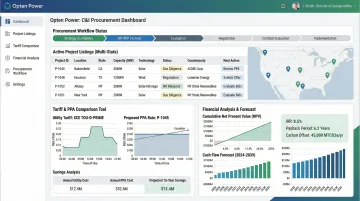
Buyers can compare project options side by side, model lifecycle savings against grid tariffs, and close deals faster — typically 50% faster — using standardized documentation built for Indian C&I procurement.
Frequently Asked Questions
What is a solar-wind hybrid energy system?
A solar-wind hybrid energy system combines solar PV panels and wind turbines with energy storage and control components to generate more reliable and continuous electricity than either source alone. The system qualifies as hybrid when one resource's rated capacity is at least 25% of the other.
How do solar and wind energy complement each other?
Solar energy peaks during daytime and summer months, while wind energy is stronger at night, during monsoons, and in early morning hours. This seasonal and daily offset reduces generation gaps throughout the year, delivering more consistent power than either source alone.
What are the main components of a solar-wind hybrid system?
The five core components are solar PV array, wind turbine, MPPT charge controller, battery bank, and inverter. Most modern systems also include monitoring and control units that track real-time output and manage energy dispatch.
What are the advantages of a hybrid system over a standalone solar or wind system?
Hybrid systems deliver improved reliability, reduced battery storage requirements (30–50% smaller), better land utilization through vertical stacking, and lower lifecycle energy costs compared to standalone alternatives.
Are solar-wind hybrid systems suitable for large commercial and industrial users?
Yes, hybrid systems are particularly suitable for industries needing 24x7 power—manufacturing plants, data centers, hospitals, IT parks. Corporate PPAs and Open Access routes make hybrid procurement practical and financially attractive for large C&I consumers.
What is the cost of a solar-wind hybrid system in India?
System costs depend on project size, site conditions, and technology mix. Grid-connected systems typically require ₹6–8 crore per MW upfront, but deliver an LCOE of ₹3–4/kWh over 20–25 years. To compare live tariffs across developers, platforms like Opten Power provide standardized pricing data across 16 states.