Introduction
Commercial and industrial consumers in India face three simultaneous pressures: grid tariffs climbing year-on-year, supply unreliability from aging distribution infrastructure, and mounting ESG commitments requiring aggressive Scope 2 emissions cuts. Between May and December 2025 alone, India curtailed 2.3 TWh of solar generation due to grid security concerns — a direct warning to firms that cannot tolerate supply interruptions.
Hybrid renewable energy projects solve all three challenges by combining solar PV, wind, and battery storage to deliver round-the-clock, cost-stable, low-carbon power that standalone systems cannot match.
This guide covers how hybrid systems work, their economic and operational advantages, emerging configurations, and how C&I buyers can procure them through India's evolving policy landscape.
TLDR:
- Hybrid projects combine solar, wind, and storage to produce more consistent output than any single technology alone
- Battery costs fell 20% to ₹9,545/kWh in 2024, while solar LCOE dropped to ₹3.15/kWh in India
- MNRE's 2018 policy offers ISTS charge waivers for hybrid projects through June 2028
- C&I buyers can access hybrid power via open-access PPAs, group captive structures, or bilateral agreements
- Opten Power offers 4+ GW of hybrid, solar, and wind capacity across 16 states, closing deals 50% faster
What Is a Hybrid Renewable Energy Project?
A hybrid renewable energy project integrates two or more renewable energy sources (most commonly solar PV and wind turbines), often paired with battery storage, on a shared site and grid connection. The goal is a more consistent output than any single technology can deliver on its own. Under India's National Wind-Solar Hybrid Policy (2018), a project qualifies as hybrid only if the rated capacity of the secondary resource is at least 25% of the primary resource.
The Concept of Complementarity
Solar generation peaks during daytime hours and summer months, while wind generation tends to be stronger at night and during monsoon and winter seasons. Combining them creates a flatter, more predictable power curve. When solar output drops after sunset, wind turbines often ramp up, filling the generation gap and reducing reliance on grid power or expensive diesel backup.
This complementarity is the economic foundation of hybrid systems. IRENA's 2024 data shows that solar+wind hybrids achieve a weighted average LCOE of ₹1.74/kWh because they avoid the cost of battery storage while still delivering higher capacity utilization than standalone plants.
Co-located vs. Fully Integrated Hybrids
Co-located hybrid projects place separate solar and wind systems on adjacent land sharing a common grid connection point, but each technology operates independently with separate inverters and control systems.
Fully integrated hybrid projects use a shared control architecture (Hybrid Energy Management System) and dispatch logic. The system decides in real time whether to draw from solar, wind, or batteries based on generation forecasts, demand signals, and battery state-of-charge. This integration is critical for grid operators and C&I offtakers who need firm, schedulable power.
Key Components of a Hybrid Renewable Energy System
Three technologies form the core of most hybrid systems:
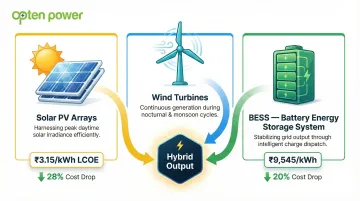
Solar PV arrays serve as the daytime generation anchor. India achieved the second-lowest utility-scale solar LCOE globally at ₹3.15/kWh in 2024, a 10% year-on-year decline, with total installed costs falling 28% in the same period. These economics make solar the cost-effective base layer of most hybrid systems.
Wind turbines cover generation when solar output is low — at night, during monsoon cloud cover, and in winter. Wind resource assessment is critical here: poorly sited capacity leads to excess curtailment or missed supply commitments.
Battery Energy Storage Systems (BESS) absorb surplus generation and release stored energy during demand peaks or output gaps. Global lithium-ion battery pack prices fell to ₹9,545/kWh in 2024 — a 20% year-on-year drop — making BESS economically viable for C&I applications and enabling intermittent hybrid systems to deliver firm, schedulable power.
Types of Hybrid Renewable Energy Configurations
Solar + Wind
Solar + Wind works best where strong annual wind speed and solar irradiance overlap. The core advantage is natural complementarity — wind and solar offset each other's seasonal and diurnal variability without requiring expensive storage.
The Solar Energy Corporation of India (SECI) recently awarded 1.8 GW under Hybrid Tranche-VIII and IX to developers including JSW Neo Energy, ACME Solar Holdings, and Juniper Green Energy — making this the most common utility-scale hybrid configuration in India.
Solar + BESS
Best fit: C&I buyers and distributed energy applications where wind resources are limited. The solar array charges batteries during the day; BESS dispatches power after sundown. With battery costs falling sharply, this configuration is now bankable for industrial buyers who need reliable night-time supply but lack viable wind resources on-site.
Wind + BESS
Best fit: Sites with strong nocturnal wind resources but limited solar potential. BESS smooths wind intermittency and enables peak-hour dispatch — converting an intermittent resource into a consistent, schedulable power supply.
Solar + Wind + BESS (Tri-Generation)
Best fit: Industries requiring 24x7 continuous supply — data centers, large manufacturers, and hospitals. Tri-generation delivers near-firm power with high Plant Load Factor (PLF), making it the only hybrid configuration capable of replacing baseload grid dependence at scale.
Real-world examples include:
- Kennedy Energy Park (Australia): Combines 15 MW solar PV, 43.2 MW wind, and 2 MW/4 MWh lithium-ion battery
- Wheatridge Renewable Energy Facility (Oregon, USA): Co-locates 300 MW wind, 50 MW solar, and 30 MW battery storage
Emerging Hybrid Variants
Solar + Green Hydrogen: Uses electrolysis-based storage for seasonal and long-duration energy needs. This is at an earlier commercial stage but gaining attention for industrial decarbonization.
Hydro + Solar/Wind: Pairs pumped hydro storage with intermittent renewables for long-duration storage applications.
Benefits of Hybrid Renewable Energy Projects
Higher Capacity Utilization and Reduced Curtailment
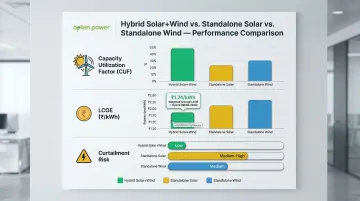
Hybrid systems achieve significantly higher Capacity Utilization Factors (CUF) than standalone solar or wind because generation sources complement each other. IRENA's 2024 benchmarking puts the weighted average LCOE of solar+wind hybrids at ₹1.74/kWh — driven largely by higher CUF reducing per-unit generation costs. Standalone solar, by comparison, saw 2.3 TWh curtailed in India in just eight months due to grid constraints.
Grid Reliability and Firm Power Supply
Hybrid projects with storage can commit to firm supply schedules with DISCOMs or corporate offtakers — a non-negotiable requirement for industries where power interruptions cause direct revenue loss:
- Steel and cement plants with continuous kilns and furnaces
- Data centers with uptime SLA commitments
- Hospitals and healthcare facilities
- Process industries running 24x7 operations
Standalone renewables cannot match this reliability without expensive backup diesel generators.
Cost Competitiveness Over the Long Run
While upfront capital costs are higher, shared land, shared transmission infrastructure, and higher CUF reduce the levelized cost of energy (LCOE). C&I buyers can lock in long-term tariffs below grid parity through Power Purchase Agreements (PPAs) for hybrid projects.
With solar LCOE at ₹3.15/kWh and BESS costs at ₹9,545/kWh, Solar+Wind+BESS hybrids are already undercutting India's rising industrial grid tariffs. Platforms like Opten Power let businesses compare real-time tariffs and IRR across hybrid project developers before signing a PPA — turning a complex procurement decision into a data-driven one.
Environmental and Regulatory Benefits
Hybrid projects help C&I consumers meet their Renewable Purchase Obligations (RPO) more efficiently and contribute to Scope 2 emissions reduction under ESG and decarbonization commitments. Round-the-clock hybrid power counts toward both solar and non-solar RPO categories simultaneously, maximizing compliance value with a single procurement contract.
The Technology Stack: How Hybrid Systems Deliver Consistent Power
Hybrid Energy Management System (HEMS)
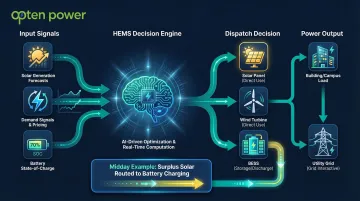
The HEMS is the brain of a hybrid project. It uses generation forecasts, demand signals, and battery state-of-charge data to dynamically dispatch power from the optimal source at every moment.
For example, if solar output exceeds demand at midday, HEMS directs surplus power to charge batteries. When demand peaks in the evening and solar drops, it dispatches from wind and batteries to ensure the committed power schedule is met.
Shared Grid Interconnection Infrastructure
Co-locating multiple generation assets on a single Point of Connection (PoC) reduces overall project cost compared to building separate grid connections for each technology. Under India's MNRE policy, no additional connectivity or transmission capacity charges are levied for hybridization at existing plants if the already granted transmission access is used. This shared infrastructure includes transformers, switchgear, and transmission lines.
Resource Assessment and Project Sizing
Developers use multi-year wind and solar data modeling to determine the optimal ratio of solar capacity to wind capacity to storage capacity. An incorrect ratio leads to two costly outcomes:
- Excess curtailment — over-sized generation that cannot be absorbed by storage or the grid, eroding revenue
- Supply gaps — under-sized storage that fails to cover demand during generation troughs, triggering penalties
Getting this ratio right is what makes a hybrid project bankable. Lenders and off-takers scrutinize resource assessment reports closely; a weak study can delay financial closure by months.
Challenges in Developing Hybrid Renewable Energy Projects
Land Availability and Multi-Resource Site Identification
Truly high-yield hybrid sites require both good solar irradiance and adequate wind speeds, which narrows viable geography. Co-locating solar arrays and wind turbines on the same site increases land footprint compared to standalone projects, creating land acquisition challenges in densely populated or agriculturally valuable regions.
Grid Connectivity and Inter-State Transmission
Hybrid projects face challenges securing evacuation infrastructure. The Ministry of Power extended a 100% ISTS charge waiver to BESS co-located with renewables until June 30, 2028, reducing transmission costs for storage-integrated projects. Even so, transmission infrastructure buildout consistently lags project commissioning, creating evacuation bottlenecks that delay commercial operations.
Higher Upfront Capital Cost and Financing Complexity
While long-run economics are favourable, hybrid projects require larger initial capital outlay and more complex finance structures. Key factors that strain bankability include:
- Multiple technology vendors, each with separate warranties and performance guarantees
- Heightened lender due diligence across solar, wind, and storage components
- Equity investors pricing in technology-mix risk, raising the cost of capital
Smaller developers face the steepest hurdles here, often lacking the balance sheet strength to absorb these structuring costs without specialist financing support.
India's Hybrid Renewable Energy Market: Policy and Procurement
National Wind-Solar Hybrid Energy Policy (2018)
India's MNRE policy defines a hybrid project as requiring the secondary resource to be at least 25% of the primary resource's capacity. Key provisions include ISTS charge waivers and standardised grid connection protocols. SECI and NTPC have tendered multi-GW-scale hybrid projects under this framework. SECI's recent awards totalled over 11 GW across various renewable schemes, including significant hybrid capacity.
C&I Buyer Opportunity in India's Hybrid Market
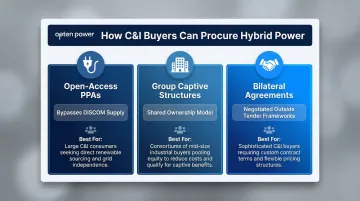
Industrial consumers can procure hybrid power through several routes:
- Open-access PPAs — direct agreements with generators, bypassing DISCOM supply
- Group captive structures — shared ownership models for eligible industrial consumers
- Bilateral agreements — negotiated contracts outside standard tender frameworks
Hybrid PPAs are particularly attractive for 24x7 consumers because they deliver more reliable round-the-clock green power than standalone solar PPAs. Platforms like Opten Power aggregate 4+ GW of hybrid, solar, and wind capacity across 16 states — with real-time DISCOM landing prices and automated RFP tools — helping C&I buyers compare options and close deals without the usual procurement delays.
Key States for Hybrid Project Development
State selection significantly affects both project viability and landed power costs. The five states with the strongest complementary wind-solar resource profiles are:
- Rajasthan
- Gujarat
- Tamil Nadu
- Karnataka
- Andhra Pradesh
Regulatory frameworks vary considerably across these states. Three cost variables that shift materially by jurisdiction are wheeling charges, cross-subsidy surcharges, and banking provisions — each set independently by the respective State Electricity Regulatory Commission (SERC). Tracking these in real time is essential before committing to any hybrid PPA.
Frequently Asked Questions
What is a hybrid renewable energy project?
A hybrid renewable energy project combines two or more renewable energy sources—most commonly solar and wind, often with battery storage—at a shared site to produce more consistent, dispatchable clean power than any single source alone.
What is an example of a hybrid energy system?
In India, SECI has tendered multiple GW-scale wind-solar hybrid projects awarded to developers like JSW Neo Energy and ACME Solar Holdings. Internationally, the Kennedy Energy Park in Australia and the Wheatridge Renewable Energy Facility in Oregon (both wind + solar + BESS) are widely cited examples.
What are the main types of hybrid renewable energy configurations?
The four primary configurations are Solar + Wind, Solar + BESS, Wind + BESS, and Solar + Wind + BESS (tri-generation). The tri-generation configuration delivers the most consistent output and is favoured for 24x7 applications.
How does battery storage improve a hybrid renewable energy project?
BESS absorbs surplus generation during high-output periods and dispatches stored energy during low-generation or peak-demand windows. This converts an intermittent hybrid system into a firm, schedulable power source capable of meeting committed supply schedules.
Are hybrid renewable energy projects suitable for industrial and commercial consumers?
Hybrid projects are especially well-suited for 24x7 industrial consumers like steel, cement, data centres, and hospitals. Compared to standalone solar or wind, they offer greater supply reliability, better RPO compliance, and long-term tariff certainty through PPAs.
Are hybrid renewable energy projects more expensive than standalone solar or wind?
Upfront capital costs are higher, but shared infrastructure savings, higher CUF, and a lower lifetime LCOE make hybrid projects more cost-competitive per unit. With solar LCOE at ₹3.15/kWh and BESS costs at ₹9,545/kWh (2024), the economics have shifted firmly in hybrid's favour.