Introduction
India's average cost of power supply more than doubled in 14 years — from ₹3.40/kWh in 2008-09 to ₹7.11/kWh in 2022-23. For commercial and industrial buyers, this isn't just a statistic. It's a direct hit to operating margins.
Rising DISCOM tariffs, state-by-state regulatory variations, and tightening Renewable Purchase Obligations have turned energy from a routine utility line item into one of the most consequential decisions a business makes.
For sectors like steel and cement—where energy accounts for 20-40% of production costs—even marginal tariff increases directly erode margins. Yet many businesses still rely on fragmented data, manual procurement processes, and reactive decision-making — leaving measurable savings on the table.
This article examines the four most common challenges in commercial energy procurement: tariff complexity, supplier comparison, regulatory compliance, and contract risk — and provides practical strategies to overcome each one.
Key Takeaways
- Price volatility demands portfolio strategies — long-term PPAs paired with flexible contracts — not reactive spot buying
- Regulatory complexity across states demands real-time market intelligence and standardised cost comparisons
- Manual procurement delays savings; automation cuts deal timelines by up to 50%
- Verified developer capacity across 16 states is accessible through platforms that aggregate and vet renewable supply in one place
Why Commercial Energy Procurement Has Become More Complex
Energy is no longer a simple utility bill. For commercial and industrial businesses, it represents one of the largest operational costs and a strategic lever for both competitiveness and sustainability. In highly energy-intensive sectors like cement, power and fuel account for approximately 30% of total manufacturing costs, making effective procurement essential to maintaining margins.
The Indian energy landscape has shifted dramatically. The Green Energy Open Access Rules 2022 reduced eligibility thresholds from 1 MW to 100 kW, theoretically opening renewable procurement to a broader range of consumers. By November 2024, 28 out of 29 states had adopted GEOA regulations, creating a patchwork of state-level frameworks with varying tariff structures, approval timelines, and charges.
India's renewable energy push is accelerating alongside this regulatory expansion. The country achieved 266.78 GW of non-fossil fuel capacity by December 2025, representing 51.93% of total installed capacity, with the government targeting 500 GW by 2030. For businesses, that growth brings real procurement opportunities — and a more complex decision environment.
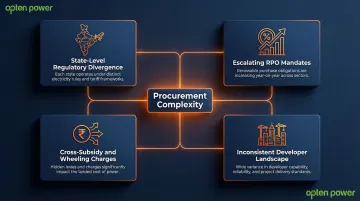
What's driving this complexity:
- State-level regulatory divergence in DISCOM tariffs and open access frameworks
- Escalating RPO mandates requiring businesses to source minimum renewable percentages
- Cross-subsidy surcharges, wheeling charges, and banking fees varying significantly by state
- Growing developer landscape with inconsistent track records and delivery timelines
Yet many businesses still rely on fragmented data, spreadsheet comparisons, and reactive purchasing. In a market this dynamic, that approach consistently leads to overpaying and missed procurement windows.
Challenge 1: Managing Price Volatility and Unpredictable Energy Costs
The Problem with Reactive Energy Buying
Relying on short-term or spot purchases exposes businesses to price spikes that directly disrupt financial planning. Tamil Nadu's HT-I industrial tariff increased from ₹6.90/kWh to ₹7.25/kWh in July 2024, a 5% jump that translates to crores of rupees in additional costs for large consumers.
For energy-intensive industries, unpredictable tariffs create cascading planning problems. When energy represents 20-40% of production costs, a 5-10% tariff increase can eliminate margins entirely. The effects spread across departments:
- Finance teams struggle to forecast budgets with any reliability
- Procurement teams lose negotiating leverage without visibility into future pricing
- Operations teams face pressure to cut consumption, often at the cost of productivity
How to Build Price Stability Into Your Procurement Strategy
Portfolio approach: The most effective strategy combines long-term Power Purchase Agreements for cost certainty with flexible or short-term contracts to capture market opportunities.
A typical portfolio might allocate:
- 60-70% of consumption to long-term PPAs at fixed rates
- 20-30% to medium-term contracts with indexed pricing
- 10-20% to flexible purchasing for opportunistic savings
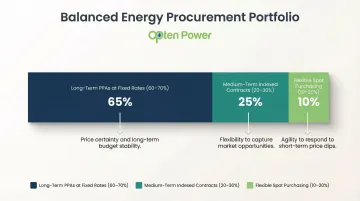
Hedging and scenario planning: Leading procurement teams model purchasing decisions against multiple scenarios — tariff hikes, grid congestion, new DISCOM charges — before committing capital. Running best-case, base-case, and worst-case projections ensures a contract remains viable even if the regulatory environment shifts.
Corporate PPAs as stability tools: Corporate PPAs enable businesses to lock in renewable energy at predictable rates for 10-25 years, providing both cost certainty and sustainability benefits. The C&I open access market grew 90.4% between FY2023 and FY2024, reaching 18.7 GW cumulative capacity, demonstrating strong demand for long-term renewable contracts.
Opten Power's platform lets businesses access and compare Corporate PPAs across 4+ GW of projects in 16 states, with real-time savings and IRR analysis. Teams can evaluate multiple developers and contract structures side by side — with numbers, not assumptions.
Challenge 2: Navigating Regulatory Complexity Across Multiple States
Why Multi-State Operations Make Compliance Especially Difficult
India's fragmented DISCOM landscape creates significant challenges for businesses operating across multiple states. Tariffs, open access charges, and approval timelines differ dramatically—making it difficult to compare true landed energy costs.
Cross-subsidy surcharge variations:
- Maharashtra: ₹1.82/kWh for HT-I Industry (FY2025-26)
- Tamil Nadu: ₹1.92/kWh for HT-IA Industry (FY2024-25)
- Gujarat: ₹1.53/kWh for HTMD-1 (FY2024-25)
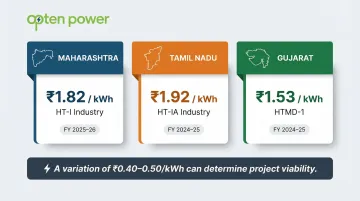
These variations can swing landed costs by ₹0.40-0.50/kWh—enough to make an economically attractive project in one state unviable in another.
Two further layers add complexity for multi-state buyers:
RPO/RCO compliance obligations vary by state and consumer category. Current targets for 2024-25 stand at 29.91% for Tamil Nadu, Karnataka, and Maharashtra, scaling to 43.33% by 2029-30. Non-compliance carries penalties, yet each state uses different calculation methodologies—turning what should be a straightforward obligation into a multi-jurisdictional tracking exercise.
Mid-term policy shifts can alter contract economics with little warning. Tamil Nadu introduced an 8% banking charge and shifted to 15-minute time block settlement in 2025, eliminating annual banking and changing the financial calculus for solar projects that depend on banking excess generation.
How to Stay Ahead of Regulatory Change
Procurement teams that operate across states need a structured approach to regulatory monitoring—not just periodic checks at contract renewal. Two practices make the biggest difference:
Set up a formal monitoring cadence that covers State Electricity Regulatory Commission orders, DISCOM tariff revisions, and open access notifications across every state where you hold contracts. Key areas to watch:
- Cross-subsidy surcharge revisions (announced during tariff petitions)
- Banking and settlement rule changes
- RPO target updates and compliance deadlines
- Open access charge notifications
Use real-time market intelligence tools to eliminate manual research. Platforms like Opten Power's Real-Time DISCOM Intelligence provide standardised, updated landing prices across all states for direct cost comparisons. When regulatory changes occur, these tools recalculate landed costs automatically—so teams catch the impact immediately rather than during reconciliation months later.
Challenge 3: Slow, Manual Procurement Processes That Delay Savings
The Hidden Cost of Inefficient Procurement
Traditional energy procurement—spreadsheet-based comparisons, manual RFP creation, back-and-forth negotiations—takes months. The Ministry of Power's guidelines indicate the entire procedure from Request for Selection to signing power agreements should take about 140 days. In practice, many businesses take 6-9 months.
The compounding cost of delay: For a mid-sized manufacturing unit spending ₹7 crore annually on electricity at ₹7/kWh, delaying procurement by six months while a ₹4.50/kWh PPA remains unsigned means paying an extra ₹2.50/kWh for 50 lakh units—₹1.25 crore in foregone savings.
Every month at higher tariffs represents measurable opportunity cost. When procurement teams are buried in administrative work, strategic activities—market analysis, supplier relationship management, portfolio optimisation—get deprioritised. The solution isn't just working faster. It's rebuilding the process itself.
What a Modern Procurement Process Looks Like
Key elements of streamlined procurement:
- Standardised RFP templates eliminating repetitive document creation
- Automated shortlisting of developer proposals based on predefined criteria
- Pre-approved contract structures reducing legal negotiation cycles
- Single dashboard for comparing tariffs, savings, and ROI in real time
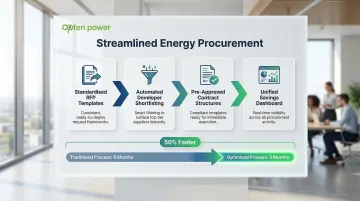
Opten Power's Automated Tender Engine handles RFP creation, distribution, and management using modular templates—cutting a typical 6-month process down to 3 months by eliminating manual coordination and standardising commercial terms.
When all energy assets and contracts are visible in one place, procurement and finance teams make faster, better-coordinated decisions—without chasing data across departments or waiting on status updates. A portfolio management dashboard gives leadership a clear, current picture of every contract, tariff, and savings milestone.
Challenge 4: Identifying and Vetting Reliable Renewable Energy Suppliers
Not all renewable energy developers have the same track record for delivery timelines, grid connectivity, or financial stability. In India's growing renewable market, a poorly vetted developer can delay a project by 12–18 months—or worse, result in contract termination.
From 2020 to 2024, 38.3 GW of utility-scale renewable capacity was cancelled, representing 19% of total issued capacity. India's cumulative unsigned Power Sale Agreement capacity exceeded 40 GW, largely due to offtaker expectations of falling tariffs—but also reflecting developer execution challenges.
Thorough due diligence needs to cover:
- Developer credentials and project completion track record
- Transmission connectivity status and grid approval timelines
- State-level approvals and land acquisition progress
- Financing status and balance sheet strength
- Technology partnerships and EPC contractor quality
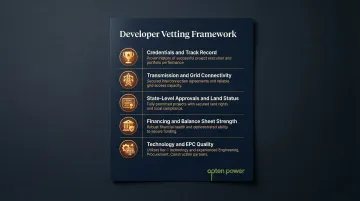
Each of these areas demands specialized knowledge. Evaluating 5–10 developers across multiple states requires legal, technical, and financial expertise that most procurement teams don't have in-house—and that gap is where projects most often go wrong.
Platforms that pre-vet developers and aggregate verified capacity across regions address this directly. When businesses can compare developers across solar, wind, and hybrid projects in one place—with connectivity status, financing health, and track record already screened—the process moves faster and with far less exposure to execution risk. Opten Power, for instance, aggregates 4+ GW of pre-verified capacity across 16 states through partnerships with India's leading power producers, giving procurement teams a credible starting point rather than a blank slate.
Turning These Challenges Into a Smarter Procurement Strategy
Businesses that treat energy procurement as a strategic category — with defined governance, cross-functional ownership, and decisions based on real-time tariff data and regulatory analysis — consistently achieve better outcomes than those handling it as a routine administrative task.
Three actionable steps businesses can take immediately:
- Audit current contracts for renewal windows and hidden charges—cross-subsidy surcharges, wheeling fees, banking charges—that may not be explicitly itemised but significantly affect landed costs
- Benchmark current landed energy costs across all operating states using real-time tariff data, not last year's assumptions
- Evaluate at least one long-term PPA or renewable procurement option against current grid costs, including full regulatory impact analysis
As Indian energy markets evolve and RPO targets tighten to 43.33% by 2029-30, businesses that invest in better procurement infrastructure today will have a structural cost advantage over competitors still reacting to market changes. Early movers are already feeling the pressure: PPA tariffs rose by approximately ₹0.25/kWh in Q4 2025 due to Domestic Content Requirement mandates, compressing savings for solar open-access consumers.
Frequently Asked Questions
What are the most common challenges in commercial energy procurement in India?
The top challenges include navigating multi-state regulatory complexity (varying DISCOM tariffs, open access rules, RPO compliance), managing price volatility and unpredictable costs, overcoming slow manual procurement cycles, and identifying reliable renewable energy suppliers at scale.
How does price volatility affect commercial energy buyers?
Unpredictable tariff movements disrupt budgeting and erode margins — a serious problem for energy-intensive industries where power accounts for 20-40% of production costs. Combining long-term PPAs with flexible contracts helps manage this exposure by locking in base load costs while keeping room for spot-market purchasing.
What is a Corporate PPA and how does it help manage energy costs?
A Corporate PPA is a long-term agreement to purchase renewable energy directly from a developer at a fixed or indexed rate, typically for 10-25 years. It provides price certainty and sustainability credentials, with savings often reaching 25-40% compared to grid tariffs.
How do open access regulations affect commercial energy procurement in India?
Open access allows large consumers to buy power outside their local DISCOM, but state-specific charges — wheeling fees, cross-subsidy surcharges, and banking levies — significantly affect net savings. These vary by ₹0.40-0.50/kWh across states, so calculating true landed cost is essential before committing to any procurement structure.
How long does the commercial energy procurement process typically take?
Traditional procurement cycles run 4-6 months or longer, slowed by manual RFP creation, developer screening, and drawn-out contract negotiation. Automated platforms with standardised RFPs and pre-approved contracts can cut that timeline by up to 50%, closing deals in 2-3 months.
What should businesses look for when evaluating renewable energy developers?
Key evaluation criteria include:
- Project delivery track record and commissioning history
- Grid connectivity and transmission approval status
- State-level land and environmental clearances
- Financial stability and balance sheet strength
- Available capacity in the relevant geography
Working with a marketplace that pre-vets developers across these criteria significantly compresses due diligence timelines.