Introduction
In 2025 alone, corporations signed deals for 55.9 GW of clean power globally — the clearest signal yet that long-term renewable energy contracts have replaced spot purchases as the default procurement strategy. For large corporations navigating volatile wholesale prices and tightening ESG mandates, choosing the right PPA provider has become one of the most consequential energy decisions they'll make.
Energy-intensive sectors — manufacturing, data centres, steel, and chemicals — struggle most with unpredictable power costs. A well-structured corporate PPA fixes or floors electricity costs for 10–25 years, delivering both financial certainty and verifiable green credentials.
This guide covers the top companies offering PPAs to large corporations worldwide, what sets each apart, and how to evaluate the right fit for your energy portfolio.
Key Takeaways
- Corporate PPAs lock in renewable energy prices for 10–25 years, providing cost certainty and sustainability credentials
- Global corporate PPA market hit 55.9 GW in 2025, driven by tech, manufacturing, and data centre sectors
- Top providers include ENGIE, EDP Renewables, Lightsource bp, NextEra Energy Resources, and Ørsted
- Shortlisting providers comes down to geographic reach, portfolio diversity, deal flexibility, and execution track record
- Indian C&I buyers can use Opten Power to compare developers across 4+ GW of capacity in 16 states and close deals faster
What is a Corporate PPA and Why Large Corporations Are Adopting It
A Corporate PPA is a direct, long-term contract between a renewable energy generator and a corporate buyer, bypassing the traditional utility model to fix electricity prices for 10–25 years. Two structures dominate the market:
- Physical (sleeved) PPAs involve actual electricity delivery from the generator to the buyer via the grid
- Virtual (synthetic) PPAs are financial contracts for difference where the corporate hedges its electricity price without taking physical delivery — common in disaggregated US energy markets
The Dual Business Case
Corporate PPA adoption is accelerating for two concrete reasons:
- Cost certainty: Long-term price locks protect against volatile wholesale markets, enabling accurate budget forecasting and reduced exposure to energy price spikes
- ESG compliance: PPAs deliver verifiable green power credentials satisfying RE100 commitments (440+ businesses across 140 markets), Science Based Targets (80% renewable electricity by 2025, 100% by 2030), and stricter investor ESG mandates
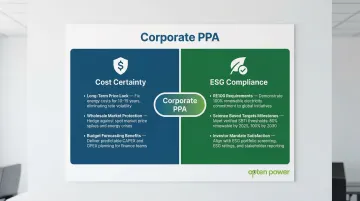
Not all PPA providers are built the same — geography, deal structure expertise, and project pipeline size vary significantly across the companies that dominate this space.
Top Companies Offering PPAs for Large Corporations Worldwide
The companies profiled below were evaluated on renewable capacity under contract, geographic presence, deal structuring capability, and demonstrated track record with large corporate offtakers across multiple sectors.
ENGIE
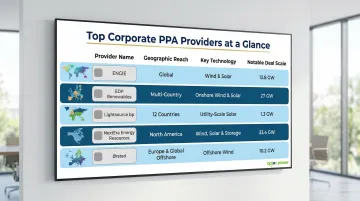
ENGIE ranks as the world's largest seller of renewable corporate PPAs, holding the #1 position according to BloombergNEF with 3.6 GW contracted in 2025 alone. Since 2011, ENGIE has contracted 13.8 GW of corporate PPA capacity globally. The company's International Supply & Energy Management (ISEM) division manages both physical and financial PPA structures for industrial and tech sector clients across five continents.
Key differentiators: ENGIE's multi-commodity capability spans wind, solar, hydro, and biomethane, enabling cross-border and multi-technology deals. Named corporate clients include Apple (80% of 173 MW in Italy under a 15-year PPA), Nestlé, Bosch, and Arkema (25 GWh/year biomethane supply to three French sites). This cross-industry reach demonstrates ENGIE's ability to tailor contracts to diverse operational profiles.
| Attribute | Details |
|---|---|
| Geographic Reach | Active corporate PPA contracts across 5 continents: North America, South America, Asia, Europe, and Oceania |
| Energy Portfolio | Wind, solar, hydro, and biomethane; cross-border and multi-technology deals available |
| Notable Clients / Deal Scale | Apple (173 MW, Italy), Arkema (25 GWh/year biomethane), Bosch, Nestlé; 3.6 GW contracted in 2025 |
EDP Renewables (EDPR)
EDP Renewables is the renewable arm of EDP Group, one of Europe's largest utilities, with a multi-geography PPA offering covering Europe (Germany, France, Italy, Spain, Poland), North America, Brazil, and APAC. EDPR manages 27 GW of capacity worldwide and secured over 2 GW of new PPAs in 2024.
Key differentiators: EDPR's standout capability is structuring multi-country PPAs under a single framework agreement. In 2024, EDPR executed a rare simultaneous multi-country PPA (176 MWp across Germany, France, and Italy) for a single US-based tech company, with contract duration up to 20 years. This bundled approach reduces procurement overhead for multinational corporations, and investment-grade counterparty backing from EDP Group adds financial assurance for offtakers.
| Attribute | Details |
|---|---|
| Geographic Reach | Active PPA markets across Europe (Germany, France, Italy, Spain, Poland), North America, Brazil, and APAC |
| Energy Portfolio | Onshore wind, solar, offshore wind; hybrid and storage-backed deals in development |
| Notable Clients / Deal Scale | Multi-geography contracts with large tech companies (176 MWp across Germany, France, Italy); 2+ GW contracted in 2024 |
Lightsource bp
Lightsource bp is a bp-backed global solar developer that signed 10 corporate PPAs totalling 1.3 GW across Europe, the Americas, and Asia-Pacific in 2024 alone. Following bp's full acquisition in late 2024, the developer now carries bp's balance sheet directly, giving corporate offtakers stronger financial counterparty assurance on large-scale, cross-border VPPAs.
Key differentiators: Strong pipeline of development-stage solar assets allows long-term PPA lock-ins before project commissioning. bp's balance sheet backing provides financial security for corporate offtakers. Demonstrated wins in diverse markets including the US, UK, Australia, Japan, Greece, New Zealand, and Portugal.
| Attribute | Details |
|---|---|
| Geographic Reach | Active or contracted PPA deals in 12 countries including US, UK, Australia, Japan, Greece, New Zealand, Portugal |
| Energy Portfolio | Utility-scale solar, agrivoltaic projects, battery storage integration; primarily physical PPAs |
| Notable Clients / Deal Scale | Toyota Motor North America (231 MW VPPA, Texas); 1.3 GW total contracted across 10 PPAs in 2024 |
NextEra Energy Resources
NextEra Energy Resources is the largest generator of renewable energy in North America, with approximately 33.4 GW of total net generating capacity as of December 2024. NEER operates one of the world's largest renewable energy fleets and serves Fortune 500 corporations directly through both physical and virtual PPA structures.
Key differentiators: Unmatched US renewable capacity pipeline enables serving multi-site corporate buyers under master PPA frameworks. Strong track record in both physical and virtual (synthetic) PPAs — the preferred structure in the disaggregated US energy market. In 2025, NEER signed 2.5 GW across 13 projects with Meta alone, including 2.1 GW through nine solar projects across ERCOT, SPP, and MISO.
| Attribute | Details |
|---|---|
| Geographic Reach | Primarily North America (US and Canada); strategic focus on long-term contracted assets throughout the region |
| Energy Portfolio | Wind, solar, and battery storage; one of the largest wind portfolios globally |
| Notable Clients / Deal Scale | Meta (2.5 GW across 13 projects), DuPont (135 MW wind VPPA, Texas); 33.4 GW operating capacity |
Ørsted
Ørsted is the world's largest offshore wind developer by installed capacity — 10.2 GW operational and 8.1 GW under construction — making it a primary PPA partner for corporations with sustainability mandates requiring firm, large-scale renewable supply. Headquartered in Denmark, Ørsted operates projects across Europe, the US, and APAC.
Key differentiators: Offshore wind PPAs deliver consistent, high-capacity factor power suited for energy-intensive industries such as steel, chemicals, and data centres. Ørsted's project pipeline covers the UK, Germany, Denmark, Netherlands, Taiwan, South Korea, and the US East Coast. Typical contract durations range from 15–25 years, longer than most onshore renewable PPAs.
| Attribute | Details |
|---|---|
| Geographic Reach | Europe (UK, Germany, Denmark, Netherlands), US East Coast, Taiwan, South Korea |
| Energy Portfolio | Offshore wind (primary), onshore wind, solar; long-term contracts of 15–25 years typical |
| Notable Clients / Deal Scale | Google (50 MW, Germany), Amazon (250 MW, Germany), Covestro (100 MW, Germany), TSMC (920 MW, Taiwan) |
How We Chose These PPA Providers
The companies were shortlisted based on three objective criteria:
- Independently verified renewable capacity under corporate PPA contract — using BloombergNEF or equivalent rankings to confirm deal volume and market position
- Active multi-geography presence — demonstrated ability to serve large corporate offtakers across sectors and continents
- Deal flexibility — including both physical and virtual PPA structures to accommodate different regulatory environments and corporate needs
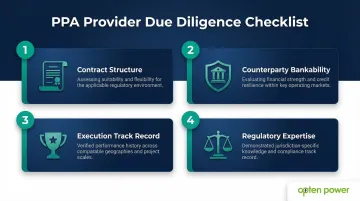
A common mistake large corporations make is shortlisting PPA providers on brand name alone. A PPA is a 10–25 year commitment, so due diligence must go deeper. Evaluate each provider against:
- Contract structure suitability for your regulatory environment
- Counterparty bankability in your specific operating markets
- Project execution track record across comparable geographies
- Regulatory expertise in your jurisdictions
For Indian enterprises applying these same criteria to domestic developers, the comparison process is more complex — tariffs, DISCOM regulations, and contract templates vary significantly by state. Opten Power addresses this directly: its marketplace covers 4+ GW of renewable capacity across 16 states, with real-time tariff data, automated RFP tools, and pre-approved contract templates that cut deal timelines by up to 50%.
Conclusion
The corporate PPA market is no longer niche. With 55.9 GW contracted globally in 2025, it is the primary route for large corporations to lock in cost-competitive renewable energy at scale. The five providers profiled — ENGIE, EDP Renewables, Lightsource bp, NextEra Energy Resources, and Ørsted — collectively span every major region and cover both physical and virtual deal structures, giving procurement teams a strong starting point for shortlisting.
Procurement and sustainability teams should evaluate providers not just on headline capacity but on regulatory track record in their specific operating countries, contract structure options (physical vs. virtual), and financial bankability. Since a PPA is a 10–25 year commitment, counterparty due diligence is critical.
For Indian enterprises navigating this process, Opten Power provides a direct path from evaluation to execution. The platform lets you compare developers across 16 states, model IRR and payback in real time, and close deals up to 50% faster with automated RFPs and pre-approved contracts. Get started at app.optenpower.com.
Frequently Asked Questions
Which companies offer PPAs to large corporations internationally?
The top global providers are ENGIE, EDP Renewables, Lightsource bp, NextEra Energy Resources, and Ørsted. Regional specialists also operate in Asia-Pacific, Latin America, and the Middle East, serving specific markets with localized expertise.
Who is the largest corporate buyer of renewable energy?
Technology companies — particularly Amazon, Microsoft, Google, and Meta — consistently rank as the largest corporate buyers of renewable PPAs globally. Amazon leads for grid impact, having displaced 35.5 megatons of CO2 by purchasing over 45 GW of renewable capacity.
How big is the global PPA market?
Corporations announced deals for 55.9 GW of clean power in 2025, representing a 10% decrease from the record 62.1 GW set in 2024, according to BloombergNEF. The market remains robust despite grid congestion and policy uncertainty slowing growth.
What is the difference between a physical PPA and a virtual PPA?
A physical (sleeved) PPA involves actual electricity delivery from the generator to the corporate buyer via the grid. A virtual (synthetic) PPA is a financial contract for difference where the corporate hedges its electricity price without taking physical delivery — common in the US.
How long do corporate PPAs typically last?
Corporate PPAs typically run for 10–25 years, varying by market and technology. Terms of 10–15 years are common in Europe and India, while the US favors 15–20 year structures. The duration reflects both the project's financing needs and the buyer's procurement horizon.
What are the key risks large corporations should assess before signing a PPA?
The three risks to evaluate are price basis risk (gap between strike price and market price), volume risk (renewable output variability against actual load), and counterparty credit risk (the generator's financial durability over a long contract term). Most buyers address these through output-firming agreements and credit support provisions negotiated upfront.