Introduction
Manual procurement and accounts payable processes quietly drain enterprise resources — and the numbers make the scale hard to ignore. According to Ardent Partners' 2025 benchmarks, the average cost to process a single invoice is $9.84, with cycle times stretching over 8 days and an invoice exception rate of 18.4%. For organizations processing tens of thousands of invoices annually, these inefficiencies translate into lost profit margins and strained supplier relationships.
Procure-to-pay automation solves this by connecting every step — from purchase requisition and approval workflows to invoice matching and vendor payment — in one structured digital workflow. This eliminates manual handoffs, reduces coding errors, and closes the cost leakage that occurs when procurement and AP operate in silos.
What follows is a platform-by-platform breakdown of the best P2P automation solutions in 2026 — evaluated on ERP compatibility, workflow depth, and the specific operational contexts where each one performs best.
Key Takeaways
- P2P automation manages the full purchasing lifecycle — request, PO, receipt, invoice, payment — in one digital system
- Key criteria: ERP integration quality, AI-driven automation, workflow flexibility, adoption ease, total cost of ownership
- Top platforms: SAP Ariba (enterprise), Coupa (unified spend management), Stampli (fast AI deployment), Procurify (mid-market), Precoro (accessible pricing)
- The right choice depends on company size, ERP environment, and whether you're digitizing procurement for the first time or optimizing at scale
What Is Procure-to-Pay Automation and Why Does It Matter in 2026
Procure-to-pay automation is software that manages the full purchasing lifecycle — from purchase requisition through vendor payment — in a single digital workflow.
The six core stages it covers are:
- Purchase requisition — employees submit requests for goods or services
- Approval workflow — managers review and approve requests based on budget and policy
- PO issuance — approved requests generate purchase orders sent to vendors
- Goods receipt — receiving teams confirm delivery and quality
- Invoice matching — AP verifies invoices against POs and receipts (2-way or 3-way matching)
- Payment — approved invoices trigger vendor payments
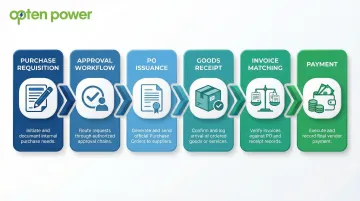
Connecting these six steps into one continuous workflow eliminates duplicate data entry, reduces approval delays, and delivers real-time spend visibility that disconnected manual handoffs simply cannot.
P2P automation has become a strategic priority in 2026 as AI and machine learning capabilities have matured rapidly. By the end of 2024, 74% of AP departments expected to use AI in some capacity. Today, AI handles high invoice volumes, detects anomalies, automates GL coding, and runs real-time spend analytics — tasks that required manual intervention or rigid rule-based systems just two years prior.
That expanded capability is pushing organizations beyond indirect spend (office supplies, IT, services) into strategic categories like energy, logistics, and direct materials. Gartner forecasts that supply chain management software with agentic AI will grow from under $2 billion in 2025 to $53 billion by 2030, driven by platforms that autonomously execute procurement workflows — making platform selection in 2026 a decision with long-term financial weight.
Best Procure-to-Pay Automation Platforms in 2026
These platforms were selected based on breadth of automation, ERP integration depth, AI capabilities, user adoption track record, and suitability across business sizes.
SAP Ariba
SAP Ariba is a cloud-based, enterprise-grade procurement and source-to-pay platform widely used by large multinational organizations for sourcing, supplier management, invoice processing, and spend analysis.
Key differentiators:
- Ariba Network facilitates $6.1 trillion in annual commerce across 761 million B2B transactions in 190 countries
- Deep native integration with SAP S/4HANA and SAP ERP
- Strong compliance and audit trail features
- AI-embedded analytics for spend visibility
The platform carries a steep learning curve and high implementation cost, making it best suited for large enterprises with dedicated IT resources and existing SAP infrastructure.
| Criteria | Details |
|---|---|
| Key Features | End-to-end S2P automation, supplier network access, AI-powered spend analysis, contract management, invoice management |
| Best For | Large multinational enterprises with complex procurement needs and existing SAP ERP environments |
| Pricing Model | Custom pricing; contact vendor for quote |
Coupa
Coupa is the widely recognized market leader in business spend management, offering a comprehensive AI-native platform that covers sourcing, procurement, invoicing, expense management, supplier collaboration, and supply chain visibility.
Key differentiators:
- Real-time analytics and reporting across all spend categories
- Global community of over 10 million buyers and suppliers
- Supplier collaboration tools backed by $9.5 trillion in spend data
- Navi AI agent portfolio for autonomous transaction execution
- Named a Leader in the 2026 Gartner Magic Quadrant for Source-to-Pay Suites
Its breadth can mean longer implementation timelines and higher costs, making it most suitable for large to mid-market enterprises with mature procurement functions.
| Criteria | Details |
|---|---|
| Key Features | Strategic sourcing, procurement management, AP automation, expense management, supply chain design, spend analytics |
| Best For | Large to mid-market enterprises needing a unified spend management platform across procurement, AP, and expenses |
| Pricing Model | Custom pricing via partner network; contact vendor for quote |
Stampli
Stampli is an AI-powered procure-to-pay and AP automation platform known for its "Billy the Bot" AI co-pilot, which learns from historical invoice patterns to automate coding, routing, and exception handling. It has expanded from AP automation into full P2P with purchase request and PO functionality.
Key differentiators:
- Fastest deployment in the category — typically live in weeks, not months
- Rated 4.6/5 on G2 (1,883 reviews) and 4.8/5 on Capterra (463 reviews)
- Pre-built integrations with 70+ ERPs including SAP, Oracle NetSuite, Microsoft Dynamics, Sage Intacct, and QuickBooks
- Implementation maps to existing workflows rather than replacing them
Reporting capabilities and advanced procurement features are still maturing relative to enterprise-grade S2P platforms.
| Criteria | Details |
|---|---|
| Key Features | AI invoice automation (Billy the Bot), 3-way PO matching, purchase requests and POs, vendor management, pre-built ERP integrations |
| Best For | Mid-market and enterprise businesses that want fast AP automation with an expanding P2P capability and minimal implementation disruption |
| Pricing Model | Custom pricing; contact vendor for quote |
Procurify
Procurify is an AI-powered intake-to-pay platform designed for mid-sized organizations, combining purchase requisitions, approval workflows, PO management, AP automation, expense management, and spend analytics in a centralized, user-friendly system.
Key differentiators:
- Strong mobile app for on-the-go approvals and purchase requests
- AI-assisted intake auto-fills requests from uploaded quotes
- Natural-language Spend Insights for real-time budget queries
- ERP integrations with QuickBooks, NetSuite, Sage Intacct, and Microsoft Dynamics
- Rated 4.6/5 on G2 (319 reviews) and 4.6/5 on Capterra (198 reviews)
Pricing is not publicly listed, and it may lack the sourcing depth required by large enterprises.
| Criteria | Details |
|---|---|
| Key Features | AI intake, purchase requisitions, approval workflows, PO management, AP automation, budget management, mobile app, spend insights |
| Best For | Mid-sized businesses and scaling teams that want proactive spend control, AP automation, and user-friendly procurement in one platform |
| Pricing Model | Custom pricing based on company size and usage; contact vendor for quote |
Precoro
Precoro is an AI-powered procurement automation platform built for mid-sized businesses, connecting intake, approvals, budgets, supplier management, purchasing, and AP automation in a single system — with a strong emphasis on ease of setup, fast adoption, and multi-entity management for companies with multiple locations or subsidiaries.
Key differentiators:
- Consistently rated among the easiest P2P platforms to implement without IT involvement
- AI Assistant supports natural-language spend queries for granular visibility
- Rated 4.8/5 on Capterra (254 reviews) and 4.7/5 on G2 (194 reviews)
- Integrates with NetSuite, QuickBooks Online, Xero, Sage Intacct, and Microsoft Dynamics 365 Business Central
Designed to layer on top of an existing ERP rather than replace it — not a substitute for dedicated inventory management systems.
| Criteria | Details |
|---|---|
| Key Features | AI invoice capture, 3-way matching, purchase requisitions, approval workflows, budget tracking, vendor management, spend reporting, multi-entity support |
| Best For | Mid-sized businesses with fragmented purchasing across teams or locations that need a fast, structured P2P layer on top of their existing ERP |
| Pricing Model | Core and Automation tiers starting at $499/month billed annually; Enterprise pricing on request |
How We Chose the Best P2P Automation Platforms
Each platform on this list was evaluated across six criteria:
- Automation coverage from requisition through payment
- AI and OCR capabilities for invoice processing
- ERP integration quality with major systems
- Ease of deployment and user adoption
- Customer satisfaction scores from G2 and Capterra
- Scalability across business sizes
The most common buyer mistake: selecting on features alone, without accounting for total cost of ownership, implementation complexity, and workflow fit.
Key Factors Tied to Business Outcomes
These four factors consistently separate high-performing P2P implementations from stalled ones:
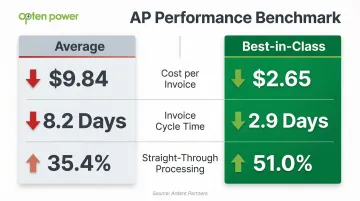
- Automation depth: Directly cuts invoice cycle times and processing errors. According to Ardent Partners, best-in-class operations process invoices for $2.65 versus $9.84 at average organizations — and in 2.9 days versus 8.2 days. (Figures in USD from Ardent Partners U.S. research.)
- ERP integration quality: Native connectors for SAP, NetSuite, and Microsoft Dynamics eliminate duplicate data entry and accelerate financial close cycles.
- Ease of use: Platforms that map to existing workflows — rather than forcing process redesigns — reach time-to-value faster. Adoption drives ROI, not features alone.
- Vendor support during implementation: Organizations that wait for full ERP upgrades before launching P2P projects routinely delay savings by 12–18 months. Sequencing matters.
| Metric | Average Performance | Best-in-Class Performance |
|---|---|---|
| Cost per Invoice | $9.84 | $2.65 |
| Invoice Cycle Time | 8.2 days | 2.9 days |
| Straight-Through Processing | 35.4% | 51.0% |
Conclusion
Choosing the right P2P automation platform is not about finding the most feature-rich tool — it is about finding the solution that fits your organization's size, process complexity, ERP environment, and adoption capacity. A platform that works brilliantly for a global enterprise may be overkill for a mid-sized company needing straightforward purchasing control.
Assess scalability, total cost of ownership, integration reliability, and vendor support before finalizing a decision. Start with a personalized demo to see how each platform handles your specific workflows, and validate vendors by requiring proof of high Straight-Through Processing rates in your ERP environment.
Procurement automation is no longer limited to office supplies and indirect spend. Enterprises are increasingly applying the same principles to strategic categories like energy procurement.
Opten Power's automated tender engine and RFP management platform gives commercial and industrial businesses in India a direct path to faster, more transparent energy sourcing. The platform handles:
- Comparing developer offers in real time with instant IRR and payback analysis
- Closing power purchase agreements 50% faster using pre-approved contract templates
- Accessing standardized DISCOM intelligence across 16 states
Frequently Asked Questions
What's the best procurement automation platform?
No single platform fits every organization. The right choice depends on company size, ERP environment, and process complexity. Coupa and SAP Ariba lead for large enterprises with complex global procurement needs, while Stampli, Procurify, and Precoro suit mid-market buyers with faster deployment and easier adoption.
What is the procurement trend in 2025 and 2026?
The dominant shift is toward AI-powered intake-to-pay automation and agentic AI for autonomous procurement tasks. Digital procurement is also expanding beyond indirect spend into strategic categories like energy, logistics, and direct materials. Gartner forecasts agentic AI adoption in 60% of enterprises using SCM software by 2030.
What is the difference between procure-to-pay and source-to-pay software?
P2P covers the operational cycle from purchase requisition to payment, while S2P extends upstream to include strategic sourcing, contract management, and supplier qualification before any purchase is made. S2P platforms offer broader functionality for organizations managing complex supplier relationships and strategic categories.
How long does it take to implement a P2P automation platform?
Implementation timelines vary widely. Mid-market platforms like Stampli or Precoro can go live in two to four weeks with minimal IT involvement, while enterprise platforms like SAP Ariba or Coupa typically require two to six months of configuration, integration setup, and change management.
Can P2P software integrate with existing ERP systems?
Yes. Most leading P2P platforms offer native connectors for major ERPs like SAP, Oracle NetSuite, Microsoft Dynamics, Sage Intacct, and QuickBooks. Ask vendors specifically about integration architecture, sync frequency, and supported ERP versions to ensure compatibility with your environment.
What features should I prioritize when evaluating P2P platforms?
Focus on these core capabilities first:
- Automated 3-way invoice matching
- Configurable approval workflows
- Reliable ERP integration
- Real-time spend reporting and audit trails
AI-powered invoice capture and mobile accessibility are now table stakes in 2026 — evaluate how mature and production-ready these features are in each platform before committing.