Introduction
India's manufacturing sector consumes 42% of the nation's total electricity, and for energy-intensive industries like steel, cement, and textiles, power costs account for 20% to 40% of total operating expenses. At that share of costs, energy pricing directly determines whether a plant stays competitive or bleeds margin.
Leading manufacturers across India are reducing grid dependency through solar, wind, hybrid systems, and Corporate Power Purchase Agreements (PPAs). Three forces are converging to make this shift urgent: renewable tariffs have fallen below grid rates in most states, Renewable Purchase Obligations (RPO) now carry penalties of up to ₹10 lakh plus double the shortfall value, and global buyers increasingly require verified renewable usage as a supply chain condition.
Each of these pressures has a direct financial consequence — which is why procurement decisions that were once optional are now operationally necessary.
This guide covers which energy sources fit different manufacturing profiles, the main procurement models from rooftop solar to long-term PPAs, the measurable cost and compliance benefits, and a practical starting framework.
TLDR:
- India's RPO framework mandates 43.33% renewable energy by 2029-30, with severe penalties for non-compliance
- Solar PPAs cost ₹2.55–₹2.69/kWh versus grid tariffs exceeding ₹7.00/kWh in many states
- Hybrid solar-wind projects deliver round-the-clock power for continuous manufacturing operations
- Open access thresholds dropped to 100 kW under 2022 Green Energy rules, expanding access to smaller manufacturers
- Opten Power lets buyers compare PPA offers across 16 states with real-time regulatory and savings analysis
Why Manufacturers in India Are Making the Switch to Renewable Energy
Renewable Purchase Obligations (RPO) and Compliance Penalties
The Ministry of Power's 2022 RPO trajectory establishes aggressive renewable energy targets for industrial consumers. The framework mandates total renewable energy procurement rising from 29.91% in 2024-25 to 43.33% by 2029-30, with specific sub-targets including wind (3.48%), hydro (1.33%), and distributed renewable energy (4.50%) by 2030.
Non-compliance triggers severe financial consequences. Under Section 26(3) of the amended Energy Conservation Act 2001, manufacturers failing to meet RPO targets face a base penalty of ₹10 lakh plus twice the price of every metric ton of oil equivalent (TOE) for the shortfall. For large manufacturers, this can translate to crores in annual penalties, making compliance a financial imperative rather than a sustainability preference.
Bureau of Energy Efficiency (BEE) and PAT Scheme
The Perform, Achieve & Trade (PAT) scheme enforces Specific Energy Consumption (SEC) norms across 13 energy-intensive sectors covering 1,104 to 1,196 Designated Consumers. The scheme has delivered measurable results:
- Cycle I: Saved 8.67 MTOE and avoided 31 million tonnes of CO2
- Cycle II: Saved 14.08 MTOE and avoided 68.43 million tonnes of CO2
- Cycle III: Saved 1.594 MTOE and avoided 5.59 million tonnes of CO2 (partial cycle data)
Companies missing targets face the same penalty structure as RPO non-compliance: ₹10 lakh plus double the TOE price for shortfalls. Manufacturers must purchase Energy Saving Certificates (ESCerts) on power exchanges to cover gaps, creating additional procurement costs. This dual regulatory pressure—RPO for renewable procurement and PAT for energy efficiency—makes renewable adoption both a compliance necessity and a cost optimization strategy.
Escalating Grid Power Costs
Industrial electricity tariffs have risen consistently over the past decade while renewable energy costs have fallen dramatically. Current High Tension (HT) industrial tariffs illustrate the gap:
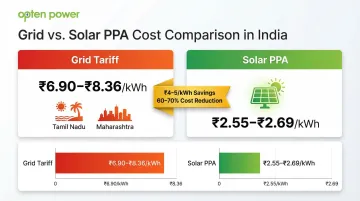
- Tamil Nadu: ₹6.90/kWh base energy charges plus ₹562/kVA/month demand charges
- Maharashtra: ₹8.12 to ₹8.36/kVAh energy charges plus ₹499 to ₹549/kVA/month demand charges
Recent utility-scale solar auctions, by comparison, came in at ₹2.55/kWh to ₹2.69/kWh. This ₹4-5/kWh differential represents a 60-70% cost reduction opportunity for manufacturers who switch to renewable PPAs via open access.
For sectors where energy represents 20-40% of production costs—particularly steel and cement—this tariff gap impacts global competitiveness. Manufacturers procuring renewable energy through Corporate PPAs or open access can lock in multi-year price certainty while grid tariffs continue rising with fuel costs and distribution charges.
ESG Pressure and Supply Chain Requirements
Global buyers are transforming renewable energy from a CSR initiative into a procurement prerequisite. Export-focused manufacturers face explicit renewable energy mandates from their largest customers:
- H&M Group requires textile suppliers to source 100% renewable electricity by 2030 and exit coal by 2026
- Inditex (Zara) mandates 50% renewable supply chain electricity by 2030, scaling to 100% by 2040
- Autoliv requires automotive suppliers to run entirely on renewable electricity by 2030
These requirements reflect Scope 2 emissions reduction targets that cascade through supply chains. Indian manufacturers who cannot demonstrate verified renewable usage risk losing export contracts — a market access consequence, not just a reputational one.
Meeting these mandates also opens financing doors. India's sustainable debt market reached USD 55.9 billion by December 2024 — a 186% increase since 2021. Manufacturers with verified renewable usage can access sustainability-linked loans at preferential rates and issue green bonds, lowering their overall cost of capital.
What Types of Renewable Energy Are Used in Manufacturing?
Not all renewable sources suit every manufacturing operation. The right choice depends on energy load profile, location, available land, process heat requirements, and capital budget. Here's how different technologies map to manufacturing needs.
Solar (Rooftop and Ground-Mounted)
Rooftop solar serves as the entry point for most manufacturers, particularly those with daytime-heavy electricity loads. The model requires relatively low capital investment and straightforward installation on existing factory rooftops.
Key limitations:
- No generation at night or during cloudy periods
- Roof load capacity constraints limit installation size
- Intermittency creates supply gaps for continuous operations
Ground-mounted utility-scale solar becomes viable for manufacturers with large land parcels or those procuring via open access from third-party projects. Current solar PPA tariffs of ₹2.55–₹2.69/kWh make this the most cost-effective renewable option for manufacturers with daytime load concentration.
Wind and Hybrid (Solar + Wind)
Standalone wind is less common for on-site manufacturing installations but highly relevant through power purchase agreements from wind-rich states like Gujarat, Rajasthan, and Tamil Nadu. Wind generation typically peaks during monsoon months and evening hours—precisely when solar output drops.
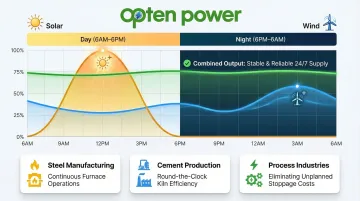
Hybrid solar-wind projects deliver the most consistent supply profile for 24x7 manufacturing operations. Solar generates during daylight hours while wind often generates at night — together reducing the need for expensive battery storage and minimizing grid curtailment (unused power rejected by the grid).
Hybrid systems are particularly relevant for:
- Steel plants running continuous furnace operations
- Cement manufacturers with round-the-clock kiln demands
- Process industries where unplanned stoppages carry heavy cost penalties
Biomass and Waste Heat Recovery
Biomass energy suits manufacturers with access to agricultural residue, bagasse, or industrial waste streams. Common applications include food processing, sugar mills, and paper industries where feedstock is readily available.
Waste heat recovery (WHR) systems capture excess thermal energy from furnaces, boilers, or kilns to generate electricity—highly applicable to cement and steel manufacturing:
Cement: WHR systems generate 25 to 45 kWh per tonne of clinker, covering up to 30% of a plant's electricity needs. This can improve EBITDA margins by 10% to 15%.
Steel: Top-Pressure Recovery Turbines (TRT) on blast furnaces produce 40 to 60 kWh per tonne of hot metal.
WHR represents a behind-the-meter efficiency solution that reduces both grid dependency and total energy costs without requiring land for solar or wind installations.
Green Hydrogen (Emerging)
Green hydrogen addresses a gap electrification cannot fill: high-temperature industrial heat in sectors like steel, chemicals, and cement. The National Green Hydrogen Mission targets 5 Million Metric Tonnes (MMT) per annum production by 2030, with cost targets below $2/kg (USD).
Major industrial groups are piloting applications:
- Reliance Industries: Targeting 3 MMTPA production by 2032 at Jamnagar
- Tata Steel: Commenced hydrogen injection trials in Jamshedpur blast furnaces to reduce coke rates and CO2 emissions
- NTPC: Setting up 1 Tonne-Per-Day plant using municipal solid waste gasification
For most manufacturers, green hydrogen becomes commercially viable once production costs fall below $1.5/kg — a threshold industry analysts project for the early 2030s. Hard-to-abate sectors should track domestic pilot outcomes closely, as early offtake agreements will likely carry preferential pricing.
How Manufacturers Are Implementing Renewable Energy: Key Procurement Models
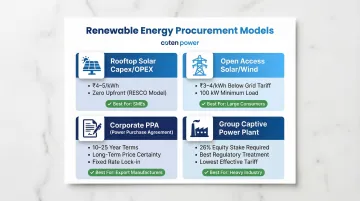
Once manufacturers decide to adopt renewable energy, the critical next decision is how to procure it. Different models suit different scales, risk appetites, and operational profiles. The four main pathways used in Indian manufacturing are outlined below.
Rooftop Solar (Capex and OPEX/RESCO Models)
Manufacturers can install rooftop solar through two distinct structures:
Capex (Ownership): The manufacturer funds installation through equity or debt, then captures full savings after a typical 3-4 year payback across the system's 25-year lifespan. Maximum long-term returns, but requires upfront capital.
OPEX/RESCO (Zero Capex): A third-party developer installs and owns the system on the manufacturer's roof. The manufacturer pays a per-unit tariff—typically ₹4-5/kWh versus ₹7-8/kWh grid rates—with no upfront investment. This makes rooftop solar accessible for manufacturers who want to preserve working capital.
For manufacturers with higher energy loads, open access procurement offers a more direct route to large-scale renewable supply.
Open Access Power Procurement
Open access allows large industrial consumers (typically above 1 MW contracted demand, now reduced to 100 kW under 2022 Green Energy Open Access rules) to purchase electricity directly from renewable generators, wheeling it (transporting power) through the state distribution network.
Key cost components:
- Transmission charges
- Wheeling charges
- Cross-Subsidy Surcharge (CSS), capped at 20% of Average Cost of Supply
- Banking charges (vary by state: Gujarat charges ₹1.50/kWh; Tamil Nadu proposes 8% in-kind)
Despite these charges, open access often delivers electricity at ₹3-4/kWh below grid tariffs for large consumers. Rules vary significantly by state, requiring manufacturers to assess state-specific regulations before committing.
For manufacturers seeking long-term price certainty rather than per-unit savings, corporate PPAs offer a more structured alternative.
Corporate Power Purchase Agreements (PPAs)
Corporate PPAs are long-term contracts (10-25 years) between a manufacturer and a renewable developer, locking in a fixed or escalating tariff for electricity supply.
Key advantages:
- Price certainty and protection from grid tariff increases
- Hedge against fossil fuel price volatility
- Can be structured for captive projects (manufacturer co-owns) or third-party supply via open access
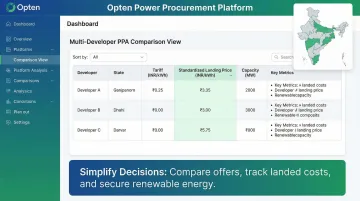
Platforms like Opten Power let manufacturers compare PPA offers from multiple developers across solar, wind, and hybrid projects across 16 states simultaneously. The platform's Real-Time Discom Intelligence feature provides standardized landing prices for each state—accounting for wheeling charges, cross-subsidy surcharges, and banking provisions—so manufacturers see true all-in costs before signing.
Group Captive Power Plants
The group captive model allows a manufacturer or consortium to jointly invest in a renewable project, holding at least 26% equity stake and consuming at least 51% of output.
Regulatory advantages:
- Exemption from Additional Surcharge
- Favorable wheeling and banking treatment
- Direct ownership and control of generation assets
This model requires capital commitment but offers the most favorable regulatory treatment available. It suits large energy consumers—steel, cement, and process industries—with stable long-term demand. Co-investing with other industrial consumers helps meet the 51% consumption threshold.
Key Benefits Manufacturers Are Seeing
Significant Cost Reduction
Manufacturers procuring renewable energy through Corporate PPAs or open access achieve substantial electricity cost savings compared to grid tariffs. With industrial grid tariffs exceeding ₹7.00/kWh in many states and solar PPA tariffs ranging ₹2.55–₹2.69/kWh, manufacturers can reduce energy costs by 40–60% even after accounting for wheeling, transmission, and banking charges.
For a mid-sized manufacturer consuming 10 million units annually, switching from a ₹7.50/kWh grid tariff to a ₹3.00/kWh renewable PPA (including all charges) delivers annual savings of ₹4.5 crore. That directly widens operating margins—a meaningful edge in price-sensitive export markets.
Operational Resilience
Manufacturers generating their own renewable power through captive or rooftop installations reduce dependency on grid power, which remains subject to outages, load shedding, and voltage fluctuations—all causing costly production downtime.
On-site generation paired with battery storage provides backup during grid failures. For continuous process industries, the stakes are high:
- Even a 15-minute outage can trigger furnace re-start costs or batch losses running into lakhs
- Voltage fluctuations damage sensitive equipment, shortening asset life
- Load shedding in industrial zones can disrupt multi-shift production schedules
For these industries, resilience alone often makes the case for renewables—separate from any cost argument.
ESG Ratings and Access to Capital
Manufacturers with verified renewable energy usage achieve better ESG ratings, unlocking access to green financing instruments at preferential rates. India's sustainable debt market has grown to USD 55.9 billion, reflecting strong investor demand for decarbonization commitments.
Companies can access:
- Green bonds with lower interest rates
- Sustainability-linked loans tied to emission reduction targets
- Preferential lending from development finance institutions
Verified renewable usage also satisfies supply chain sustainability requirements from global buyers, protecting market access in export-focused sectors like textiles, automotive components, and pharmaceuticals.
Common Challenges and How to Overcome Them
Intermittency for 24x7 Manufacturing Operations
Solar doesn't generate at night, and manufacturing lines in steel, cement, and chemicals cannot stop without costly downtime. This creates a supply-demand mismatch for continuous operations.
Solutions:
- Pair solar with wind through hybrid PPAs for more consistent round-the-clock generation
- Add battery storage — still ₹8–12 lakh per MWh, but costs are falling with lithium-ion price trends
- Keep grid as backup in hybrid configurations, drawing renewables during peak generation and grid power after dark
Hybrid projects are particularly effective in India where wind speeds peak during monsoon months and evening hours, exactly when solar output drops. This natural complementarity reduces the need for expensive storage.
Regulatory and State-Level Complexity
Open access rules, RPO exemptions, banking charges, and cross-subsidy surcharges differ significantly across Indian states and change frequently. Gujarat imposes fixed banking charges of ₹1.50/kWh while Tamil Nadu proposes 8% in-kind banking charges with monthly settlement cycles. This creates procurement uncertainty and makes multi-state operations challenging.
Manufacturers need either dedicated energy procurement expertise or platforms with real-time regulatory intelligence. Opten Power's Real-Time Discom Intelligence addresses this directly — standardized landing prices across all 16 states it operates in, accounting for state-specific charges so cost comparisons remain accurate despite the fragmentation.
Upfront Capital and Long-Term Contract Risk
PPAs lock manufacturers into 15-25 year agreements, creating concern about offtake risk if production volumes change due to market conditions or business restructuring.
Mitigation strategies:
- Conduct thorough tariff benchmarking across multiple developer offers before signing
- Structure PPAs with flexible offtake provisions or minimum consumption guarantees
- Evaluate developer track record, financial stability, and project execution history
- Compare multiple offers using platforms like Opten Power rather than accepting the first proposal
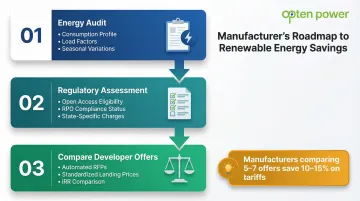
Manufacturers who compare 5-7 developer offers typically secure tariffs 10-15% lower than those who accept the first proposal — and negotiate stronger contract terms on offtake flexibility and exit clauses in the process.
How to Get Started: A Practical Roadmap for Manufacturers
Step 1: Conduct an Energy Audit
Profile your actual consumption patterns before evaluating renewable options:
- Monthly units consumed and peak demand
- Load factors and time-of-day usage patterns
- Process heat versus electricity split
- Seasonal variations in consumption
This determines which renewable types and procurement models are viable. A manufacturer with 70% daytime load concentration can maximize rooftop solar, while a 24x7 operation needs hybrid solar-wind or grid backup.
Step 2: Assess Regulatory Eligibility and State-Specific Options
Review your state's current regulations:
- Open access eligibility thresholds (now 100 kW minimum under Green Energy rules)
- Current RPO compliance status and potential penalties
- Banking provisions and wheeling charges
- Cross-subsidy surcharge rates
State-specific regulations directly shape the economics. A manufacturer in Gujarat faces ₹1.50/kWh banking charges while one in Tamil Nadu faces 8% in-kind charges—directly affecting net landed cost of renewable power.
Step 3: Compare Multiple Developer Offers Before Committing
Renewable energy tariffs, PPA terms, and developer track records differ widely across projects. Manufacturers who accept the first proposal often overpay by 10–15%.
Platforms like Opten Power give manufacturers a structured way to run this comparison. Key capabilities include:
- Issue automated RFPs to multiple developers across solar, wind, and hybrid projects in 16 states
- Compare real-time tariff offers with standardized landing prices that account for state-specific charges
- Evaluate IRR and payback side-by-side across competing proposals
- Close deals 50% faster than manual RFP processes through an automated tender engine
Frequently Asked Questions
What are the renewable energy sources for manufacturing?
The primary renewable sources used in manufacturing are solar (rooftop and ground-mounted), wind, hybrid solar-wind systems, biomass, waste heat recovery, and hydropower. The best fit depends on your facility's energy load profile, location, and industry type.
Can factories use renewable energy?
Yes, factories can and do use renewable energy through multiple pathways including rooftop solar, open access procurement, Corporate PPAs, and captive power plants. In India, regulatory frameworks like RPO obligations and the Green Energy Open Access Rules actively encourage industrial adoption.
What is a Corporate PPA and how does it work for manufacturers?
A Corporate PPA is a long-term electricity supply contract between a manufacturer and a renewable energy developer. It allows the manufacturer to procure clean power at a fixed or predictable tariff, typically ₹3–4/kWh lower than grid rates, directly from a solar, wind, or hybrid project.
What is the most cost-effective renewable energy option for manufacturers in India?
Solar PPAs via open access are currently among the most cost-effective options for large manufacturers, with tariffs ranging ₹2.55–₹2.69/kWh. Hybrid solar-wind PPAs offer better supply reliability for 24x7 operations. The optimal choice depends on state-specific regulations and your contracted demand.
How can small and medium manufacturers adopt renewable energy without large capital investment?
The OPEX/RESCO rooftop solar model allows a third-party developer to install the system at zero upfront cost. The manufacturer pays a below-grid per-unit tariff, making renewable energy accessible without upfront capital or balance sheet impact.
What challenges do manufacturers face when switching to renewable energy?
Manufacturers commonly run into three hurdles: intermittency for continuous operations (hybrid projects or storage help here), state-level regulatory complexity, and long-term PPA contract risk. Staying current on Discom rules and comparing developers thoroughly before signing mitigates most of these concerns.