Introduction
India's commercial and industrial energy buyers face mounting pressure on multiple fronts. Grid tariffs are climbing across states—with some DISCOMs hiking charges by over 14% in a single year—while Renewable Purchase Obligation (RPO) compliance mandates tighten under the new Renewable Consumption Obligation (RCO) framework backed by a ₹347/MWh buyout price. Yet procurement remains fragmented, manual, and opaque, forcing buyers to navigate complex state-level regulations, developer outreach, and tariff negotiations without standardized benchmarks.
For high-consuming businesses, a structured renewable energy marketplace is no longer optional—it's essential infrastructure for cost control and regulatory compliance. This guide covers what a renewable energy marketplace is, how trading and procurement mechanisms work, who participates, and what to look for when choosing a platform.
Whether you're a C&I buyer targeting 40% cost savings, a developer seeking off-take agreements, or an investor sourcing screened project opportunities, this guide gives you the frameworks and benchmarks to make faster, better-informed decisions in India's clean energy market.
Key Takeaways
- A renewable energy marketplace connects C&I buyers, developers, and financiers to discover, negotiate, and close energy deals on one platform
- Key mechanisms include Corporate PPAs (10-25 year contracts), open access (direct sourcing above 1 MW), group captive models (26% equity, 51% consumption), and RECs for compliance
- Digital marketplaces deliver real-time price comparison, automated RFP creation, and state-specific tariff intelligence
- Platform selection hinges on capacity availability (4+ GW ideal), multi-state coverage (16+ states), contract flexibility, and deal speed
What Is a Renewable Energy Marketplace?
A renewable energy marketplace is a digital platform where energy buyers (C&I companies), renewable project developers, and financiers connect to discover, evaluate, and transact clean energy. Unlike traditional bilateral deals negotiated through brokers or utility procurement locked into DISCOM tariffs, a marketplace consolidates supply, standardizes processes, and accelerates transactions through a single interface.
India operates two distinct markets. The mandatory/compliance market is driven by RPO mandates requiring obligated entities to source minimum percentages from renewables—now transitioning to the stricter RCO framework under the Energy Conservation Act. The voluntary market comprises C&I buyers procuring beyond regulatory requirements for cost reduction, ESG goals, or sustainability commitments.
Marketplaces aggregate supply across solar, wind, hybrid, and storage projects, covering the full procurement process from price discovery and due diligence to contract execution and portfolio monitoring. Buyers get access to multiple projects at once rather than negotiating with one developer at a time—eliminating weeks of scattered outreach.
Opten Power, for instance, provides access to 4+ GW of capacity across 16 states, enabling simultaneous comparison across developers on a single platform.
India's fragmented regulatory landscape makes state-specific intelligence non-negotiable. DISCOM policies, open access charges, and RPO targets vary sharply by state—and so do costs. According to Mercom India, landed costs for third-party solar open access range widely:
- ₹4.3/kWh in Chhattisgarh (among the lowest)
- ₹5.8–6.2/kWh across mid-range states
- ₹7.4/kWh in Maharashtra (among the highest)
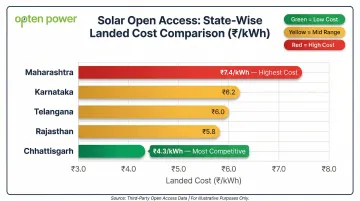
A marketplace that consolidates real-time landing prices, grid zone data, and regulatory parameters across states directly solves this information gap—making accurate ROI calculations possible before any commitment.
Beyond procurement, marketplaces are also enabling secondary market transactions—trading operational renewable assets between investors and developers. This adds liquidity to a sector that has historically had very little.
How Renewable Energy Trading Works: Key Mechanisms
Corporate Power Purchase Agreements (PPAs)
Long-term Corporate PPAs are the most common mechanism for large C&I buyers. The buyer signs a multi-year agreement (typically 10–25 years) directly with a developer for a fixed or indexed tariff, locking in below-grid rates.
On-site vs. off-site PPAs:
- On-site PPAs: Rooftop or captive installations where generation occurs at the buyer's facility
- Off-site/open access PPAs: Power is generated remotely and wheeled through the grid to the buyer's premises
Corporate PPAs deliver significant cost savings for qualifying C&I buyers. While base PPA tariffs for hybrid projects range competitively between ₹3.35/kWh and ₹3.43/kWh, actual savings depend on state-specific open access charges and the buyer's current grid tariff. Buyers typically achieve 10-40% savings versus grid tariffs, though rising surcharges are shrinking margins in high-cost states like Maharashtra and Tamil Nadu.
Open Access and Group Captive Models
Open access procurement allows eligible consumers (typically above 1 MW contracted demand in most states) to bypass their DISCOM and source power directly from generators. Buyers pay transmission, wheeling, and cross-subsidy surcharge as applicable. Two procurement types exist:
- Short-term open access: Exchange-based spot pricing via IEX/PXIL
- Long-term open access: Bilateral contracts with developers
Group captive model offers the highest ROI for eligible buyers. A C&I buyer acquires at least 26% equity in a generating company and contracts for at least 51% of output annually, qualifying for captive status. This structure exempts buyers from Cross-Subsidy Surcharges (CSS) and Additional Surcharges (AS), delivering 15-25% savings versus third-party PPAs.
Steel, cement, and data center operators benefit most — industries with continuous 24×7 base-load demand where those surcharge exemptions translate directly to material cost reduction.
Renewable Energy Certificates (RECs)
RECs separate the environmental value of renewable generation from the physical electricity itself. Buyers who cannot source green power directly — through a PPA or open access — can purchase RECs through IEX or OTC markets to meet RPO obligations or voluntary sustainability targets. CERC established a buyout price of ₹347/MWh for FY 2024-25 and FY 2025-26 as an alternative compliance mechanism for RPO shortfalls.
Hybrid and Round-the-Clock (RTC) Solutions
Standalone solar and wind projects generate power intermittently — a problem for industries that need consistent supply. Co-locating wind and solar assets smooths out generation gaps and optimizes shared evacuation infrastructure. As states tighten energy banking provisions (restricting banking to monthly cycles or banning peak-hour drawals), this physical complementarity becomes a structural necessity rather than a bonus.
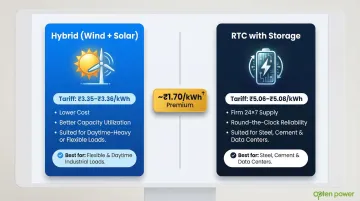
Recent NTPC 1.2 GW wind-solar hybrid auctions discovered tariffs at ₹3.35-₹3.36/kWh, while SECI's 1.2 GW RTC-IV auction with storage commanded ₹5.06-₹5.08/kWh. The ~₹1.70/kWh premium for RTC supply reflects the cost of storage — a tradeoff industries with non-negotiable 24×7 load requirements are increasingly willing to make.
Key distinctions between the two structures:
- Hybrid (wind + solar): Lower tariff, better capacity utilization, suited for buyers with daytime-heavy or flexible load profiles
- RTC with storage: Higher tariff, firm round-the-clock supply, suited for steel, cement, data centers, and process industries with constant base load
Who Participates in a Renewable Energy Marketplace?
Three primary participant categories drive marketplace activity:
- C&I energy buyers — Manufacturers, data centers, hospitals, IT parks, hotels, and process industries seeking cost reduction and ESG compliance. These buyers range from 500 kW commercial facilities to multi-MW industrial operations.
- Renewable developers and IPPs — Solar, wind, and hybrid project owners with available capacity seeking off-take agreements. India added 7.8 GW of solar open access capacity in 2025 alone, reflecting strong developer activity.
- Investors and financiers — Funds, NBFCs, and project finance providers seeking vetted deal flow and due diligence support for debt and equity deployment.
Beyond these three core groups, EPC companies and energy advisors participate as intermediaries—structuring RFPs, evaluating developer bids, and managing regulatory filings. Digital marketplaces cut their transaction overhead by automating bid management and contract standardization.
Aggregators and third-party sellers bundle capacity from smaller projects to meet minimum procurement thresholds. This opens up competitive open access rates for medium-sized buyers (500 kW–5 MW) who may not qualify individually for large bilateral PPAs.
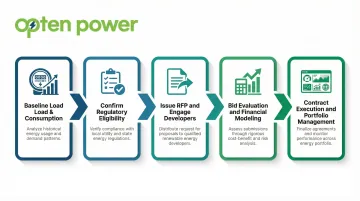
How to Procure Renewable Energy Through a Marketplace: A Step-by-Step Guide
Step 1: Baseline Your Load and Consumption
Before approaching any developer or marketplace, build your consumption profile:
- Map monthly and hourly consumption, including peak and base-load requirements
- Calculate your effective tariff with all DISCOM levies included
- Set a procurement target in MW or MU per year
This baseline directly determines which mechanism — captive, open access PPA, or REC — delivers the highest IRR.
Step 2: Confirm Regulatory Eligibility
Open access eligibility, group captive qualification, RPO compliance status, and applicable surcharges all vary by state and consumer category. Confirm your SERC regulations, DISCOM zone, and banking/scheduling provisions before issuing an RFP.
Platforms like Opten Power offer standardized, state-wise landing price data across 16 states — cutting out the manual regulatory research that typically consumes weeks of pre-procurement effort.
Step 3: Issue Your RFP and Engage Developers
Issue a Request for Proposal to shortlisted developers on the marketplace. Specify technology preference, contract duration, delivery point, tariff structure (fixed or escalating), and key commercial terms. Automated tender engines with modular templates compress this step significantly, enabling parallel bid comparison across multiple developers at once.
Step 4 — Bid Evaluation and Financial Modeling
Evaluate received bids on:
- Levelized cost of energy (LCOE)
- Payback period
- Internal rate of return (IRR)
- Counterparty risk
- Regulatory compliance
Standardized bid formats on marketplace platforms eliminate apples-to-oranges comparison problems common in manual procurement. Key metrics should include all-in landed costs, not just base PPA tariffs.
Step 5 — Contract Execution and Ongoing Portfolio Management
Pre-approved contract templates reduce negotiation cycles. Post-commissioning, monitor energy generation, savings versus baseline, and regulatory compliance from a unified portfolio dashboard. Flag deviations from contracted output early to trigger remediation under PPA terms.
What to Look for When Choosing a Renewable Energy Marketplace
Capacity and Technology Diversity
Evaluate whether the platform offers access to a meaningful pipeline of vetted projects across solar, wind, and hybrid technologies—distributed across your operating states. A platform with 4+ GW of available capacity across 16+ states provides genuine choice rather than a constrained shortlist, reducing sole-source pricing risk.
Real-Time Regulatory and Pricing Intelligence
The platform should provide current, state-specific DISCOM tariff data, open access charge schedules, and RPO compliance status—not static PDFs. This intelligence directly determines whether a proposed PPA tariff represents genuine savings or a false comparison against an outdated grid rate benchmark.
Open access charges can comprise 27% to 51% of landed costs depending on the state. Without accurate, live regulatory data, cost projections become unreliable before a contract is even signed.
Transaction Speed and Contract Infrastructure
Assess whether the platform offers automated RFP creation, pre-vetted developer profiles, and standardized contract templates. Renewable energy projects face PPA signing delays of 8 to 12 months due to regulatory uncertainties and grid constraints. Platforms with pre-approved legal frameworks and automated bid management can compress those timelines by around 50%, which is a measurable operational advantage.
When evaluating any marketplace, check for these capabilities at a minimum:
- Project pipeline: 3+ GW of vetted capacity across multiple states and technologies
- Regulatory data: Live DISCOM tariff and open access charge schedules, not static documents
- Contract tooling: Automated RFP workflows and standardized PPA templates
- Developer vetting: Pre-screened profiles that reduce due diligence time
Frequently Asked Questions
What are 7 renewable energy sources?
The seven primary renewable energy sources are solar, wind, hydropower, biomass, geothermal, tidal/ocean, and green hydrogen. In the Indian C&I context, solar, wind, and hybrid combinations dominate marketplace procurement due to cost competitiveness and grid availability, with solar installed capacity reaching 143.60 GW and wind at 55.13 GW as of February 2026.
What is a renewable energy marketplace and how does it work?
A renewable energy marketplace is a digital platform connecting energy buyers, developers, and financiers to discover and transact clean energy deals. It consolidates price discovery, RFP management, bid evaluation, and contract execution in one place, replacing fragmented manual procurement with automated workflows and standardized processes that accelerate deal closure.
What is the difference between a Corporate PPA and a Renewable Energy Certificate (REC)?
A Corporate PPA is a long-term physical supply contract at a fixed tariff, typically 10–25 years. RECs are tradable certificates representing the environmental attribute of renewable generation, used for RPO compliance or voluntary sustainability claims without physical delivery, currently priced at ₹347/MWh buyout rate for FY 2024–26.
Who is eligible for open access renewable energy procurement in India?
The Green Energy Open Access Rules set the threshold at 100 kW, down from the earlier 1 MW norm, and allow load aggregation across multiple connections in the same electricity division. Buyers must still account for wheeling charges, cross-subsidy surcharge, and banking provisions, which vary significantly by state SERC.
How long does it take to close a renewable energy procurement deal through a marketplace?
For C&I buyers, the end-to-end process from feasibility to commissioning typically takes 8–12 months. Digital marketplaces with automated RFP tools and pre-approved contract templates can cut that timeline by up to 50% through standardized processes and pre-vetted developer networks.
How can a C&I buyer track the performance of their renewable energy investment after signing?
Portfolio management dashboards let buyers monitor generation output, actual savings versus baseline tariff, and regulatory compliance in real time. Verified generation data from a single interface simplifies ESG reporting and helps flag underperformance across multiple contracts and technologies.