Introduction
For most Indian municipalities, electricity is the single largest operating cost — averaging 51% of total O&M for water supply across cities surveyed, with Surat spending 79% of its water O&M budget on power alone. Yet most urban local bodies still draw from the grid at prevailing DISCOM tariffs, absorbing price volatility without a strategy to manage it.
Municipal clean energy procurement is the structured process by which city governments source electricity from renewable projects — solar, wind, or hybrid — to power public infrastructure and municipal operations. With state-level Renewable Purchase Obligation (RPO) requirements tightening and India's national target of 50% cumulative installed capacity from non-fossil sources by 2030 looming, municipalities face real compliance risk if they continue deferring action.
This guide covers the available procurement options under Indian regulations, how the end-to-end process works, and the barriers that most commonly stall municipal projects before they start.
Key Takeaways
- Municipal clean energy procurement covers how city bodies formally source renewable power—via rooftop solar, open access PPAs, tenders, or group captive arrangements
- Indian municipalities face distinct constraints: DISCOM dependencies, multi-level approvals, and state-specific open access rules
- Procurement follows a fixed sequence: baseline assessment → mechanism selection → RFP → developer evaluation → contract execution
- Picking the wrong mechanism for your eligibility profile causes delays, cost overruns, or stranded commitments
- Platforms with automated RFP tools and real-time bid comparison can cut procurement timelines by up to 50%
What Is Municipal Clean Energy Procurement?
Municipal clean energy procurement is the formal method by which urban local bodies (ULBs), municipal corporations, and government-run utilities acquire electricity generated from renewable sources—either through direct ownership, service contracts, or purchase agreements—to reduce dependence on fossil-fuel-based grid power.
The goal is to lock in cost-predictable, low-carbon power for public-use assets while meeting Renewable Purchase Obligation (RPO) targets under state electricity regulations. Covered assets typically include:
- Streetlights and public lighting networks
- Sewage treatment plants
- Water supply infrastructure
- Municipal administrative buildings
This sets municipal procurement apart from how commercial buyers approach renewables. Corporate buyers optimize primarily for cost savings and ESG reporting. Municipal bodies, by contrast, must satisfy public finance rules, tendering obligations under GFR (General Financial Rules) or state procurement codes, and accountability to elected bodies—making the process structurally more complex.
Why Municipalities Need a Structured Procurement Approach
Cost and fiscal pressure
Municipal electricity bills represent a significant share of operating budgets. Across 10 diagnostic Indian cities, electricity costs average 51% of water supply O&M expenses, with individual cities ranging from 20% (Bengaluru) to 79% (Surat). Unstructured procurement leaves municipalities exposed to DISCOM tariff hikes with no hedge or savings mechanism—directly cutting into budgets that are already stretched thin.
Regulatory pressure
Under India's Electricity Act 2003 and state RPO regulations, distribution-connected consumers above specified load thresholds are required to source a portion of their consumption from renewable energy. Municipalities with high grid consumption face RPO compliance penalties if they don't procure green power proactively.
What goes wrong without structured procurement
Municipalities that procure reactively tend to:
- Accept suboptimal tariff structures with uncapped escalation clauses
- Sign poorly negotiated PPAs with weak performance guarantees
- Miss out on central government scheme subsidies—such as Component C under PM-KUSUM for feeder-level solarization or SECI bulk tender benefits—by failing to plan ahead
- Experience project delays and approval bottlenecks due to DISCOM non-cooperation or incomplete RFP documentation
A structured approach prevents each of these outcomes—and the sections below lay out exactly how to build one.
Clean Energy Procurement Options Available to Municipal Bodies
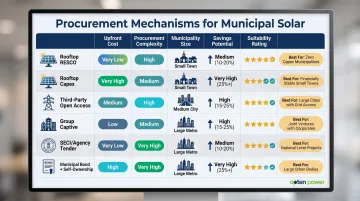
Rooftop Solar (RESCO or Capex Model)
Municipal bodies can install solar on government building rooftops under two models. The Capex model means the ULB owns the asset outright and is eligible for MNRE subsidies. The RESCO (Renewable Energy Service Company) model means a private developer installs and owns the system, then sells power to the municipality at a fixed per-unit rate over 15–25 years.
Key differences at a glance:
- RESCO: Zero upfront capital, O&M responsibility on developer, moderate savings (₹1–2/kWh)
- Capex: High upfront investment, full savings after payback, eligible for central subsidies
RESCO is the preferred route for cash-constrained ULBs. Capex suits municipalities with access to grant funding or long planning horizons.
Open Access Power Purchase Agreement (Third-Party or Group Captive)
Under the Green Energy Open Access Rules 2022, municipalities consuming above a defined threshold can procure power directly from renewable generators outside the DISCOM network. The eligibility threshold was reduced from 1 MW to 100 kW for green energy.
Two structures exist:
- Third-party open access: Municipality buys from an independent developer through a PPA
- Group captive: Municipality takes a minority equity stake in a project to qualify for captive status and lower wheeling charges (requiring at least 26% equity by captive users and 51% collective consumption)
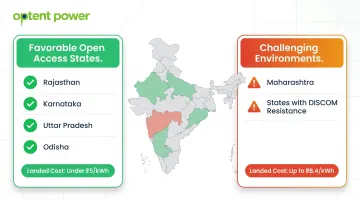
Caveat: State-specific open access charges and DISCOM objections remain barriers in several states. Net landed open access costs in Q4 2025 ranged from under ₹5/kWh to ₹8.4/kWh across 15 states, with Maharashtra among the highest-cost environments.
Government Scheme-Based Procurement (SECI/State Agency Tenders)
Central and state agencies regularly conduct bulk tenders for solar, wind, and hybrid power through SECI, NTPC Renewable Energy, and state nodal agencies. Municipalities can participate as off-takers under these tendered PPAs at pre-negotiated rates — without running their own competitive process.
This route works well for municipalities with limited procurement capacity or those entering renewable energy for the first time:
- No upfront capital required
- Pre-set tariffs eliminate negotiation complexity
- Suitable for ULBs of all sizes
The trade-off is limited flexibility — project location, technology mix, and contract terms are fixed by the tendering agency.
For municipalities seeking direct asset ownership rather than third-party supply arrangements, green bonds offer an alternative financing path.
Municipal Bonds and Financed Self-Ownership
Larger municipal corporations have used green municipal bonds to finance solar and waste-to-energy assets directly. Indore Municipal Corporation commissioned a 60 MW solar plant in 2026, funded by green bond proceeds plus ₹42 crore in Government of India VGF. This mechanism suits larger ULBs with strong credit ratings and access to SEBI's municipal debt securities framework.
Comparison Summary
| Mechanism | Upfront Cost | Procurement Complexity | Municipality Size | Savings Potential |
|---|---|---|---|---|
| Rooftop RESCO | Zero | Low | All sizes | Moderate (₹1–2/kWh savings) |
| Rooftop Capex | High | Medium | Medium–Large | High (full savings after payback) |
| Third-Party Open Access | Zero | High | Above 100 kW load | High (₹2–4/kWh savings) |
| Group Captive | Medium (equity) | Very High | Above 1 MW load | Very High (₹3–5/kWh savings) |
| SECI/Agency Tender | Zero | Very Low | All sizes | Moderate (pre-set tariffs) |
| Municipal Bond + Self-Ownership | Very High | Very High | Large corporations only | Highest (full asset ownership) |
How Municipal Clean Energy Procurement Works
Municipal clean energy procurement is not a single transaction—it is a phased process that begins with understanding current energy use and ends with long-term performance monitoring. Each phase involves different internal departments (finance, engineering, legal) and external parties (developers, DISCOMs, state regulators).
Step 1: Baseline Assessment and Goal Setting
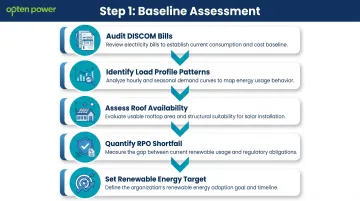
The first step is quantifying the municipality's total electricity consumption across all assets—buildings, streetlights, pumping stations—then mapping it against available budgets and identifying any RPO compliance gaps. The output is a procurement target: either a percentage of load to be met via renewables or a specific MW figure.
Municipalities that skip this step often procure too little or too much capacity, resulting in stranded commitments or unmet obligations.
Key activities:
- Audit 12–24 months of DISCOM bills by asset category
- Identify peak demand and load profile patterns (24x7 vs. seasonal)
- Assess roof availability for rooftop solar on government buildings
- Quantify current RPO shortfall, if applicable
- Set a renewable energy target aligned with budget and operational needs
Step 2: Mechanism Selection and Market Discovery
With a consumption baseline in hand, the municipality must select the most appropriate procurement mechanism—rooftop RESCO, open access PPA, SECI tender, and others—based on its load profile, credit standing, applicable state open access regulations, and available budget.
Market intelligence tools make this comparison faster. Platforms like Opten Power let procurement teams compare tariffs, developer capacity, and ROI across multiple renewable options in their state before committing to a mechanism—using real-time DISCOM data with standardized landing prices and instant IRR and payback period calculations.
Step 3: RFP Development and Issuance
With a mechanism confirmed, a detailed Request for Proposal (RFP) must be drafted that specifies:
- Technical requirements: Capacity in MW, technology type, delivery point, grid interconnection
- Commercial terms: Tariff structure, escalation clause, payment security
- Compliance requirements: Land ownership, DISCOM NOC, grid connectivity approval
Municipalities should use standardized modular templates where possible to reduce preparation time and legal risk. NIUA/MoHUA's training manual provides example RFP structures and tools for ULBs. Automated tender engines can further streamline RFP creation and distribution, cutting preparation time by weeks.
Step 4: Bid Evaluation and Developer Selection
Bids are evaluated across:
- Technical feasibility: Site suitability, technology alignment, grid interconnection plan
- Financial soundness: IRR, payback period, developer financial health
- Reference projects: Track record with similar municipal or government buyers
- Tariff competitiveness: Quoted tariff plus all pass-through costs
Critical: Municipalities often focus only on the quoted tariff and miss hidden cost factors like annual O&M obligations, degradation guarantees, termination liability, and escalation caps. A complete evaluation scorecard should weight these factors alongside the headline tariff.
Step 5: Contract Execution, Approvals, and Project Commissioning
After a developer is selected, the municipality must obtain:
- Internal approvals (council resolution or finance committee sign-off depending on contract value)
- DISCOM/open access NOC if applicable
- State regulatory approvals (SERC open access approval for third-party or captive arrangements)
This stage is where most procurement processes stall in India due to multi-departmental sign-off requirements. Municipalities can streamline by pre-engaging DISCOM and regulatory bodies during the RFP stage rather than after award, identifying potential objections early and resolving them before contract execution.

Key Factors That Influence Municipal Clean Energy Procurement Outcomes
State-level regulatory environment
Open access charges, DISCOM cross-subsidy surcharges, banking and wheeling charges, and state RPO regulations vary significantly across India's states. In Q4 2025, landed open access costs ranged from under ₹5/kWh in states like Odisha and Chhattisgarh to ₹8.4/kWh in Maharashtra. A tariff that is cost-competitive in Rajasthan may be unviable in Maharashtra due to higher wheeling charges.
States with favorable open access environments in 2025:
- Rajasthan: Progressive Integrated Clean Energy Policy 2024 promoting 100% green power supply
- Karnataka, Uttar Pradesh, Odisha: Lower landed costs and streamlined approval processes
States with challenging environments:
- Maharashtra: High cross-subsidy surcharges and landed costs
- States with inconsistent DISCOM cooperation on open access NOCs
Municipality size and load profile
Procurement complexity scales with load size. Small municipalities (below 1 MW demand) are generally limited to rooftop solar or SECI empanelled vendors. Larger municipal corporations (above 5 MW) have sufficient scale to negotiate bilateral PPAs and access group captive structures.
Load profile stability also shapes technology selection. Water pumping loads with daytime peaks align well with solar, while round-the-clock municipal operations typically require hybrid solar-wind or solar-plus-storage solutions.
Financing and payment security constraints
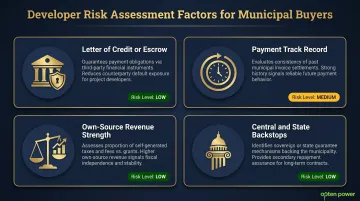
Renewable developers require payment security from municipal buyers. Key mechanisms and risk factors include:
- Letter of Credit or escrow: Standard requirements from most developers before finalizing a PPA
- Payment track record: Municipalities with poor DISCOM bill payment histories may struggle to attract competitive bids
- Weak own-source revenues: Thin revenue bases reduce creditworthiness, making developers cautious
- Central and state backstops: Viability gap funding or state government payment guarantees can bridge the credibility gap for weaker municipal buyers
Internal capacity and procurement expertise
Many Indian municipalities lack in-house energy procurement expertise — and this gap directly affects outcomes. Three paths are available depending on capacity:
- Independent procurement: Viable only when the municipality has experienced energy or finance staff who can draft RFPs and evaluate bids
- Transaction advisor: A consultant or advisory firm manages the process, suitable for medium-complexity procurements
- Automated marketplace: Platforms like Opten Power provide modular RFP templates, pre-approved contracts, and real-time DISCOM intelligence — allowing municipalities to speed up bid evaluation and contract execution without deep in-house expertise
Common Challenges and Misconceptions in Municipal Clean Energy Procurement
Misconception: Lowest tariff equals best deal
Many municipal procurement committees evaluate bids purely on the quoted per-unit tariff, ignoring several contract factors that determine long-term cost:
- Escalation clauses and annual rate increase caps
- O&M cost pass-throughs to the municipality
- Plant availability guarantees and penalty provisions
- Exit provisions and termination costs
A slightly higher tariff with a firm performance guarantee and no escalation delivers more value over a 25-year contract than a low headline rate with uncapped annual increases.
Challenge: DISCOM resistance and open access barriers
Even where state policy permits open access, local DISCOMs in India have historically delayed or refused NOCs for municipal open access connections. APTEL's 2026 ruling in Appeal No. 375 of 2019 found a Madhya Pradesh DISCOM's denial of long-term open access erroneous and ordered compensation—but only after years of adjudication.
Municipalities should engage the DISCOM early — ideally before issuing an RFP — and structure procurement with DISCOM-compatible interconnection arrangements to reduce resistance at the NOC stage.
Common process failure: Procurement without stakeholder alignment
Municipal clean energy projects frequently stall mid-process because the elected council, finance department, and technical department were never aligned on procurement objectives, budget envelope, and risk tolerance.
Securing cross-departmental buy-in before issuing an RFP is not optional. It is the single most consistent differentiator between projects that close and those that are abandoned.
Frequently Asked Questions
Can a city run on 100% renewable energy?
Technically yes—Diu Smart City has achieved 100% renewable electricity for city needs. Most Indian cities, however, face grid reliability constraints and DISCOM dependencies that make full renewable supply difficult today; targets of 50–80% through a portfolio of procurement mechanisms are more immediately achievable.
What is the National Renewable Energy Program 2020–2040?
India's NDC commitments target 500 GW non-fossil capacity by 2030, with 50% of cumulative installed capacity from non-fossil sources. These targets create procurement mandates and incentive structures—including PM-KUSUM and SECI tenders—that municipalities can directly leverage.
What is the Energy Act of 2020?
There is no separate "Energy Act of 2020." India's governing framework is the Electricity Act 2003—which established open access, RPO obligations, and SERC roles—along with the Electricity (Rights of Consumers) Rules 2020. The Electricity (Amendment) Bill 2022 was introduced but had not been enacted as of 2026.
What procurement mechanism is best suited for municipalities in India?
For most small-to-medium municipalities, rooftop solar under a RESCO model offers the best combination of zero upfront cost and immediate savings. Larger municipal corporations with higher loads and stronger balance sheets are better positioned to pursue open access PPAs or participate in SECI/state agency tendered projects for greater long-term savings.
How long does municipal clean energy procurement typically take in India?
From baseline assessment to contract signing, procurement typically takes 9–18 months for open access PPAs and 6–12 months for rooftop RESCO arrangements. Delays most commonly occur during DISCOM approval and internal multi-department sign-off stages. Automated RFP and contract platforms can reduce timelines by up to 50%.
What role do DISCOMs play in municipal clean energy procurement?
DISCOMs remain central to most municipal procurement—they control grid interconnection, open access approvals, net metering registrations, and banking arrangements. Municipalities procuring via open access or rooftop solar must engage with their local DISCOM formally throughout the process. DISCOM non-cooperation is the most commonly cited barrier to successful municipal clean energy deals in India.