Introduction
Data centres face a defining energy challenge: as AI workloads, cloud computing, and digital infrastructure expand at record pace, electricity consumption is climbing faster than ever. The International Energy Agency projects that data centre electricity use will grow approximately 15% annually from 2024 to 2030, accounting for roughly one-tenth of global electricity demand growth this decade. In India, this pressure is acute: the country added over 900 MW of new data centre capacity in 2023 alone, with operators facing rising grid tariffs and tightening sustainability expectations from global enterprise clients.
Running a data centre on fossil fuel-based grid power is no longer just an environmental concern — it's a financial and compliance risk. Rising electricity costs, mandatory carbon disclosures, ESG investor pressure, and contractual sustainability commitments are pushing operators to act.
Understanding your renewable energy options — what's available, how each source performs, and which procurement route fits your operations — determines how quickly you can act and how much you save. This guide covers the main renewable energy sources used by data centres, how they compare on reliability and cost, and what to consider when choosing the right fit for your load profile.
Key Takeaways
- Data centers are among the fastest-growing global energy consumers, making renewables both a sustainability goal and a cost strategy
- Solar, wind, hydro, and geothermal each offer distinct strengths depending on location and load profile
- Intermittency with solar and wind is managed through battery storage (BESS) and hybrid configurations for 24/7 uptime
- Procurement routes include on-site generation, PPAs, open access, and Renewable Energy Certificates (RECs)
- The right source depends on geography, load profile, budget, reliability needs, and regulatory context
Why Data Centers Need to Transition to Renewable Energy
The Scale of the Energy Challenge
Data centers now represent one of the most energy-intensive sectors globally. Goldman Sachs Research projects data center power demand will surge 175% by 2030 compared to 2023 levels, driven primarily by AI-accelerated compute, cloud services expansion, and IoT proliferation.
In India specifically, the picture is stark: data center capacity is projected to rise from 1.4 GW to 9 GW by 2030, with electricity consumption climbing to approximately 3% of India's total demand from less than 1% currently. For operators still relying on grid power, that scale of growth compounds every risk below.
Business Outcomes Beyond Sustainability
Energy sourcing directly impacts operational performance and competitive positioning:
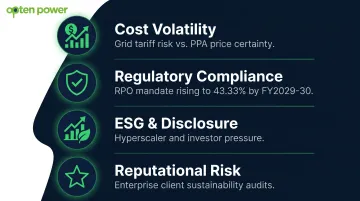
- Cost volatility exposure: Grid tariffs fluctuate with fuel costs and regulatory changes; renewable PPAs lock in predictable pricing
- Regulatory compliance risk: India's Renewable Purchase Obligation (RPO) framework mandates rising renewable procurement—from 29.91% in FY2024-25 to 43.33% by FY2029-30—with penalties for non-compliance
- ESG and disclosure requirements: Hyperscalers signed roughly 80% of global corporate renewables contracts in 2025, reflecting investor pressure and tenant demands
- Reputational risk: Enterprise customers increasingly audit supplier sustainability performance before signing contracts
The sections below cover which renewable sources best fit data center load profiles—and how to structure procurement for each.
Types of Renewable Energy Sources for Data Centers
No single renewable energy source is universally optimal. The right choice depends on your location, load pattern, reliability needs, and procurement model.
Solar Energy
Description:
Solar energy uses photovoltaic (PV) panels to convert sunlight into electricity. For data centers, this can be deployed as rooftop installations, captive solar farms, or through off-site solar PPAs connected via open access—making it one of the most accessible renewable options for large facilities.
Why It Stands Out:
Solar is the most scalable and cost-competitive renewable source today. IRENA reports that global weighted average LCOE for new utility-scale solar PV was USD 0.044/kWh in 2023, representing a sharp decline over the past decade. However, solar is intermittent—generation is limited to daylight hours and heavily depends on cloud cover and seasonal variation.
Best Suited For:
- Data centers in high solar irradiance regions (Rajasthan, Gujarat, Telangana, Maharashtra in India)
- Facilities with large rooftops or adjacent land available
- Organizations willing to pair solar with battery storage to offset nighttime demand
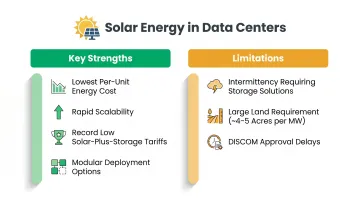
Key Strengths:
- Lowest per-unit cost among renewables in most regions
- Rapid scalability for incremental capacity additions
- Recent Indian solar-plus-storage tenders reached record-low tariffs of INR 2.86/kWh
- Modular deployment options (rooftop, ground-mount, captive)
Limitations:
- Intermittency requires backup power or storage integration
- Large-scale on-site deployment needs significant land area (approximately 4-5 acres per MW)
- Grid connectivity and DISCOM approvals can delay timelines in certain Indian states
Wind Energy
Description:
Wind energy captures kinetic energy from wind via turbines, converting it to electricity. For data centers, wind power is almost always procured through long-term PPAs or hybrid wind-solar projects, rather than on-site turbine installation.
Why Data Centers Choose It:
Unlike solar, wind generation can occur at night and during winter months, making it a natural complement to solar in hybrid renewable configurations. This improves overall capacity utilization and reduces storage dependency.
Best Suited For:
- Data centers in wind-rich states (Tamil Nadu, Andhra Pradesh, Gujarat, Karnataka, Rajasthan)
- Large enterprises with 24/7 baseload demand seeking to smooth out solar intermittency through a hybrid approach
Key Strengths:
- High capacity utilization factors in strong wind corridors
- Recent SECI wind auction tariffs reached INR 3.97/kWh
- Combined with solar in a hybrid PPA, wind significantly reduces need for grid backup and lowers blended tariffs
- Generates during off-peak solar hours, improving round-the-clock supply reliability
Limitations:
- Wind resource availability is highly location-specific and cannot be generated on-site for most data centers
- Turbine installation requires large land parcels and faces greater permitting complexity than solar
- Standalone wind faces the same intermittency challenges as solar, though at different times
Hydropower
Description:
Hydropower generates electricity from the kinetic and potential energy of flowing or falling water. For data centers, this is primarily accessed through grid-connected hydroelectric power or through PPAs with hydro-based Independent Power Producers (IPPs), rather than on-site generation.
What Makes It Reliable:
Unlike solar and wind, hydropower is largely dispatchable (meaning output can be adjusted on demand), making it one of the most reliable and firm renewable sources available. This makes it particularly valuable for data centers with strict uptime requirements.
Best Suited For:
- Data centers in states with access to hydroelectric grids (Himachal Pradesh, Uttarakhand, northeastern India)
- Organizations seeking to use hydro as a firm-power complement to intermittent solar/wind in a blended energy portfolio
Limitations:
- Geographic constraints limit direct hydro procurement to specific regions
- Large-scale hydro projects face long lead times, high capital costs, and environmental scrutiny
- Run-of-river hydro faces seasonal variability, with research indicating seasonal flow patterns will become more pronounced, impacting reliability during low-flow periods
Geothermal Energy
Description:
Geothermal energy harnesses heat from beneath the Earth's surface to generate electricity via steam-driven turbines. Unlike solar and wind, it provides continuous baseload power with no intermittency, but is currently limited to geologically active zones.
Why It Stands Out:
Geothermal is the only renewable source that operates independently of weather or time of day, offering the highest capacity factor among renewables. For most Indian data centers, however, it remains a long-term option rather than a near-term procurement choice.
Key Strengths:
- No storage required — output is continuous and fully predictable
- Highest capacity factor among all renewable sources
- Relevant for global operators in geothermally active regions (Iceland, US Pacific Northwest, East Africa)
Limitations:
- India has no commercial-scale geothermal generation; exploratory assessments are still ongoing
- Viable only in geologically active zones, ruling out most Indian data center locations
- Not a practical near-term procurement option for most C&I buyers in India
How to Choose the Right Renewable Energy Source for Your Data Center
Choosing the right renewable source comes down to your data center's specific operational profile, location, and constraints — not which technology is trending.
Load Profile and Reliability Requirements
Data centers running mission-critical, 24/7 workloads need firm or near-firm power. This favors:
- Hydro (where geographically available)
- Solar/wind hybrid configurations with battery storage
- Blended portfolios combining multiple sources
Standalone solar cannot guarantee continuous supply without backup, making it unsuitable as the sole source for facilities with strict uptime requirements.
Where you're located determines which of these options is actually accessible — and at what cost.
Geographic Availability
Renewable resource potential varies significantly by region:
- High solar irradiance: Rajasthan, Gujarat, Telangana, Maharashtra
- Strong wind corridors: Tamil Nadu, Andhra Pradesh, Gujarat, Karnataka
- Hydro access: Himachal Pradesh, Uttarakhand, northeastern states
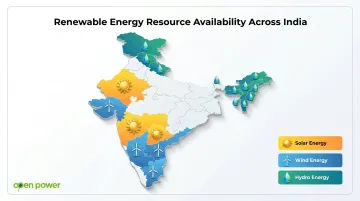
State-level DISCOM regulations and open access policies also affect which sources are procurable. Wheeling charges, cross-subsidy surcharges, and banking provisions vary considerably across states.
Beyond geography, your scale and budget shape which procurement model makes sense.
Scale and Budget
On-site solar or captive projects:
- Require significant upfront capital and land
- Deliver long-term cost certainty
- Provide maximum control over generation assets
Off-site PPAs:
- Lower capital burden
- Lock in competitive tariffs (often below DISCOM rates)
- Enable faster deployment
Opten Power lets data centers compare real-time tariffs, IRR, and payback periods across solar, wind, and hybrid developers in 16 Indian states — before committing to any procurement path.
Long-Term Flexibility
Consider whether your chosen source and procurement structure allows for capacity additions as your data center scales:
- Hybrid PPAs offer flexibility to adjust capacity over time
- Phased solar captive projects allow incremental expansion
- Single-source, fixed-term contracts may constrain growth
Regulatory and Compliance Context
Factor in:
- India's Renewable Purchase Obligation (RPO) requirements rising to 43.33% by FY2029-30
- Open access regulations specific to your state
- Banking of energy provisions (allowing you to bank surplus generation for later use)
- State-specific DISCOM approvals and interconnection timelines
Getting these details right early prevents delays and unexpected costs once procurement is underway.
How Data Centers Procure Renewable Energy
There are two primary procurement models: on-site generation (rooftop solar, captive solar/wind farms) and off-site procurement (PPAs, open access, group captive, RECs). Most large data centers use a combination of both, depending on location, load, and capital structure.
Power Purchase Agreements (PPAs)
A PPA is a long-term contract between a data center and a renewable energy developer. The data center agrees to purchase power at a pre-agreed tariff, for 15-25 years.
Key Benefits:
- Recent Indian solar auctions delivered tariffs of INR 2.52-2.53/kWh for Maharashtra DISCOM procurement, often below prevailing retail tariffs
- Fixed pricing insulates against grid tariff volatility across the contract term
- Developer finances, builds, and operates the project — no upfront capital required
- Faster deal closure is possible with standardized RFP templates and pre-approved contract structures
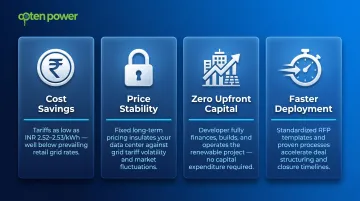
Platforms like Opten Power's automated tender engine help data centers close renewable deals up to 50% faster using pre-approved contract templates and real-time developer comparisons.
Considerations:
- Long-term commitment (15-25 years)
- State-specific wheeling and transmission charges apply
- Exit clauses and change-of-control provisions should be negotiated upfront
Renewable Energy Certificates (RECs) and Green Tariffs
RECs are a lower-complexity mechanism for data centers that cannot source direct renewables. The data center purchases certificates representing renewable generation elsewhere on the grid, letting them claim renewable consumption without physical power delivery.
Limitations:
- RECs do not guarantee additionality (new renewable capacity)
- No 24/7 time-matching of generation to consumption
- Less valued by sustainability-focused stakeholders than direct PPAs
- Limited impact on actual grid decarbonization
RECs work well for interim compliance or supplemental claims. For data centers building a credible long-term energy strategy, direct PPAs or on-site generation are the more defensible path — both financially and from a stakeholder scrutiny standpoint.
Common Mistakes to Avoid When Adopting Renewable Energy
Three mistakes consistently derail renewable energy transitions for data centers in India — each avoidable with the right planning upfront.
Choosing Intermittent Sources Without a Storage or Backup Plan
Many data centers invest in solar-only configurations without accounting for nighttime demand or cloudy periods. This leads to continued grid dependence that undermines both reliability and cost objectives.
The Fix:
Design a storage strategy or hybrid configuration from the start. According to a 2025 PV Magazine report, India's battery storage costs have fallen sharply, with recent tenders showing installed costs around INR 2.1/kWh and effective storage costs near INR 2.8/kWh at 1.5 cycles/day. Pairing solar with BESS or procuring a solar-wind hybrid PPA is a baseline requirement — not an afterthought.
Selecting a Source Based on Cost Alone
The cheapest renewable option per unit may not align with your data center's reliability, location, or procurement timeline requirements. Selecting based only on tariff benchmarks—without evaluating capacity factors, curtailment risk, and DISCOM approval timelines—often leads to operational mismatches.
The Fix:
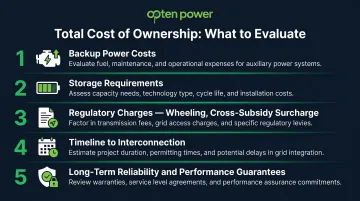
Evaluate total cost of ownership, including:
- Backup power costs
- Storage requirements
- Regulatory charges (wheeling, cross-subsidy surcharge)
- Timeline to interconnection
- Long-term reliability and performance guarantees
Underestimating Regulatory and Interconnection Complexity
In India, open access approvals, wheeling charges, cross-subsidy surcharges, and state-specific banking regulations significantly affect the true landed cost of renewable power. An IEEFA analysis estimates 40–55 GW of renewable capacity is currently facing PPA execution delays — a direct result of underestimating this complexity.
The Fix:
Conduct detailed regulatory due diligence before signing a PPA:
- Understand state-specific DISCOM approval processes and timelines
- Model total landed cost including all regulatory charges
- Engage legal and regulatory advisors familiar with the specific state's framework
Platforms like Opten Power can accelerate this process — providing real-time DISCOM intelligence and standardized landing prices across 16 states, so you're modeling actual costs rather than estimates.
Conclusion
Renewable energy sources—solar, wind, hydro, and geothermal—each offer distinct advantages for data centers, and no single source suits every scenario. Location, load profile, reliability requirements, and procurement capabilities all shape which combination makes sense for your facility.
Understanding energy types, procurement mechanisms, and local regulatory factors determines whether your strategy actually delivers cost savings or introduces new operational risk. In India, this means navigating DISCOM tariffs, open access regulations, and state-specific policies that vary significantly across regions. Data centres that map these variables before committing to a procurement model avoid costly course corrections later.
Opten Power's marketplace gives data centre operators access to 4+ GW of solar, wind, and hybrid projects across 16 states, with real-time DISCOM intelligence and automated RFP tools to move from evaluation to signed contract faster.
Frequently Asked Questions
What renewable energy sources do data centers use?
Data centers primarily use solar, wind, hydro, and geothermal energy—sourced through on-site generation, PPAs, or grid procurement. Solar and wind are the most widely adopted due to cost competitiveness and scalability, though hydro and geothermal offer superior reliability where geographically available.
Where are data centers getting their energy?
Most data centers still source the majority of their energy from the local utility grid. However, a growing number are procuring directly from renewable energy developers through open access PPAs, on-site solar installations, or green tariff programmes offered by DISCOMs.
Can renewable energy reliably power a data center 24/7?
Solar and wind alone cannot guarantee 24/7 supply due to intermittency. However, hybrid configurations (solar + wind + BESS), hydro-backed power, or a blend of on-site generation with grid backup can meet the continuous uptime requirements of mission-critical data center operations.
What is a Power Purchase Agreement (PPA) for data centers?
A PPA is a long-term contract between a data center and a renewable energy developer at a fixed tariff. This provides cost predictability and protection from grid price swings, typically at rates below prevailing DISCOM tariffs.
What is the most cost-effective renewable energy source for data centers?
Solar is currently the lowest-cost renewable option in most regions—in India, recent auctions have delivered tariffs below INR 2.6/kWh. Total cost-effectiveness still depends on pairing solar with storage or wind to address intermittency, plus state-specific wheeling, banking, and open access charges.
How are Indian data centers adopting renewable energy?
Indian data centers are increasingly procuring renewable energy through open access solar and wind PPAs, group captive projects, and DISCOM green tariff programmes. Falling renewable tariffs, rising RPO compliance requirements, and ESG commitments from global technology tenants are all accelerating this transition.