Introduction
Commercial and industrial companies across India face pressure from multiple directions: DISCOM tariff hikes that erode margins, and growing demands from investors, customers, and regulators to show real sustainability progress. For C&I energy buyers, green energy procurement has moved well beyond corporate responsibility—it's now a viable strategy to cut costs, hedge against tariff volatility, and meet ESG reporting requirements.
India's renewable energy market offers real opportunity, but navigating it isn't straightforward. Multiple procurement pathways exist—open access, corporate PPAs, group captive structures, rooftop solar, and RECs—each with distinct cost profiles, risk allocations, and regulatory requirements. State-by-state variations in wheeling charges, cross-subsidy surcharges, and DISCOM approval processes make comparing options genuinely difficult for most businesses.
This guide covers what you need to make an informed decision:
- The main procurement pathways available in India
- A step-by-step process to structure your purchase
- Realistic cost and savings expectations
- The regulatory framework for each option
- Common pitfalls to avoid
Key Takeaways
- Green energy procurement means sourcing electricity from solar, wind, or hybrid projects instead of relying solely on conventional DISCOM supply
- India offers five primary pathways: Open Access, Corporate PPAs, Group Captive, Rooftop Solar, and Renewable Energy Certificates
- Corporate PPAs deliver up to 40% cost reduction versus rising C&I DISCOM tariffs, with long-term price certainty
- The Green Energy Open Access Rules (2022) lowered the minimum threshold to 100 kW, opening access to smaller consumers
- Opten Power lets businesses compare live PPA offers across 4+ GW in 16 states, closing deals 50% faster via automated RFPs
What Is Green Energy Procurement?
Green energy procurement is the deliberate sourcing of electricity from renewable energy sources—solar, wind, or hybrid—by commercial or industrial consumers. Instead of drawing power exclusively from a state DISCOM at conventional grid tariffs, C&I buyers contract directly with generators or use market instruments to access renewable electricity.
Why it matters for Indian industry:
- DISCOM tariffs for C&I consumers have risen steadily, making renewables cost-competitive against grid power
- Renewable Purchase Obligations (RPO) require certain consumer categories to source a set percentage from renewables—or purchase RECs to cover shortfalls
- Investors scrutinize Scope 2 emissions, and global supply chains increasingly require suppliers to demonstrate measurable decarbonization
Market context:
India has set a 500 GW renewable energy target by 2030. As of March 2026, total installed renewable capacity reached 274.68 GW—including 150.26 GW of solar and 56.09 GW of wind.
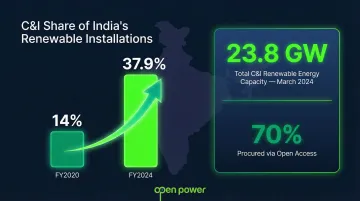
The C&I segment is a primary driver of that growth. C&I entities had set up approximately 23.8 GW of RE capacity by March 2024, with 70% procured through open access. Their share of total renewable installations more than doubled—from 14% in FY2020 to 37.9% in FY2024—reflecting how decisively corporate buyers have moved toward self-sourcing clean power.
Green Energy Procurement Options for Businesses in India
Indian C&I buyers have multiple pathways to procure renewable energy, each with different cost structures, risk profiles, scalability, and suitability. The right mix depends on load size, state location, capital availability, and strategic goals.
Open Access (Third-Party Power Purchase)
Open access allows eligible consumers to buy power directly from a renewable energy generator via the state transmission or distribution network, bypassing the DISCOM for that portion of supply. The Green Energy Open Access Rules 2022 reduced the minimum threshold to 100 kW, expanding access to smaller commercial and industrial consumers.
Large industrial consumers with stable baseload demand are the primary fit here, though economics depend heavily on state-specific charges:
- Wheeling charges: Fees for using the DISCOM's distribution network
- Transmission losses: Energy lost during delivery
- Cross-subsidy surcharge (CSS): Capped at 20% of Average Cost of Supply under GEAR 2022
- Additional surcharge (AS): Waived for green energy open access if fixed charges are paid to the DISCOM
These charges vary significantly by state and must be factored into the true "landed cost" of open access power.
Corporate Power Purchase Agreements (PPAs)
Where open access involves buying through the grid, a Corporate PPA goes further — locking in a fixed or escalating tariff directly with a developer for 10–25 years. This provides price certainty and insulation against DISCOM tariff hikes.
Financial appeal:
In March 2026, CERC approved tariffs of ₹3.35–₹3.36/kWh for 1.2 GW of NTPC wind-solar hybrid projects. Compare this to Maharashtra's FY 2025-26 HT Industry Average Billing Rate of ₹10.50/kVAh — a potential saving of over ₹7/kWh for buyers who move fast.
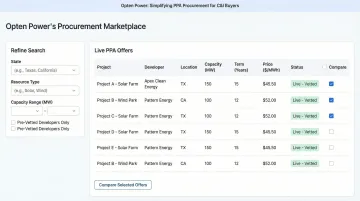
Corporate PPAs are the primary vehicle for large-scale procurement. Opten Power's marketplace lets C&I buyers compare live PPA offers from India's top producers — 4+ GW across solar, wind, and hybrid spanning 16 states — with automated RFP tools that compress deal timelines by up to 50%.
Group Captive Power Plants
The Group Captive model allows multiple companies to co-invest in a renewable energy project and draw power proportional to their stake. Each participant must hold a minimum 26% equity share under the Electricity Rules. This confers captive status, exempting buyers from certain surcharges that apply to open access third-party power.
Regulatory clarity:
The Electricity (Amendment) Rules, 2026 clarified that the 26% equity and 51% consumption thresholds apply collectively to Association of Persons (AoPs) or Special Purpose Vehicles (SPVs). If an individual captive user holds 26% or more ownership, the proportionate consumption cap does not apply—their entire consumption qualifies as captive.
Trade-off:
Requires upfront capital commitment and more complex legal/contractual structuring, but can deliver lower effective tariffs than third-party open access—CSS and AS exemptions alone can push effective savings 25–30% beyond what third-party open access delivers.
Rooftop Solar and On-Site Captive Generation
Rooftop or on-site captive solar is the simplest form of green procurement—installing solar panels on owned or leased premises to self-generate power and reduce grid dependency. Buildings, warehouses, commercial complexes, and manufacturing units with sufficient roof area are natural candidates.
Financial mechanisms:
- CAPEX: Own-and-operate model with upfront investment
- OPEX/RESCO: No upfront cost, pay per unit generated
- Hybrid: Combination of equity and financing
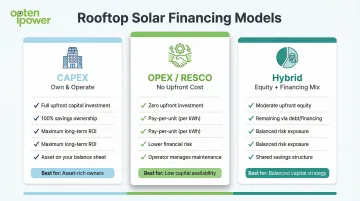
Installed costs for C&I rooftop solar range from ₹32,000 to ₹45,000 per kW as of early 2026, with typical payback periods between 3 and 5 years.
Renewable Energy Certificates (RECs)
RECs are market instruments issued by POSOCO/NLDC representing 1 MWh of renewable generation. Consumers can purchase RECs to meet RPO compliance without physically procuring renewable power.
Under the CERC REC Regulations 2022, floor and forbearance prices were removed, allowing prices to be discovered freely based on market demand and supply. RECs are useful for compliance-driven buyers or those without viable open access or rooftop options, but do not provide direct cost savings.
How to Procure Green Energy: A Step-by-Step Process
While the exact process varies by procurement pathway, the core steps follow a logical sequence every C&I buyer should know to avoid costly mistakes.
Step 1 — Assess Energy Profile and Set Goals
Conduct a thorough energy audit to analyze:
- Current consumption (units per month/year)
- Peak demand and load profile
- Existing supply mix from the DISCOM
This data determines eligibility for open access, appropriate contract size, and which renewable technology (solar, wind, hybrid) best matches your consumption curve.
Step 2 — Determine Regulatory Eligibility and State Framework
Check state-specific eligibility rules:
- Applicable open access threshold (100 kW under GEAR 2022, but some states vary)
- Charges: wheeling, CSS, banking, and additional surcharge
- DISCOM approval requirements and processing timelines
- State DISCOM cooperation levels
India's 16+ state frameworks vary significantly. For example, Maharashtra's wheeling charge is ₹0.76/kVAh, while Tamil Nadu's is ₹1.04/kWh. Understanding the landed cost in your specific state is critical before proceeding.
Step 3 — Shortlist Developers and Issue RFPs
Define your RFP scope before approaching developers:
- Technical specifications: capacity, technology type, delivery point
- Commercial terms: tariff, escalation rate, contract tenor
- Developer credentials and project readiness status
Traditional bilateral RFP processes are slow and produce inconsistent data. Opten Power's Automated Tender Engine lets businesses issue structured RFPs to multiple pre-vetted developers at once, receiving comparable proposals that can be evaluated side-by-side — closing deals up to 50% faster.
Step 4 — Evaluate Proposals and Model Financial Returns
Evaluate competing proposals beyond headline tariff:
- Calculate true landed cost (tariff + all applicable charges + losses)
- Model IRR and payback period
- Assess project timeline and risk
- Verify developer track record
Key financial metrics to compare: landed cost of power, net savings vs. DISCOM, payback period, and project commissioning timeline.
Step 5 — Negotiate, Finalise Contracts, and Obtain Approvals
Two workstreams run in parallel at this stage:
PPA negotiation covers tariff, escalation, curtailment provisions, termination clauses, and security deposit terms.
Regulatory approvals include State DISCOM/SLDC open access clearances, connectivity agreements, and commissioning coordination.
Ensure legal review of all PPA terms and regulatory approvals before financial close. Once both tracks are complete, the project moves to commissioning.
Costs, Savings, and ROI of Green Energy Procurement
For most C&I consumers, the primary driver of green energy procurement is economics—not just sustainability.
Understanding the True Landed Cost
The "quoted tariff" from a developer is rarely the final cost. The true landed cost includes:
- PPA/open access tariff
- Wheeling charges
- Transmission losses
- Cross-subsidy surcharge
- Additional surcharge
- Scheduling charges
- Banking charges
Example calculation:
| Component | Maharashtra (FY26) | Amount |
|---|---|---|
| PPA Tariff | Hybrid solar-wind | ₹3.35/kWh |
| Wheeling Charge | HT | ₹0.76/kVAh |
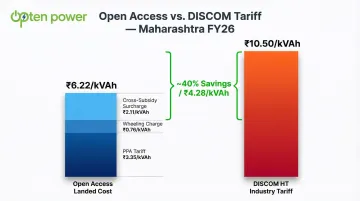
| Cross-Subsidy Surcharge | HT Industry | ₹2.11/kVAh |
| Additional Surcharge | Exempt if fixed charges paid | ₹0.00 |
| Total Landed Cost | ~₹6.22/kVAh |
Compare this to Maharashtra's DISCOM HT Industry tariff of ₹10.50/kVAh, yielding potential savings of ₹4.28/kVAh or approximately 40%.
Savings Potential and Payback
Under well-structured open access or PPA arrangements, businesses can achieve savings of 20–40% versus grid tariffs. In Q4 2025, net landed open access costs across states ranged from less than ₹5/kWh to ₹8.4/kWh, with Maharashtra reporting the highest landed costs and Odisha, Uttar Pradesh, and Chhattisgarh the lowest.
Those cost gaps also reflect why contract structure matters beyond the headline tariff. Long-term price locking via PPA insulates buyers from DISCOM tariff escalation across the contract period. This makes PPAs a reliable hedge against India's pattern of steady grid tariff increases.
Beyond Direct Cost Savings: Additional Financial and Strategic Benefits
- RPO compliance: Avoid penalties for non-compliance with rising RPO targets (33.01% for 2025-26, 35.95% for 2026-27, 38.81% for 2027-28)
- ESG reporting: Reduce Scope 2 emissions and improve ESG scores with investors
- Export market access: Green certifications support compliance with global supply chain requirements
- Energy cost predictability: Fixed tariffs improve financial planning and budgeting accuracy
India's Regulatory Framework for Green Energy Procurement
India's green energy procurement operates within a layered regulatory structure — one that determines your costs, timelines, and obligations before you sign a single agreement. Getting this right matters.
Section 42 of the Electricity Act 2003 requires distribution licensees to provide open access subject to wheeling charges and cross-subsidy surcharge. The Green Energy Open Access Rules 2022 (GEAR 2022)%20Rules,2022.pdf) built on this foundation — streamlining approvals, limiting state discretion, and setting a 15-day deemed approval timeline.
Key GEAR 2022 provisions:
- Consumers with contracted demand or sanctioned load of 100 kW or more (single or aggregated connections in the same division) qualify for green energy open access
- Applications must be processed within 15 days — failing which, approval is deemed granted subject to technical requirements
- Cross-subsidy surcharge is capped at 20% of Average Cost of Supply, with increases limited to 50% over 12 years from plant operation
- Additional surcharge is waived when fixed charges are paid to the DISCOM
Renewable Purchase Obligations (RPO)
State electricity regulatory commissions set RPO targets requiring large C&I consumers to source a defined percentage of annual consumption from renewable energy — or purchase Renewable Energy Certificates (RECs) to cover the shortfall.
Non-compliance carries real consequences. Under Section 26(3) of the Energy Conservation Act, 2001, penalties run up to ₹10 lakh, plus additional penalties not exceeding twice the price per metric ton of oil equivalent consumed above prescribed norms. RPO targets are rising annually, which means reactive, compliance-driven purchasing typically costs more than proactive procurement.
State-by-State Variation
GEAR 2022 established a national baseline, but DISCOMs apply charges, banking norms, and approval processes differently at the state level. Tamil Nadu, for instance, maintains a 63 kVA threshold for HT consumers and requires DISCOM consent, with a preference for long-term over short-term access.
Businesses operating across multiple states need to model each state's cost structure separately. Platforms with real-time DISCOM intelligence — like Opten Power's standardised, updated landing price data across 16 states — eliminate the manual legwork of tracking these variations.
Common Challenges in Green Energy Procurement (and How to Overcome Them)
Green energy procurement in India involves navigating regulatory complexity, assessing developer reliability, and negotiating long-term contracts — each carrying real financial consequences if handled poorly. Here's where most buyers run into trouble, and how to get ahead of each risk.
Regulatory and Approval Complexity
Securing DISCOM approval for open access, managing connectivity agreements, and navigating state-specific charges can delay projects by months if approached without expertise.
How to address it: Engage an experienced energy advisor or use platforms that provide standardized, updated regulatory data across states before committing to a procurement structure.
Developer and Project Viability Risk
Not all renewable developers have the same financial strength, project execution track record, or land/connectivity readiness. Selecting the wrong developer can result in delayed commissioning or project cancellation.
How to address it: Vet developers on financial standing, project pipeline, commissioned capacity, and grid connectivity status. Platforms like Opten Power — which provides access to pre-vetted producers across 16 states and 4+ GW of available capacity — reduce this risk significantly by removing unqualified counterparties from consideration upfront.
PPA Contract Complexity and Long-Term Risk
PPAs are 10–25 year commitments with complex provisions around curtailment, change-in-law, termination, and security. Poorly negotiated terms can expose buyers to financial risk if energy demand changes or if state surcharges increase.
How to address it: Before signing, cover three non-negotiables:
- Legal review of all PPA terms, including termination and security provisions
- Scenario modelling for charge changes and demand fluctuations over the contract period
- Explicit negotiation of change-in-law pass-through and curtailment compensation clauses
Frequently Asked Questions
What is green energy procurement?
Green energy procurement is the process by which businesses source electricity from renewable energy sources—such as solar, wind, or hybrid—either through direct agreements with generators, on-site generation, or market instruments like RECs, rather than relying solely on conventional DISCOM supply.
What are the main green energy procurement options available in India?
The five primary pathways are Open Access (Third-Party), Corporate PPAs, Group Captive Power Plants, Rooftop/On-Site Solar, and Renewable Energy Certificates (RECs). The right choice depends on load size, state location, capital availability, and procurement goals.
How does a Corporate PPA work for industrial buyers?
A Corporate PPA is a long-term contract between an industrial buyer and a renewable developer at a fixed or escalated tariff. Power is delivered to the buyer's premises through the grid under open access, offering price certainty and protection against DISCOM tariff increases.
What is the minimum load requirement for open access under the Green Energy Open Access Rules 2022?
The threshold is 100 kW contracted demand or sanctioned load (single or aggregated connections in the same electricity division). This applies to both individual and aggregated connections within the same electricity division.
How much can businesses save through green energy procurement in India?
Savings depend on the procurement model, state, and applicable charges. Well-structured Corporate PPAs or open access arrangements can reduce energy costs by 30-40% compared to C&I DISCOM tariffs, though buyers must model their specific landed cost before committing.
What are Renewable Purchase Obligations (RPO) and do they apply to my business?
RPOs are state-mandated requirements for eligible C&I consumers to source a defined percentage of annual consumption from renewable energy or purchase RECs, with penalties for non-compliance. Targets are set to reach 38.81% by 2027-28, so businesses not yet compliant face growing shortfall risk each year.