Introduction
Commercial and industrial (C&I) consumers across India pay ₹7.79/kWh on average for industrial tariffs and ₹10.17/kWh for commercial tariffs — while the 11-state average cost of supply sits at just ₹7.47/kWh. Small businesses absorb this gap because they lack the load size and negotiating leverage to secure direct Power Purchase Agreements or favorable grid tariffs from DISCOMs.
The cross-subsidy structure reinforces this disparity. Small businesses effectively subsidize agricultural and residential consumers, with no direct mechanism to opt out through individual procurement.
Group buying power offers a way out, but outcomes vary widely depending on procurement structure, state regulations, load profile, and how the collective is organized. This guide breaks down how small businesses can access it, when it works, and what drives — or kills — actual savings.
Key Takeaways
- Group buying power pools energy demand to meet volume thresholds, unlocking open access and PPA rates typically reserved for large industrial consumers
- The most common structures are Group Captive Power Plants, Group Open Access arrangements, and collective PPA platforms that aggregate demand across buyers
- Small businesses typically need 100 kW minimum contracted load (depending on state) and stable consumption to participate effectively
- Savings depend on state DISCOM tariff rates, applicable charges (wheeling, banking, cross-subsidy surcharges), contract tenure, and developer quality
- Platforms like Opten Power aggregate demand across 16 states and offer real-time tariff comparisons, cutting procurement complexity
What Is Group Buying Power in Energy Procurement?
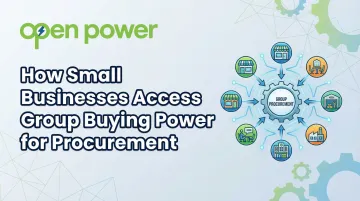
Group buying power in energy procurement refers to the aggregation of electricity demand from multiple small or mid-sized businesses so that the collective volume qualifies for bulk procurement contracts, open access thresholds, or favorable PPA terms with renewable energy developers.
Unlike general GPO models used for office supplies or logistics, energy-specific collective procurement structures operate within unique regulatory layers. Three primary models exist:
- Group Captive: Multiple businesses co-own generation capacity to access captive power benefits
- Group Open Access: Aggregated demand crosses open access thresholds that individual businesses cannot reach alone
- Demand-aggregation platforms: Digital intermediaries pool load across businesses to negotiate PPA terms
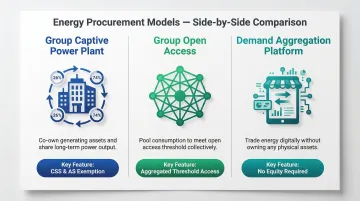
These structures must navigate DISCOM rules, state open access policies, and CERC/SERC guidelines — making energy procurement fundamentally different from commodity buying.
Why This Matters for Small Businesses
Individual businesses consuming under 1 MW typically cannot access open access markets or negotiate directly with Independent Power Producers (IPPs). The Green Energy Open Access (GEOA) Rules reduced the eligibility threshold from 1 MW to 100 kW, allowing demand aggregation across multiple connections.
This regulatory shift makes collective demand pooling the primary pathway to competitive energy pricing for small businesses — one that was effectively closed off before 2022.
As of November 2024, 28 out of 29 Indian states and Union Territories have adopted the GEOA framework — meaning this pathway is available to small businesses across nearly the entire country, not just in select markets.
How Small Businesses Can Access Group Buying Power for Energy Procurement
Step 1: Audit Your Energy Consumption and Load Profile
Collect at least 12 months of energy consumption data covering:
- Monthly units consumed (kWh)
- Peak demand in kW/MW
- Load factor (capacity utilization)
- Operating hours (daytime vs. 24x7)
This baseline determines which procurement structures your business qualifies for and what savings are realistic. Verify your sanctioned load and contracted demand with your DISCOM. Then check whether your state's open access policy has a minimum load threshold you currently meet — or could meet by aggregating with others.
State-specific minimum load thresholds vary:
| State | Minimum Load Threshold | Aggregation Permitted |
|---|---|---|
| Rajasthan | 100 kW | Yes, across multiple connections in same division |
| Gujarat | 100 kW | Yes, across multiple connections in same division |
| Maharashtra | 100 kW | Yes, across multiple connections in same circle |
| Tamil Nadu | 63 kVA | Not specified for aggregation |
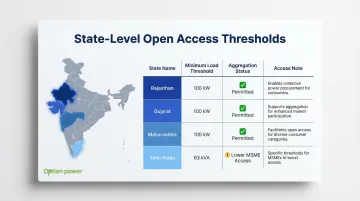
Tamil Nadu's lower 63 kVA threshold expands access for smaller MSMEs that would not qualify in other states.
Step 2: Identify the Right Group Procurement Structure
Three primary structures serve small businesses:
Group Captive Power Plant — Multiple businesses co-own shares of a renewable asset and draw power from it. Under Section 9 of the Electricity Act 2003, captive users must hold at least 26% ownership and consume at least 51% of aggregate electricity generated annually. The key advantage: exemption from Cross-Subsidy Surcharge (CSS) and Additional Surcharge (AS).
Group Open Access — Businesses pool demand to meet state-level minimum thresholds and procure from a third-party generator. This structure faces CSS and AS charges, which can erode 30-50% of potential savings in unfavorable states.
Demand Aggregation via Marketplace Platform: A platform bundles member demand and negotiates collective PPAs with multiple developers simultaneously. This option suits businesses that want procurement support without taking equity in a physical asset.
Choosing between these structures comes down to four factors:
- Consumption size and whether you meet minimum thresholds independently
- Willingness to hold equity in a captive generation asset
- Preferred contract flexibility and tenure
- State-specific regulations (not all structures are available everywhere)
Step 3: Find and Join a Collective or Energy Procurement Platform
Two pathways exist:
Industry associations or cooperatives that run buying groups for energy — common in textile clusters and MSME industrial estates. Membership is typically limited to businesses within the same geographic area or industrial sector, which simplifies load aggregation but restricts your developer pool.
Digital energy marketplaces work differently: they aggregate demand across businesses in multiple states, issue collective RFPs to renewable developers, and handle regulatory compliance, tariff comparison, and contract management on behalf of members. Opten Power, for instance, operates across 16 states, connecting small and mid-sized C&I buyers to pre-vetted renewable capacity with an automated tender engine that closes deals up to 50% faster than traditional procurement.
Step 4: Evaluate Developer Proposals and Compare Terms
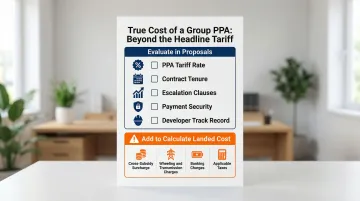
Once the platform aggregates collective demand, multiple developers submit proposals. Evaluate these factors carefully:
- Tariffs (₹/unit): Utility-scale solar PPAs currently clear at ₹2.56–₹2.57/kWh, while wind-solar hybrids clear at ₹3.43/kWh
- Contract tenure: 15-25 years for lower fixed tariffs vs. shorter tenures with higher rates or escalation clauses
- Annual escalation clauses: Fixed vs. variable tariff structures
- Payment security mechanisms: Bank guarantees, letters of credit, escrow arrangements
- Developer track record: Past project delivery, balance sheet strength, existing PPA performance
Before finalizing any comparison, factor in cross-subsidy surcharge, wheeling and transmission charges, banking charges, and applicable taxes. These charges routinely catch businesses off guard — the landed cost per unit, not the headline tariff, is what determines actual savings against your current DISCOM rate.
Step 5: Execute the Contract and Set Up Monitoring
After selecting a developer and finalizing PPA terms, work with your legal/advisory team to review contract clauses covering:
- Minimum offtake obligations
- Force majeure provisions
- Grid connectivity requirements
- Exit provisions
Set up a monitoring system to track actual energy delivered versus contracted, landed cost per unit, and regulatory compliance across billing cycles. Catching a billing discrepancy or compliance gap in month two is manageable; catching it in year two is not.
When Group Buying Power Makes Sense for Your Business
Group procurement is not a fit for every small business. It works best when:
- Your business has relatively stable, predictable load (not highly seasonal or intermittent)
- You're located in a state with favorable open access regulations and reasonable cross-subsidy surcharges
- You have a planning horizon of at least 3–5 years to justify PPA contract tenures
Certain operation types consistently check all three boxes.
Business Types That Benefit Most
Operations with high 24x7 or daytime energy consumption — and significant DISCOM tariff exposure — see the strongest returns:
- Manufacturing units
- Warehouses and cold storage facilities
- Data centres
- Hospitals and commercial complexes
- Hotels and IT parks
Open access consumers at IEX paid an average of ₹3.92/kWh in March 2023, compared to a ₹5.90/kWh weighted average grid price — a 33% reduction before factoring in additional charges.
When the Approach Becomes Inefficient
Group procurement may not work for:
- Businesses with very low or unpredictable consumption
- Those in states with prohibitive open access charges
- Operations needing very short-term flexibility
For these situations, rooftop solar or spot power exchange purchases typically offer a better fit — lower commitment, faster setup, and no cross-subsidy exposure.
Key Variables That Determine How Much Your Business Saves
Two businesses joining the same group procurement arrangement can see very different outcomes depending on how these critical variables align.
Load Size and Aggregated Volume
Larger aggregated volumes give the collective stronger negotiating leverage with developers and reduce per-unit tariff. SECI tenders typically require a minimum bid quantum of 50 MW for grid-connected renewable projects to achieve economies of scale.
Small individual loads need to combine meaningfully to cross the negotiating threshold. A single business consuming 150 kW gains little leverage alone, but 20 similar businesses aggregating 3 MW can command competitive bids.
State Open Access Policy and Applicable Charges
Open access charges — wheeling, transmission, cross-subsidy surcharge (CSS), and scheduling & deviation charges — vary significantly by state and can erode or eliminate the tariff advantage of a group PPA.
The difference between states is stark:
| State | PPA Rate | CSS (HT-Industry) | Wheeling | Landed Cost |
|---|---|---|---|---|
| Maharashtra (FY 2025-26) | ₹2.56/kWh | ₹2.11/kWh | ₹0.95/kWh | ₹5.62/kWh |
| Odisha / UP / Chhattisgarh | Lower | Lower | Lower | Among lowest nationally |
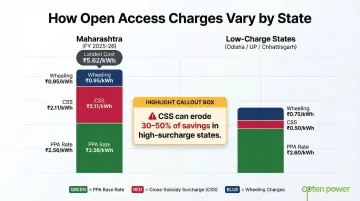
The group captive model exempts buyers from CSS and additional surcharge (AS), shielding them from state-level regulatory changes. Gujarat's AS, for instance, dropped from ₹1.00/kWh to ₹0.76/kWh in April 2026, a shift that would directly affect open access buyers but not group captive participants.
Contract Tenure and Tariff Structure
Longer tenures (15–25 years) typically yield lower fixed tariffs but lock businesses into obligations. Shorter tenures offer flexibility at higher rates or with escalation clauses.
Model the break-even point against projected DISCOM tariff increases. If your DISCOM tariff has risen 6% annually over the past five years, a 15-year fixed PPA at ₹3.50/kWh could deliver cumulative savings exceeding 40% by year 10.
Renewable Energy Source and Plant Load Factor
Solar, wind, and hybrid projects have different generation profiles and Plant Load Factors (PLF). CERC specifies normative CUF/PLF benchmarks: solar PV minimum 21%, wind 22–35%, hybrid minimum 30%.
A mismatch between the plant's generation profile and your consumption pattern increases dependence on grid backup at DISCOM rates, reducing net savings. Daytime-heavy manufacturing units benefit most from solar, while 24x7 operations should consider wind or hybrid.
Developer Track Record and Financial Strength
In group procurement, one weak developer affects all participating businesses. Delayed commissioning, under-delivery, or financial distress creates shared risk across every member.
Before committing, vet developers on:
- Past project delivery record and commissioning timelines
- Balance sheet strength and credit rating
- Existing PPA performance across their portfolio
A developer with 500+ MW of successfully commissioned capacity and an investment-grade credit rating presents far lower risk than a new entrant.
Common Mistakes Small Businesses Make in Group Energy Procurement
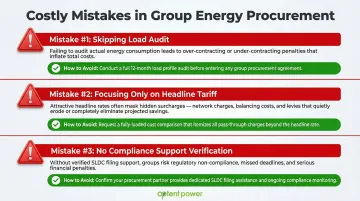
Even well-intentioned group energy deals fall apart when businesses skip the groundwork. These are the three mistakes that cost small businesses the most:
Skipping the Load Audit and Baseline Analysis
Many businesses enter group procurement without a clear picture of actual consumption, load factor, or peak demand. The result is over-contracting or under-contracting — both of which trigger penalty charges or erase projected savings before they materialize.
Focusing Only on Headline Tariff, Ignoring Landed Cost
The ₹/unit rate in a PPA is only part of the story. Wheeling charges, transmission fees, cross-subsidy surcharges, and scheduling costs all affect your net rate. In high-surcharge states like Maharashtra, businesses that ignore these components often discover their actual savings are far smaller than expected — or negative.
Joining a Group Without Verifying Compliance Support
Group procurement requires state SLDC filings, open access approvals, banking arrangements, and metering compliance. Businesses that join without verifying end-to-end compliance support from the organizing entity face significant operational and financial risks.
Frequently Asked Questions
What is the procurement process for small businesses?
Small businesses typically procure energy directly from their state DISCOM at regulated tariffs. To access better rates, they audit consumption, identify collective procurement structures (group open access or group PPAs), join a buying group or marketplace platform, evaluate developer proposals, and execute a structured contract with ongoing monitoring.
What is a GPO for procurement?
A Group Purchasing Organization (GPO) is an entity that aggregates buying volume across multiple businesses to negotiate better prices and terms with suppliers. In energy procurement, equivalent structures include group PPA arrangements, group captive plants, and demand-aggregation platforms that pool small business loads to unlock rates otherwise reserved for large industrial buyers.
What is a group PPA and how does it work for small businesses?
A group Power Purchase Agreement is a contract where multiple businesses collectively purchase renewable energy from a single developer at a pre-negotiated rate. Each business commits a share of the total contracted volume, with the combined load meeting the minimum threshold for a competitive long-term deal.
What load size do small businesses need to participate in group energy procurement?
Minimum load requirements vary by state open access policy, but individual businesses typically need at least 100 kW of contracted demand in many Indian states. Through demand aggregation platforms or industry clusters, businesses below this threshold can pool demand to qualify collectively.
How much can small businesses realistically save through group energy buying?
C&I consumers can save 30–50% on energy costs through open access, though actual savings depend on current DISCOM tariff, applicable open access charges, contract tenure, and renewable source. The group captive model maximizes savings by exempting businesses from CSS and AS charges.
What is the difference between a buying group and a group purchasing organization in energy?
A buying group typically refers to businesses informally pooling purchases for a single transaction, while a GPO or structured energy collective is a formalized entity with ongoing supplier contracts, regulatory compliance management, and portfolio monitoring — a critical distinction given the regulatory complexity of open access procurement.