Introduction
Energy costs represent one of the most significant financial burdens for Indian commercial and industrial operations. For cement manufacturers, energy accounts for 35%–50% of total manufacturing costs, while Electric Arc Furnace steel plants face energy bills of $35–$60 per ton. Yet proactive manufacturers have driven their energy bills to a 20-year low of 1.98% of net sales by moving aggressively into renewable energy procurement.
This cost divide isn't accidental. Businesses that stay on default DISCOM tariffs or auto-renew contracts without market analysis overpay year after year, steadily eroding margins in commodity markets where every rupee per unit matters.
Energy procurement doesn't have to be this expensive. Cheaper alternatives exist — open access power, corporate PPAs, hybrid project structures. What blocks access to them is passive decision-making, poor contract structuring, and limited visibility into what the market actually offers.
This article breaks down where energy costs accumulate, what drives them up, and the specific procurement strategies — from tariff benchmarking to long-term PPAs — that Indian businesses are using to bring them down.
Key Takeaways
- Passive renewals, poor contract structures, and missed open access opportunities quietly inflate your energy bill
- Market timing, peak demand penalties, and DISCOM tariff dependency are the top cost drivers to address
- Switch to open access, lock in long-term PPAs, and renegotiate contracts before auto-renewal kicks in
- Audit invoices and track tariff changes regularly to catch hidden cost leakage before it compounds
- Negotiate harder: state-level supplier competition means better rates are available if you actively seek them
How Energy Procurement Costs Build Up for Businesses
Energy procurement costs rarely appear as a single, visible line item. They accumulate gradually through multiple charges that most businesses never itemize:
- Supply charges — the base per-unit rate from the utility or open access source
- Transmission and wheeling fees — state-level pass-through costs that vary by corridor
- Cross-Subsidy Surcharges (CSS) — levied on open access consumers to subsidize other user categories
- Demand charges — billed on peak contracted or recorded demand, regardless of actual consumption
- Billing errors — overcharges, wrong tariff category assignments, and missed rebates that go unchallenged
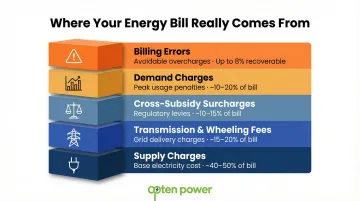
Cost build-up compounds over time. A business that auto-renews contracts or stays on default utility rates locks itself into an unfavorable baseline. As the gap between market rates and contract rates widens, switching becomes progressively harder.
States like Maharashtra, Andhra Pradesh, and Telangana now mandate kVAh billing for high-tension consumers, which directly penalizes poor power factor in the base energy charge — a facility operating at 0.85 power factor pays 15% more than one at 0.99 for the exact same useful work.
Many of these costs stay hidden until contract expiry or a scale-up forces a full audit. Invoice complexity, multi-location billing, and opaque surcharge structures mean most businesses underestimate their true per-unit energy cost — often by 10–20% or more.
Key Cost Drivers in Energy Procurement
Contract Structure Determines Volatility Exposure
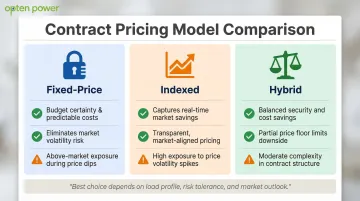
The dominant cost driver for most C&I businesses is contract structure. Whether a business operates on a fixed-price, indexed, or hybrid contract directly determines how much market volatility it absorbs—and most businesses default to structures they haven't re-evaluated in years.
DISCOM Dependency as a Structural Cost Driver
Default grid tariffs in India include cross-subsidy surcharges, reactive energy charges, and time-of-day penalties that open access procurement can help bypass. Yet CSS and wheeling charges consume 40%–50% of the landed Open Access tariff. Mapping state-specific charges before switching is what separates a genuine saving from a paper one.
High-tension industrial tariffs vary dramatically by state:
- Maharashtra: ₹7.48–₹9.59/kVAh base tariff + ₹2.11/kVAh CSS (capped at 20% of Average Cost of Supply)
- Gujarat: ₹8.46/kWh with CSS ranging from ₹0.09–₹1.36/kWh depending on DISCOM
- Haryana: ₹6.65/kVAh with ₹1.47/kWh CSS and ₹0.61/kWh wheeling charges
Demand Charges and Peak Load Penalties
Unmanaged consumption profiles directly inflate per-unit costs during high-load periods. Demand charges are levied based on peak consumption intervals—often 15–30 minutes per billing cycle. Maharashtra's FY26 tariff structure penalizes evening peaks with an additional ₹1.10/kVAh from 18:00 to 22:00, while offering solar-hour rebates from 09:00 to 17:00.
Procurement Timing as a Cost Driver
Peak-load exposure and contract timing are linked—businesses that renew at expiry without watching market windows often lock in rates at price peaks. The mandatory Domestic Content Requirement (DCR) for solar modules starting June 2026 has already triggered a ~₹0.25/kWh premium on forward PPA tariffs in Q4 2025. Businesses that enter 12–24 months ahead of such regulatory shifts lock in rates before compliance costs are priced in.
Cost-Reduction Strategies for Energy Procurement
Energy procurement cost savings come from three distinct levers: the decisions made before signing a contract, how energy is managed during the contract lifecycle, and the regulatory and market conditions shaping what's available. Each layer requires different tools and actions.
Strategies That Reduce Costs by Changing Decisions
Shift from DISCOM Default Tariffs to Open Access Procurement
For eligible C&I consumers, open access allows businesses to source power directly from generators at competitive rates. The Green Energy Open Access Rules (2022) reduced the eligibility threshold from 1 MW to 100 kW, unlocking this option for mid-sized commercial and industrial facilities.
While long-term wind-solar PPAs clear at ₹2.86–₹3.19/kWh, landed Open Access costs range from under ₹5/kWh in Odisha and Uttar Pradesh to ₹8.40/kWh in Maharashtra after factoring in CSS and wheeling charges. Businesses must model 10-year landed costs using state-specific CSS ceilings rather than base PPA tariffs before signing contracts.
Sign Long-Term Corporate Power Purchase Agreements (PPAs)
Locking in solar or wind power at a fixed tariff over 10–25 years protects businesses from grid tariff escalation. Corporate PPAs currently clear at ₹2.86–₹3.19/kWh, undercutting HT industrial tariffs that range from ₹6.65/kVAh in Haryana to over ₹10.00/kVAh in Maharashtra.
Platforms like Opten Power provide access to 4+ GW of projects across solar, wind, and hybrid technologies with real-time tariff and ROI comparison across developers, enabling businesses to evaluate multiple options simultaneously.
Optimize Contract Structure — Fixed, Indexed, or Hybrid
The right pricing model depends on load profile, risk tolerance, and market outlook. Each structure has distinct tradeoffs:
- Fixed-price contracts provide budget certainty but may lock in above-market rates during price dips
- Indexed contracts capture downside savings but expose businesses to spot market volatility
- Hybrid structures balance fixed-rate security with index-linked opportunity, reducing volatility without sacrificing savings potential
Aggregate Load Across Facilities or Business Units
Businesses with multiple sites that procure energy separately miss the pricing power that consolidated volume provides. Bundling contracts across plants, locations, or subsidiaries enables wholesale-indexed pricing and reduces per-unit cost.
The 100 kW threshold under Green Energy Open Access Rules makes load aggregation viable for smaller facilities previously trapped in default utility tariffs.
Strategies That Reduce Costs by Changing How Energy Procurement Is Managed
Implement Real-Time Tariff Monitoring and Time Market Entry Precisely
Energy markets move continuously. Businesses that monitor spot and forward market conditions can identify favorable windows to lock in rates or renegotiate ahead of renewal. Passive renewal at contract expiry consistently results in above-market pricing, particularly when regulatory changes like the DCR mandate create temporary supply chain bottlenecks.
Audit Invoices and Billing Systematically
Billing errors, missed tax exemptions, misapplied tariff categories, and unclaimed incentives are common in multi-location C&I energy billing. The sheer complexity of HT billing—kVAh conversions, time-of-day overlaps, reactive penalties—guarantees leakage. C&I energy buyers should treat automated, third-party invoice auditing as a mandatory fiduciary control.
Manage Peak Demand Charges Actively
Demand charges are levied based on a business's peak consumption interval, often 15–30 minutes per billing cycle. Operational changes such as:
- Staggering equipment start-up times
- Shifting production to off-peak hours
- Using automated load controllers
can reduce the demand charge component significantly without capital investment.
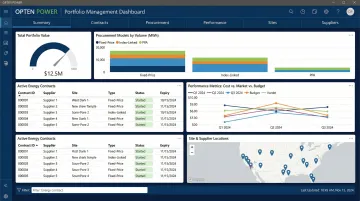
Use a Unified Portfolio Dashboard to Track All Contracts
Businesses managing multiple sites or supplier relationships without centralized visibility cannot detect anomalies, compare performance, or act on optimization opportunities quickly. Opten Power's Portfolio Management Dashboard enables businesses to monitor all renewable energy investments and contract performance from a single platform, maintaining visibility across different procurement models and platforms.
Strategies That Reduce Costs by Changing the Context Around Energy Procurement
Relying on a single generation source, such as solar alone, introduces risk from seasonal generation variability. Hybrid procurement combining solar, wind, and storage improves round-the-clock power availability while maintaining cost advantages over grid tariffs.
Solar provides predictable daytime generation; wind typically peaks during evening and nighttime hours. These complementary profiles reduce intermittency risk without sacrificing the economics of renewable procurement.
Conclusion
Energy procurement costs don't rise because energy is inherently expensive. They rise because businesses allow passive decisions, outdated contracts, and poor market visibility to go uncorrected. The opportunity to save is consistently available but requires intentional action.
Effective cost reduction in energy procurement is strategic and continuous — it spans the full procurement lifecycle, and the earlier a business acts, the more it saves. The divide is already playing out: businesses still locked into passive DISCOM-dependent purchasing face compounding tariff hikes, while those who have shifted to active renewable procurement are widening their cost advantage year over year. The question is which side of that divide your business is on.
Frequently Asked Questions
What is procurement cost savings?
Procurement cost savings refer to the reduction in total spend achieved by sourcing goods or services more efficiently. In energy procurement, this includes securing better tariff rates, reducing surcharges, improving contract terms, and eliminating wasteful consumption.
What is the average procurement savings in energy?
Savings vary based on consumption volume, contract structure, and sourcing approach. C&I businesses shifting from utility rates to competitive procurement or PPAs typically achieve 10–40% reductions on energy supply costs, with some heavy industries documenting up to 44% average savings through open access.
How do you contribute to cost savings in procurement?
Energy procurement savings come from three distinct layers, each targeting different cost drivers:
- Strategic decisions: contract structure, market timing, open access adoption
- Active management: invoice auditing, demand control, portfolio monitoring
- Structural changes: supplier competition, regulatory navigation
What is a Power Purchase Agreement (PPA) and how does it reduce business energy costs?
A PPA is a long-term contract between a business and a renewable energy developer that locks in a fixed or structured tariff over 10–25 years. It provides price certainty and protection from grid tariff escalation, with current rates of ₹2.86–₹3.19/kWh significantly undercutting default DISCOM tariffs.
What is the difference between open access power and DISCOM grid supply for C&I consumers?
DISCOM grid supply is the default utility option, where the state distribution company sets the tariff. Open access lets eligible consumers (100 kW or more under 2022 Green Energy rules) buy power directly from generators at competitive rates instead. The trade-off: open access adds wheeling, transmission, and cross-subsidy surcharge costs that must be netted against the tariff savings to confirm viability.
How can businesses reduce peak demand charges in their energy bills?
Peak demand charges are based on the highest consumption interval in a billing period, typically 15–30 minutes. Businesses can reduce these by staggering high-load equipment start-up times, scheduling energy-intensive operations during off-peak hours, and using automated load management systems to prevent simultaneous high-draw events.