Introduction
For C&I businesses facing rising grid tariffs and mounting pressure to decarbonise, wind energy has become one of the most viable answers. India now ranks as the 4th largest wind power nation globally, with total installed onshore wind capacity surpassing 55 GW as of February 2026.
With wind power tariffs stabilising between ₹3.43 and ₹3.69 per kWh in recent auctions, wind PPAs offer predictable, long-term cost reduction for heavy industries — from steel and cement to data centres and IT parks.
The government's target of 150 GW wind capacity by 2030 is accelerating project development across high-yield wind corridors. This guide profiles the top wind power plants and parks behind India's growth, and explains how businesses can access this capacity through corporate procurement.
Key Takeaways
- India holds the 4th largest installed wind capacity globally at 55.13 GW, concentrated in Gujarat, Tamil Nadu, Karnataka, Maharashtra, and Rajasthan
- The largest commissioned wind farm is Muppandal Wind Farm (Tamil Nadu) at 1,500 MW
- Gujarat's Kutch Wind Park has 11,500 MW allocated but remains under development
- Top developers include Adani Green, Suzlon Energy, ReNew Power, and JSW Energy
- C&I businesses can compare wind project tariffs, PPA terms, and savings across 16 states in real-time on Opten Power
Wind Energy in India: Scale, Significance & State-Wise Distribution
Wind energy in India harnesses kinetic energy from strong coastal and inland wind corridors through onshore wind farms connected to the national grid. As of February 28, 2026, India's total commissioned onshore wind capacity stands at 55,132.50 MW, securing its position as the world's fourth-largest wind power nation behind China, the US, and Germany.
State-Wise Wind Capacity Distribution:
| State | Installed Capacity (MW) | National Share (%) |
|---|---|---|
| Gujarat | 15,197.19 | 27.56% |
| Tamil Nadu | 12,102.76 | 21.95% |
| Karnataka | 8,500.54 | 15.41% |
| Maharashtra | 5,873.01 | 10.65% |
| Rajasthan | 5,229.15 | 9.48% |
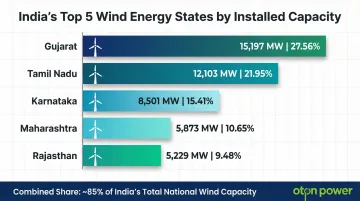
These five states collectively account for 46,902.65 MW — over 85% of India's total wind capacity. Gujarat officially surpassed Tamil Nadu as the leading wind state in mid-2023, driven by large-scale developments in the Kutch region.
The sections below profile the largest wind parks within these states by installed capacity, location, and developer.
Top Wind Power Plants & Parks in India
India's largest wind power projects span four states and range from India's oldest commercial wind farm to multi-gigawatt development zones still taking shape. What follows profiles the most significant operational and high-credibility development sites — ranked by verified commissioned capacity, not announced allocations.
Muppandal Wind Farm, Tamil Nadu
Muppandal Wind Farm holds the distinction of being India's largest operational onshore wind farm — and one of its oldest. Located near Kanyakumari in Tamil Nadu, it was pioneered by the Tamil Nadu Energy Development Agency (TEDA) starting in 1985, predating the commercial wind industry in most Indian states.
Key differentiators:
- Commissioned in 1986, Muppandal established the technical and financial feasibility of large-scale wind generation in India before most developers had entered the market
- Aralvaimozhi pass advantage — The natural funnelling effect of this mountain corridor creates consistent, high-quality wind speeds that underpin the farm's long-run output
- Tamil Nadu's wind turbine manufacturing cluster nearby has enabled efficient maintenance and technology upgrades across decades of operation
| Attribute | Details |
|---|---|
| Location & State | Kanyakumari, Tamil Nadu |
| Installed Wind Capacity | 1,500 MW (~3,000 turbines) |
| Key Developer | Muppandal Wind (supported by TEDA) |
Kutch Wind Farm, Gujarat
Kutch's wind zone sits within the Gujarat Hybrid Renewable Energy Park (GHREP) — also called the Khavda Renewable Energy Park — India's most ambitious renewable development zone. SECI has allocated 11,500 MW of wind capacity here for competitive bidding, though this reflects planned scale, not commissioned output.
As of early 2026: Adani Green Energy has commissioned 185 MW of wind capacity at Khavda, with additional blocks under active development.
Key differentiators:
- Once fully developed, GHREP will be the world's largest hybrid renewable energy park at 30 GW total capacity (wind and solar combined) — a scale no other single site globally approaches
- Gulf of Khambhat corridor — Consistent winds from this coastal channel support strong annual generation yields across the development zone
- Wind, solar, and grid evacuation infrastructure are being built in an integrated single-zone model — a template India intends to replicate at other sites
| Attribute | Details |
|---|---|
| Location & State | Kutch, Gujarat |
| Allocated Wind Capacity | 11,500 MW (under development) |
| Key Developers | Adani Group, Suzlon Energy |
Jaisalmer Wind Park, Rajasthan
Developed primarily by Suzlon Energy from 2001 onwards, the Jaisalmer Wind Park is a sprawling cluster of sites in western Rajasthan. With a verified commissioned capacity of 1,064 MW, it ranks as India's second-largest operational onshore wind farm.
Key differentiators:
- Suzlon's end-to-end capabilities — turbine manufacturing, project development, and O&M — reduce counterparty risk for PPA buyers evaluating long-term offtake
- The Rajasthan Wind and Hybrid Energy Policy (2019) actively incentivises large-scale renewable investment and hybrid wind-solar configurations
- Hybrid yield potential — NIWE studies show hybridisation in this region can increase energy yields by 49% to 84%, creating firmer power profiles suited to industrial offtakers
- The Thar Desert's annual average wind speeds of 5.5 m/s at 25m hub height make modern turbines with 120m–150m towers essential to maximise yield
| Attribute | Details |
|---|---|
| Location & State | Jaisalmer, Rajasthan |
| Installed Wind Capacity | 1,064 MW |
| Key Developer | Suzlon Energy |
Brahmanvel Wind Farm, Maharashtra
Located in Dhule district, the Brahmanvel Wind Farm is one of Maharashtra's largest wind installations at 528 MW commissioned capacity. Operated by Parakh Agro Industries, it reflects the state's early move into industrial-scale wind generation across the Satara-Sangli-Dhule belt.
Key differentiators:
- Maharashtra's high industrial electricity tariffs make wind PPAs financially compelling — Brahmanvel's captive model has validated this for a generation of C&I buyers in the state
- The state's manufacturing-heavy economy continues to drive corporate PPA adoption, with Brahmanvel-region projects attracting greenfield and repowering interest
- MEDA and NIWE studies confirm significant repowering potential in this cluster — replacing aging sub-1 MW turbines with modern high-capacity machines could substantially increase output without new land acquisition
| Attribute | Details |
|---|---|
| Location & State | Dhule, Maharashtra |
| Installed Wind Capacity | 528 MW |
| Key Developer | Parakh Agro Industries |
Kayathar Wind Farm, Tamil Nadu
Thoothukudi (Tuticorin) district is one of Tamil Nadu's most productive wind corridors, with several large IPPs operating in close proximity. JSW Energy commissioned a 300 MW wind project here under SECI Tranche X, while ReNew Power maintains an extensive wind portfolio across the region.
Key differentiators:
- Siemens Gamesa has supplied turbine technology to ReNew Power across India — including Tamil Nadu projects — deploying modern high-efficiency machines suited to moderate-to-high wind speeds
- ReNew Power's 4.7 GW of commissioned wind capacity makes it one of India's largest wind IPPs, with proven PPA execution and project management at scale
- Tamil Nadu's established grid evacuation infrastructure and consistent state policy support keep it among India's top destinations for new wind capacity additions
| Attribute | Details |
|---|---|
| Location & State | Thoothukudi (Tuticorin), Tamil Nadu |
| Installed Wind Capacity | 300 MW (JSW Energy project) |
| Key Developers | JSW Energy, ReNew Power, Siemens Gamesa (turbine supplier) |
How We Selected These Top Wind Power Plants
Evaluating wind power plants for C&I procurement starts with one key distinction: commissioned (operational) capacity versus announced (planned or awarded) capacity. For example, while Gujarat's Khavda park has an 11,500 MW allocation, only a fraction is currently operational. We rely strictly on MNRE physical progress reports and SECI commissioning registers to verify operational status.
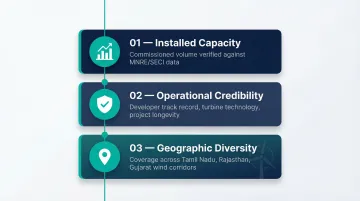
Selection criteria focused on three primary factors:
- Installed capacity: Commissioned generation volume, verified against official MNRE and SECI data
- Operational credibility: Developer track record, turbine technology deployed, and project longevity
- Geographic diversity: Coverage across India's primary wind corridors — coastal Tamil Nadu, desert Rajasthan, and western Gujarat
Common mistakes buyers and researchers make:
- Verify commissioning dates and actual generation data — many parks hold large allocations but have limited operational capacity
- Check for dedicated transmission lines and ISTS connectivity — a park's nameplate capacity means little without reliable grid evacuation
- Account for turbine age — farms approaching their 20-year design life carry real performance and maintenance risks
These same criteria shape how Opten Power screens wind projects across its 4+ GW portfolio — so C&I buyers can benchmark PPA options against projects that are already generating, not just permitted.
Conclusion
India's wind energy sector is led by a small number of large, strategically located parks — primarily in Gujarat, Tamil Nadu, Rajasthan, and Maharashtra. These projects represent both the scale of current capability and the foundation for India's 150 GW wind target by 2030. With recent wind auction tariffs ranging from ₹3.43 to ₹3.69 per kWh, wind PPAs offer predictable, long-term cost reduction for C&I businesses.
The practical next step is accessing wind power competitively through corporate PPAs. When evaluating projects, focus on what actually drives long-term value:
- Tariff competitiveness against current benchmark rates
- Grid reliability and state-level DISCOM track record
- PPA contract terms, including tenure, escalation clauses, and exit provisions
Opten Power gives C&I buyers real-time tariff comparisons and PPA terms across 16 states, with access to 4+ GW of wind, solar, and hybrid capacity — so procurement decisions are based on live data, not developer proposals.
Frequently Asked Questions
Which is the largest wind power plant in India?
The Muppandal Wind Farm in Tamil Nadu is India's largest commissioned onshore wind farm at 1,500 MW. Gujarat's Kutch Wind Farm has 11,500 MW allocated under the Gujarat Hybrid Renewable Energy Park, but this represents planned capacity, not fully operational capacity as of early 2026.
Which state of India has the largest installation of wind power?
Gujarat leads with approximately 15,197 MW of installed wind capacity as of February 2026, having officially surpassed Tamil Nadu in mid-2023. Tamil Nadu follows with 12,103 MW, then Karnataka with 8,501 MW.
Which company is leading in wind energy in India?
Leading wind developers include ReNew Power (4.7 GW), JSW Energy (3.48 GW), Greenko (3.17 GW), and Adani Green Energy (1.97 GW). Suzlon Energy dominates turbine manufacturing with 15.1 GW of installed turbines nationwide, operating primarily as an OEM and EPC provider rather than a pure IPP.
How many wind power plants are there in India?
India has hundreds of wind power projects across 9+ states, with total installed wind capacity of over 55 GW as of February 2026. These range from large utility-scale parks like Muppandal (1,500 MW) to smaller captive installations serving individual industrial consumers.
What is the cost of 1 MW windmill project in India?
A 1 MW onshore wind project in India typically costs ₹5.6–₹6.3 crore per MW (2023–2024), varying by turbine size and site conditions. PPA tariffs under competitive auctions are separate and currently range from ₹3.43 to ₹3.69 per kWh.
Who are the wind energy developers in India?
Major wind energy developers active in India include Adani Green Energy, Suzlon Energy, ReNew Power, Greenko, JSW Energy, Torrent Power, NTPC Renewable Energy, and Vena Energy — spanning competitive auctions, corporate PPAs, and captive project models.