Introduction
Manufacturing units paying ₹15–20/kWh and data centres running 24x7 operations are under real pressure to cut energy costs — yet most decision-makers don't know where to begin, what questions to ask, or what pitfalls to avoid. C&I consumers added 7.8 GW of open access capacity in 2025 alone, so the shift is already underway.
Whether you're evaluating solar for the first time or ready to issue an RFP, this guide walks you through every decision — from energy audits and financing structures to policy incentives and developer selection.
TLDR:
- Conduct an energy audit first to determine system size and savings potential
- Choose between captive rooftop and open access based on your load profile and land availability
- CAPEX models maximize long-term savings; PPAs require zero upfront capital
- Accelerated depreciation lets businesses claim 40% depreciation in year one
- Run a structured RFP process to compare technical specs, tariffs, and O&M terms side-by-side
What Qualifies as a Commercial Solar Project?
A commercial solar project is any solar system designed to meet the energy demands of businesses, industries, and institutions — as opposed to residential setups. These systems typically range from 100 kW to several megawatts and include:
- Rooftop arrays on warehouses, manufacturing units, or commercial complexes
- Ground-mounted plants for factories or industrial estates
- Open access projects serving IT parks, hotels, or data centres via the grid
Two Primary Models in the Indian Context
Under the Green Energy Open Access (GEOA) Rules 2022, any consumer with a contracted demand of 100 kW or more is eligible for open access, with no capacity limit for captive consumers.
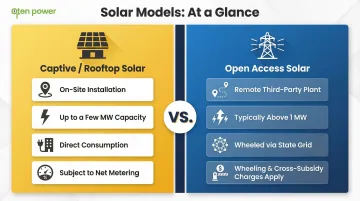
Captive/Rooftop Solar:
- Suits facilities with available rooftop or land — typically up to a few MW
- Ideal when you have available rooftop or land area
- Energy consumed directly reduces grid dependency
- Subject to state net metering policies
Open Access Solar:
- Power sourced from a remote third-party project and wheeled through the grid to your facility
- Suitable for larger consumers (typically above 1 MW)
- Involves wheeling, transmission, and cross-subsidy charges
- Best when on-site space is limited or tariffs justify grid procurement
The right model depends on your load profile, available land, and state DISCOM policies.
That demand is well-established: as of February 2026, India's cumulative grid-connected solar rooftop capacity reached 24.86 GW, with the C&I segment accounting for approximately 75% of that market.
Key Factors to Assess Before You Start
Conduct an Energy Audit First
An energy audit is where every commercial solar project should begin. It reveals:
- Peak demand hours and load profile
- Current per-unit electricity cost (including demand charges and Time-of-Day surcharges)
- System size needed to meet your consumption
- Expected savings benchmark any solar tariff must beat
For example, commercial consumers paying ₹15–20/kWh can recover rooftop solar investments in 12 to 18 months, while industrial consumers typically see payback periods of 2 to 3 years.
Evaluate Your Site
Key siting criteria include:
- Sufficient rooftop or ground area for panel installation
- Roof structure rated to support panel weight (typically 15–20 kg/m²)
- Minimal shading from trees, adjacent buildings, or other obstructions
- Solar irradiance levels — India's average GHI ranges from 3.5 to 5.5 kWh/m²/day, with the Thar Desert and Deccan Plateau at the high end
- Proximity to the nearest substation or distribution line for grid interconnection
Flat terrain and southward-facing surfaces are optimal. For ground-mounted systems, modern 20% efficiency modules deliver approximately 0.49 MWp per acre (roughly 2 acres per MWp).
Check State-Level DISCOM Regulations
Net metering policies, open access charges, and interconnection procedures vary across Indian states. Research your state's current rules before committing to a procurement model.
Sample open access charges (2025-26):
| State | Wheeling Charges | Cross-Subsidy Surcharge (CSS) | Additional Surcharge (AS) |
|---|---|---|---|
| Maharashtra | ₹0.62/kVAh (HT) | Capped at 20% of ACoS | Exempt for GEOA consumers paying fixed charges |
| Gujarat | Determined by GERC | Applicable (exempt for captive/waste-to-energy) | ₹0.76/kWh (April-Sept 2026) |
| Tamil Nadu | ₹1.04/kWh (HT) | ₹1.99/kWh (HT Industry) | Applicable based on TNERC orders |
In Q4 2025, net landed open access costs ranged from under ₹5.00/kWh to ₹8.40/kWh, with Maharashtra reporting the highest costs and Odisha/Uttar Pradesh the lowest.
Estimate Your Financial Baseline
Before approaching any developer, calculate your current per-unit electricity cost. Maharashtra's MSEDCL HT I (A) Industry tariff for FY 2025-26, for instance, carries a demand charge of ₹555/kVA/month and an energy charge of ₹7.48/kVAh. Any solar tariff that doesn't beat this number isn't worth signing.
Identify Internal Stakeholders Early
Commercial solar projects require sign-off from finance, operations, facilities, and sometimes the board. Map out who needs to approve what — and by when — before you issue a single RFP.
Stages of Commercial Solar Project Development
Stage 1: Feasibility and Pre-Development
This initial stage covers:
- Energy assessment and load profiling
- Site shortlisting and shadow analysis
- Preliminary financial model (IRR, payback period, levelized cost of energy)
- Determination of economic viability
A thorough feasibility study answers whether the project makes economic sense before you commit capital. C&I projects currently deliver IRRs ranging from 14% to 18%.
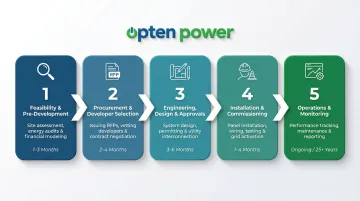
Stage 2: Procurement and Developer Selection
Issue a Request for Proposal (RFP) to shortlisted EPC contractors or Independent Power Producers (IPPs). A structured RFP process includes:
- Technical specifications and performance guarantees
- Tariff offers and O&M terms
- Contract terms and payment schedules
- Developer track record and financial stability
Opten Power's Automated Tender Engine provides modular RFP templates and DISCOM-standardized landing prices across states, so you can distribute RFPs and compare true developer costs without manual benchmarking.
Stage 3: Engineering, Design, and Approvals
The selected developer finalizes system design and applies for necessary permits:
- Net metering approval or open access approval
- Structural clearances for rooftop installations
- Utility interconnection paperwork
- Environmental and safety clearances (for large ground-mount projects)
Timelines:
- Rooftop solar (<500 kW): 30–60 days for DISCOM approval
- Open access projects: 3–9 months for the full approval process, though GEOA Rules 2022 mandate nodal agencies approve applications within 15 days (deemed approved if delayed)
Stage 4: Installation and Commissioning
Physical installation includes:
- Mounting structures and panel installation
- Inverters and electrical balance-of-system components
- Metering equipment and monitoring systems
- Testing, safety inspections, and grid synchronization
Timelines:
- Small rooftop systems (<500 kW): 8–16 weeks
- Large ground-mount or open access projects: 6–18 months depending on permitting and site complexity
Stage 5: Operations, Monitoring, and Performance Tracking
Post-commissioning, continuous monitoring ensures long-term yield and ROI stay on track:
- Generation vs. forecast comparisons
- Scheduled preventive maintenance
- Performance reviews and yield analysis
- Contract compliance and tariff reconciliation
For multi-site or multi-contract portfolios, Opten Power's Portfolio Management Dashboard consolidates generation data, active contracts, and energy assets in one place — reducing the overhead of tracking performance across multiple projects.
Financing and Ownership Models Explained
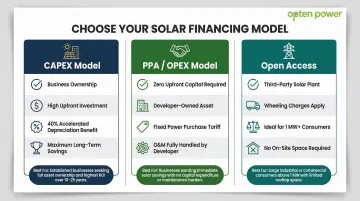
Outright Purchase (CAPEX Model)
How it works: The business owns the system outright and captures all financial incentives, including accelerated depreciation.
Best for:
- Large enterprises with capital to deploy
- High tax liability businesses
- Companies wanting complete asset control
Advantages:
- Maximum long-term savings
- 40% accelerated depreciation in year one
- Full control over operations and maintenance
Drawback: High upfront cost (typically ₹40–50 lakh per MW for rooftop systems).
Power Purchase Agreement (PPA / OPEX Model)
How it works: A developer finances, installs, and owns the system. The business agrees to buy the power generated at a fixed tariff over 10–25 years — no upfront cost required.
Best for:
- Businesses with limited capital availability
- Companies preferring predictable energy costs
- Organizations wanting to avoid asset management
Advantages:
- Zero upfront investment
- Fixed tariff protects against grid rate escalations
- Developer handles all O&M and performance risk
Opten Power's platform lets C&I buyers compare Corporate PPA tariffs from multiple developers side-by-side, with instant IRR and payback calculations across all three procurement models.
Open Access Procurement
How it works: For larger consumers (typically above 1 MW), solar power is purchased from a third-party project connected via the state grid.
Involves:
- Wheeling charges (₹0.62–₹1.04/kWh depending on state)
- Cross-subsidy surcharge (capped at 20% of ACoS under GEOA Rules)
- Transmission charges and additional surcharges (varies by state)
Best for:
- Commercial complexes, IT parks, hotels with high grid tariffs (₹10–15/kWh)
- Businesses without adequate on-site space
- Consumers in states with favorable open access policies
Despite additional charges, open access can still deliver significant net savings. Opten Power's real-time DISCOM intelligence provides standardized landing prices across all states for accurate cross-state cost comparisons.
Key Decision Factors
Choose between models based on:
- High tax liability favors CAPEX — accelerated depreciation delivers the most value when there's a strong tax position
- Limited capital availability makes PPA or open access the practical path forward
- Lower risk appetite suits PPA — the developer absorbs performance and maintenance risk
- Preference for asset control points to CAPEX; businesses wanting operational simplicity are better served by PPA
Incentives and Policy Benefits for Indian C&I Businesses
Accelerated Depreciation (AD) Benefit
Under Section 32 of the Income-tax Act, 1961, solar power generating systems are eligible for 40% accelerated depreciation in the first year. Businesses engaged in power generation can claim an additional 20% depreciation, allowing for up to 60% total depreciation in the initial year.
Tax saving calculation:
- Solar system cost: ₹50 lakh
- Year 1 depreciation (40%): ₹20 lakh
- Tax rate (30%): ₹6 lakh tax savings
- Effective system cost after tax benefit: ₹44 lakh
That ₹6 lakh in first-year savings directly compresses the payback period — a material advantage for CAPEX-heavy installations.
Renewable Purchase Obligation (RPO)
Many Indian states mandate that large consumers meet a percentage of their energy needs from renewable sources. Going solar helps businesses meet RPO targets and avoid penalties.
RPO trajectory set by Ministry of Power (July 2022):
| Year | Wind RPO | Hydro RPO | Other RPO | Total RPO |
|---|---|---|---|---|
| 2024-25 | 2.46% | 1.08% | 26.37% | 29.91% |
| 2025-26 | 3.36% | 1.48% | 28.17% | 33.01% |
| 2029-30 | 6.94% | 2.82% | 33.57% | 43.33% |
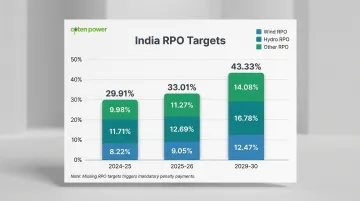
Missing these targets triggers penalty payments to state regulators — costs that a well-structured solar PPA can offset while building toward compliance.
Net Metering and Banking Policies
Surplus energy fed back to the grid earns credits or can be "banked" for later use in states with favourable policies. Under GEOA Rules 2022:
- Banks energy on at least a monthly cycle, giving businesses flexibility around seasonal generation patterns
- Allows banking of at least 30% of your total monthly grid consumption — usable when solar output dips
- Some states (like Maharashtra) allow consumers to simultaneously avail of open access and net metering for rooftop solar systems
Rules differ by state and system size, making it important to verify local regulations before finalizing your project model.
How to Choose the Right Solar Developer
Mistakes to Avoid When Evaluating Developers
Don't select based solely on the lowest quoted tariff. The cheapest bid often hides risks:
- Inferior equipment quality (non-ALMM modules, low-tier inverters)
- Weak O&M commitment or limited warranty terms
- Financial instability that jeopardizes long-term performance guarantees
- Lack of experience in your state's DISCOM processes
Evaluate these factors alongside tariff before shortlisting any developer:
- Track record with completed project references in your state
- Financial stability and creditworthiness (request audited financials)
- Module and inverter brands used — ALMM-compliant equipment only
- O&M terms: minimum 5-year comprehensive coverage, 25-year performance warranty
- Familiarity with your state's DISCOM interconnection process
Run a Structured RFP Process
A formal RFP that specifies technical requirements, performance guarantees, and contract terms forces apples-to-apples comparison and protects the buyer.
Key RFP components:
- System size, technology, and performance specifications
- Tariff structure and escalation clauses (if any)
- O&M scope, response times, and penalty clauses
- Warranty terms for modules, inverters, and workmanship
- Payment milestones and performance guarantees
Platforms like Opten Power's Automated Tender Engine simplify this process — modular RFP templates, structured bid collection, and pre-approved contracts covering CAPEX, Group-CAPEX, and Third-Party Open Access models can cut deal timelines by up to 50%.
Conduct Thorough Due Diligence
Before signing:
- Visit operational sites and speak with existing customers to verify track record
- Verify certifications: Ensure compliance with BIS/IEC standards (IS/IEC 61730-1:2023 and IS/IEC 61730-2:2023)
- Only models listed on the MNRE's Approved List of Models and Manufacturers (ALMM) List-I qualify for open access and net-metering projects
- Request audited financials and bank references to confirm financial stability
- Define O&M terms upfront: Preventive maintenance schedules, breakdown response times, and performance guarantees should be in writing before you sign
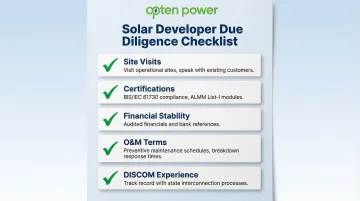
Thorough vetting also reduces execution risk. Common project delays — land acquisition disputes, forest or wildlife clearances, right-of-way conflicts for transmission infrastructure — are far easier to manage with a developer who has already navigated them in your state.
Frequently Asked Questions
What are the stages of commercial solar project development?
The five key stages are: feasibility assessment (energy audit, site evaluation, financial modeling), procurement/RFP (developer selection), engineering and approvals (permits, interconnection), installation and commissioning (physical construction, testing, grid sync), and ongoing O&M and monitoring (performance tracking, maintenance).
What qualifies as a commercial solar project?
Any solar system installed to meet the energy needs of a business, industry, or institution — typically 100 kW and above — qualifies. Captive rooftop systems generate power on-site for direct consumption, while open access models procure power from a remote third-party plant via the grid.
Is commercial solar profitable?
Yes, for most Indian C&I users. Falling panel costs, policy incentives like 40% accelerated depreciation, and rising grid tariffs all support strong returns. Payback periods typically range from 12–18 months for commercial consumers to 2–3 years for industrial consumers, varying by system size, procurement model (CAPEX vs. PPA), and state.
How much money does a 1 acre solar farm make?
Revenue depends on location, irradiance, system capacity (roughly 0.5–1 MW per acre), tariff structure, and applicable incentives. Landed power costs via open access range from ₹5.00–₹8.40/kWh across states, significantly affecting returns. Run a project-specific financial model for an accurate figure.
What is the difference between rooftop solar and open access solar for commercial use?
Rooftop solar is installed on the business's own premises and consumed directly on-site. Open access solar procures power from a remote third-party plant via the grid — suited for larger consumers above 1 MW — and attracts additional state-level charges such as wheeling, transmission, and cross-subsidy surcharges.
How long does it take to install a commercial solar project?
Smaller rooftop systems (under 500 kW) are typically commissioned in 8–16 weeks. Larger ground-mount or open access projects take 6–18 months depending on permitting, grid approvals, and site complexity. Green Energy Open Access (GEOA) Rules mandate 15-day nodal approvals, though practical timelines often run 3–9 months.