Introduction
Commercial and industrial buyers in India face a common challenge: receiving multiple solar PV proposals from different developers, each formatted differently, making true comparison nearly impossible. One developer presents costs per Wp, another focuses on PPA tariffs, a third emphasizes IRR without clarifying underlying assumptions — and weeks disappear chasing clarifications, normalizing data, and still wondering if you're comparing apples to oranges.
A standardized solar PV project proposal template solves this by creating a consistent framework across technical design, financial returns, equipment specs, and contractual terms.
This blog covers the essential components every solar proposal must include, India-specific compliance requirements that protect your investment, and how platforms like Opten Power take the manual work out of comparing multiple bids.
TLDR:
- Standardized proposal templates enable true like-for-like comparison of competing solar developers
- Essential sections include system design, financial analysis (IRR, payback), equipment specs, and O&M terms
- India-specific compliance requirements cover DISCOM approvals, open access regulations, and ALMM standards
- Financial details must specify CAPEX costs (₹/Wp) or PPA tariffs (₹/kWh) with clear ROI projections
- Opten Power automates proposal comparison with real-time tariff analysis and standardized RFP templates
What Is a Solar PV Project Proposal — and Why C&I Buyers Need a Template
A solar PV project proposal is a formal document submitted by a developer or EPC company that details the complete technical, financial, and contractual framework for a solar installation. It answers three fundamental questions: What system will be built? How much will it cost? What returns can the buyer expect?
Two Primary Procurement Models in India:
Indian C&I buyers encounter two distinct proposal structures:
- CAPEX (Capital Expenditure): The buyer purchases the solar system outright, typically at ₹3.5–4.5 crore per MW for ground-mount installations. The buyer owns all assets, claims depreciation benefits, and retains full control over operations.
- OPEX/PPA (Power Purchase Agreement): The developer owns and operates the system; the buyer pays only for electricity consumed at a fixed tariff (typically ₹3.20–4.50/kWh). Zero upfront capital is required, but the developer retains ownership and depreciation benefits.
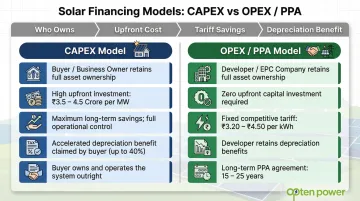
A well-designed proposal template must accommodate both models, clearly separating cost structures, ownership terms, and financial benefits unique to each approach.
RFP vs. Proposal: Two Sides of Procurement
Understanding the distinction between these documents accelerates procurement:
- RFP (Request for Proposal): Issued by the buyer to solicit bids from multiple developers, specifying technical requirements, site constraints, consumption profiles, and evaluation criteria
- Solar Proposal: The developer's response containing system design, pricing, financial projections, and commercial terms
Having standardized templates for both sides eliminates back-and-forth clarifications. When buyers issue RFPs with clear technical specifications and developers respond using consistent proposal formats, deal timelines shrink considerably. Opten Power's automated RFP templates and pre-approved contract structures, for instance, cut deal closure time by 50% — a direct result of removing the ambiguity that typically stalls negotiations between buyers and developers.
Core Sections of a Solar PV Project Proposal Template
Cover Letter and Executive Summary
This opening section establishes the developer's intent and presents the headline value proposition. It should state:
- Proposed system size (kWp capacity)
- Project location and deployment type (rooftop or ground-mount)
- Primary financial benefit—either estimated annual savings in ₹ (for CAPEX) or the proposed PPA tariff in ₹/kWh (for OPEX)
- Brief overview of why the developer is qualified for this project
Keep this section to one page maximum. The executive summary should enable decision-makers to grasp the core offer in under two minutes.
Once a buyer reads the executive summary and decides to look deeper, the credentials section is what builds or breaks trust.
Company Profile and Credentials
This section must give buyers enough to verify the developer's track record independently. Look for:
- Years in business and total installed capacity to date
- Completed C&I projects with references from comparable installations (same industry, similar capacity)
- Certifications and empanelments: BIS compliance for equipment (IS 14286 for modules, IS 16221 for inverters) is required; MNRE empanelment for C&I EPCs is not universally mandated but worth noting
- Key team members—project manager, lead engineer, O&M head—with relevant experience stated
- Financial stability indicators: credit ratings, banking partners, or audited financials for larger projects
Verify references directly. A developer unwilling to provide verifiable project contacts raises immediate red flags.
Strong credentials set expectations. The design section is where those expectations get tested against numbers.
Proposed System Design and Production Estimates
Technical credibility is proven or lost here. At minimum, the proposal should include:
- Module layout: a visual site plan showing panel placement, shading analysis, and any obstructions
- System capacity: total kWp (kilowatt-peak) and expected annual generation in kWh/units
- Performance metrics:
- Performance Ratio (PR): industry benchmark is 77–86% annually; anything below 75% warrants scrutiny
- Specific Yield: kWh generated per kWp installed annually (typically 1,400–1,600 kWh/kWp in most Indian states)
- Simulation tool used: PVSyst remains the gold standard for energy assessments that lenders will accept for project financing; SAM is also widely recognized
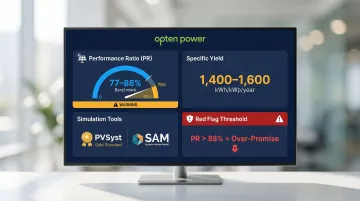
Unrealistically high generation estimates—PR above 88% or specific yields exceeding regional norms—indicate either poor modeling or deliberate over-promising.
Once the design checks out, buyers need to confirm exactly what the developer is—and isn't—committing to deliver.
Scope of Work
Ambiguous scope is where cost overruns begin. The proposal must clearly define:
- Civil and structural work (foundation, cable trenches, inverter room)
- Module installation, inverter setup, and DC/AC cabling
- Metering infrastructure and monitoring systems
- DISCOM interconnection application and grid synchronization
- Testing, commissioning, and handover procedures
- Explicit exclusions—such as rooftop reinforcement, land leveling, or transformer upgrades
If exclusions are buried in fine print or left vague, assume those costs will surface later as change orders.
A well-scoped installation means little without a plan for what happens after commissioning.
Warranty and O&M Plan
Long-term performance depends on what the developer commits to in writing. Proposals should specify:
- Module warranties: typically a 10-year product warranty and 25-year linear performance warranty (80% output at year 25)
- Inverter warranties: 5–10 years standard; some manufacturers offer extended coverage
- Workmanship warranty: 2–5 years covering installation defects
- AMC (Annual Maintenance Contract) terms: preventive maintenance frequency, response SLAs, and remote monitoring provisions
- Performance guarantees: minimum annual generation thresholds with compensation mechanisms for underperformance
Without clear O&M commitments, even the best system design will underperform within five years.
Financial and Commercial Details Every Solar Proposal Must Include
Pricing Structure
Transparency begins with clear cost presentation:
- CAPEX model: Turnkey EPC cost per Wp (₹/Wp) or total project cost in ₹ crore. Currently, 1 MW ground-mount solar costs ₹3.5–4.5 crore; rooftop installations run 1.1–1.2 times higher.
- OPEX/PPA model: Solar tariff in ₹/kWh, typically ₹3.20–4.50/kWh for C&I projects—well below DISCOM tariffs of ₹7.50–9.00/kWh in most states.
- Excluded costs: Itemize any expenses not covered—land lease, grid upgrades, statutory approvals, or financing charges.
Proposals that present "all-inclusive" pricing without itemization often hide cost escalations in later stages.
ROI and Payback Analysis
Financial viability must be demonstrated through standardized metrics:
- IRR (Internal Rate of Return): Typical C&I solar projects deliver 12–15% IRR
- Simple payback period: CAPEX projects typically achieve payback in 4–6 years; faster payback often indicates aggressive assumptions
- NPV (Net Present Value): Positive NPV over 25 years confirms long-term value creation
- Year-wise cash flows: Must factor in DISCOM tariff escalation (typically 3–5% annually) and O&M cost inflation
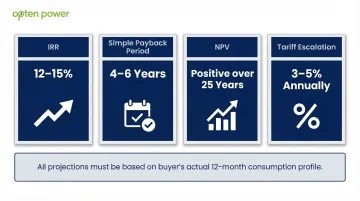
The analysis must be tied to the buyer's actual consumption profile—not generic load assumptions. Buyers should provide 12 months of historical consumption data and demand charges before a developer can generate credible projections.
Financing Options
For CAPEX projects, proposals may reference financing partners or loan structures (typically 70–80% debt at 9–11% interest). For OPEX models, model total cost of ownership across the full PPA term — not just year-one tariffs. Key terms to scrutinize:
- PPA term length (15–25 years standard)
- Tariff escalation clauses (fixed, indexed, or step-up)
- Buyout options and pricing schedules (typically after year 7 or 10)
- Early termination penalties
Incentives and Subsidies
Proposals must transparently flag applicable financial benefits:
- Accelerated Depreciation (AD): Claim 40% depreciation in year one under Section 32. For CAPEX buyers, this reduces taxable income enough to bring payback periods down to 4–5 years.
- MNRE subsidies: Central subsidies currently apply to residential installations only. C&I projects rarely qualify unless covered by a specific state scheme.
- State-level incentives: Rajasthan offers 100% electricity duty exemption for seven years plus mandi fee reimbursement — the type of benefit that can materially shift project economics.
The proposal should specify who applies for and retains each benefit—particularly important in OPEX models where the developer typically claims AD.
Savings Projection
Quantified savings build the business case. Proposals should include:
- Monthly and annual savings in ₹ based on current DISCOM tariff and net metering credits or banking charges
- Sensitivity analysis: Show savings under different grid tariff escalation scenarios (e.g., 3%, 5%, 7% annual increases)
- Net metering impact: Account for state-specific banking regulations and any charges for surplus energy fed to the grid
Without sensitivity analysis, a proposal is essentially a single-scenario bet. Over a 25-year horizon, even a 1–2% difference in tariff escalation assumptions can shift projected savings by ₹1–2 crore for a mid-size C&I installation.
Technical and Equipment Specifications
Bill of Materials
Equipment quality directly impacts 25-year performance. The proposal must list:
- Modules: Specific make, model, wattage, efficiency, and degradation rate (0.5–0.7% annually is standard)
- ALMM compliance: Only ALMM-listed modules qualify for government projects, open access, and net metering; behind-the-meter captive projects commissioned before June 1, 2026, are exempt
- Inverters: String or central inverters with make, model, efficiency curve, and warranty terms
- Mounting structures: Rooftop ballast systems (for load-constrained roofs) or ground-mount structures with wind and snow load certifications per IS 875 (Part 3)
- Monitoring systems: Real-time performance tracking with mobile/web dashboards
- Data sheets: Attach manufacturer spec sheets for all major components
Generic references to "Tier-1 modules" without named models won't hold up under lender or DISCOM scrutiny. Every equipment selection must be verifiable against BIS standards and current ALMM lists.
Site conditions shape how well that equipment performs — which is why the proposal also needs documented, location-specific assessments.
Site-Specific Assessment
A site visit — not desktop assumptions — should drive this section. Proposals that skip field verification routinely miss shading losses, structural constraints, or land access issues that surface only during construction. Document the following:
- Shadow analysis: Identify shading from nearby structures, trees, or terrain throughout the year
- Rooftop load-bearing assessment: Structural engineer's certification that the roof can support module weight, wind loads up to 2,400 Pa, and snow loads (if applicable)
- Land feasibility summary: For ground-mount projects, confirm land ownership, soil conditions, and access for construction equipment
- Shading mitigation: Specify use of module-level power electronics (optimizers) or string inverter configurations to minimize shading losses
Skipping this step is a common cause of P90 yield shortfalls and commissioning delays — both of which erode investor confidence and trigger contract disputes.
Regulatory and Compliance Requirements (India-Specific)
DISCOM and Net Metering/Banking Provisions
State-specific regulations vary significantly. Proposals must address:
- Net metering limits: Maharashtra raised the cap to 5 MW or contract demand (whichever is lower); other states maintain 1 MW limits
- Banking regulations: Policies on surplus energy credits, settlement periods, and any banking charges
- DISCOM approval timeline: Realistic estimates for application submission, technical feasibility study, agreement signing, and meter installation—typically 30 days post-installation per national regulations, though real-world timelines routinely run 60–90 days
State-specific DISCOM processes and approval timelines should be mapped explicitly in the proposal, with conservative estimates built into the project schedule.
Open Access Compliance
For larger C&I projects using open access (100 kW minimum under Green Energy Open Access 2023), proposals must address:
- Cross-subsidy surcharge: Additional charges levied by DISCOMs; varies by state (e.g., Tamil Nadu's ₹0.54/kWh)
- Wheeling charges: Transmission fees for using the grid to wheel power from generator to consumer
- Scheduling and forecasting requirements: Regulatory obligations for energy scheduling with state load dispatch centers
These charges directly affect project economics. Any proposal modeling open access savings must account for these costs in the tariff comparison and payback calculations.
Environmental and Statutory Clearances
For ground-mounted projects, proposals should outline:
- Land conversion requirements: Agricultural land may require conversion approvals
- CEA technical standards compliance: Grid connectivity standards per Central Electricity Authority regulations
- Environmental impact assessment: Projects above certain capacity thresholds may require MoEFCC clearance, though solar projects under 25 MW are typically exempt from dual EC/CTE compliance
How to Compare and Evaluate Multiple Solar PV Proposals
Standardize for Comparison
Before scoring proposals, ensure all bids use identical baseline assumptions:
- Same consumption data (actual 12-month load profile, not estimates)
- Same grid tariff trajectory (agree on DISCOM escalation rate)
- Same project lifetime (25 years standard)
- Same performance degradation assumptions
Without standardization, ROI comparisons are meaningless. One developer assuming 3% tariff escalation and another assuming 5% will show vastly different savings—but the difference reflects assumptions, not proposal quality.
Key Evaluation Criteria and Weightage
Score proposals across four dimensions:
Financial Competitiveness (30–40% weight):
- CAPEX cost per Wp or PPA tariff competitiveness
- IRR, payback period, and NPV projections
- Transparency of excluded costs
Technical Design Quality (25–30% weight):
- Energy yield accuracy (realistic PR and specific yield)
- Equipment tier and warranty terms
- Site-specific assessment depth
Developer Credentials (20–25% weight):
- Track record in comparable projects
- Financial stability and references
- Certifications and compliance history
O&M and Warranty Terms (15–20% weight):
- Warranty coverage comprehensiveness
- AMC response SLAs and monitoring provisions
- Performance guarantees with compensation mechanisms
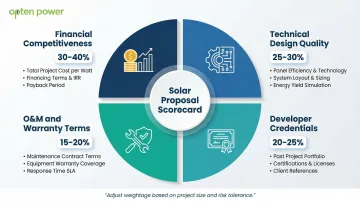
Adjust weightage based on project size and risk tolerance. Larger projects warrant higher weight on developer credentials and financial stability.
Red Flags to Watch For
Reject or heavily discount proposals with:
- Unrealistically high generation estimates: PR above 88% or specific yields 15%+ above regional norms
- Vague exclusions: "Subject to site conditions" without itemized contingencies
- Missing DISCOM timeline acknowledgment: No mention of approval processes or grid interconnection timelines
- No performance guarantee: Developer assumes no responsibility for underperformance
- PPA contracts lacking buyout schedules: OPEX models without clear exit options lock buyers into unfavorable long-term commitments
Leverage Opten Power's Marketplace
Running this evaluation manually across multiple bids is time-intensive. Opten Power's marketplace removes that friction by standardizing inputs and automating comparisons for C&I buyers:
- Compare tariffs, savings, and ROI across multiple pre-vetted developers in real time using standardized financial models
- Get instant IRR, payback, and regulatory analysis tailored to your consumption profile and state-specific DISCOM regulations
- Generate RFPs using automated templates with consistent technical specifications and evaluation criteria
- Close deals 50% faster through pre-approved PPA contracts and streamlined procurement workflows
The result: procurement timelines drop from months to weeks, with real-time DISCOM intelligence ensuring your cost benchmarks reflect what projects actually land at.
Frequently Asked Questions
How to write a solar project proposal?
Start with an executive summary and company profile, then detail system design with production estimates, cost breakdown (CAPEX per Wp or PPA tariff), financial analysis (IRR, payback, NPV), equipment specifications with BIS compliance, and O&M terms.
What are the 12 parts of a project proposal?
A comprehensive solar PV proposal typically covers: cover letter, company profile, project background, scope of work, system design, production estimates, cost proposal, financing options, incentives, warranty/O&M plan, timeline, and compliance documentation for DISCOM approvals and regulatory requirements.
How do you write a good project proposal for funding?
Focus on demonstrating financial viability through IRR and NPV projections tied to realistic consumption data, highlight applicable incentives like Accelerated Depreciation (40% in year one) or state subsidies, and showcase the developer's track record with verifiable references to build lender confidence.
How to explain a solar system project?
A solar system project installs photovoltaic panels that convert sunlight into electricity, connected to the grid or battery storage to reduce a facility's dependence on costly DISCOM power. The proposal captures all technical, financial, and contractual details required to move from concept to commissioning.
What is the difference between a solar RFP and a solar proposal?
An RFP is issued by the buyer to solicit bids from multiple developers, outlining technical requirements and evaluation criteria. A solar proposal is the developer's response, containing system design, pricing, and commercial terms.