Introduction
Indian industrial consumers face converging pressure from rising costs and tightening regulation. Grid tariffs continue their relentless climb—industrial rates in Bihar hit ₹12.50/kWh in FY24, while heavy consumers in Uttar Pradesh pay ₹6.10-7.10/kVAh depending on voltage levels. The Ministry of Power's October 2023 mandate requires designated C&I consumers to reach 43.33% non-fossil energy consumption by 2029-30, transforming sustainability from aspiration to regulatory obligation.
Competitive auctions for long-term Power Purchase Agreements (PPAs) address both pressures directly. When multiple renewable energy developers compete for your offtake contract, market forces drive tariffs down while quality rises. Recent SECI wind auctions cleared at ₹3.67-3.69/kWh—a fraction of grid rates—demonstrating how structured competitive procurement locks in predictable, lower-cost energy for 15-25 years.
This guide covers how competitive PPA auctions work, why they consistently outperform bilateral negotiations on tariffs, and what buyers must evaluate before participating. It also examines how India's digital procurement platforms are compressing deal timelines while expanding access to vetted projects.
TLDR:
- Competitive reverse auctions drive tariffs 25-30% below grid rates by forcing developers to sharpen bids
- Long-term PPAs (15-25 years) hedge against DISCOM escalation and secure RPO compliance
- Group Captive structures eliminate Cross-Subsidy Surcharges, making them more cost-effective than standard third-party supply arrangements
- Digital platforms compress RFP-to-PPA timelines by up to 43% through automated workflows
- Evaluate bids on project maturity and developer credentials, not just headline tariffs
What Are Competitive Auctions for Long-Term PPAs?
Reverse Auction Mechanics in Power Procurement
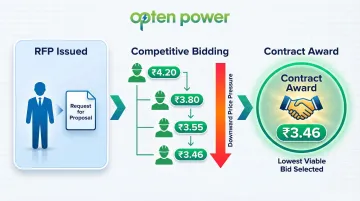
A competitive reverse auction inverts traditional bidding: instead of buyers competing to purchase, multiple renewable energy developers compete to sell electricity to a single offtaker. In India's tariff-based competitive bidding framework, developers submit progressively lower tariff quotes during live online bidding windows, with contracts awarded to the most competitive combination of price and commercial terms.
The "reverse" structure creates downward price pressure: each developer knows competitors can undercut their quote, which drives aggressive but sustainable tariff discovery. E-reverse auctions allow real-time bid adjustments in standard increments of 1 paisa/kWh until the lowest viable price emerges.
Long-Term Duration: Why 15-25 Years Matters
Typical PPA tenures in India:
- SECI/state DISCOM auctions: 25 years from Commercial Operations Date (COD)
- Corporate bilateral PPAs: 10-25 years depending on negotiation
- Short-term contracts: 1-5 years, typically for balancing or spot market hedging
Long-term contracts serve both sides of the agreement differently:
| Stakeholder | Primary Benefit |
|---|---|
| Developers | 20+ year revenue certainty enables project financing; lenders size debt against P90 generation estimates over the full PPA tenure |
| Buyers | Fixed tariffs for two decades hedge against DISCOM escalation, which historically outpaces inflation by 2-4% annually in many states |
Government vs. Corporate Auctions
Government-administered auctions (SECI, state DISCOMs) aggregate demand across multiple buyers to achieve procurement scale. SECI acts as intermediary procurer, conducting competitive bidding and signing back-to-back Power Sale Agreements with buying entities.
Private corporate auctions operate under India's open access framework. C&I consumers qualifying for open access (generally above 100 kW under Green Energy Open Access Rules 2022) can run competitive tenders directly, inviting developers to bid against their specific load profile and delivery point.
The market is moving fast in this direction. CRISIL projects C&I open access capacity to surge from 40 GW in 2026 to 57 GW by FY28 — a signal that direct competitive procurement is no longer niche, but a primary route for large energy buyers.
How Competitive PPA Auctions Work: From RFP to Signed Contract
Step 1: Defining Requirements and Issuing the RFP
The buyer specifies procurement parameters before issuing a formal Request for Proposal:
Key RFP components:
- Annual kWh requirement based on consumption forecasts
- Technology preference: solar, wind, hybrid, or technology-agnostic
- Contract duration — typically 15–25 years for lender confidence in project viability
- Delivery point (state/substation) for wheeling cost calculation
- Evaluation criteria covering tariff weighting, project maturity, and developer credentials
Opten Power's Automated Tender Engine offers modular RFP templates that standardize these specifications across procurement models — Capex, Group Captive, and Third-Party Open Access — cutting drafting time from weeks to days.
Step 2: Developer Bid Submission
With the RFP issued, developers submit comprehensive bid packages that go well beyond a single price quote:
- Levelized tariff quote in ₹/kWh over contract tenure
- Land status, permits, and grid connectivity approval stage
- Capacity (MW), location (state/substation), and expected COD
- Billing cycle, security requirements, and payment terms
- Escalation structure — fixed vs. indexed tariff components
Price alone doesn't tell the full story. A developer quoting ₹3.40/kWh with uncertain land status carries higher delivery risk than one quoting ₹3.55/kWh with signed land leases and approved grid connectivity.
Step 3: Bid Evaluation and Shortlisting
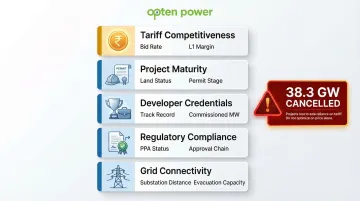
Shortlisting requires scoring bids across five dimensions — not just tariff:
| Dimension | Evaluation Factors |
|---|---|
| Tariff competitiveness | All-in landed cost including wheeling, transmission, banking charges |
| Project maturity | Land acquisition status, environmental clearances, grid connectivity approval |
| Developer credentials | Track record, financial backing, operational project portfolio |
| Regulatory compliance | Open access eligibility, RCO contribution, state-specific requirements |
| Grid connectivity | Substation availability, evacuation capacity, DISCOM approval status |
Between 2020–2024, 38.3 GW of utility-scale renewable capacity was cancelled in India — largely because developers bid unsustainably low tariffs and later abandoned projects. Before awarding, buyers should verify P90 generation estimates, developer liquidity, and overall project viability. The lowest tariff on paper can become the most expensive outcome in practice.
Step 4: Negotiation and Contract Finalization
Once a preferred developer is shortlisted, four contractual areas typically require the most negotiation time:
- Payment security — letter of credit requirements and escrow mechanisms
- Change-in-law provisions — how regulatory shifts affecting project economics are allocated between parties
- Force majeure — qualifying events and the remedies available to each side
- Termination rights — notice periods, triggering conditions, and compensation formulas
Typical timelines: SECI's tender processes average 140 days from RfS to signed PPA (22 days bid submission + 99 days bidding/evaluation + negotiations). Digital platforms using pre-approved contract templates can compress this significantly — global e-procurement implementations have reduced procurement cycles by up to 43%, from 100 days to 57 days.
Why Competitive Auctions Drive Better PPA Tariffs
The Price Discovery Mechanism
When multiple developers compete for the same offtake, they sharpen tariff bids by optimizing project design, passing on equipment cost reductions, and accepting lower margins. This competitive pressure delivered measurable cost reductions globally: utility-scale solar PV costs fell 69% between 2010-2016 according to IRENA, as auction-driven procurement replaced feed-in tariffs.
India experienced similar compression. Wind Feed-in Tariffs ranged ₹4-6/kWh before 2017; the first competitive wind auction that year discovered ₹3.46/kWh, immediately establishing a new market benchmark.
Transparency vs. Bilateral Opacity
Competitive auctions create real-time tariff comparability that bilateral negotiations cannot match. Instead of accepting a single developer's quote, buyers simultaneously evaluate offers across projects, technologies, and geographies—revealing true market pricing rather than negotiated positions.
Recent Indian Benchmarks
Competitively discovered tariffs (2024-2026):
- Wind: SECI Tranche XIX cleared at ₹3.67-3.69/kWh for 1,200 MW ISTS-connected capacity
- Solar + Storage: CERC adopted ₹2.86-2.87/kWh for SECI's 2 GW projects
- Solar: CERC approved ₹2.43-2.47/kWh for NHPC's 1.7 GW projects
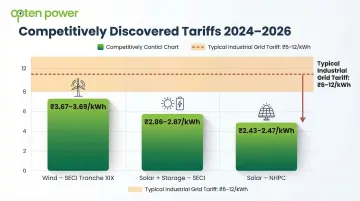
These auction-discovered rates matter beyond government procurement — they set the floor for private C&I buyers negotiating corporate PPAs, directly informing what tariffs are achievable today.
Long-Term Savings vs. Grid Escalation
Locking in fixed PPA tariffs over 15-25 years protects against DISCOM retail tariff escalation. While specific escalation rates vary by state, C&I consumers sourcing renewable energy intra-state typically achieve landed cost savings of 25-30% compared to grid tariffs when factoring in fixed PPA rates against rising DISCOM charges.
Example economics: A manufacturer locking ₹3.60/kWh today avoids exposure to grid rates that may reach ₹8-12/kWh by year 15, compounding savings annually.
Indirect Quality Benefits
Competition encourages developers to present more advanced, financially bankable projects to win bids. Buyers benefit from improved delivery certainty, as developers with approved grid connectivity, signed land leases, and committed financing are more likely to commence generation on schedule.
Key Considerations Before Entering a PPA Auction
Volume and Load Profile Alignment
Sizing risk: Over-contracting in a long-term PPA creates stranded capacity costs; under-contracting exposes you to expensive grid power for the shortfall.
P90 vs. P50 generation estimates:
- P50 (median): 50% probability actual generation exceeds this level—used by equity investors for base-case returns
- P90 (conservative): 90% probability generation meets or exceeds this level—used by lenders to size debt and ensure coverage ratios
Recommendation: Align take-or-pay volume commitments closer to P90 estimates to avoid penalizing developers for natural weather variability while ensuring reliable delivery.
Regulatory and Open Access Framework
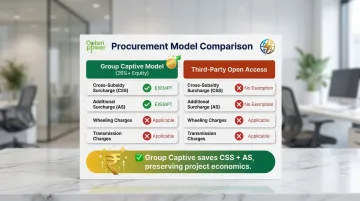
Understanding state-level charges:
| Charge Type | Purpose | Group Captive Exemption |
|---|---|---|
| Cross-Subsidy Surcharge (CSS) | Compensates DISCOMs for lost cross-subsidy revenue | ✅ Exempt with 26%+ equity |
| Additional Surcharge (AS) | Covers fixed costs of stranded power commitments | ✅ Exempt with 26%+ equity |
| Wheeling charges | Payment for using DISCOM distribution network | ❌ Applicable to all models |
| Transmission charges | ISTS/STU network usage fees | ❌ Applicable to all models |
Strategic implication: The Group Captive model (requiring minimum 26% equity stake) legally bypasses CSS and AS under the Electricity Act, preserving project economics as open access charges rise. Third-party models face full CSS/AS exposure, shrinking savings margins.
Green Energy Open Access Rules 2022 reduced minimum contracted demand from 1 MW to 100 kW, expanding auction participation to mid-sized consumers. Captive consumers face no load floor.
Developer Creditworthiness and Project Maturity
Due diligence checklist:
- Track record: Operational portfolio size, COD adherence history
- Land status: Signed leases vs. MoUs vs. under-negotiation
- Grid connectivity: DISCOM approval vs. application-stage
- Financial backing: Committed debt, equity investor profile, balance sheet strength
- PPA experience: Number of executed corporate PPAs, default history
Don't select solely on tariff—verify the developer can deliver the project.
Contractual Risk Allocation
Once you've shortlisted credible developers, the contract terms determine who absorbs the real financial risk. Critical clauses to scrutinize:
- Change-in-law: How are mid-tenure regulatory changes (new surcharges, duty hikes) allocated? Maharashtra's attempted Additional Surcharge on captive consumers (later quashed by Supreme Court in 2021) illustrates this risk
- Payment security: Are letter of credit or escrow requirements reasonable given your credit profile?
- Curtailment risk: Who bears generation loss if DISCOM curtails renewable evacuation?
- Termination rights: What triggers early termination, and what are compensation formulas?
Each of these clauses can shift millions of rupees in exposure over a 15–25 year tenure—negotiating them upfront costs far less than disputing them mid-contract.
Common Pitfalls in PPA Auctions and How to Avoid Them
The "Winner's Curse" Problem
Overly aggressive competition produces financially unsustainable bids. Developers banking on future cost reductions — or underestimating project expenses — submit tariffs below viable levels, then cancel post-award when the economics don't materialize.
Between 2020 and 2024, 38.3 GW of awarded capacity was cancelled — a direct consequence of this pattern.
When a tariff lands 15–20% below market benchmarks, dig into the assumptions behind it:
- Verify equipment cost projections against current procurement prices
- Confirm financing terms are locked or realistically achievable
- Cross-check generation yield estimates against site data
- Request detailed project pro formas before issuing the award letter
Regulatory Uncertainty Mid-Tenure
A 20-year PPA spans multiple policy cycles. Changes in open access regulations, DISCOM surcharges, GST rates, or Basic Customs Duty can make a deal that looked solid at signing financially unviable mid-tenure.
The standard protection is a well-drafted change-in-law clause — one that clearly specifies which party absorbs which category of regulatory change and defines the compensation mechanism upfront. Leaving this vague invites disputes later.
Mismatched Timelines
Issuing an RFP without the internal infrastructure to act on it quickly is a costly mistake. Developers with advanced-stage, competitively priced projects have multiple buyer options — evaluation delays push them toward faster-moving competitors.
Before launching any competitive tender, confirm that budget allocation, decision authority, and contract approval workflows are already in place. The best bids won't wait.
How Digital Platforms Are Transforming PPA Auctions in India
From Manual RFPs to Digital Marketplaces
Traditional broker-intermediated RFP processes are slow, opaque, and fragmented. Digital marketplace models give C&I buyers simultaneous access to multiple vetted developers, real-time tariff comparison across states, and standardized bid formats—reducing procurement time and information asymmetry.
Platforms aggregating supply across solar, wind, and hybrid—paired with real-time state-level DISCOM landing prices—give buyers a complete cost picture beyond headline tariffs. Opten Power's marketplace covers 4+ GW of renewable capacity across 16 states, with live DISCOM intelligence that makes multi-developer cost comparison immediate and transparent.
Deal Speed Advantage
That transparency also translates into speed. Automated procurement workflows compress RFP-to-PPA timelines:
| Process | Timeline |
|---|---|
| Traditional manual process | ~140 days (SECI benchmark) |
| Digital e-procurement platforms | ~57 days (43% reduction, based on global implementations) |
Acceleration drivers:
- Modular RFP templates eliminate drafting from scratch
- Pre-approved contract templates reduce negotiation cycles
- Digital bid management automates evaluation and comparison
- Standardized documentation reduces legal review time
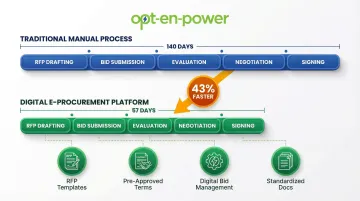
For C&I buyers facing tight sustainability timelines or RPO compliance deadlines, this speed advantage is critical.
Frequently Asked Questions
What is a competitive auction in the context of a power purchase agreement?
A competitive auction is a structured procurement process where an offtaker invites multiple renewable energy developers to submit bids for a long-term PPA contract. Awards typically go to the most competitive combination of price, project maturity, and commercial terms, ensuring tariffs reflect true market rates.
How long is a typical long-term PPA signed through a competitive auction in India?
Long-term PPAs in India typically span 15-25 years from the Commercial Operations Date. SECI and state DISCOM auctions standardize on 25-year terms, while corporate bilateral agreements range 10-25 years depending on buyer preferences and financing requirements.
What is the difference between a competitive PPA auction and a bilateral PPA negotiation?
Competitive auctions involve multiple developers bidding simultaneously, creating price discovery through market competition. Bilateral negotiations are one-on-one discussions with a single developer. Auctions typically deliver lower, market-reflective tariffs; bilateral deals offer more flexibility for customized terms and faster execution with known counterparties.
Who can run or participate in a private corporate PPA auction in India?
C&I consumers who qualify for open access—typically loads above 100 kW under Green Energy Open Access Rules 2022—can run competitive PPA tenders; captive consumers face no minimum threshold. Developers with land secured and grid connectivity approved can submit bids.
What are the main risks for buyers in a competitive PPA auction?
The three primary risks buyers face are:
- Project non-delivery from under-priced bids (winner's curse)
- Regulatory shifts mid-tenure affecting open access economics (CSS/AS hikes, new surcharges)
- Inadequate due diligence on developer financial strength and project maturity
Headline tariff alone is not a reliable signal of value — contractual risk allocation matters equally.
How do competitive auctions affect the final PPA tariff compared to negotiated deals?
Competitive pressure typically results in tariffs 25-30% lower than bilateral negotiations, as developers sharpen bids to win contracts. However, price must be balanced against project quality and delivery certainty—abnormally low bids may signal execution risk rather than genuine value.