Introduction
Energy represents one of the largest operational cost lines for industrial and commercial businesses in India. In cement manufacturing alone, clinker production accounts for 94-95% of total energy consumption, while energy costs typically constitute 20-40% of steel production expenses. Yet most organizations overpay—not because they chose the wrong supplier, but because they didn't know which contract terms to negotiate.
Suppliers structure agreements to protect their margins. Buyers, meanwhile, focus almost entirely on the stated price per unit — and miss the clauses that inflate actual costs: termination fees, usage bandwidth restrictions, and material change provisions that can override your negotiated rate entirely.
This guide covers 10 specific things every C&I buyer must evaluate before signing an energy contract: consumption benchmarking, pricing structures, payment terms, and the hidden risk-shifting clauses that determine what you actually pay.
Key Takeaways
- Energy contract negotiation goes well beyond the per-unit rate — contract terms drive your actual costs
- Map your consumption profile, peak demand, and load pattern before approaching suppliers or developers
- Match pricing structure (fixed, indexed, or variable) to your organization's risk tolerance and budget stability needs
- Watch termination fees, usage bandwidth, and material change provisions — these can override your negotiated price entirely
- For renewable PPAs, scrutinize generation risk, deemed generation provisions, and open access compliance as closely as the tariff
Why Energy Contract Negotiation Deserves More Attention Than Most Buyers Give It
When a buyer negotiates one clause to their advantage, suppliers typically adjust another to compensate—shifting risk back. This "marble tilt" dynamic means the contract works as a system. Optimizing one line without reading the rest can leave you worse off overall.
Commercial and industrial buyers in India can cut electricity bills by 30%–60% by moving to renewable energy through well-negotiated contracts. For steel, cement, and manufacturing operations running 24×7, that gap represents millions in costs that better terms could have avoided.
Energy suppliers budget for penalty and fee revenue from poorly negotiated contracts — and that's not a figure of speech. DISCOMs (Distribution Companies) actively enforce Late Payment Surcharges on industrial buyers:
- Gujarat: 15% per annum
- Telangana: 18% per annum
These penalties are deliberate revenue streams, not administrative accidents. Knowing which clauses trigger them — before you sign — is what separates a cost-optimized contract from an expensive one.
Considerations 1–3: The Groundwork You Must Lay Before Any Negotiation
Consideration 1: Map Your Consumption Profile in Detail
Suppliers price risk based on how predictable and consistent your load is. Buyers who enter negotiations without a clear load profile lose leverage immediately.
What data to gather:
- Collect 12-24 months of bills across all meters
- Identify Maximum Demand (MD) charges and when peaks occur
- Track month-by-month consumption fluctuations
- Break down peak vs. off-peak consumption by time of use
- Compare sanctioned load against actual drawal to spot gaps
The Indian Electricity Grid Code (IEGC) 2023 mandates Special Energy Meters capable of recording time-differentiated measurements at 15-minute intervals. Access this data through your State Load Despatch Centre (SLDC) or Qualified Coordinating Agency (QCA) data portals — you have 15 days to verify readings.
Without this profile, you cannot evaluate whether a supplier's offer matches your actual consumption pattern or whether you'll trigger out-of-bandwidth penalties.
Consideration 2: Benchmark Against Current Rates and Market Prices
Know your current landing price — including all regulatory charges, transmission costs, and taxes — before engaging suppliers. Without a benchmark, you cannot evaluate whether a new offer is actually better.
Components of your true cost:
- Base DISCOM tariff (energy + demand charges)
- Time of Day (ToD) surcharges (20-25% during peak hours)
- Transmission and wheeling charges
- Distribution losses
- Cross-subsidy surcharge (CSS)
- Additional surcharge (AS)
- Applicable taxes
State tariff disparities are massive. HT industrial tariffs for FY 2025-26 range from ₹4.00-4.30/kWh in Gujarat to ₹7.50/kWh (plus ₹608/kVA demand charge) in Telangana. Maharashtra's rates sit at ₹7.48/kWh with ₹555/kVA demand charges.
For renewable open access buyers, the landed cost stack has nine components:
For renewable open access buyers, the landed cost stack has nine components:
- Generator tariff
- Transmission charges
- Wheeling charges
- Distribution losses
- Cross-subsidy surcharge (CSS)
- Additional surcharge (AS)
- SLDC charges
- Taxes
Cross-subsidy surcharges alone add ₹1.33-2.18/kWh depending on your state.
Opten Power provides real-time DISCOM intelligence and standardized landing prices across states, enabling accurate cost comparisons without manual calculation.
Consideration 3: Choose the Right Contract Duration and Timing
Contract length affects both price and flexibility — but the right choice depends on your risk appetite and operational horizon, not just the rate on offer.
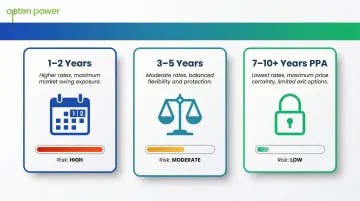
Contract duration trade-offs:
| Duration | Rate Profile | Risk Level |
|---|---|---|
| 1-2 years | Higher rates | Maximum exposure to market swings |
| 3-5 years | Moderate rates | Balanced flexibility and protection |
| 7-10+ years (PPAs) | Lowest rates | Limited exit options; maximum price certainty |
Timing matters. Initiate renegotiation 6-12 months before contract expiry to avoid being forced into unfavorable rollover terms. Power exchange prices exhibit seasonal patterns — Day-Ahead Market (DAM) volumes increase from September onwards, while prices spike during morning and evening peak hours.
Target negotiation windows when wholesale prices dip — the savings compound across a multi-year contract. In 2023-24, DAM price volatility was 14.94%, while Real-Time Market (RTM) volatility reached 20.71%. That spread represents real money; entering at the right moment locks it in.
Considerations 4–7: Pricing Structure and Financial Terms
Consideration 4: Fixed, Indexed, or Variable — Choose the Right Pricing Model
Three pricing models:
- Fixed: Stable, predictable, typically higher base rate—ideal for budget certainty
- Indexed: Tied to market benchmarks like IEX Day-Ahead Market prices—cheaper when markets fall, expensive during spikes
- Variable: Fully market-exposed—maximum risk and volatility
Your choice depends on risk appetite, cash flow predictability, and whether you can pass energy cost swings to customers.
Suppliers offer aggressively low indexed rates knowing market upswings will increase actual billing. The gap between average mid-day and late evening prices rose from ₹1.5/kWh in 2019 to ₹5.5/kWh in 2025. Evaluate indexed offers using historical market volatility data, not just the current rate.
For industries with thin margins or fixed-price customer contracts, fixed pricing offers protection. For businesses that can pass energy costs through to customers or have strong cash reserves, indexed pricing may deliver savings during low-price periods.
Consideration 5: Payment Terms and the True Cost of Short Windows
Agreeing to shorter payment windows in exchange for a lower rate can backfire. A single missed deadline triggers a late fee that erases the savings.
Late Payment Surcharge rates vary significantly by state:
- Telangana: 18% per annum
- Gujarat: 15% per annum
These aren't grace periods—they're revenue generators for DISCOMs.
Negotiate payment terms that match your actual invoice processing cycle. If your accounts payable runs on a 30-day cycle, don't accept 15-day terms for a 0.2% rate reduction. The first late payment will cost you more than a year's worth of savings.
For government facilities and public entities, verify whether statutory payment period protections apply in your state.
Consideration 6: Termination Clauses and Early Exit Fees
Once you sign a contract, the supplier procures your committed energy volume. Early exit forces them to sell unused energy back into the market at potentially lower prices—and they pass those losses, plus penalties, to you.
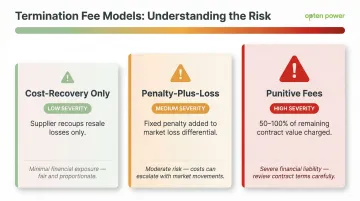
Termination fee structures range from:
- Cost-recovery only: Supplier recoups actual losses from reselling your committed volume
- Penalty-plus-loss models: Fixed penalty plus market loss differential
- Punitive fees: Percentage of remaining contract value (often 50–100%)
A common assumption is that you can exit early once you find a lower rate. The termination fee from your first contract will almost always negate savings from the new deal.
This logic applies in reverse for renewable PPAs. If the Solar Power Developer fails to commence supply by the Scheduled Commercial Operation Date, the buyer can encash the Performance Bank Guarantee. Ensure equivalent protections run both ways—if you face termination fees for early exit, the developer should face matching penalties for delayed commissioning or generation shortfalls.
Consideration 7: Add/Delete Clauses for Multi-Site or Expanding Businesses
Organizations adding or removing meters, opening new locations, or restructuring operations need clearly negotiated add/delete clauses. These define what percentage of contracted volume can change without triggering repricing or penalties.
How suppliers limit flexibility:
- Set a ceiling on add/delete flexibility (e.g., +/- 10% of contracted volume)
- Raise base rates as that ceiling increases
- Charge spot-market rates on incremental load beyond the ceiling
For businesses with warehouses, manufacturing plants, or retail networks across multiple states, this clause is critical. Without it, uncapped expansion exposes you to volatile spot-market rates on incremental load.
Under the Green Energy Open Access (GEOA) Rules 2022, consumers with contracted demand of 100 kW or more can source power through open access. However, state-level implementation varies—some states misinterpret block-change rules, restricting flexibility. Secure add/delete clauses in your PPAs to protect against uncapped spot-market exposure if load expansions are blocked by State Load Despatch Centres.
Considerations 8–9: Risk-Shifting Clauses That Can Override Everything Else
Consideration 8: Usage Bandwidth — What Happens When You Consume Outside Your Agreement
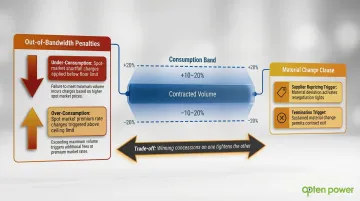
Many contracts restrict consumption to within a defined bandwidth of the originally agreed volume—typically +/- 10-20%. Any usage above or below this band is charged at real-time market rates or sold back to the supplier at a loss, and that loss is passed to you.
This clause hits hardest for industries with seasonal or process-driven demand swings. A textile manufacturer with monsoon-season shutdowns or a steel plant with furnace maintenance cycles can easily fall outside bandwidth limits.
Gas agreements typically enforce stricter bandwidth restrictions than electricity contracts, which sometimes offer unlimited bandwidth as a negotiation sweetener — worth pushing for if your load profile is variable.
Before accepting any bandwidth restriction:
- Model your worst-case consumption scenario (lowest demand month)
- Model your best-case scenario (peak production month)
- Calculate the financial impact of out-of-bandwidth charges at current spot-market rates
- Negotiate for the widest possible bandwidth or unlimited tolerance
Under the CERC Deviation Settlement Mechanism (DSM) Regulations 2024, renewable generators face deviation penalties when actual generation differs from scheduled generation by more than allowed limits (+/- 10% for wind, +/- 15% for solar). Suppliers typically pass these penalties to the offtaker unless you negotiate otherwise.
Bandwidth clauses and material change clauses often interact directly — winning concessions on one can tighten the other. Understanding both is essential.
Consideration 9: Material Change Clauses — The Supplier's Override Button
The material change clause allows the supplier to reprice, impose penalties, or terminate the agreement if your usage changes "materially" in a way that affects them. The risk lies in how loosely that term is defined.
The definition of "material" varies considerably:
- A specific percentage change (e.g., 20% reduction over 3 consecutive months)
- Any operational shift that affects energy use
- Changes in load factor or consumption pattern
- Business restructuring, mergers, or facility closures
This clause interacts with add/delete and bandwidth provisions. When a buyer wins concessions on one, the supplier may tighten the others. If you negotiate unlimited bandwidth, expect a stricter material change definition.
Negotiate for:
- A narrow, quantified definition of "material change" (e.g., "reduction exceeding 25% of contracted volume sustained for 6+ months")
- Clear notification requirements and cure periods before penalties apply
- Reciprocal rights—if the supplier can reprice due to your changes, you should have equivalent rights if their performance degrades
Without a quantified definition, suppliers retain discretion to invoke this clause at any point — effectively overriding every other term you negotiated.
Consideration 10: Renewable Energy and PPA-Specific Contract Terms
Power Purchase Agreements for solar, wind, or hybrid renewable energy carry risks that standard supply contracts simply don't address. Before signing, buyers need to understand generation risk, open access charges, scheduling penalties, and curtailment exposure — each of which can significantly affect the actual cost of power delivered.
Generation Risk
Unlike conventional supply agreements, PPAs involve generation risk. The buyer commits to offtake from a specific plant, and if that plant underperforms due to low irradiation, equipment failure, or grid curtailment, the buyer may still need to procure backup power at spot rates.
Ensure your PPA defines:
- Minimum annual generation guarantees
- Compensation mechanisms for underperformance
- Force majeure provisions covering equipment failure and natural events
- Backup power procurement responsibilities and cost allocation
Open Access Compliance in India
Buyers procuring renewable energy under open access must account for state-specific wheeling charges, transmission losses, cross-subsidy surcharges, and scheduling compliance requirements. These vary significantly across the 16+ states where renewable projects are located.
The table below shows how these charges differ across key states for FY 2025-26 — differences that directly affect your landed cost:
State-by-state charge variations (FY 2025-26):
| State | Wheeling Charge | CSS | AS | T&D Loss |
|---|---|---|---|---|
| Maharashtra | ₹0.76/kVAh | ₹1.79/kWh | Exempt (GEOA) | 7.50% |
| Gujarat | ₹0.24/kWh | ₹1.33/kWh | ₹0.76/kWh | 6.50% |
| Tamil Nadu | ₹1.04/kWh | ₹1.99/kWh | ₹0.10/kWh | N/A |
| Karnataka | N/A | ₹2.18/kWh | N/A | 2.95% |
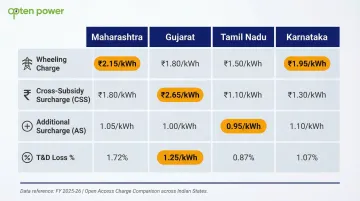
These charges can substantially alter the effective landed cost of renewable power. A PPA with a ₹3.50/kWh tariff in Maharashtra has a landed cost near ₹6.00/kWh after adding all regulatory charges.
Scheduling and Deviation Penalties
Renewable generators must submit day-ahead generation forecasts under the Indian Grid Code. Deviations beyond allowed limits attract penalties that are typically passed to the offtaker unless explicitly negotiated otherwise.
Under CERC DSM 2024:
- Error calculation: Error (%) = 100 × [Actual Generation – Scheduled Generation] / Available Capacity
- Deviation limits: +/- 10% for wind, +/- 15% for solar
- Penalties: Increase progressively for errors beyond 15%
Contracts must clearly assign:
- Which party bears scheduling risk (generator, Qualified Coordinating Agency (QCA), or buyer)
- Who pays forecasting service costs
- Caps on deviation penalty pass-through
- Performance guarantees tied to scheduling accuracy
Curtailment Provisions
Grid curtailment remains a significant risk in RE-rich states like Tamil Nadu, Rajasthan, and Andhra Pradesh. When grid operators curtail renewable generation due to grid congestion or oversupply, the buyer may not receive contracted energy and must procure replacement power at spot rates.
Negotiate curtailment clauses that specify:
- Compensation for curtailed energy (e.g., deemed generation payments)
- Limits on curtailment hours per year
- Buyer's right to terminate if curtailment exceeds thresholds
- Whether curtailment events extend contract duration
Real-Time Intelligence for PPA Evaluation
For Indian C&I buyers evaluating PPAs across multiple developers, manually comparing tariffs, open access eligibility, and regulatory charges across states is slow and prone to outdated data. Opten Power addresses this with real-time DISCOM intelligence and standardized landing prices across states, plus an Automated Tender Engine that lets buyers run competitive RFPs across solar, wind, and hybrid developers. The result is faster deal closure with accurate, state-specific cost comparisons built in.
Frequently Asked Questions
Can you negotiate your energy contract with your energy provider?
Yes, negotiation is possible in both regulated and deregulated markets, especially for commercial and industrial buyers with significant load. Suppliers have flexibility on pricing model, tenor, payment terms, and certain clause language—but some terms like termination fee structures are harder to change than others.
What are the main types and key elements of energy contracts?
Main contract types include fixed-price, indexed, variable, and PPAs for renewable energy. For each, the critical elements to review are price structure, contract duration, termination provisions, usage bandwidth, and material change language.
What negotiation frameworks should I know for energy contract negotiation?
Treat contract terms as trade-offs, not isolated wins — gaining flexibility on one clause often prompts the supplier to tighten another, such as the base rate. Prioritize clauses based on your organization's actual risk exposure rather than pushing for every concession.
Why is my energy bill suddenly so much higher?
Sudden bill increases typically result from out-of-bandwidth penalties, material change clause enforcement, automatic rate reversion at contract expiry, or pass-through of transmission and regulatory charges.
When is the best time to negotiate an energy contract?
Negotiations should begin 6-12 months before contract expiry to avoid being forced into unfavorable terms at rollover. Market timing also matters—prices fluctuate daily, and entering negotiations during periods of lower market rates can lock in better rates.
What is the difference between a fixed-price and indexed energy contract?
Fixed-price contracts offer predictability at a slightly higher base rate, while indexed contracts are tied to market benchmarks and can be cheaper when prices fall but more expensive during spikes. The right choice depends on your tolerance for bill volatility and ability to hedge against market movements.