Introduction
For manufacturers, electricity can consume 20-40% of total production costs — and the pressure is growing. India's data centre power demand alone is projected to jump from 1 GW in 2025 to 13 GW by FY 2031-32, a 44% compound annual growth rate. Across sectors, rising tariffs are compressing margins and forcing businesses to reconsider how they buy and use power.
Power purchase costs account for 70-80% of what distribution utilities charge, which means tariff increases hit your bottom line fast. But high electricity bills are rarely inevitable.
Most overpayment traces back to four fixable problems: wrong tariff category, unmanaged peak demand, inefficient equipment, and overlooked procurement options like open access or corporate PPAs. This guide works through each one, with practical steps to cut costs without cutting operations.
Key Takeaways
- Indian business electricity bills go far beyond units consumed—demand charges, fuel surcharges, regulatory levies, and wheeling charges all add up
- The biggest cost drivers are load profile mismatch with Time-of-Day tariffs, aging inefficient equipment, and defaulting to grid tariffs when cheaper alternatives exist
- Effective cost reduction works across three levels: tariff and equipment decisions before consumption, real-time demand control, and smarter procurement routes
- Open access and Corporate PPAs can deliver sustained tariff reductions of ₹3–5 per unit—far beyond what efficiency tweaks alone achieve
- Cost reduction starts with understanding where costs originate—demand charges, ToD surcharges, power factor penalties—not blanket cuts
How Business Electricity Costs Typically Build Up
Indian business electricity bills are multi-component structures that extend far beyond simple per-unit consumption. An HT industrial bill typically comprises energy charges (₹/kWh or ₹/kVAh), fixed or demand charges (₹/kVA/month), Fuel and Power Purchase Cost Adjustment (FPPCA), electricity duty, cross-subsidy surcharge, and wheeling charges. Most businesses track only the total figure, missing the breakdown that reveals where costs actually originate.
Cost build-up is gradual and compounding:
- Inefficient equipment raises baseline kWh consumption over months without triggering immediate alarms
- Reactive loads push power factor below penalty thresholds, triggering surcharges
- Demand spikes lock in higher demand charges for the entire billing cycle
- Time-of-Day consumption during peak hours compounds per-unit costs
None of these appear as sudden events, so they go unaddressed until an energy audit or billing dispute surfaces them. A separate layer of charges compounds the problem further — penalty costs that don't accumulate gradually but sit embedded in the bill, invisible unless you know where to look.
The most expensive costs are often hidden:
- Power factor penalties for inductive loads below 0.85-0.90
- Contract demand charges on unused capacity
- Time-of-Day surcharges for peak-hour consumption (up to +25% in some states)
- Cross-subsidy surcharges for open access non-adoption
These only become visible when businesses break down their bills line by line or conduct formal energy audits. Once each cost component is mapped, it becomes straightforward to identify which lever — efficiency, demand management, or tariff restructuring — delivers the fastest savings.
Key Cost Drivers for Business Electricity Bills
Tariff Structure Complexity
Indian Discom tariff structures vary significantly by state, category, and voltage level. Businesses on the wrong tariff slab or consumer category—commercial versus industrial HT, for example—often pay more per unit than necessary. Demand charges alone can represent 30-40% of monthly bills for HT consumers.
Tariffs decrease at higher voltage levels due to lower technical losses. In Gujarat, the HTP-1 energy charge ranges from 400 to 430 paise/unit depending on billing demand, with voltage-level rebates of 1% for 11/22 kV, 1.5% for 33/66 kV, and 2% for 132 kV and above.
Load Profile Mismatch
Running high-draw equipment during Discom-designated peak hours triggers Time-of-Day surcharges and elevates maximum demand readings—both of which inflate bills independent of total units consumed.
ToD tariff impacts by state:
| State | Peak Hour Premium | Off-Peak/Solar Discount |
|---|---|---|
| Maharashtra | +25% (17:00-24:00) | -20% to -30% (09:00-17:00) |
| Karnataka | +₹1.00/unit (06:00-09:00, 18:00-22:00) | -₹1.00/unit (22:00-06:00) |
| Gujarat | +45 paise/unit (07:00-11:00, 18:00-22:00) | 60 paise/unit concession (11:00-17:00) |
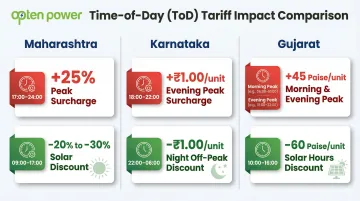
Maharashtra's deep solar hour discounts reflect regulatory shifts to absorb daytime renewable generation, while Karnataka and Gujarat penalize evening peak consumption heavily.
Equipment Age and Efficiency Gaps
Aging motors, compressors, chillers, and lighting systems draw more current for the same output, raising both kWh consumption and demand peaks. Replacing a standard 45 kW motor with a premium efficiency IE3 motor delivered measured savings of 11,721 kWh/year in a Belgaum foundry, Replacing a standard 45 kW motor with a premium efficiency IE3 motor delivered measured savings of 11,721 kWh/year in a Belgaum foundry, per a BEE-documented case study. These efficiency gaps accumulate quietly over time, making equipment upgrades one of the highest-ROI investments available.
Procurement Inertia
Even when equipment is running efficiently, the procurement contract itself can be the biggest cost lever. Many businesses default to full grid dependence even when open access power, group captive arrangements, or long-term PPAs with renewable developers could deliver lower per-unit costs. This inertia is driven by lack of information or perceived regulatory complexity, not by any actual cost advantage of staying on the grid. Per the GERC Green Energy Open Access Regulations 2024, eligibility is now 100 kW—making alternative procurement accessible to medium and large consumers alike.
Cost-Reduction Strategies for Business Electricity Bills
The right strategy depends on where a business's costs are actually originating. A company losing money to demand charges needs different interventions than one paying above-market per-unit rates. This section organizes strategies by the type of change required.
Strategies That Reduce Costs by Changing Decisions
These are structural decisions—around procurement, contracts, and equipment—that typically deliver larger and longer-lasting savings than operational adjustments alone.
Conduct a Detailed Energy Audit to Establish a Consumption Baseline
A formal energy audit disaggregates bill components, benchmarks equipment efficiency, and surfaces the highest-cost areas. It is the prerequisite for any investment decision because it establishes what to fix first based on ROI. Under the BEE-SME programme, energy audits in 25 MSME clusters identified savings of 0.0122 million toe and prevented 72,585 tonnes of CO₂ emissions annually.
An audit reveals:
- Which equipment accounts for the highest consumption
- Where power factor penalties are originating
- Whether contract demand is right-sized
- How ToD consumption patterns affect bills
Renegotiate or Right-Size Contract Demand
Many businesses are locked into a contracted demand level higher than their actual peak, which inflates fixed demand charges. Conversely, businesses exceeding contract demand incur steep penalty charges—200% of the normal rate in Uttar Pradesh, for example. Periodically reviewing and adjusting this figure is a low-effort, high-return decision.
Replace Aging, Energy-Inefficient Equipment
Upgrading motors to IE3/IE4 efficiency ratings, switching to LED lighting, and replacing old HVAC units reduces kWh consumption directly. The Bureau of Indian Standards mandates that all three-phase induction motors meet at least IE2 standards, but IE3 and IE4 motors deliver significantly higher efficiency. Prioritize equipment with the highest run-hours and the largest gap between current and optimal efficiency ratings.
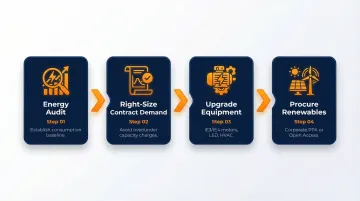
Procure Renewable Energy Through a Corporate PPA or Open Access Arrangement
Long-term PPAs with renewable developers can lock in per-unit tariffs below Discom rates for 10-25 years. Tariffs for wind-solar hybrid power projects in India ranged between ₹3.15/kWh and ₹3.65/kWh in 2024, significantly undercutting grid tariffs. This is a procurement decision, not an infrastructure investment, and is increasingly accessible to medium and large industrial consumers through platforms that aggregate supply from multiple developers.
Strategies That Reduce Costs by Changing How Electricity Is Managed
These are operational decisions—around timing, monitoring, and load management—that reduce what you pay for electricity already being consumed.
Shift Non-Critical Loads to Off-Peak Hours
Indian Discoms charge a premium for consumption during peak hours (typically morning and evening). Rescheduling non-time-sensitive operations—batch processing, cooling pre-loading, pumping—to off-peak windows can reduce per-unit effective cost without changing total units consumed. Maharashtra offers up to a 30% discount during solar hours (09:00-17:00), making daytime load shifting particularly attractive.
Monitor and Control Maximum Demand
Demand charges are often calculated on the highest 15- or 30-minute demand reading in a billing cycle. In Telangana, MD is calculated as four times the largest kVAh delivered during any consecutive 15 minutes for consumers above 4,000 kVA. Installing demand controllers or setting operational alerts to prevent brief spikes can significantly reduce this component, which is often the highest-cost line item for HT consumers.
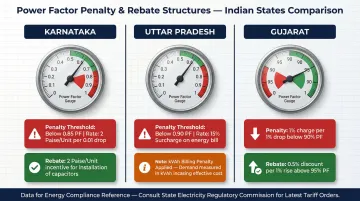
Maintain Power Factor Above Minimum Discom Threshold
Low power factor (caused by inductive loads like motors and transformers) attracts penalties from most Indian Discoms, while a high power factor (above 0.95-0.99 depending on the state) often earns a tariff rebate. Installing an 83 kVAR capacitor bank to improve PF from 0.96 to 0.99 cost ₹16,675 and yielded annual savings of ₹38,700—a six-month payback period.
Power factor penalties and rebates by state:
| State | Penalty Threshold | Rebate/Incentive |
|---|---|---|
| Karnataka | 2 paise/unit for every 0.01 drop below 0.85 | 2 paise/unit rebate for approved capacitors |
| Uttar Pradesh | 15% surcharge if PF falls below 0.90 | N/A (kVAh billing penalizes poor PF) |
| Gujarat | 1% penalty per 1% drop below 90% | 0.5% rebate for every 1% rise above 95% |
Deploy an Energy Management System for Continuous Visibility
Real-time monitoring by circuit, equipment, or production line gives businesses the data to catch inefficient assets early, flag abnormal consumption spikes, and schedule operations around actual demand patterns. Monthly bill estimates alone can't support that level of control.
Strategies That Reduce Costs by Changing the Context Around Electricity
When the tariff regime, energy source, or regulatory route is the primary cost driver, operational changes have limited impact. These strategies address the external setup itself.
Explore Open Access as a Route to Bypass Retail Discom Tariffs
Open access allows eligible industrial and commercial consumers (typically above 100 kW contracted demand) to procure power directly from generators or exchanges, often at a lower per-unit cost than retail Discom tariffs. However, it involves wheeling, transmission, and cross-subsidy charges that must be factored into the calculation.
Cross-subsidy surcharge is capped at 20% of Average Cost of Supply. In Tamil Nadu, the Additional Surcharge was set at ₹0.54/kWh for December 2024 to March 2025—a cost that directly affects net savings calculations.
Install Rooftop or Behind-the-Meter Solar
On-site solar generation offsets the most expensive portion of grid consumption—peak-hour units—and can be structured as a capex model or through a solar service agreement with no upfront cost. The C&I segment accounts for approximately 66% of all rooftop solar installations in India.
Net metering policies in most states allow excess generation to offset future bills. Gujarat went further in 2023, removing the sanctioned load cap and allowing installations up to 1 MW.
Use a Unified Energy Marketplace to Compare Renewable Supply Options
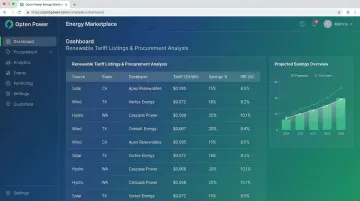
One reason businesses default to the grid is the complexity of evaluating multiple PPA offers, Discom landing prices, and regulatory costs at the same time. Opten Power's marketplace consolidates this by enabling real-time comparison of tariffs, savings, and IRR across solar, wind, and hybrid developers across 16 states. Standardized landing prices, instant regulatory analysis, and automated RFP management cut deal timelines by up to 50%.
Engage with Demand Response or Interruptible Load Programs
Some state utilities offer incentives—tariff rebates or payments—to large consumers who agree to curtail or shift load during grid stress periods. Karnataka's Framework for Demand Flexibility mandates DISCOMs to achieve Demand Flexibility Portfolio Obligations starting at 0.5% of peak demand in FY 2026-27, scaling to 2% by FY 2029-30, with performance-linked incentives of ₹2 million/MW for exceeding targets. This converts a cost into a potential revenue offset without requiring capital investment.
Conclusion
Reducing business electricity costs is not about applying generic tips. It requires first identifying whether costs originate in tariff structure, procurement choices, load behavior, equipment, or a combination. Different origins require different interventions. A business paying power factor penalties needs capacitor banks, not a PPA. A business with high ToD surcharges needs load scheduling, not LED retrofits.
The most durable cost reductions come from layering two categories of action:
- Operational discipline: demand management, ToD scheduling, and power factor correction
- Strategic procurement: open access arrangements, corporate PPAs, and renewables integration
Companies that sustain savings treat electricity cost reduction as a continuous process, not a one-time project. Those that revert to baseline typically fix one issue in isolation and stop reviewing.
Start with an energy audit to establish where costs originate, then apply the strategies that address those specific drivers.
Frequently Asked Questions
What makes up a commercial electricity bill in India beyond per-unit charges?
Indian Discom bills typically include energy charges (₹/kWh or ₹/kVAh), fixed or demand charges (₹/kVA/month), fuel surcharge adjustments, electricity duty, cross-subsidy surcharges, and wheeling charges where applicable. Demand charges can account for 30-40% of the total for HT consumers.
How much can an industrial business save by signing a renewable energy PPA?
Corporate PPA tariffs for wind-solar hybrids ranged between ₹3.15/kWh and ₹3.65/kWh in 2024. Net savings depend on open access charges (wheeling, transmission, cross-subsidy surcharge) relative to your current Discom tariff — reaching up to 40% in states with capped cross-subsidy surcharges.
What is open access power procurement, and is it available to all businesses?
Open access allows eligible consumers to procure power from third-party generators instead of their Discom. Eligibility is now 100 kW contracted demand under Green Energy Open Access rules. The route involves additional charges—wheeling, transmission, and cross-subsidy surcharge (capped at 20% of ACoS)—that affect actual savings.
How do demand charges work, and what is the fastest way to reduce them?
Demand charges are levied on the highest peak demand recorded in a billing cycle, often in 15-30 minute intervals. The fastest reduction comes from demand controllers that prevent brief spikes, operational scheduling to flatten load peaks, and renegotiating contract demand to match actual usage rather than inflated historical levels.
What is Time-of-Day (ToD) tariff, and how should businesses use it?
ToD tariffs charge a premium for consumption during Discom-designated peak hours (up to +25% in Maharashtra) and a discount during off-peak or solar hours (up to -30%). Businesses can reduce effective per-unit cost by shifting flexible loads like batch processes, pumping, and cooling to off-peak windows without changing total consumption.
Is a formal energy audit necessary before investing in efficiency or renewables?
An energy audit is strongly advisable — it identifies the true source of costs and prevents investment in low-ROI interventions. It also establishes the consumption baseline needed to calculate accurate payback periods for any efficiency or procurement decision.