Introduction
Energy costs represent one of the most significant and fastest-growing operating expenses for commercial and industrial businesses in India. In the steel sector, energy constitutes 20-40% of production costs depending on production route and technology, while the cement industry faces power and fuel expenses accounting for 26-28% of total costs—expenses projected to rise 10-12% year-on-year in FY27.
Yet a substantial portion of energy project overruns stems not from volatile market forces but from avoidable procurement decisions made during planning and execution. Poorly timed contracts, single-source sourcing, and weak cost visibility all compound expenses that teams had the opportunity to control.
What follows covers where procurement decisions go wrong, what better practices look like in practice, and how leading industrial buyers are structuring their approach to energy sourcing differently.
Key Takeaways
- Energy project costs compound across tariff choices, procurement delays, contract terms, and hidden charges like open access levies. They rarely appear as clean single line items.
- The most controllable costs lock in early — design-phase decisions determine 70–80% of total project expenditure, making upfront choices the highest-leverage moment
- Running competitive RFPs, securing long-term PPAs, and benchmarking tariffs in real time are the three levers that move the needle most on cost
- Portfolio visibility, demand-side optimization, and regulatory alignment matter as much as the initial deal
- India-specific factors — Discom rate volatility, open access charges, and state-level policy variation — require live market intelligence rather than static benchmarks
How Costs in Energy Procurement Typically Build Up
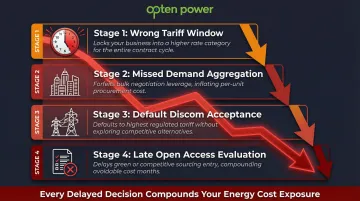
Energy project costs rarely appear as a single, visible expense. They accumulate in layers — each triggered by a distinct decision point that procurement teams often encounter too late to address effectively:
- Tariff exposure during delays: Project timelines slip, but contracted rates don't — leaving buyers locked into unfavorable terms
- Design decisions without procurement input: Engineering choices lock in vendor dependencies before commercial teams have a say
- Uncompetitive vendor selection: Without benchmarked comparisons, shortlisted suppliers face little pressure to sharpen pricing
- Unmodeled ongoing charges: Banking fees, scheduling charges, and reactive power penalties rarely appear in initial cost models
The pattern is consistent: costs that seem unavoidable at commissioning were actually created by decisions made months earlier. Entering a contract at the wrong tariff window, failing to aggregate demand across facilities, or accepting default Discom rates without evaluating open access alternatives — each of these locks in expenditure that's nearly impossible to recover once a project is operational. Catching these decision points early is where procurement teams have the most leverage.
Key Cost Drivers in Energy Projects
Tariff Structure and Rate Selection
Tariff structure ranks among the most significant cost drivers. Procurement teams defaulting to Discom grid supply without evaluating open access or renewable alternatives often pay rates 20–40% higher than competitive sourcing could deliver. Discom HT tariffs across major states range from ₹4.30/kWh in Gujarat to ₹7.50/kWh in Tamil Nadu, excluding demand charges and electricity duties.
Meanwhile, landed open access costs ranged between ₹4.3/kWh and ₹7.4/kWh in Q3 2024, with savings potential heavily dependent on state-level regulatory structures.
Contract Timing and Structure
Locking in energy contracts reactively—at short notice or without forward visibility—consistently produces worse pricing outcomes. Proactive market entry timed 12–24 months ahead gives procurement teams leverage in negotiations.
Late procurement activities delay project disbursement. Half of projects sign their first contract near the end of year one, delaying implementation and locking in higher costs.
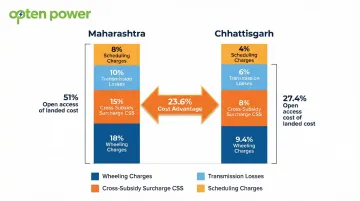
Hidden Charges in Open Access Procurement
Open access transactions in India carry charges that are routinely underestimated during procurement planning:
- Wheeling charges — transmission and distribution fees paid to the Discom
- Cross-subsidy surcharges (CSS) — a significant component varying sharply by state
- Transmission losses — typically 3–5%, billed as additional units
- Scheduling fees — coordination costs for third-party power injection
In Maharashtra, open access charges comprised 51% of landed costs for third-party projects, while in Chhattisgarh they accounted for only 27.4%. The spread between states means a deal that looks attractive on headline tariff can turn uneconomical once the full landed cost is calculated.
Procurement Process Inefficiency
Single-source selection, manual RFP management, and slow developer qualification inflate both cost and cycle time. Competitive tendering consistently yields better outcomes — the highest winning bids in Indian solar auctions were on average 36% lower than feed-in tariffs, showing what structured price discovery delivers.
Cost-Reduction Strategies for Energy Procurement
Strategies vary depending on whether costs are driven by upfront decisions, by how energy supply is governed once live, or by the external environment—state-level policy, market timing, and organizational structure. The most effective procurement teams address all three.
Strategies That Reduce Costs by Changing Decisions
The most impactful cost reductions in energy projects are secured during the pre-procurement and sourcing design phase—not after contracts are signed.
Engage procurement at the design stage. Involving procurement during feasibility or FEED-equivalent planning (front-end engineering and design) allows teams to influence load assumptions, site selection, and connection strategy—all of which materially affect cost outcomes.
Run competitive RFPs across multiple renewable developers. Competitive tendering yields better tariffs, more favorable contract terms, and stronger developer accountability. Opten Power's Automated Tender Engine allows teams to issue structured RFPs, compare tariffs and IRR across multiple developers in real time, and close deals significantly faster than manual processes.
Evaluate long-term Corporate PPAs as a cost-hedging tool. A well-structured PPA can deliver tariffs significantly below prevailing Discom rates while protecting against future rate escalation. India added 6.9 GW of solar open access capacity in 2024—a 77% year-over-year increase driven by Corporate PPA adoption. Evaluate full PPA economics: contract duration, escalation clauses, and termination provisions.
Model total cost of ownership, not just headline tariff. A lower quoted tariff can carry higher hidden costs through open access charges, scheduling penalties, or poor grid reliability. Comprehensive cost models across the contract lifecycle produce better supplier selection decisions.
Strategies That Reduce Costs by Changing How Energy Supply Is Managed
Ongoing cost leakage in energy projects is most often a visibility problem. Teams that cannot see what they are actually paying across sites, tariff categories, and charge types cannot effectively manage or challenge costs.
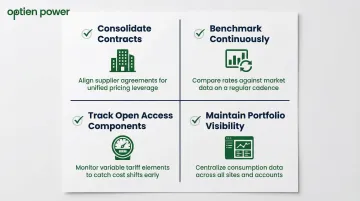
Four practices close the visibility gap:
- Consolidate contracts across facilities. Organizations with several sites procuring energy independently give up volume leverage. Aggregating demand shifts bargaining power toward wholesale-indexed pricing and simplifies supplier management.
- Benchmark active contracts continuously. Discom tariff revisions, open access policy changes, and market price shifts can make a previously competitive contract expensive. Opten Power's Real-Time Discom Intelligence tracks standardized landing prices across 16 states, enabling timely renegotiation or switching decisions.
- Track open access cost components actively. Wheeling, CSS, transmission losses, and scheduling charges vary by state and are subject to regulatory revision. Procurement teams that monitor these can restructure sourcing or shift supply allocation to reduce exposure.
- Maintain portfolio-level visibility. A unified view across all active energy agreements helps identify underperforming contracts, flag approaching renewals, and allocate load efficiently.
Strategies That Reduce Costs by Changing the Context Around Energy Procurement
The surrounding context often drives cost more than the procurement decision itself. The same energy requirement can carry very different costs depending on when it is procured, under which regulatory framework, and at what organizational scale.
Time market entry deliberately. Energy prices—both conventional and renewable—move with regulatory cycles, capacity additions, and grid congestion. Teams that enter contracts during supply-side abundance or policy-favorable windows secure meaningfully better rates than those procuring under deadline pressure.
Build demand-side flexibility to cut peak charges. For industrial buyers, shifting energy-intensive processes to off-peak hours can reduce demand charges—often a significant share of the total bill. In Maharashtra, the HT Industry category carries a demand charge of ₹555/kVA/month; Tamil Nadu charges ₹608/kVA/month. This requires coordination across procurement, operations, and plant management.
Use consortium procurement when individual demand is insufficient. Hybrid and round-the-clock (RTC) power structures typically require minimum contracted volumes. Smaller C&I buyers can meet those thresholds through joint procurement. HUL partnered with Brookfield to establish a 45 MW solar park in Rajasthan, supplying renewable electricity to 32 sites under the Group Captive Open Access scheme.
Align sourcing with state-level open access rules. India's open access framework varies significantly by state—eligible consumer categories, charge structures, and approval timelines all differ. Karnataka, Maharashtra, Rajasthan, Gujarat, and Tamil Nadu led solar open access installations in 2025, accounting for over 85% of the total. Understanding state-specific rules lets procurement teams design structures that minimize regulatory cost.
Conclusion
Reducing costs in energy procurement depends on identifying where cost originates—whether in upfront decisions, in how supply is governed day-to-day, or in the structural environment—rather than applying blanket cost-cutting pressure. The most expensive procurement decisions are often those that look cheap on day one.
The teams that reduce costs most reliably aren't cutting harder—they're engaging earlier. Procurement teams that build live market intelligence, manage contracts actively, and align sourcing with regulatory realities extract value at every stage of a project, not just at signing.
Frequently Asked Questions
What is the single biggest source of avoidable cost in energy project procurement?
The largest avoidable costs typically arise from delayed or single-source procurement, where teams accept the first available offer without competitive benchmarking. These costs are compounded by hidden charges like open access levies that were not factored in at the decision stage.
How does a Corporate PPA help reduce long-term energy costs?
A Corporate PPA locks in a pre-agreed tariff with a renewable developer over a multi-year period, insulating the buyer from Discom rate hikes and wholesale price volatility. Most agreements deliver tariffs below prevailing grid supply costs and lock in price certainty for 10–12 years.
When should procurement teams get involved in an energy project?
Procurement should be involved before technology, scale, or site decisions are finalized. Early involvement allows procurement to shape the cost baseline rather than simply execute against decisions already made, which lock in 70-80% of total project costs.
What are open access charges and why do they matter for procurement cost planning?
Open access charges—including wheeling fees, cross-subsidy surcharges, transmission losses, and scheduling charges—are state-regulated costs applied to power sourced outside the Discom. They vary significantly by state and can erode the apparent savings of switching to renewable supply if not modeled accurately.
How can procurement teams compare multiple energy developers objectively?
Objective comparison requires standardizing evaluation across tariff, IRR, payback period, contract terms, and regulatory compliance. Automated RFP platforms that pull live developer data eliminate the inconsistency of manual, spreadsheet-based shortlisting.
How does procurement aggregation across sites lower energy costs?
Aggregating demand across facilities helps organizations access wholesale-indexed pricing and meet minimum volume thresholds for renewable and hybrid supply agreements. It also reduces per-unit procurement overhead — benefits that individual site buying rarely achieves.