
Introduction
Indian C&I buyers—manufacturers, data centres, steel plants, and cement units—are signing renewable energy contracts that can span 10–25 years. Yet locking into the wrong structure can erode the savings that justified the contract.
The scale of the problem is hard to ignore. Between FY2023 and FY2024, India's open access market nearly doubled, adding 6.9 GW of solar capacity in 2024 alone.
Many buyers caught in that wave discovered their fixed-rate PPAs—signed when tariffs seemed competitive—had turned expensive as newer projects locked in lower rates. By 2024, analysts noted that offtakers were cancelling PPAs to avoid procuring expensive electricity from plants installed just a few years earlier.
This guide breaks down what contract flexibility actually means, which structures work in the Indian market, and the specific clauses worth negotiating before you sign.
Key Takeaways
- Flexible renewable energy contracts let buyers adjust pricing, volume, or sourcing terms over time, unlike fixed agreements that lock everything in upfront
- In India, flexibility appears through open access, group captive, hybrid-source contracts, and indexed pricing mechanisms
- Your ideal structure depends on load size, budget predictability needs, and ability to track regulatory changes
- Watch for volume tolerance bands, banking provisions, renegotiation windows, and tariff escalation caps
What Is Flexibility in a Renewable Energy Contract?
Flexibility in a renewable energy contract refers to the ability to adjust one or more parameters—price, volume, contract duration, energy source mix, or settlement terms—without voiding the agreement or incurring prohibitive penalties.
In a standard fixed-rate PPA, the tariff per unit is locked for the entire tenure (typically 10–25 years). When a flexible structure is applied, the buyer gains the ability to respond to changing load profiles, falling market tariffs, or shifting regulatory charges—but typically accepts some pricing variability or a higher initial risk-share with the developer.
Key distinction: "Flexible" does not mean "cancellable at will." Most renewable energy contracts in India still carry multi-year tenure. Flexibility refers to adaptable clauses within that framework, not freedom from commitment.
Why it matters:
- A textile unit running seasonal shifts needs volume flexibility; a steel plant running 24×7 needs source reliability
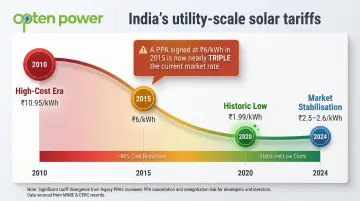
- Solar tariffs fell from ₹10.95/kWh in 2010 to ₹1.99/kWh in 2020, then stabilised at ₹2.5–2.6/kWh by 2024. A fixed contract signed in 2018 could be double the current market rate.
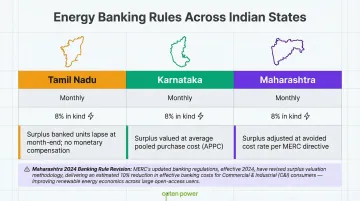
- Maharashtra revised banking rules in 2024, reducing C&I savings by at least 10%. Contracts with regulatory pass-through clauses absorb this risk.
Types of Flexible Renewable Energy Contracts in India
Flexible Corporate PPAs (Open Access and Group Captive)
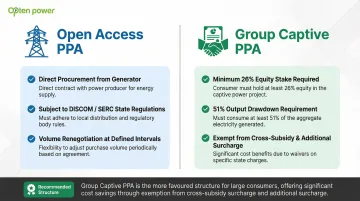
Open Access PPAs:
The buyer procures renewable power directly from a generator, wheeling it through the grid to their facility. The Green Energy Open Access Rules, 2022 reduced the eligibility limit from 1 MW to 100 kW, expanding access to smaller C&I buyers.
Flexibility options include:
- Choice of multiple generators or source states
- Ability to renegotiate volumes at defined intervals
- Subject to DISCOM and SERC regulations that vary by state
Group Captive PPAs:
Under Electricity (Amendment) Rules, 2026, a plant qualifies as captive if the buyer holds at least 26% equity stake and draws at least 51% of output.
Flexibility options include:
- Allocating consumption across group entities as business scales
- Restructuring consumption as new facilities come online
- Exemptions from cross-subsidy surcharge and additional surcharge
This model is the most favoured open access structure in India due to charge exemptions, making it financially viable where third-party open access isn't. Beyond structure, how the tariff is priced adds another layer of flexibility worth evaluating.
Indexed and Hybrid Pricing Structures
Index-linked or pass-through tariff structures:
Instead of a fixed rupee-per-unit rate, the price is tied to a benchmark such as APPC (Average Power Purchase Cost) or wholesale market rates, with a discount applied.
- APPC is the weighted average pooled price at which the DISCOM purchases electricity. For example, KERC notified Karnataka's APPC at ₹4.25/unit for FY 2023-24
- Passes market upside to buyers when renewable supply is abundant
- Carries downside risk if the benchmark index rises due to coal shortages or grid stress
Globally, indexed or floating price PPAs constitute approximately 20% of PPA contracts, while hybrid price PPAs (mixing fixed and floating) constitute approximately 10%.
Hybrid contracts:
Blend a fixed base tariff with a variable top-up component, offering partial price certainty while retaining exposure to favourable market movements. For large C&I buyers managing multi-site loads, this balance between cost predictability and market upside has made hybrid pricing one of the more practical structures in Indian corporate renewable deals.
Volume-Flexible Contracts
Volume tolerance clauses:
Provisions that allow a buyer to over-draw or under-draw energy within a specified band (e.g., ±15–20%) without penalty. This accommodates:
- Seasonal load fluctuations in industries like textiles, hospitality, or process manufacturing
- Unexpected capacity additions or plant shutdowns
- Protection from deemed generation charges when contracted energy isn't consumed
Matching contract type to load profile:
Platforms like Opten Power give buyers real-time access to 4+ GW of solar, wind, and hybrid capacity across 16 states. Comparing tariffs, volume structures, and ROI across multiple developers before committing removes the guesswork — and helps align the right contract structure with actual consumption patterns.
Why Flexibility Matters: Key Benefits for C&I Buyers
Cost Optimisation Over the Contract Lifecycle
A flexible structure allows buyers to renegotiate or re-price at defined intervals, so they don't remain locked into a tariff that was competitive in year 1 but becomes expensive by year 8.
The tariff decline risk for fixed contracts:
- Utility-scale solar tariffs declined from ₹10.95/kWh in 2010 to ₹1.99/kWh in 2020
- By 2024, tariffs stabilised at ₹2.5–2.6/kWh
- A fixed contract signed in 2015 at ₹6/kWh is now triple the market rate
- Analysts report that offtakers are cancelling PPAs to avoid expensive electricity from plants installed just a few years back
Volume flexibility prevents overpayment:
Volume-flexible contracts prevent buyers from paying for contracted energy they don't consume (deemed generation charges), which is a real cost risk for industries with variable or seasonal production cycles.
Risk Mitigation Against Market and Regulatory Shifts
State regulators govern India's open access framework, and charges like wheeling, banking, and cross-subsidy surcharges have changed multiple times across several states.
Recent regulatory volatility examples:
- Gujarat: Reduced additional surcharge to ₹0.76/kWh for April–September 2026
- Karnataka: Lowered additional surcharge from ₹0.82/kWh to ₹0.4/kWh for FY 2026
- Maharashtra: Revised banking rules in 2024, restricting energy stored during 'normal' ToD slots to be utilised in the same slot or during solar hours—effectively creating a 'no-banking' scenario that reduced savings by at least 10% for C&I consumers
Renegotiation windows and regulatory pass-through clauses address this directly—buyers aren't left absorbing cost increases that weren't priced into the original deal.
Contracts that blend solar with wind or storage also reduce curtailment risk and deliver more reliable supply across the 24-hour cycle, which is essential for 24×7 operations like steel plants, cement units, and data centres.
ESG and RPO Compliance Benefits
India's Renewable Purchase Obligation (RPO) targets are increasing under the National Electricity Policy. The Ministry of Power notified the RPO trajectory, mandating an increase from 24.61% in FY 2022-23 to 43.33% by FY 2029-30.
Flexible contracts provide compliance optionality:
- Scale up renewable volumes to meet rising RPO targets without signing a new agreement
- Switch source types (solar to wind/hybrid) as obligations shift
- Generate traceable REC (Renewable Energy Certificate) data
ESG and supply chain drivers:
The EU's Carbon Border Adjustment Mechanism (CBAM) will levy taxes on excess emissions starting in 2026. Indian steelmakers average 2.55 tonnes of CO₂ per tonne of steel—double the EU benchmark of 1.28 tonnes.
Companies like JSW and Tata Steel are already securing renewable energy PPAs to reduce supply chain emissions and avoid CBAM penalties.
The Risks of Flexible Contracts (and How to Manage Them)
Complexity and Active Management
Unlike a fixed PPA where the buyer simply pays a unit rate, a flexible contract demands ongoing monitoring of market rates, regulatory notifications, and volume tracking. Businesses without a dedicated energy manager or advisory partner can end up absorbing costs the contract was designed to prevent.
Pricing Risk in Indexed Structures
If the benchmark index rises due to a coal shortage, grid stress, or geopolitical disruption, the buyer's renewable tariff also climbs — partially eroding the benefit of flexibility. The March 2022 price spike illustrates this clearly: prices at power exchanges surged due to early summer heat and fuel supply constraints, prompting CERC to impose a ₹12/kWh price cap on April 1, 2022, later reduced to ₹10/kWh in March 2023.
Buyers can limit this exposure through:
- Negotiating a price floor/ceiling mechanism
- Using a partial fixed-rate carve-out for baseline load
- Structuring a partially indexed tariff — IEEFA models show a lower first-year rate rising at a pre-set index for 15 years, then flat for the remaining PPA term, can generate significant long-run savings
Regulatory Unpredictability
Open access charges, banking norms, and injection/withdrawal windows are state-specific and subject to revision. Buyers should include a "regulatory change" clause allowing renegotiation if a material policy change alters contract economics by more than a defined threshold (e.g., 10%).
Fixed vs. Flexible Renewable Contracts: How to Choose
The Core Trade-Off
- Fixed contracts: Budget certainty and administrative simplicity
- Flexible contracts: Cost optimisation potential and adaptability, but require more active management and carry some pricing or volume uncertainty
When a Fixed Renewable PPA Makes More Sense
Fixed contracts work best for:
- Businesses with stable, predictable load — for example, a manufacturing unit running consistent shifts year-round
- Organisations with strict CFO or treasury constraints around budget predictability
- Buyers in states where open access regulations shift frequently, and fixed tariffs reduce regulatory exposure
When a Flexible Structure Is the Better Fit
Flexible contracts are better suited to:
- Large C&I buyers with high energy spend, where even small per-unit savings compound significantly
- Businesses with seasonal or variable production cycles
- Companies scaling operations across multiple states
- Organisations with active ESG reporting requirements that need source-level transparency and procurement scalability
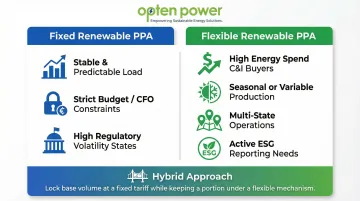
Neither structure is universally superior — many buyers find that a hybrid approach delivers the best of both.
Lock in a base volume at a fixed tariff for operational certainty, then keep a portion of procurement under a flexible mechanism to capture market upside when conditions favour it.
Platforms like Opten Power's automated RFP engine — with pre-approved contract templates and built-in flexibility clauses — make structuring these hybrid deals significantly faster than traditional procurement routes.
Key Flexibility Clauses to Negotiate in Your Renewable PPA
Volume Tolerance Band
Push for a ±15–20% tolerance on contracted units without penalty, so operational changes — plant shutdowns, capacity additions — don't trigger deemed generation claims or shortfall charges.
Once volume tolerance is locked in, the next clause that shapes day-to-day economics is how surplus energy gets handled.
Banking and Carry-Forward Provisions
In states that permit energy banking, negotiate:
- The maximum units that can be banked
- The settlement period (monthly vs. annual)
- The rate at which surplus units are valued
Getting these terms right determines whether banked surplus becomes a financial cushion or a stranded asset during low-load months.
State-specific banking examples:
| State | Banking Period | Banking Charges | Surplus Valuation |
|---|---|---|---|
| Tamil Nadu | Monthly | 8% in kind | Unutilised energy at month-end sold to DISCOM at 75% of applicable RE tariff |
| Karnataka | Monthly | 8% in kind | Energy banked during off-peak ToD slots can only be drawn during off-peak slots; unutilised energy earns RECs |
| Maharashtra | Monthly | 8% in kind | Energy stored during 'normal' ToD slots restricted to same slot or solar hours |
Renegotiation or Review Windows
Request a defined review clause — at year 5 and year 10 of a 25-year PPA, for example — that allows both parties to revisit tariff, volume, or source mix in response to material changes in market rates or regulations. Structuring this as a scheduled review, rather than a renegotiation trigger, keeps the process clear of contract breach territory.
Exit and Step-Down Provisions
Negotiate a structured exit or volume step-down right (with a defined notice period and buyout formula) so that a business restructuring, site closure, or merger doesn't leave the buyer holding full PPA obligations.
Frequently Asked Questions
What is a flexible energy contract?
A flexible energy contract is an energy procurement agreement that allows one or more key terms—price, volume, sourcing mix, or duration—to be adjusted within the contract period in response to market changes or operational needs, as opposed to a fully fixed agreement.
What is a renewable energy contract?
A renewable energy contract (commonly a Power Purchase Agreement or PPA) is a long-term agreement between a generator and a buyer. It specifies the volume of clean energy to be supplied, the tariff, and the delivery terms over a defined period.
What is the difference between a fixed and flexible PPA in India?
A fixed PPA locks in a single tariff per unit for the entire tenure, while a flexible PPA allows the tariff, volume, or source to be adjusted at intervals or in response to specific triggers such as regulatory changes or market rate movements.
Are flexible renewable energy contracts suitable for mid-sized businesses in India?
Flexible contracts were historically limited to large C&I buyers with high energy volumes. Today, group captive structures and aggregated procurement platforms make volume-flexible renewable contracts accessible to medium-sized businesses as well.
What clauses make a renewable energy PPA more flexible?
The four key clauses are volume tolerance bands (±15–20%), energy banking provisions, renegotiation windows at defined intervals (for example, year 5 and year 10), and exit or step-down rights with a pre-agreed buyout formula.
How does open access affect the flexibility of renewable energy contracts in India?
Open access allows C&I buyers to source power directly from generators rather than the DISCOM. However, flexibility is shaped by state-level SERC regulations on wheeling charges, banking norms, and cross-subsidy surcharges—all of which vary by state and can shift during the contract period.