Introduction
For industries like steel, cement, manufacturing, and data centres in India, energy is a strategic cost driver, not a background overhead. Fuel and power account for 30-35% of total cement production costs and represent similarly substantial shares across heavy industries, making energy procurement decisions among the highest-leverage cost levers available to C&I businesses.
Leading organisations now treat energy with the same rigour as raw material sourcing or capital allocation. Companies that align procurement decisions with efficiency goals consistently outperform peers on both margins and sustainability benchmarks. Shree Cement's energy efficiency advantage, for example, delivers Rs 483-488 crore in annual cost savings.
This guide walks C&I buyers through the full picture: what energy efficient procurement means, the core principles behind it, how contract structures compare, and a step-by-step process you can act on today.
What Is Energy Efficient Procurement?
Energy efficient procurement is the practice of acquiring energy—and energy-consuming products and services—by evaluating total cost of ownership, source efficiency, carbon intensity, and long-term supply reliability—not just upfront price. Efficiency becomes a core criterion alongside cost and availability.
How It Differs from Standard Energy Buying
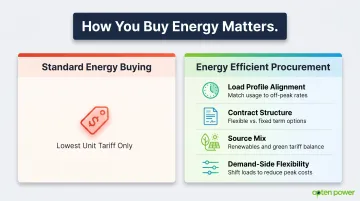
Standard energy procurement focuses on the lowest unit tariff. You select the cheapest per-kWh rate available from your DISCOM or open access supplier and move on.
Energy efficient procurement evaluates these factors together as a system:
- Load profile alignment — does the contract match when and how you actually consume energy?
- Contract structure — fixed, variable, or PPA, and how each affects landed cost
- Source mix — renewable vs. conventional, and the impact on RPO obligations and Scope 2 emissions
- Demand-side flexibility — wheeling charges, cross-subsidy surcharges, and banking provisions that change your true cost
Why Energy Efficiency Should Drive Your Procurement Strategy
The Cost Case
Across Indian heavy industries, energy costs represent 20-40% of total operating expenses. For cement manufacturers, fuel and power account for 30-35% of production costs, with coal contributing approximately 30% and electricity comprising the balance, according to JMK Research (2024).
For steel producers, India's average specific energy consumption stands at 21.31 GJ per tonne of crude steel, closely aligned with the global average. Even a 5-10% improvement in procurement efficiency translates to crores in annual savings for a mid-sized facility.
The gap between poor procurement decisions and optimized ones is measurable: a solar PPA at ₹2.5-3/kWh versus DISCOM industrial tariffs of ₹7-10/kWh represents potential gross savings of ₹4-7 per unit—before accounting for regulatory charges. Over a 10 MW facility consuming 60 million kWh annually, that's ₹24-42 crore per year.
The Compliance Case
Indian C&I consumers above certain thresholds face a tightening regulatory web. The revised Renewable Consumption Obligation (RCO) framework mandates 29.91% renewable energy in FY2024-25, rising to 43.33% by FY2029-30.
This obligation applies uniformly to DISCOMs, open access consumers, and captive users — steel, cement, aluminium, and data centre operators included.
The Green Energy Open Access Rules 2022 lowered the eligibility threshold from 1 MW to 100 kW, opening renewable procurement to thousands of mid-sized C&I consumers. Approval timelines are capped at 15 days.
BEE's Perform, Achieve and Trade (PAT) scheme covers designated consumers across aluminium, cement, fertilisers, steel, textiles, and thermal power sectors. During PAT Cycle I, over 400 designated consumers achieved a 5.3% reduction in energy consumption, surpassing targets and earning tradeable Energy Savings Certificates (ESCerts).
The Sustainability and Reputational Case
ESG reporting is no longer optional — it carries direct financial consequences. Three converging pressures are reshaping how large C&I consumers think about their energy mix:
- BRSR compliance: SEBI's framework applies to India's top 1,000 listed companies, mandating disclosure across 98 indicators including energy consumption and emissions
- CBAM exposure: Indian steel exporters face a projected 32% cost increase by 2032 under the EU's Carbon Border Adjustment Mechanism, driven by an emission intensity of 2.1 tCO2/tonne versus the EU benchmark of 1.37 tCO2
- SBTi commitments: As of 2026, 445 Indian businesses have set science-based targets, making India the 8th largest participant globally
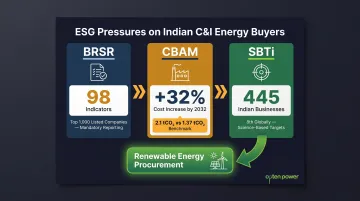
For each of these, renewable energy procurement is the fastest path to measurable Scope 2 reduction — and the one with the clearest ROI.
The Core Principles of Energy Efficient Procurement
Principle 1: Energy Efficiency First
Before sourcing additional energy, procurement teams must assess and reduce load. Sourcing less energy efficiently is always cheaper than sourcing more at any price.
The Shree Cement case illustrates this principle. With a specific energy consumption of just 2.32 GJ per tonne (644 kWh), Shree Cement operates well below the Indian cement industry average of 2.57 GJ per tonne. This efficiency advantage delivers Rs 483-488 crore in annual energy cost savings and 1.44 MtCO2 in carbon abatement.
Energy audits identify demand peaks, parasitic loads, and efficiency opportunities that directly affect procurement sizing. An audit-driven approach ensures you're not locking in long-term contracts for energy you can eliminate before the contract is ever signed.
Principle 2: Life-Cycle Cost Assessment Over Spot Price
Total Cost of Ownership (TCO) is the right evaluation metric. The cheapest headline tariff often carries the highest long-term cost once you account for:
- Transmission and wheeling charges
- Cross-subsidy surcharges (CSS)
- Banking charges (for open access consumers)
- Scheduled maintenance costs
- Contract exit penalties
According to Mercom India (2026), the net landed cost of open access solar varies from under Rs 5/kWh in Odisha to Rs 8.4/kWh in Maharashtra—driven primarily by regulatory charges, not generation costs. In Karnataka, the CSS alone is Rs 1.89/kWh for third-party PPAs versus zero for captive structures.
A 10 MW facility consuming 60 million kWh annually would pay Rs 11.3 crore more in Karnataka using a third-party model versus captive—purely from CSS differences. Structure determines cost more than tariff. TCO analysis must precede any procurement decision.
Principle 3: Load Profile Alignment
Once you understand your cost structure, the next step is matching your procurement instrument to how you actually consume energy. Peak demand hours, load factor, and seasonal variation all determine which contract type delivers real savings.
India's peak electricity demand occurs around 3 PM during solar hours, with industrial consumers accounting for 32% of total electricity sales. This natural alignment makes solar PPAs ideal for daytime-heavy industrial loads like manufacturing, textiles, and cement grinding operations.
For 24x7 operations like data centres, hospitals, and process industries, hybrid renewable solutions (solar + wind) or round-the-clock contracts are essential. Wind generation peaks at night, complementing solar's daytime profile and reducing reliance on grid power during non-solar hours.
Principle 4: Supplier and Developer Diversification
Single-source dependency exposes buyers to curtailment risk, regulatory changes, and developer defaults.
Best-in-class procurement maintains a portfolio across:
- Multiple procurement instruments (utility grid, open access renewable, captive)
- Multiple developers and geographies
- Multiple technologies (solar, wind, hybrid)
This hedging approach ensures continuous supply and protects against state-specific regulatory changes that can alter open access economics overnight.
Principle 5: Monitoring, Reporting, and Continuous Improvement
Effective procurement demands ongoing oversight. That means:
- Real-time metering data
- Consumption benchmarking against contracted volumes
- Periodic renegotiation as market conditions evolve
- Integration with sustainability reporting (BRSR, SBTi)
Opten Power's Portfolio Management Dashboard centralizes this oversight—tracking renewable energy investments, active contracts, and energy assets across all states from a single interface.
Types of Energy Procurement Contracts
Fixed-Price Contracts
Fixed contracts lock in a per-unit rate for a defined term (typically 1–5 years), providing budget certainty and protection against market volatility.
- Best suited for: Businesses with stable, predictable load profiles and low risk tolerance.
- Trade-off: Fixed prices embed a risk premium paid to the supplier — you pay for predictability, which may exceed spot market prices during periods of high renewable generation.
Variable/Market-Linked Contracts
Variable contracts track wholesale or exchange-determined prices, offering lower costs when renewable generation is high but exposing buyers to price spikes during supply constraints or peak demand periods.
Best suited for: Firms with flexible operations that can shift load to off-peak windows or absorb short-term cost fluctuations.
For buyers seeking price stability over longer horizons — without the risk premium of a fixed retail tariff — corporate PPAs offer a direct alternative.
Power Purchase Agreements (PPAs)
Corporate PPAs are long-term bilateral contracts (typically 10–25 years) directly between a C&I buyer and a renewable energy developer — either on-site (captive) or off-site (open access).
Key benefits:
- Significant cost reduction versus DISCOM tariffs (₹4–7/kWh savings potential)
- Renewable Energy Certificates (RECs) for carbon accounting
- Exemption from cross-subsidy surcharges under captive/group captive structures
- Fixed pricing over contract term, hedging against future tariff increases
Cost benchmarks (JMK Research, 2024):
| Procurement Mode | Cost (₹/kWh) |
|---|---|
| On-site solar (capex) | 1.0–1.5 |
| Off-site solar/wind (captive open access) | 2.5–3.0 |
| DISCOM industrial tariff | 7.0–10.0 |
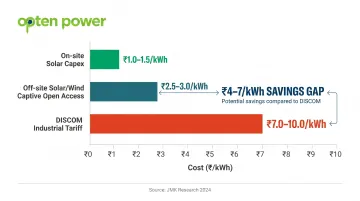
Platforms like Opten Power enable C&I buyers to compare PPA offers across 4+ GW of solar, wind, and hybrid projects from India's top developers in real time, reducing discovery and negotiation timelines by up to 50%.
Hybrid and Layered Procurement
Larger C&I buyers often layer these instruments to balance cost, reliability, and renewable targets:
- Baseload: Long-term renewable PPA (solar or wind)
- Variability management: Short-term open access contracts
- Grid fallback: DISCOM supply for backup and peak demand
Together, these layers cover the full demand profile — keeping costs low, supply secure, and renewable commitments on track.
Best Practices for Energy Efficient Procurement
Conduct a Detailed Energy Audit Before Going to Market
The most common procurement mistake is sizing contracts based on historical billing data rather than granular load analysis.
A proper energy audit identifies:
- Demand peaks and load factor variations
- Parasitic loads (equipment running unnecessarily)
- Efficiency improvement opportunities
- Seasonal consumption patterns
This analysis directly informs the volume and type of energy contract needed. A 10% demand reduction through efficiency measures can eliminate the need for a 1 MW PPA entirely—saving both capital and ongoing costs.
Define Clear Technical and Sustainability Specifications in the RFP
An effective energy procurement RFP should specify:
- Load requirements (MW capacity, annual kWh consumption)
- Contract duration and pricing structure
- Renewable content percentage (to meet RCO obligations)
- Metering and settlement terms
- Performance guarantees and liquidated damages
- Force majeure provisions
Platforms like Opten Power's Automated Tender Engine provide modular RFP templates pre-configured for C&I energy procurement, so buyers can issue structured RFPs and receive standardized, comparable bids from multiple developers.
Evaluate Bids on a Total Value Basis, Not Headline Tariff
A comprehensive bid evaluation covers three dimensions:
Financial metrics:
- Landed cost (base tariff + wheeling + CSS + transmission + banking)
- IRR and payback period
- Contract flexibility (step-up/step-down clauses)
Supplier metrics:
- Balance sheet strength and credit rating
- Track record and operational portfolio
- Compliance with RPO/REC obligations
Technical metrics:
- Generation profile alignment with load
- Metering and forecasting accuracy
- Grid connectivity and evacuation capacity
The developer offering the lowest headline tariff may not deliver the lowest landed cost once state-specific charges are factored in.
Incorporate DISCOM Tariff Intelligence Into Contract Design
Open access economics vary dramatically across Indian states. Cross-subsidy surcharges range from Rs 0.13/kWh in Gujarat to Rs 1.89/kWh in Karnataka for third-party open access consumers.
Example: A 10 MW solar PPA at Rs 2.5/kWh base tariff results in:
- Odisha: ~Rs 5/kWh (low wheeling and CSS)
- Maharashtra: ~Rs 8.4/kWh (high wheeling and CSS)
That Rs 3.4/kWh gap equals Rs 20.4 crore annually for a facility consuming 60 million kWh. State-level tariff intelligence must inform contract design before a developer is selected.
Build in Review Clauses and Exit Mechanisms
Long-term energy contracts carry significant risk if business conditions change—capacity expansion, plant relocation, or production cutbacks.
Well-structured agreements address this through:
- Step-up/step-down clauses that adjust contracted capacity as consumption trends shift
- Assignment rights allowing contract transfer if the facility changes ownership
- Termination-for-convenience provisions with defined notice periods and penalty structures
Getting these terms right at signing is far easier than renegotiating mid-contract when leverage has shifted to the developer.
How to Build Your Energy Efficient Procurement Process
Mapping the Procurement Workflow
The six-stage procurement cycle:
- Energy audit and load profiling – Understand current consumption, demand patterns, and efficiency opportunities
- Market intelligence and benchmarking – Research state-specific tariffs, open access charges, and developer offerings
- RFP design and issuance – Create structured RFPs with clear technical and commercial requirements
- Bid evaluation and shortlisting – Compare landed costs, developer credentials, and contract terms
- Contract negotiation and due diligence – Finalize pricing, performance guarantees, and exit clauses
- Execution, metering, and portfolio monitoring – Implement contracts and track performance against benchmarks
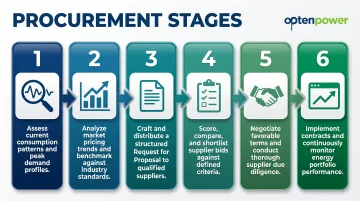
Stage 1 is where most procurement failures begin. Without load profiling, you risk over-procuring (locking in excess capacity) or under-procuring and falling back on expensive grid backup.
Common Pitfalls to Avoid
Even well-structured procurement processes can break down at the execution stage. These three mistakes account for most avoidable losses:
- Ignoring open access charge structures: Each state has different wheeling charges, CSS rates, and banking policies. What works economically in Odisha may be unviable in Maharashtra. Model landed cost state-by-state before committing.
- Accepting standard developer contracts as-is: Developer contracts are typically one-sided, with limited buyer protections around performance guarantees, curtailment risk, and exit rights. Negotiate step-down clauses, force majeure definitions, and termination provisions before signing.
- Siloing procurement from sustainability reporting: Energy procurement decisions directly impact GHG Scope 2 emissions, BRSR disclosures, and SBTi commitments. Contracts should include REC issuance, carbon attribute tracking, and reporting-ready documentation.
Frequently Asked Questions
What are the 7 principles of procurement?
The seven core procurement principles are value for money, transparency, accountability, proportionality, integrity, efficiency, and sustainability. In energy procurement, these guide everything from total cost of ownership evaluation to renewable source prioritization and structured RFP issuance.
What is the RFP for energy efficiency?
An energy efficiency RFP is a formal document sent to suppliers or developers that specifies technical requirements, performance standards, and evaluation criteria. It ensures structured, comparable bids — driving competitive pricing and clear accountability.
What are the four types of procurement contracts?
The four main types are fixed-price, cost-reimbursable, time-and-materials, and unit-price contracts. In energy procurement, fixed-price contracts (locking in a per-kWh rate) and unit-price models (variable rates tied to market indices) are most common. PPAs represent a specialized long-term fixed or indexed variant.
What is the purpose of the tender?
A tender is a formal competitive bidding process used to invite, evaluate, and select the most suitable energy supplier or developer. It ensures transparency, drives competitive pricing, and establishes contractual accountability — essential for long-term energy contracts running to ₹ crore values.
What is open access energy procurement in India?
Open access is the right of large C&I consumers (typically above 100 kW, per Green Energy Open Access Rules 2022) to procure power directly from generators outside their DISCOM. Buyers pay wheeling, transmission, and cross-subsidy charges that vary by state, which must be factored into total landed cost calculations.
How can businesses reduce energy procurement costs?
Three levers deliver the most impact:
- Reduce consumption first through energy audits before sizing any contract
- Shift to long-term renewable PPAs for cost stability against rising DISCOM tariffs
- Use platforms like Opten Power to aggregate developer offers and close deals faster