Introduction
India's renewable energy capacity is surging fast. The country added a record 44.5 GW in 2025 alone, nearly doubling the previous year's additions. Yet beneath this headline growth lies a harsh reality: approximately 42 GW of awarded capacity sits stalled without Power Sale Agreements, and 38.3 GW of tendered projects were cancelled between 2020 and 2024 — representing 19% of all issued capacity.
For commercial and industrial buyers and investors, this creates a paradox. Opportunities are abundant, but not all projects are viable. A poor evaluation decision can lock capital into underperforming assets for 15–25 years, while rushed due diligence often misses red flags that derail projects post-commitment.
The core problem is that most C&I buyers and investors lack a framework that evaluates renewable energy projects across financial, technical, and regulatory dimensions together. This guide addresses that gap — covering project lifecycle assessment, financial metrics, India-specific regulatory requirements, and how to identify red flags before committing capital.
Key Takeaways
- Evaluating renewable energy projects means assessing financial, technical, regulatory, and risk dimensions together — not returns alone
- Key financial metrics include IRR (13-16% for solar), LCOE, DSCR (minimum 1.20x), and PPA offtaker creditworthiness
- Technical evaluation must verify resource data quality, equipment specifications, grid connectivity status, and site feasibility
- India-specific factors like DISCOM policies, open access charges, SERC/CERC approvals, and RPO compliance vary by state and directly affect project economics
What Is Renewable Energy Project Evaluation and Why It Matters
Renewable energy project evaluation is the systematic assessment of a solar, wind, or hybrid energy project across financial, technical, site-specific, and regulatory dimensions to determine whether it is viable, competitive, and worth pursuing or procuring.
This process applies to three primary stakeholder groups, each with different evaluation depth but the same foundational framework:
- C&I buyers entering Power Purchase Agreements
- Investors financing or acquiring projects
- Developers benchmarking their projects against market alternatives
Without rigorous due diligence, businesses risk overpaying for energy, locking into poorly structured contracts, or investing in projects that fail to deliver projected output. The financial impact is well-documented — India's renewable sector saw 38.3 GW of capacity cancelled between 2020 and 2024, representing billions in stranded capital and wasted development costs.
Technology-specific risks make that evaluation even more critical. Over 60% of Indian wind assets underperformed their P90 generation estimates over five years, while 77% of solar assets met targets — a gap that only structured technical review can catch before capital is committed.
How to Evaluate a Renewable Energy Project – Step by Step
Most evaluation failures happen not because of missing data, but because evaluators skip steps or treat financial metrics in isolation from technical and regulatory realities. The following six-step framework prevents these gaps.
Step 1 – Identify the Project Lifecycle Stage
Every renewable energy project passes through four distinct lifecycle stages, each carrying a different risk-return profile:
| Lifecycle Stage | Risk Level | Expected IRR Range (India) | Key Considerations |
|---|---|---|---|
| Development | Highest | 16-18% | Permitting uncertainty, land acquisition risk, interconnection queue position unclear |
| Pre-Construction (Shovel-Ready) | High | 14-16% | Permits secured, financing committed, but construction execution risk remains |
| Construction | Moderate | 13-15% | EPC contractor performance, cost overrun risk, timeline delays |
| Operational | Lowest | 11-13% | Stable revenue, predictable cash flows, limited upside |
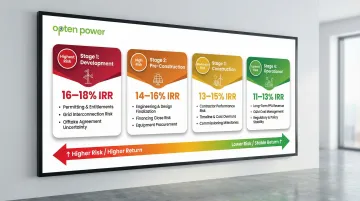
Development-stage projects offer higher potential returns but face significant permitting and interconnection uncertainty. Operational projects deliver stable, predictable revenue with lower risk but limited upside. Match your risk appetite to the project stage. Conservative investors should prioritize operational assets; those seeking higher returns can accept development-stage exposure with proper risk mitigation in place.
Step 2 – Analyse the Financial Metrics
Critical Financial Indicators:
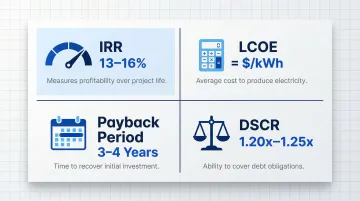
Evaluate these four core metrics together, not in isolation:
- Internal Rate of Return (IRR): Measures the annualized return on equity investment. For Indian utility-scale solar projects, realistic equity IRRs range from 13-16%, with hybrid projects achieving 14-18% due to better grid utilization and Viability Gap Funding support.
- Levelized Cost of Energy (LCOE): The average cost per unit of electricity generated over the project's lifetime, accounting for all capital and operating expenses. Compare LCOE against current grid tariffs to assess competitiveness.
- Payback Period: Time required to recover initial investment through energy savings or revenue. Solar projects typically offer 3-4 year payback periods for C&I buyers.
- Debt Service Coverage Ratio (DSCR): Measures the project's ability to service debt obligations. Indian lenders like IREDA require minimum DSCR of 1.20x to 1.25x, with operating projects typically maintaining 1.20x to 1.40x.
Power Purchase Agreement (PPA) Evaluation:
The PPA is the financial backbone of most renewable energy projects. Assess these critical elements:
- Duration: Typically 15–25 years for utility-scale projects
- Tariff Structure: Fixed tariffs provide cost certainty; escalating tariffs (2-3% annually) hedge against inflation but increase long-term costs
- Offtaker Creditworthiness: DISCOMs carry accumulated debt of ₹6.84 trillion, creating payment risk. Private C&I offtakers with strong balance sheets offer more reliable cash flows
- Termination Clauses: Understand exit provisions, force majeure conditions, and penalty structures
Capital Structure Considerations:
Most utility-scale renewable projects use 60-80% debt financing. Key parameters to verify:
- Benchmark Debt-to-Equity Ratio: The Central Electricity Regulatory Commission uses a 70:30 ratio for tariff determination; IREDA permits up to 80:20 for experienced developers with strong credit ratings
- Current Debt Pricing: 8.5% to 9.75%, with solar and wind projects accessing identical rates
- Lender Requirements: Minimum DSCR thresholds and covenant packages vary by lender — confirm terms before finalizing capital structure
Step 3 – Evaluate Technical and Site Factors
Resource Assessment Foundation:
Technical due diligence begins with resource data quality. Poor resource assessment is the leading cause of underperformance: over 60% of Indian wind assets missed P90 generation estimates over five years, while 77% of solar assets met targets.
Verify the following for each technology:
- Solar: Irradiance data quality, measurement period (minimum 12 months, ideally 3+ years), and independent engineer validation
- Wind: Wind speed measurements, tower height, and minimum 12-month measurement duration at hub height
Equipment and Site Evaluation:
Check these technical specifications:
- Panel Efficiency and Degradation: Tier-1 manufacturers provide 25-30 year linear power warranties, guaranteeing at least 83-85% of nominal output at year 25 for P-type modules and 87% for N-type modules
- Inverter Specifications: Verify manufacturer reputation, efficiency ratings, and warranty terms (typically 10-15 years)
- Land Control Security: Owned land eliminates lease risk; long-term leases (25+ years) must have clear renewal terms
- Grid Proximity: Distance to nearest substation impacts interconnection costs — projects beyond 5-10 km face significant transmission upgrade expenses
- Environmental Constraints: Verify no protected species, wetlands, flood zones, or other constraints that could delay approvals
Step 4 – Review Regulatory and Policy Compliance
India-Specific Regulatory Evaluation:
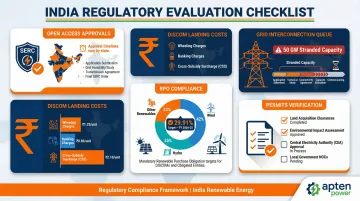
India's renewable energy regulatory environment is highly state-specific. Evaluation must cover:
- Open Access Approvals: State Electricity Regulatory Commission (SERC) rules govern open access permissions, which vary significantly by state
- DISCOM Landing Costs: Wheeling charges, banking charges, transmission charges, and Cross-Subsidy Surcharge (CSS) vary by state and can materially affect project economics
- Renewable Purchase Obligation (RPO) Compliance: For FY 2024-25, the total RPO target is 29.91% (2.46% Wind, 1.08% Hydro, 26.37% Other), creating mandatory demand among obligated entities
- Grid Interconnection Queue Status: Verify Central Transmission Utility (CTU) or State Transmission Utility (STU) connectivity agreements are in place — over 50 GW of renewable capacity is currently stranded due to transmission infrastructure gaps
Permits and Approvals Verification:
Incomplete permitting is a major red flag at any stage. Verify:
- Environmental clearances from state pollution control boards
- Local zoning and land use approvals
- Electrical permits and safety certifications
- Interconnection agreements with CTU/STU
- Water usage permits (for solar panel cleaning)
Step 5 – Assess Risk and Mitigation Measures
Primary Risk Categories:
- Development Risk: Permitting failure, financing gaps, land acquisition delays
- Construction Risk: Cost overruns, EPC contractor reliability, equipment delivery delays
- Operational Risk: Resource underperformance, equipment failure, O&M contractor quality
- Policy Risk: Changes to subsidies, tariff revisions, open access regulations
Evaluating Mitigation Quality:
Strong projects demonstrate comprehensive risk mitigation:
- Long-Term Performance Warranties: Panels 20-25 years, inverters 10-15 years
- Insurance Coverage: Property, business interruption, and performance guarantees
- Experienced Contractors: Verify EPC and O&M contractors have completed similar projects successfully
- Developer Track Record: Check verifiable completion history, financial stability, and litigation record
Step 6 – Compare Options and Make a Decision
Evaluation only creates value when it enables comparison. Benchmark the project against alternative developers, tariff structures, and technology configurations before committing.
C&I buyers should compare at least three developers for any significant procurement. Investors should stress-test assumptions across multiple scenarios: conservative resource estimates, higher O&M costs, and extended construction timelines.
Running these comparisons manually across multiple developers is time-intensive. Opten Power's platform lets C&I buyers compare tariffs, savings, and IRR across developers in real-time — with instant access to 4+ GW of pre-vetted projects across 16 states, standardised DISCOM landing costs, and automated financial analysis built in.
Key Evaluation Criteria to Get Right
Financial Metrics: What the Numbers Should Tell You
IRR alone is insufficient — a project can show an attractive IRR based on optimistic capacity factor assumptions or underestimated O&M costs. Realistic capacity factors for Indian projects typically range from 20-30% for solar and higher for wind (25-35% depending on site quality).
For utility-scale solar projects in India, benchmark equity IRRs of 13-16% are realistic when using conservative assumptions. Hybrid projects achieve 14-18% due to better grid utilization and Viability Gap Funding support.
Capital Structure and Financing:
Most utility-scale renewable projects use 60-80% debt financing. Understanding how leverage, tax structures, and financing costs affect returns is critical. With WACC expanding by 320 basis points through 2024, debt pricing now ranges from 8.5% to 9.75% — financial models must be stress-tested against a prolonged high-interest environment.
Key structural benchmarks lenders and sponsors work to:
- Debt-to-equity ratio: Standard 70:30; optimizing toward 75:25 where permissible improves equity IRR
- DSCR floor: Lenders require a minimum of 1.20x–1.25x coverage
- Debt tenor: 18+ years needed to comfortably clear DSCR hurdles across the project life
Technical Assessment: Where Projects Succeed or Fail
Financial models are only as reliable as the technical inputs behind them. Independent technical due diligence (ITD) from a qualified engineer is a hard requirement for any significant project commitment. Key outputs to request:
- P50/P90 Energy Yield Assessment: P50 represents the median expected generation; P90 represents conservative estimates with 90% probability of achievement
- Equipment Specification Review: Validation of panel efficiency, inverter ratings, and manufacturer warranties
- Grid Interconnection Study: Assessment of substation capacity, transmission upgrade requirements, and estimated costs
Site-Specific Considerations:
Transmission infrastructure proximity directly affects project economics. Estimated interconnection upgrade costs can range from ₹50 lakh to ₹5 crore depending on distance and required capacity. Land control status (owned vs. leased) impacts long-term security, and environmental sensitivities (protected species, wetlands, flood zones) can delay approvals by 6-18 months.
Regulatory Landscape: India-Specific Considerations
India's renewable energy regulatory environment is highly state-specific. Open access charges — wheeling, transmission, banking, and cross-subsidy surcharge (CSS) — vary by state and DISCOM, and a project that is economically attractive in one state may be marginal in another.
The difference is material:
| Charge Environment | Combined Open Access Charges | Impact on Procurement |
|---|---|---|
| Favorable states | 2–3% of energy consumed | Open access highly attractive |
| Moderate states | 8–12% | Viable with careful structuring |
| High-charge states | 15–20%+ | Most procurement savings eroded |
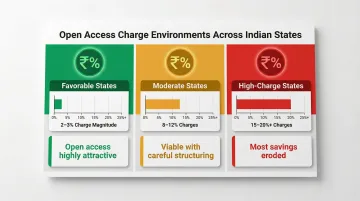
RPO obligations create mandatory demand for renewable energy among obligated entities. CERC and SERC frameworks govern tariff approvals, connectivity standards, and dispute resolution — and projects that don't align upfront face costly corrections later.
Red Flags and Common Mistakes to Avoid
Key Red Flags:
- IRR and LCOE estimates not validated by an independent engineer
- Permits described as "in process" with no confirmed interconnection queue position
- PPA offtakers — DISCOMs or private buyers — with weak payment history or poor balance sheets
- Developers with no completed projects of similar scale and technology
Commercial buyers and investors also tend to repeat the same evaluation mistakes:
- Accepting IRR projections without stress-testing for resource variability, equipment degradation, or O&M cost inflation
- Overlooking state-level charges — wheeling, banking, and cross-subsidy surcharges — that quietly erode savings
- Signing heads of terms before verifying land ownership and environmental approvals
- Relying on developer-provided technical assessments instead of commissioning independent due diligence
Use this checklist before committing to any project:
- Has an independent engineer validated the P50/P90 energy yield assessment?
- Are all required permits in hand — not just "in process"?
- What is the exact interconnection queue position and substation capacity availability?
- Does the developer have a verifiable track record of completing similar projects on time and on budget?
- What is the offtaker's payment history and credit rating?
A developer who answers these questions clearly and completely is worth engaging. One who deflects, hedges, or can't provide documentation is telling you something important.
How Opten Power Can Help
Opten Power is India's unified clean energy marketplace, giving C&I buyers and investors access to 4+ GW of renewable energy projects across solar, wind, and hybrid technologies spanning 16 states, so evaluation starts with the right pool of vetted options.
The platform eliminates the most time-consuming parts of project evaluation, cutting deal timelines by up to 50%. Buyers can:
- Compare tariffs, projected savings, and IRR across multiple developers in real-time
- Access standardized DISCOM intelligence with up-to-date landing prices across all states
- Get instant regulatory analysis without manual research
Beyond procurement, the Portfolio Management Dashboard tracks performance across the full lifetime of an energy portfolio, giving businesses visibility and control over every renewable investment from one place.
Frequently Asked Questions
What is the most important metric when evaluating a renewable energy project?
No single metric is sufficient. IRR, LCOE, and PPA terms must be assessed together, as an attractive IRR built on weak resource assumptions or poor offtaker creditworthiness can still lead to a poor investment outcome.
What is a realistic IRR for a renewable energy project in India?
For utility-scale solar, realistic equity IRRs range from 13-16%; hybrid projects typically achieve 14-18%. Development-stage projects carry higher risk but offer 16-18% IRRs, while operational projects deliver steadier returns of 11-13%.
How do I evaluate the risk of a Power Purchase Agreement (PPA)?
Assess offtaker creditworthiness, contract duration, tariff structure (fixed vs. escalating), and termination clauses. DISCOMs carry ₹6.84 trillion in accumulated debt — a meaningful payment risk relative to creditworthy private C&I buyers.
What regulatory approvals are required for renewable energy projects in India?
Projects require open access approvals from SERC, CERC/STU connectivity agreements, environmental clearances, local zoning permits, and confirmed interconnection queue status. Requirements vary significantly by state and project scale — always verify state-specific compliance.
How does a project's lifecycle stage affect its risk and return profile?
Development-stage projects carry the highest risk (permitting, land acquisition, interconnection uncertainty) and highest potential return (16-18% IRR). Operational projects offer stable, predictable returns (11-13% IRR) with lower upside.
What technical information should I request before committing to a renewable energy project?
Before committing, request the following — and never skip independent technical validation:
- Independent energy yield assessment (P50/P90)
- Equipment specification sheets with manufacturer warranties
- Grid interconnection study with cost estimates
- Land control documentation (ownership or lease agreements)
- Environmental clearance certificates