Introduction
Rising industrial electricity tariffs, unreliable grid infrastructure, and mandatory renewable purchase obligations are forcing commercial and industrial enterprises across India to rethink their energy strategy. Commercial electricity tariffs now range from ₹15–₹20/kWh, while unplanned downtime costs industrial operations at least USD 10,000 per hour. Energy security has become a boardroom priority. Hybrid solar power systems are emerging as the most resilient answer.
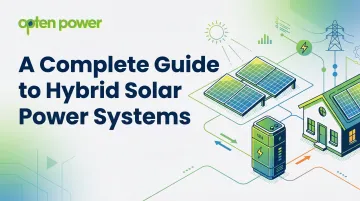
A hybrid solar power system integrates solar panels, battery storage, and grid connectivity into one unified setup. Unlike simple rooftop installations, hybrid systems deliver on three fronts simultaneously:
- Cost reduction — lower per-unit generation costs offset high grid tariffs
- Reliability — battery backup keeps operations running through outages
- Flexibility — grid synchronisation cuts peak demand charges and enables renewable energy exports
This guide helps C&I decision-makers — from manufacturing plants and data centres to IT parks and process industries — understand how hybrid solar systems work, what they cost, and how to evaluate one for their operations.
Key Takeaways
- Hybrid solar combines solar panels, battery storage, and grid connection for uninterrupted power at optimised cost
- Stores surplus solar energy and dispatches it during peak tariff hours or outages, making it well-suited for 24×7 operations
- Core components: PV array, hybrid inverter, battery bank (typically LFP), energy management system (EMS)
- Reduces peak demand charges, supports RPO compliance, cuts DISCOM dependence, and improves cost predictability
- Procurement decisions should weigh system sizing, state regulatory frameworks, and total cost of ownership, not CapEx alone
What Is a Hybrid Solar Power System?
A hybrid solar power system is a grid-interactive solar installation with integrated battery storage. It simultaneously powers loads from solar generation, draws from or exports to the grid, and charges or discharges batteries based on demand and tariff signals. An energy management system (EMS) handles this coordination in real time — giving industrial operations the kind of power continuity that on-grid and off-grid systems alone can't provide.
Key distinctions:
| Feature | On-Grid | Hybrid | Off-Grid |
|---|---|---|---|
| Grid Dependency | 100% dependent; no backup | Grid as safety net | Zero grid connection |
| Battery Storage | None | Yes (LFP, 4-6 hours typical) | Large, expensive banks |
| Backup During Outages | None (shuts down) | Seamless switchover | Full backup |
| Typical Use Case | Cost reduction only | 24×7 operations, peak shaving | Remote/no grid areas |
| Relative Cost | Lowest CapEx | Moderate (solar + storage) | Highest (oversized storage) |
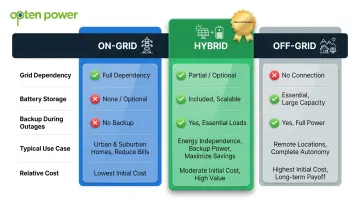
In the Indian context, "hybrid solar power system project" typically refers to utility-scale or C&I installations procured under open access or captive models. Many integrate wind generation alongside solar to improve plant load factor (PLF) and deliver more consistent power to high-consumption industrial consumers.
India's National Wind-Solar Hybrid Policy defines hybrid systems as configurations where one resource — wind or solar — must be at least 25% of the other's rated capacity. This enables complementary generation profiles and shared transmission infrastructure.
How a Hybrid Solar Power System Works: Key Components
Solar PV Array
Monocrystalline panels — the dominant choice for commercial installations due to their 20–22% efficiency — convert sunlight into DC electricity. Array sizing for C&I applications is driven by contracted demand, rooftop or land availability, and peak sun hours at the project site, not just simple consumption calculations. Proper site assessment accounts for shading, soiling rates, and seasonal irradiance variation.
Hybrid Inverter
The hybrid inverter converts DC to usable AC power, manages simultaneous inputs from solar and battery, handles grid synchronisation, and executes energy dispatch logic — all within a single unit. Integrated Maximum Power Point Tracking (MPPT) optimises solar harvest in real time by adjusting voltage and current to extract maximum power under changing irradiance and temperature conditions.
For large C&I systems, string inverters or central inverters may be used alongside separate bi-directional inverter-chargers, enabling modular scaling and redundancy.
Battery Storage
Batteries — typically lithium iron phosphate (LFP) for commercial systems — store excess solar generation for dispatch during non-solar hours or peak tariff periods. LFP chemistry is preferred for:
- Delivers 4,000–6,000+ cycles at 80% depth of discharge, extending usable system life
- Thermally stable with lower fire risk than other lithium chemistries
- Higher energy density than lead-acid alternatives in a smaller footprint
Global BESS deployments reached approximately 205 GWh in 2024, up 53% year-on-year — driven largely by C&I demand as storage costs have dropped below ₹8/Wh in several markets.
Grid Connection and Energy Flow
Hybrid systems manage four distinct energy flow scenarios:
- Solar directly powers loads during the day — minimising grid draw and reducing consumption charges
- Excess solar charges batteries — storing surplus generation for later use
- Batteries discharge during evening/night peak hours — avoiding high time-of-use tariffs and reducing maximum demand charges
- Grid supplements when solar and battery are insufficient — ensuring uninterrupted operations
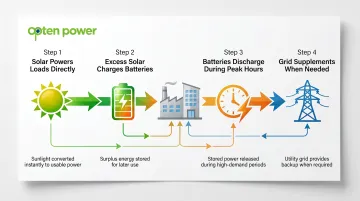
This intelligent switching happens in milliseconds and is seamless for industrial operations, managed by the EMS with no manual intervention required.
Energy Management System (EMS)
The EMS is the software layer that orchestrates power dispatch based on:
- Real-time demand and load profiles
- Battery state of charge (SOC) and health metrics
- Time-of-use tariff signals from the DISCOM
- Pre-configured priority rules (e.g., critical vs. non-critical loads)
For C&I users with 24×7 operations — steel, cement, data centres, cold storage — the EMS directly determines how much of the grid bill gets eliminated. Beyond self-consumption optimisation, intelligent charging strategies can extend battery cycle life by 15–20% over poorly managed systems.
Types of Hybrid Solar Systems
Wind-Solar Hybrid Systems
In large-scale C&I and utility projects, "hybrid" increasingly refers to wind-solar combinations where solar PV and wind turbines share common transmission infrastructure. This configuration works with complementary generation profiles — solar peaks midday, while wind often peaks in evenings or during monsoon months.
India's MNRE National Wind-Solar Hybrid Policy enables C&I open-access buyers to access these projects with higher plant load factors. The CUF (capacity utilisation factor) gains are significant:
| Configuration | Typical CUF Range |
|---|---|
| Standalone Solar | 16–20% |
| Standalone Wind | 20–26% |
| Wind-Solar Hybrid | 35–50% |
CERC's Draft RE Tariff Regulations 2024 set a minimum 30% CUF threshold for wind-solar hybrid projects for tariff determination purposes.
AC-Coupled vs. DC-Coupled Configurations
Two main battery integration architectures exist:
AC-Coupled:
- Battery connects on the AC bus (after the inverter)
- Easier to retrofit into existing solar plants
- Allows independent solar and battery sizing
- Slightly lower round-trip efficiency due to additional conversion steps
DC-Coupled:
- Battery connects directly on the DC bus (before the inverter)
- More efficient for new installations with high battery cycling
- Reduces conversion losses (typically 2-4% efficiency gain)
- Requires integrated hybrid inverter or careful system design
Research comparing large-scale PV+BESS architectures indicates DC-coupled configurations avoid additional conversion steps and can yield higher system efficiency for new-build co-located projects, while AC-coupled solutions are preferred for retrofits due to minimal PV-side modifications.
Standalone vs. Grid-Interactive Hybrid
Systems fall into two operational categories:
Standalone (backup-priority):
- Designed primarily for island mode operation
- Common in areas with poor grid quality (certain industrial zones, Tier-2/3 locations)
- Batteries sized for extended outage duration
- Limited grid export capabilities
Grid-interactive (optimisation-priority):
- Actively participate in energy arbitrage and net metering
- Optimised for peak shaving and demand charge reduction
- Can potentially participate in virtual power plant (VPP) frameworks
- Require state regulatory approval and metering infrastructure
Which configuration is viable depends heavily on the state — net metering caps, wheeling charges, and open access eligibility vary enough across states that a regulatory review should precede any procurement decision.
Why Commercial and Industrial Businesses Are Adopting Hybrid Solar
Energy Security and Operational Continuity
For industries with zero tolerance for downtime — data centres, hospitals, process industries, cold chains — hybrid solar provides seamless backup without the cost and emissions of diesel gensets. A global ABB survey of 3,600 industrial decision-makers found that 83% report unplanned downtime costs at least USD 10,000 per hour, with 76% estimating up to USD 500,000 per hour — and 44% face monthly interruptions.
Hybrid systems eliminate dependence on diesel backup, which costs ₹18-₹24/kWh when factoring in fuel, maintenance, and emissions compliance.
Peak Demand Charge Reduction
Hybrid systems discharge batteries during peak demand windows (typically 6 PM–10 PM under time-of-use tariffs), cutting maximum demand (MD) charges on DISCOM bills. For large industrial consumers, MD charges are levied per kVA of billing demand — calculated as the higher of recorded MD or a percentage (often 75–85%) of contract demand.
This makes MD charge reduction one of the strongest ROI drivers for battery storage, particularly for facilities with variable load profiles or operations running into evening peak hours.
State SERC tariff structures vary, but MD charges consistently represent a substantial share of monthly HT bills — making peak shaving a priority for any large C&I consumer evaluating storage.
Renewable Purchase Obligation (RPO) Compliance
India's RPO mandates require large C&I consumers — open access, captive, and HT industrial categories — to source a defined percentage of consumption from renewable energy. Targets have been progressively raised under India's energy transition roadmap, with specific trajectories through FY2029-30.
Hybrid solar projects — particularly wind-solar hybrids — count toward RPO compliance and help businesses avoid shortfall penalties imposed by state regulators. Key compliance benefits include:
- Counts toward both solar and non-solar RPO targets depending on project configuration
- Avoids penalty payments to state regulators for RPO shortfalls
- Supports ESG and sustainability reporting requirements
- Compliance value stacks on top of direct energy cost savings
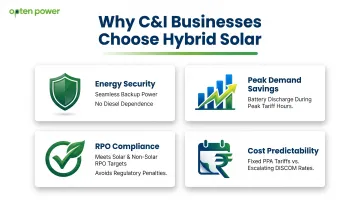
Long-Term Cost Predictability vs. Escalating DISCOM Tariffs
Locking in solar power through a long-term PPA (Power Purchase Agreement) or captive model provides cost predictability that grid tariffs cannot offer. Jharkhand SERC multi-year tariff proceedings reference an assumed ~5% year-on-year escalation in HT Industrial Services calculations, while landed costs for open access C&I consumers have risen across most states in recent quarters due to higher PPA tariffs and regulatory charges.
Hybrid solar PPAs typically offer fixed or mildly escalating tariffs (1-2% annual), delivering budget certainty over 20-25 year project lifespans and insulating operations from DISCOM tariff volatility.
Scalability and Future-Readiness
Modular hybrid systems can be scaled by adding battery capacity or generation assets as energy demand grows. This flexibility allows businesses to start with a right-sized configuration and expand without replacing core infrastructure — a key advantage for facilities planning capacity additions or phasing capex over time.