Introduction
Commercial and industrial energy buyers in India face a persistent dilemma: solar-only systems leave heavy industries exposed to grid dependency during night hours and monsoon periods, while wind-only setups demand specific site conditions and carry high capital costs. Enter hybrid solar-wind systems—a third option that's reshaping the renewable procurement landscape for 24/7 operations.
The real question is whether hybrid systems deliver tangible financial and operational value for your business. This article examines what hybrid systems are, whether their complementary generation patterns hold up in practice, and whether they make sense for Indian C&I buyers in today's energy market.
Key Takeaways
- Hybrid systems combine solar PV and wind turbines to generate power across more hours daily and seasonally
- Solar peaks during daytime in summer; wind peaks at night and in winter—creating natural complementarity
- 24/7 industries—steel, cement, data centres, hospitals—gain most from the improved plant load factor and reduced grid dependence
- Procuring hybrid power through a PPA is more practical for most C&I buyers than building captive systems
What Is a Solar-Wind Hybrid System?
A hybrid energy system combines two or more electricity generation sources to improve reliability and output consistency. In this case, solar photovoltaic (PV) panels and wind turbines operate from the same site or share grid infrastructure to deliver more consistent power than either technology alone.
Two Deployment Models
- Captive hybrid systems — Businesses install solar panels and wind turbines on or near their premises. This gives direct ownership and control, but requires significant capital and technical expertise.
- Grid-scale hybrid PPAs — A renewable developer co-locates wind and solar capacity at a utility-scale project and supplies power to C&I buyers via a Power Purchase Agreement. For most large industrial buyers, this route is more accessible: you get the reliability benefits without owning or operating any generation assets.
Understanding which model fits your load profile is the first step. The next is knowing the policy environment that shapes what's available and at what cost.
India's Policy Framework
Hybrid projects in India increasingly develop under the Ministry of New and Renewable Energy's (MNRE) hybrid renewable energy policy framework. This policy incentivises co-located wind-solar projects to improve grid stability and increase capacity utilisation of shared transmission infrastructure—both of which affect your landed tariff directly.
Why Solar and Wind Are Natural Partners for C&I Operations
Complementary Generation Profiles
Solar generation peaks during daylight hours and summer months. Wind generation is strongest at night and during winter/monsoon seasons. This means the two sources offset each other's dead zones across both daily cycles and annual cycles—solar fills the daytime gap, wind covers the night.
For C&I operations, this directly affects procurement economics:
- Steel plants, cement manufacturers, data centres, and hospitals operate around the clock with flat or near-flat load curves
- A solar-only system leaves them buying expensive grid power for 10–14 hours daily
- A well-designed hybrid system dramatically extends renewable generation coverage across the entire 24-hour period
Higher Plant Load Factor
Plant Load Factor (PLF) or Capacity Utilisation Factor (CUF) measures how much energy a plant generates relative to its maximum possible output.
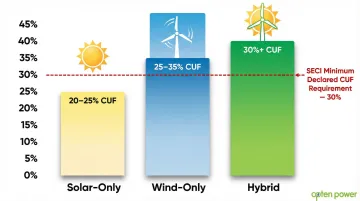
- Solar-only projects typically achieve 20–25% CUF
- Wind-only projects achieve 25–35% CUF, depending on location
- According to SECI guidelines, hybrid projects must declare an annual CUF of at least 30%, with developers maintaining generation between 90% and 120% of that declared value
By combining both technologies on shared infrastructure, hybrid projects push effective utilisation significantly higher than single-source alternatives.
India's Geographic Advantage
States like Rajasthan, Gujarat, and Tamil Nadu have both high solar irradiance and strong wind resource—making them natural hotspots for hybrid development. A C&I buyer sourcing power from these states through a hybrid PPA benefits from more consistent power delivery compared to single-source PPAs.
Grid Infrastructure Efficiency
Co-located wind and solar projects share the same grid connection point, transformers, and transmission lines. This reduces per-unit infrastructure cost and can translate into more competitive tariffs for the off-taker. Instead of paying for two separate grid connections, developers spread transmission costs across combined capacity—savings that pass through to PPA pricing.
Key Components of a Hybrid Power System
Core Hardware Components
When you procure a hybrid project through a PPA or direct investment, the developer manages all physical infrastructure. Understanding what goes into these systems helps you evaluate project quality and CUF guarantees more confidently.
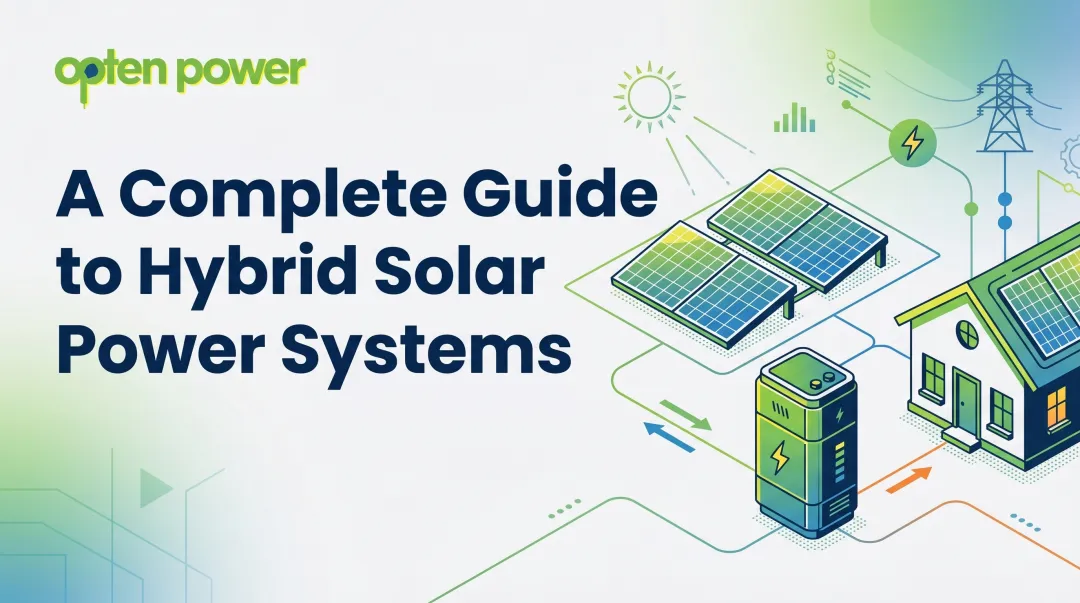
- Solar PV array — Converts sunlight into DC electricity. Modules are mounted on fixed-tilt structures or solar trackers to maximise irradiance capture throughout the day.
- Wind turbine — Converts kinetic wind energy into AC electricity. Hub heights typically range from 80 to 120 metres to access stronger, more consistent wind speeds.
- Hybrid charge controller / power management system — The operational brain of the system. It optimises power flow from both sources, manages battery charging, and routes electricity to the inverter or load based on real-time generation and demand.
- Battery storage — Stores surplus generation for use during low-output periods. Essential for off-grid or weak-grid scenarios; valuable in grid-tied setups for peak shaving and backup power.
- Inverter — Converts DC power from panels, turbines, or batteries into AC power usable by industrial equipment. Grid-tied systems use bi-directional inverters that allow excess power to be exported to the grid.
PPA Perspective
If you're procuring power rather than owning the asset, the physical stack above is the developer's responsibility. What matters to your procurement team are the commercial terms that govern what you actually receive:
- PPA contract terms (tariff, tenure, escalation)
- CUF guarantee and generation profile (hourly/monthly distribution)
- Grid connectivity and scheduling arrangements
- Curtailment and compensation clauses
The developer manages the physical infrastructure—you focus on commercial and operational terms.
Pros and Cons of a Solar-Wind Hybrid System
Pros and Cons of a Solar-Wind Hybrid System
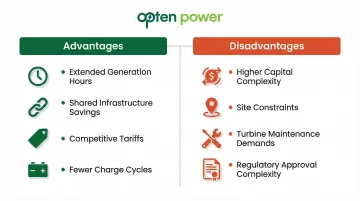
Advantages
- Offsets each source's downtime, generating power across more hours of the day and year — every grid import hour avoided is a cost saved for 24/7 operations
- Shared grid connections, land, and transmission reduce per-unit capital cost versus two separate single-source projects
- Higher CUF spreads fixed development costs across more generation units, making hybrid PPA tariffs competitive with — or better than — standalone solar or wind in high-resource states
- Fewer deep charge-discharge cycles extend battery life in captive setups and reduce storage costs in grid-tied systems
Disadvantages
- Investing in two generation technologies plus shared infrastructure makes captive hybrid projects costly — and even at the PPA level, higher development costs can weaken tariff competitiveness in low-wind or low-solar zones
- Wind turbines need minimum speeds above 6–7 m/s at hub height and open land; most urban or semi-urban industrial sites don't qualify, and rooftop turbines are largely impractical due to turbulence and structural limits
- Moving parts — blades, gearbox, generator — demand scheduled maintenance more complex than solar upkeep; in captive setups this raises opex, and under a PPA the cost is passed through in tariff pricing
- Hybrid projects may need separate approvals for wind and solar components, open access permissions, and wheeling agreements; the Green Energy Open Access (GEOA) Rules 2022 set a 15-day nodal agency approval window, but actual timelines depend on state infrastructure readiness and DISCOM responsiveness
Is a Hybrid System Worth It for Your Business?
The "Worth It" Threshold
A hybrid system delivers highest value when:
- Your business operates 24 hours a day with minimal shutdown periods
- The site or source location has strong resources for both solar and wind
- You want to maximise renewable energy percentage and minimise residual grid dependence
- Long-term tariff certainty is more important than minimising upfront complexity
Who Benefits Most
Certain segments see the clearest return from hybrid investment:
- Heavy industries (steel, aluminium, cement, fertilisers) run around the clock and consume massive power — hybrid covers a far larger share of their load profile than solar alone
- Data centres and hospitals require near-zero downtime; hybrid paired with storage is the most reliable option for facilities where every outage hour carries hard costs
- Large manufacturing units — automotive, textiles, pharmaceuticals — gain from hybrid's extended generation window and lower dependence on peak-hour grid power
- Warehouses and commercial complexes with flexible load profiles may find solar-only sufficient, particularly if peak consumption aligns with daylight generation hours
Off-Grid and Remote Facility Use Case
For industrial facilities in areas with poor grid reliability or high grid tariffs, a captive hybrid system with battery storage makes the strongest case. Grid dependence carries both cost and operational risk — unreliable supply can halt production entirely.
Key indicators that a captive hybrid setup is worth evaluating:
- Grid tariffs consistently above ₹7–8/unit
- Frequent outages or load-shedding affecting production
- Remote location with limited grid infrastructure
- Continuous process operations that cannot tolerate interruption
The Hybrid PPA: Practical Entry Point
For C&I buyers procuring rather than owning generation assets, a long-term PPA from a grid-scale hybrid renewable project delivers the reliability benefits without captive ownership complexity.
Opten Power's marketplace provides access to 4+ GW of renewable capacity including hybrid projects across 16 states. Buyers can compare options across solar, wind, and hybrid developers in real time — evaluating landed tariffs, CUF guarantees, and contractual terms on a standardised basis.
How to Evaluate and Procure a Hybrid Energy Project
Key Evaluation Metrics
When assessing any hybrid energy proposal, focus on these metrics:
CUF or PLF Guarantee: What is the declared annual CUF, and what generation profile (hourly/monthly distribution) does the developer commit to? SECI's hybrid PPA framework requires developers to maintain generation between 90% and 120% of declared CUF—shortfalls trigger liquidated damages.
Landed Tariff (₹/kWh): This is your all-in cost: wheeling, transmission, Cross Subsidy Surcharge (CSS), and scheduling charges combined. The GEOA Rules 2022 cap CSS increases at 50% for 12 years and exempt captive users from Additional Surcharges if fixed charges are paid.
State-level waivers can shift this significantly. Gujarat's 100% CSS/AS exemption for captive hybrid projects, for instance, can materially reduce your final landed cost.
IRR and Payback Period: Model multiple generation scenarios—optimistic, base, and conservative. Understand how variations in wind speed or solar irradiance impact your returns.
Contractual Terms: Shortfall provisions, curtailment compensation, exit clauses, and banking rules all materially impact your risk profile. Monthly banking is mandated under GEOA rules, but unutilized banked energy at month-end lapses or is procured by the DISCOM at a steep discount—often 75% of the RE tariff.
Procurement Process for Hybrid PPAs
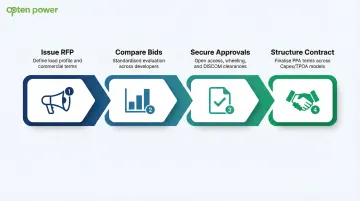
Once you've defined your evaluation criteria, the procurement process follows a four-step sequence:
Issue RFP to multiple developers — Clearly define your load profile, tenure, preferred procurement model (captive vs. third-party open access), and commercial terms upfront.
Compare bids on standardized terms — Manual RFP processes are slow and invite inconsistent responses. Platforms with automated RFP creation and real-time DISCOM intelligence cut procurement timelines significantly. Opten Power's Automated Tender Engine, for example, enables structured bid collection, automated evaluation, and up to 50% faster deal closure from discovery to contract finalization.
Secure regulatory and DISCOM approvals — This covers open access permissions, wheeling agreements, and grid connectivity. Under GEOA Rules 2022, nodal agencies must approve applications within 15 days, though actual timelines vary by state.
Structure the contract — Complex legal and commercial terms across Capex, Group-Capex, and Third-Party Open Access models benefit from pre-approved, modular templates. Opten Power's PPA Simplification service is designed specifically for this step.
Site Assessment for Captive Hybrid Projects
Site quality determines whether your financial model reflects reality or wishful thinking. Before running any numbers, quantify:
- Wind speed data at relevant hub heights (typically 80–120 metres)
- Solar irradiance (GHI/DNI) for accurate panel output modelling
- Grid connectivity distance and available evacuation capacity
- Land availability and zoning/environmental clearances
Without robust site assessment and resource mapping, your financial model rests on guesswork — and guesswork rarely survives first contact with a developer's term sheet.
Frequently Asked Questions
Can solar panels and wind turbines be used together?
Yes, solar panels and wind turbines are routinely combined in hybrid systems. Their complementary generation profiles—solar peaking during the day and wind peaking at night and in winter—make them well-suited partners for delivering more consistent electricity output across daily and seasonal cycles.
What are the advantages of a hybrid solar-wind system?
Hybrid systems deliver several advantages over single-source renewables:
- Higher power reliability across more hours of the day and year
- Improved capacity utilisation of shared grid infrastructure
- Reduced dependence on the grid or backup generation
- More competitive long-term tariffs compared to standalone solar or wind setups
What is hybrid power generation using solar and wind energy?
Hybrid power generation integrates solar PV and wind turbine technologies to draw electricity from two complementary renewable sources. It can be deployed as a captive setup on the consumer's premises or at utility scale through a shared grid connection, usually paired with battery storage or smart controllers.
Are rooftop wind turbines worth it?
Rooftop wind turbines are generally not practical for most commercial or industrial facilities. Urban and semi-urban environments create turbulence that reduces output significantly, and installation on rooftops introduces structural and noise challenges. For most businesses, rooftop solar combined with a wind or hybrid PPA is a more effective approach.
Is hybrid power generation suitable for commercial and industrial facilities?
Yes — hybrid systems are particularly well-suited for C&I consumers with high and consistent energy demand. Factories, data centres, hospitals, and process industries benefit from the round-the-clock generation profile that solar-wind combinations provide, reducing grid dependence and stabilising energy costs over long-term PPA contracts.