Introduction
Mines and heavy industries carry some of the heaviest energy burdens in any sector. Energy represents 26–28% of total operating costs in cement manufacturing; in mining, comminution alone consumes 70% of site-level expenses. These industries face punishing exposure to volatile grid tariffs, supply disruptions, and rising decarbonization pressure from investors and export markets.
In India, the structural problem runs deeper. Commercial and industrial consumers still cross-subsidize agricultural and residential users, pushing HT-industry tariffs to ₹7.50–₹8.36 per kWh across major states.
The question in 2026 is no longer whether to shift to renewables—it's how to do so without betting capital, management bandwidth, or operational continuity on building power assets.
Power Purchase Agreements (PPAs) have emerged as the answer. A PPA lets industrial energy buyers access reliable, affordable renewable power while offloading construction risk, technology obsolescence, and O&M burden to specialist developers. The sections ahead cover how PPAs work, why they outperform self-build on a risk-adjusted basis, and what C&I buyers need to act on before tariffs climb further.
Key Takeaways
- PPAs require zero upfront CAPEX—developers build, own, and operate facilities while you pay only for energy consumed
- Long-term fixed tariffs shield operations from grid volatility and enable multi-year budget certainty
- Global mining majors have reached 80–100% renewable electricity through PPAs—a benchmark Indian operations are now actively pursuing to cut Scope 2 emissions
- Rising grid tariffs, BRSR mandates, and tightening developer capacity make 2026 a strong moment to lock in long-term contracts
- Opten Power's platform cuts deal closure time by 50% through real-time tariff intelligence across 16 states
How a Renewable Energy PPA Works: The Core Mechanism
A renewable energy PPA is a long-term contract between an industrial buyer and a third-party developer. The developer finances, builds, owns, and operates the power facility—solar, wind, or hybrid. You commit to purchasing the electricity generated at a pre-agreed tariff, paying only for energy consumed. Ownership, maintenance, and operational risk stay entirely with the developer.
Two Main PPA Models for Industrial Buyers
Physical/Open Access PPAs deliver renewable energy directly to your facility via open access or group captive structures. In India, this is the dominant model for C&I buyers. Energy flows to your site through state transmission infrastructure, with applicable wheeling and cross-subsidy charges factored into landed cost.
Where physical delivery isn't viable, Virtual PPAs (VPPAs) offer an alternative: financial contracts for differences where you pay the agreed price and receive Renewable Energy Certificates (RECs) regardless of delivery location. VPPAs are more common in the US and Europe and remain rare among Indian industrial buyers today.
Typical Contract Parameters
Standard PPA tenors for mining and heavy industry range from 15 to 25 years, with 20 years common in India's open access market. Tariff structures vary:
- Fixed tariffs lock pricing for the full term
- Escalated tariffs cap annual increases (typically 2–3%)
- Hybrid structures blend fixed and escalated components
The long tenor aligns directly with mine life cycles, factory depreciation schedules, and capital planning horizons. For heavy industry, locking in tariffs for 15–20 years removes one of the largest variables from long-term cost modeling.
Why Mining and Heavy Industry Are Adopting PPAs at Scale in 2026
Energy as the Dominant OPEX Driver
Energy constitutes a disproportionate share of operating costs in capital-intensive industries:
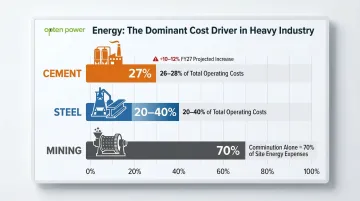
- Cement: Power and fuel represent 26–28% of total OPEX, with projected increases of 10–12% in FY27 due to crude and petcoke volatility
- Steel: Energy accounts for 20–40% of production costs depending on route and raw material quality
- Mining: Comminution alone consumes nearly 70% of total operating expenses
Even a modest tariff reduction — say, ₹1/kWh on a 50 MW load — translates to ₹4–5 crore in annual savings. At that scale, energy procurement stops being a utility function and becomes a margin lever.
The LCOE Advantage
Renewable technology costs have fallen dramatically. IRENA's 2024 report puts India's utility-scale solar LCOE at roughly ₹3.20/kWh ($0.038/kWh), while onshore wind averages ₹2.85/kWh ($0.034/kWh) globally. Both figures sit well below prevailing DISCOM grid tariffs for C&I consumers across most Indian states.
Regulatory and Investor Pressure
Mining and manufacturing companies face mounting scrutiny on Scope 2 emissions. SEBI's BRSR Core framework mandates "reasonable assurance" on Scope 1 & 2 emissions and renewable energy share for:
- Top 500 listed entities by FY 2025-26
- Top 1,000 entities by FY 2026-27
PPAs structured under open access generate RECs that satisfy BRSR disclosure requirements directly. Companies that cannot demonstrate auditable renewable procurement face both investor scrutiny and the risk of non-compliance penalties as reporting deadlines tighten.
Five Key Advantages PPAs Deliver to Industrial Energy Buyers
No Upfront Capital Expenditure
The developer assumes all capital costs—plant construction, equipment procurement, land acquisition, and grid interconnection. In contrast, a self-owned 50 MW solar project requires hundreds of crores in upfront investment and ties up project finance teams for 2–3 years before generating a single unit.
Keeping renewable energy off your capital account preserves credit lines and financial flexibility for core operational investments—equipment upgrades, mine expansions, or new product lines.
Predictable, Stable Energy Costs
PPAs fix electricity tariffs for the contract duration, eliminating exposure to:
- Spot price spikes
- Fuel cost pass-throughs
- Regulatory surcharge revisions
DISCOM grid tariffs have risen steadily. For context:
- Maharashtra: HT-Industry energy charge is ₹8.36/kVAh for FY 2024-25
- Tamil Nadu: ₹7.50/kWh
- Karnataka: ₹8.00/kWh for HT-2b category
Over a 20-year PPA, even a ₹2/kWh difference between contracted and rising grid tariffs compounds significantly. For a facility consuming 10 million units annually, that's ₹20 crore in annual savings—₹400 crore over the contract life.
Scalability and Operational Flexibility
PPAs scale with operational demand. Capacity can be added through new agreements or volume amendments without building additional on-site assets—critical for mines expanding operations or manufacturing plants adding shifts.
Holding simultaneous PPAs for solar, wind, and hybrid assets across multiple states reduces dependence on any single technology or geography. Wind complements solar's daytime peak with consistent generation suited to base load 24x7 operations—smoothing seasonal variability without new on-site infrastructure.
Risk Transfer to the Developer
The developer bears:
- Construction execution and commissioning risk
- Technology selection and equipment obsolescence
- Ongoing O&M and performance guarantees
- Insurance and force majeure events
Your primary residual risks are volume risk (if operations scale down) and grid curtailment—both mitigated through contract design.
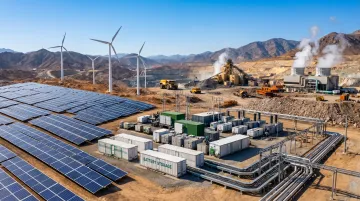
Real-world example: The Aggreko-Harmony Gold PPA for Eva Copper Mine in Australia is a 15-year agreement where Aggreko builds, owns, and operates a hybrid facility combining 118 MWp solar, 250 MWh battery storage, and 104 MVA thermal generation. The mine pays only for energy consumed, not for the facility.
Focus on Core Business Operations
With risk and capital sitting on the developer's books, your teams stay focused on what drives revenue. Outsourcing power generation to a specialist IPP frees engineering resources and management time for ore extraction, processing efficiency, and product quality—activities where your competitive edge actually lies.
The Financial Logic: Cost Savings and Capital Efficiency Through PPAs
Quantifying the Cost Opportunity
Opten Power's platform data shows industrial buyers can reduce energy costs by up to 40% through well-structured corporate PPAs. The savings vary significantly by state, driven by open access regulations, wheeling charges, and cross-subsidy surcharges.
State-by-State Landed Cost Analysis
The net economics of a PPA depend on state-specific open access regulations and charge structures:
| State | Grid Tariff (Energy Charge) | Key Open Access Charges | Estimated Landed PPA Cost |
|---|---|---|---|
| Maharashtra | ₹8.36/kVAh | Wheeling ₹0.80/kWh (HT) | ₹4.50–₹5.50/kWh |
| Tamil Nadu | ₹7.50/kWh | Wheeling ₹1.04/kWh, CSS ₹1.92/kWh | ₹5.00–₹6.00/kWh |
| Karnataka | ₹8.00/kWh | AS ₹0.40/kWh (halved from ₹0.82) | ₹4.00–₹5.00/kWh |
| Gujarat | ₹4.02/kWh (effective) | AS ₹0.93/kWh | ₹3.50–₹4.50/kWh |
Savings calculation: A well-structured group-captive PPA at ₹3.50–₹5.00/kWh effective landed cost represents 30–40% savings for large C&I consumers compared to grid tariffs.
Fixed Tariffs as an Inflation Hedge
As grid tariffs climb over the contract duration, your PPA rate stays fixed—so your savings position widens each year rather than eroding. CRISIL projects that power and fuel costs for Indian cement makers will rise 10–12% in FY27 alone due to geopolitical shocks. For sectors like steel or cement—where energy is 25–35% of operating costs—that compounding gap between locked PPA rates and rising grid tariffs can be the difference between margin protection and margin compression.
Risk-Adjusted Return Comparison
The savings number alone doesn't capture the full picture. Factor in risk, and the PPA case strengthens further:
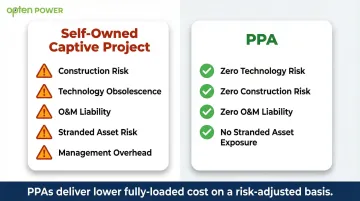
Self-Owned Captive Project:
- Construction risk
- Technology obsolescence
- O&M liability
- Stranded asset risk
- Management overhead
PPA:
- Zero technology risk
- Zero construction risk
- Zero O&M liability
- No stranded asset exposure
When you add financing costs, O&M, and management overhead to a self-owned plant's nominal tariff, PPAs routinely come out cheaper on a fully-loaded basis—not just on paper.
Opten Power's platform lets you run IRR, payback, and savings projections across multiple developers and technologies in real time, so procurement decisions rest on comparable data rather than a single developer's pitch.
PPAs and Decarbonization: What Real-World Mining Deals Have Achieved
Global Mining PPA Success Stories
Antofagasta (Chile)
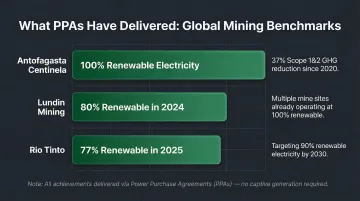
Antofagasta's Centinela mine reached 100% renewable electricity through supply contracts, cutting Scope 1 and 2 emissions by 37% since 2020. That scale of reduction — in under five years — shows what structured procurement can achieve.
Lundin Mining
Lundin grew its renewable electricity share from 74% to 80% in 2024. Several mines — including Candelaria, Caserones, and Zinkgruvan — accessed 100% renewable electrical energy via PPAs, without owning any generation assets.
Rio Tinto
Rio Tinto sourced 77% of global electricity from renewables in 2025, with a 90% target by 2030. The strategy combines VPPAs and supply agreements — no captive generation required.
The Indian Context
These global outcomes translate directly to Indian industrial operations facing their own compliance and cost pressures. PPAs enable Indian industrial buyers to:
- Credibly report renewable energy sourcing under SEBI BRSR disclosures
- Meet Renewable Purchase Obligation (RPO) requirements
- Respond to ESG due diligence from export customers and international financiers
- Build a verifiable decarbonization track record
RECs generated under open access PPAs are accepted for compliance reporting, providing regulatory and commercial value beyond energy cost savings.
Why 2026 Is the Right Time to Lock In a PPA in India
Rising PPA Prices
Global PPA prices are experiencing upward pressure. LevelTen Energy reports that North American solar PPA prices rose nearly 9% year-over-year in 2025, driven by surging demand from data centers, industrial electrification, and AI infrastructure.
While India's tariff dynamics differ, supply-demand tightening in the renewable developer market—as India races toward its 500 GW non-fossil target by 2030—will push PPA tariffs higher over the next 2–3 years. Locking in now protects against escalation that could add ₹0.30–0.50/kWh to procurement costs over a 10-year contract.
Current Enabling Environment in India
Open access regulations in most states allow C&I consumers above threshold loads to procure power from third-party generators. Group captive structures offer additional tax and regulatory advantages, including exemptions from cross-subsidy surcharges (CSS) and additional surcharges (AS).
Two recent policy shifts illustrate how quickly this environment can change:
- Karnataka halved additional surcharge to ₹0.40/kWh for FY 2026
- Tamil Nadu introduced explicit 8% banking charge in kind for renewable open access
Locking in group-captive PPAs now captures favorable regulatory structures before further banking restrictions or surcharge hikes are implemented.
What to Evaluate Before Signing
Before committing to a PPA, assess:
- Tariff structure — Clarify whether the contract uses fixed, escalated, or hybrid pricing
- Contract tenor — Match the term to your operational life and capital planning horizon
- Curtailment risk — Verify grid availability and historical downtime at the project location
- DISCOM timelines — Factor in banking and wheeling approval delays for your state
- Developer track record — Review financial health and long-term O&M capabilities
- Exit provisions — Confirm force majeure clauses and early termination conditions
How Opten Power Handles This Complexity
Each of those six factors requires data, state-specific expertise, and developer access that most procurement teams don't have in-house. Opten Power's marketplace covers all of it:
- Access to 4+ GW of pre-vetted solar, wind, and hybrid projects across 16 states
- Real-time DISCOM intelligence with standardized, updated landing prices across all states
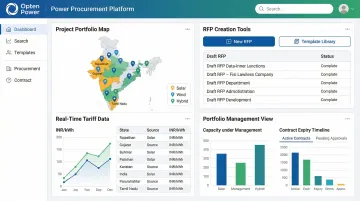
- Automated RFP creation tools enabling comparable proposals without weeks of manual work
- Portfolio management dashboard monitoring all renewable energy commitments in one place
The result: deal closure up to 50% faster than traditional procurement routes, without sacrificing due diligence.
Frequently Asked Questions
What is the renewable energy forecast for 2025?
According to IRENA's 2026 Renewable Capacity Highlights, global capacity grew by 692 GW (+15.5%) in 2025 to reach 5,149 GW, with solar contributing ~511 GW. Despite falling LCOE, PPA prices rose as demand outpaced new supply in key markets.
What is a Power Purchase Agreement (PPA) and how does it work for industrial buyers?
A PPA is a long-term contract between an industrial buyer and a renewable energy developer. The developer builds and operates the facility; the buyer pays a fixed tariff per unit of electricity consumed—with no capital investment required.
How does a PPA reduce financial risk compared to owning a renewable energy asset?
The developer bears construction, technology, O&M, and performance risk. The buyer's exposure is limited to volume risk and state-level grid/open access policy changes, both manageable through contract design.
What is the difference between a physical PPA and a virtual PPA (VPPA)?
A physical PPA involves actual energy delivery to your facility via open access or captive routes (dominant in India). A VPPA is a financial contract for differences where you receive RECs and financial settlements but not physical energy — more common in the US and Europe.
Why are renewable PPA prices expected to rise in 2026?
Rising electricity demand from industrial electrification, AI data centres, and infrastructure growth — combined with supply chain constraints and policy uncertainty — is pushing PPA tariffs upward globally. Buyers who lock in contracts now face significantly lower rates than those procuring in 12–18 months.
What is the typical duration of a renewable energy PPA contract for mining or heavy industry?
Standard PPA tenors range from 15 to 25 years, with 20 years common in India's open access market. The long duration provides price certainty matching mine life cycles and factory depreciation horizons.