Introduction: Why Open Access Solar Is a Game-Changer for Indian Businesses
Introduction: How Open Access Solar Cuts Costs and Advances India's Clean Energy Goals
India has committed to 500 GW of non-fossil fuel capacity by 2030, yet commercial and industrial (C&I) consumers still pay some of the highest electricity tariffs in the world. Cross-subsidy mechanisms shift costs onto C&I buyers to offset subsidised agricultural and residential rates — pushing Indian industrial power prices above those in many developed economies.
Open access solar directly addresses this burden. It gives eligible businesses the legal right to source renewable electricity from independent generators via the grid — bypassing default utility supply and capturing meaningful cost savings in the process. This article explains how open access solar advances both enterprise profitability and India's national clean energy targets.
Key Takeaways
- Open access solar lets C&I consumers procure solar power directly from generators, bypassing DISCOM supply
- Supports India's 500 GW target by driving private investment in renewable capacity
- Cuts electricity costs by up to 40%, reduces carbon footprint, and gives buyers direct procurement control
- Requires navigating state-specific charges and approval timelines
What Is Open Access Solar Power in India?
Under Section 42 of the Electricity Act, 2003, open access is the non-discriminatory right to use transmission and distribution networks to wheel electricity from a generator to a consumer. Solar open access allows buyers to source renewable power at competitive rates, outside standard DISCOM tariffs.
Captive vs. Third-Party Open Access
Two primary models exist:
- Captive open access — The consumer holds equity in the generation project and is legally exempt from cross-subsidy surcharges
- Third-party open access — Energy is purchased from an independent solar developer via a power purchase agreement (PPA) or exchange, subject to applicable surcharges unless specifically exempted
Most C&I consumers prefer third-party open access for faster implementation and flexibility, since captive projects require equity participation and longer lead times.
Short-Term vs. Long-Term Open Access
- Short-term open access (STOA) — Approved for up to one month, this route works well for spot purchases via power exchanges, with the State Load Despatch Centre (SLDC) as the nodal agency
- Long-term open access (LTOA) — Contracts exceeding 12 years (up to 25 years), typically used for corporate PPAs; applications are processed by the State Transmission Utility or Central Transmission Utility
Longer contract terms generally yield better per-unit rates, though they involve a more extensive regulatory approval process.
Typical application process:
- Consumer or developer applies to the SLDC or Regional Load Despatch Centre
- Approvals are granted subject to corridor capacity availability
- Power is wheeled through transmission or distribution networks to the consumer's premises
Eligibility threshold: Historically set at 1 MW minimum contract demand, the Green Energy Open Access Rules, 2022 lowered this to 100 kW for green energy open access, making it accessible to medium-sized industrial and commercial consumers.
How Open Access Solar Advances India's Clean Energy Policy Goals
India's official target is 500 GW of non-fossil capacity by 2030. As of November 2025, the country had reached 262.74 GW — 51.5% of total installed electricity capacity. Open access solar is a direct contributor to that trajectory, with India adding 7.8 GW of solar open access capacity in 2025 alone, bringing cumulative installed solar open access capacity to over 30 GW. Unlike state procurement, this capacity addition is driven by private capital.
Enabling Renewable Purchase Obligation Compliance
Renewable Purchase Obligations (RPOs) mandate that distribution companies and certain large consumers procure a defined percentage of their electricity from renewable sources. The Ministry of Power's October 2023 notification mandates RPO targets starting at 29.91% for FY2024-25, escalating to 43.33% by FY2029-30.
Open access solar procurement counts toward RPO compliance for obligated entities, making it a direct policy lever for meeting national renewable targets.
Decentralizing Clean Energy Procurement
Open access solar shifts the role of clean energy buyer from the utility to the C&I consumer. This decentralizes energy procurement decisions, diversifies India's renewable capacity pipeline, and reduces the burden on state-level tenders alone.
Supporting the Green Energy Open Access Rules, 2022
The Green Energy Open Access Rules, 2022 introduced critical reforms:
- Lowered eligibility threshold to 100 kW for green energy open access
- Mandated 15-day approval window for applications
- Permitted banking at least on a monthly basis (minimum 30% of total monthly consumption)
- Removed additional surcharge if fixed charges are being paid by the consumer
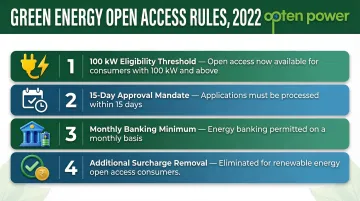
These reforms were designed to accelerate private renewable energy uptake — and together, they create a market-driven channel for clean capacity addition that works alongside government-tendered utility-scale projects.
The Business Case: Benefits for Commercial and Industrial Consumers
Cost Savings Against Grid Tariffs
According to Mercom India's Q4 2025 report, the net landed open access cost across states ranged from ₹8.4/kWh to as low as ₹5/kWh. This compares favourably to grid tariffs, which remain elevated due to cross-subsidy structures.
Hedging Against Tariff Escalation
Long-term open access PPAs (typically 15–25 years) lock in the cost of solar generation, insulating businesses from:
- Annual DISCOM tariff revisions
- Fuel-cost volatility
- Cross-subsidy surcharge escalations
For energy-intensive industries, that cost certainty is as valuable as any green credential.
Carbon Footprint Reduction and ESG Commitments
Procuring verified renewable electricity through open access gives C&I buyers a direct path to measurable emissions reductions. Specifically, it enables:
- Scope 2 reporting under GHG Protocol standards
- Progress toward RE100 commitments
- Customer-facing ESG disclosures for export-oriented and multinational-linked supply chains
The RE100 2023 Annual Disclosure Report notes that Power Purchase Agreements now deliver 35% of the volume of renewable electricity procured by RE100 members globally.
Streamlined Procurement and Deal Closure
Platforms like Opten Power allow C&I buyers to compare solar PPA tariffs, ROI, and savings projections across multiple developers in real time. Features include:
- Real-time DISCOM intelligence with standardized landing prices across all states
- Automated tender engine with modular RFP templates for structured bid collection
- Pre-approved contract templates that reduce negotiation friction
- Portfolio management dashboards for unified visibility across all renewable energy investments
These capabilities can reduce deal timelines by up to 50%, making open access procurement faster and more transparent.
Understanding the Open Access Regulatory Framework
Key Charges to Factor Into the Cost Model
| Charge Component | Description |
|---|---|
| Wheeling Charges | Fee for using the distribution network to transport electricity |
| Cross-Subsidy Surcharge (CSS) | Capped at 20% of applicable tariff; exempt for captive generation |
| Additional Surcharge (AS) | Covers fixed costs of DISCOM; not applicable under GEOA 2022 if fixed charges are paid |
| Banking Charges | Adjusted in kind at 8% of energy banked (varies by state) |
| Transmission Losses | Energy lost during transmission; varies by network distance and quality |
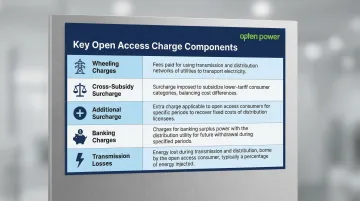
These charges vary significantly by state and can materially affect project economics. Because SERCs set the rules differently in each jurisdiction, buyers must evaluate state-specific tariff orders before committing to any open access structure.
State-Level Variability and the Role of SERCs
Open access is regulated at the state level by State Electricity Regulatory Commissions (SERCs). This means applicable charges, banking periods, approval procedures, and eligible consumer categories differ across states.
Business-friendly states:
- Chhattisgarh — Lowest open access charges; banking charges at just 2% in kind
- Karnataka — Led India in solar open access installations in 2025, accounting for 24% of new capacity
Restrictive states:
- Telangana — Imposes one of the highest CSS rates at ₹1.42/kWh, severely impacting third-party viability
The Role of DISCOMs in the Process
As the entity that wheels power to the consumer's premises, the DISCOM collects wheeling and other charges. Beyond charge collection, DISCOMs frequently introduce procedural friction that affects timelines and costs:
- Delayed approvals for open access applications
- Inconsistent application of charges across billing cycles
- Slow processing of connectivity and metering requests
- Limited transparency on current landing prices
Understanding DISCOM behavior in each state is as important as understanding the tariff structure itself. Opten Power tracks live DISCOM data across 16 states, giving buyers a clear picture of actual landing prices before they sign a PPA.
Key Challenges in Open Access Solar Adoption and How to Overcome Them
Approval Delays
Despite the Green Energy Open Access Rules, 2022 mandate for 15-day approvals, implementation varies significantly. States like Maharashtra and Uttar Pradesh can take twice as long (30 days) due to administrative inefficiencies and DISCOM reluctance.
How to handle it: Engage experienced developers or platforms that track real-time approval status and maintain relationships with nodal agencies.
Transaction Costs and Complexity
Identifying the right developer, negotiating bankable PPA terms, and conducting due diligence on project viability are significant transaction costs for first-time open access buyers.
The workaround: Centralized marketplaces that aggregate pre-approved projects with standardized RFP and contract templates cut deal timelines and reduce paperwork overhead. Platforms like Opten Power use an automated tender engine with pre-approved contract templates to speed up and standardize the procurement process.
Curtailment and Grid-Balancing Risks
In high-renewable penetration states like Rajasthan, transmission congestion and limited grid evacuation capacity remain key bottlenecks. Curtailment risks and delays in transmission infrastructure slowed project commissioning in Q4 2025.
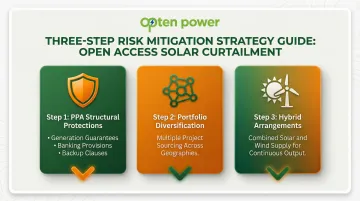
Risk mitigation: Structural protections in PPAs go a long way here:
- Include generation guarantees, banking provisions, and backup tariff clauses
- Diversify procurement across multiple projects to avoid single-source exposure
- Consider hybrid (solar + wind) arrangements for more consistent supply reliability
Frequently Asked Questions
What is open access solar power and who is eligible for it in India?
Open access solar allows eligible electricity consumers to procure solar power directly from generators through the grid network, bypassing default utility supply. Under the Green Energy Open Access Rules, 2022, eligibility starts at 100 kW connected load or contract demand.
How does open access solar help businesses meet their Renewable Purchase Obligation?
Open access solar from certified renewable sources generates Renewable Energy Certificates or counts directly toward RPO compliance. This reduces the risk of non-compliance penalties imposed by SERCs for obligated entities.
What are the main charges that affect the cost of open access solar?
The key charges are wheeling charges, cross-subsidy surcharge, additional surcharge (waived if fixed charges are paid), transmission losses, and banking charges. These vary by state and must be evaluated carefully against grid tariff savings.
Which Indian states currently have the most business-friendly open access solar policies?
Chhattisgarh has the lowest transmission and wheeling charges with just 2% banking charges. Karnataka and Maharashtra remain top markets by volume due to established frameworks, though regulatory adjustments continue.
How long does it take to get open access solar approval in India?
The Green Energy Open Access Rules, 2022 mandate approvals within 15 days for eligible applications. However, actual timelines vary by state; long-term open access approvals may take longer and depend on available corridor capacity and administrative efficiency.
What is the difference between open access solar and rooftop solar for industrial consumers?
Rooftop solar generates power on-site, limited by roof area and requiring capital expenditure or a lease arrangement. Open access solar sources utility-scale power from remote projects via the grid, making it better suited for large consumers whose demand far exceeds rooftop capacity.