Introduction
Solar open access in Madhya Pradesh lets commercial and industrial consumers procure power directly from solar generators through the distribution network, bypassing traditional DISCOM supply. For businesses facing HT tariffs that climbed to ₹8.30/kWh in FY 2026-27, the numbers are straightforward: group captive solar lands at ₹3.60–₹4.50/kWh, generating net savings of ₹2.50–₹3.00 per unit.
Yet most energy managers in MP struggle with the operational details: Which billing scenario applies to their facility? How does the February 2026 6th Amendment change surcharge liability? What exactly triggers the ₹1.18/kWh additional surcharge — and when is it waived?
This guide clarifies the mechanics — eligibility thresholds, charge structures, demand declaration requirements, and the three distinct billing scenarios introduced by MPERC's latest amendments — so you can evaluate whether solar open access fits your load profile and cost structure.
Key Takeaways
- Eligible C&I consumers (1 MW+ contracted demand) in MP can source solar power from third-party or captive generators at ₹3.60–₹4.50/kWh, compared to ₹8.30/kWh under the standard HT tariff
- MPERC's 6th Amendment (January 2026) requires upfront demand declaration: within, above, or hybrid relative to contract demand
- Open access within contract demand avoids the ₹1.18/kWh additional surcharge and technical feasibility checks
- Landed cost adds ₹2.12–₹2.64/kWh in charges (transmission, wheeling, cross-subsidy surcharge) on top of the generation tariff
- Facilities with high daytime loads and 500,000+ units/month consumption see the strongest ROI
What Is Solar Open Access in Madhya Pradesh?
Intra-state solar open access is the regulatory right of eligible consumers to use the DISCOM or transmission network to wheel power purchased from a renewable generator. This right is governed by the MPERC (Terms and Conditions for Intra-State Open Access in Madhya Pradesh) Regulations, 2021.
Eligibility threshold: Consumers with a contracted demand of 1 MW and above qualify for third-party open access. The 1 MW minimum does not apply to captive generating plants established for own use.
Captive vs. third-party distinction:
- Third-party open access: Power is procured via a PPA from an independent generator; subject to both cross-subsidy surcharge (CSS) and additional surcharge (AS)
- Captive generation: Consumer owns or co-owns the solar plant (minimum 26% equity); exempt from additional surcharge, reducing per-unit landed cost significantly for large consumers
Both models use the same network and metering infrastructure. The choice between them comes down to your willingness to hold equity — captive structures offer lower per-unit costs, while third-party PPAs require less capital commitment upfront.
Why C&I Businesses in MP Are Adopting Solar Open Access
Tariff arbitrage has widened dramatically
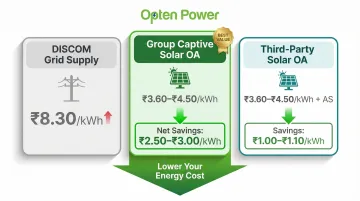
The MPERC Retail Supply Tariff Order for FY 2026-27 pushed the HV-3.1 Industrial Average Billing Rate to ₹8.30/kWh. Group captive solar PPAs in MP now land at ₹3.60–₹4.50/kWh all-in, creating a ₹2.50–₹3.00/kWh net savings opportunity after accounting for wheeling, CSS, and transmission charges.
Illustrative cost comparison (HV-3.1 Industrial consumer, 33 kV):
| Procurement Model | Effective Tariff (₹/kWh) | Net Savings (₹/kWh) |
|---|---|---|
| DISCOM Grid Supply | ₹8.30 | Base |
| Group Captive Solar OA | ₹3.60 – ₹4.50 | ₹2.50 – ₹3.00 |
| Third-Party Solar OA | ₹3.60 – ₹4.50 + AS | ₹1.00 – ₹1.10 |
Long-term price certainty and ESG alignment
Industries with energy-intensive operations — steel, cement, textiles, manufacturing — face tariff revision cycles every year. Open access PPAs lock in pricing for 15–25 years, insulating budgets from grid tariff inflation.
On the compliance side, MP's transition to the national Renewable Consumption Obligation (RCO) framework mandates that obligated entities source 35.95% of total energy from renewables in FY 2026-27. Open access solar directly satisfies RCO compliance and supports corporate ESG commitments — two priorities resolved through a single procurement decision.
Policy stability signals long-term viability
MPERC has issued six amendments to its open access regulations, progressively refining billing, metering, and surcharge rules. The latest 6th Amendment (January 2026) standardized demand declaration and energy adjustment protocols, reducing ambiguity for long-term procurement decisions.
As of March 2025, Madhya Pradesh ranks 8th nationally for open access solar capacity with 841.6 MW installed, driven primarily by manufacturing and steel sectors.
How the MP Open Access Process Works
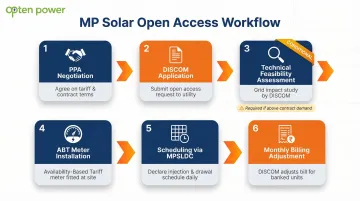
High-level workflow:
- Consumer identifies solar developer and negotiates PPA
- Applies to DISCOM/SLDC for open access approval
- DISCOM conducts technical feasibility assessment (if required)
- ABT meter installed at consumer premises
- Generator schedules injection via MPSLDC; energy settled in 15-minute blocks
- Monthly billing adjusts open access energy against DISCOM supply
Step 1: Developer Identification and PPA Negotiation
Issue an RFP to shortlisted solar developers, evaluate tariff proposals, capacity, contract tenure, and execute a PPA. C&I consumers in MP can use platforms like Opten Power to compare live project tariffs, developer credentials, and savings across 4+ GW of capacity, with automated RFP tools and pre-approved contract templates to speed up the process.
Step 2: Open Access Application and Feasibility Assessment
Submit formal application to your zone's DISCOM (MPEZ, MPMKVCL, or MPWZ). Required documents include:
- Load profile and consumption history
- Contract demand proof
- Signed PPA copy
- Technical details of generating plant
Critical: For open access above contract demand, a technical feasibility assessment at the drawal end is mandatory, evaluating total feeder load and network capacity. Open access within contract demand bypasses this check, cutting approval time.
Step 3: Scheduling, Injection, and Energy Settlement
Once approved, the generator schedules injection through MPSLDC per the MP Electricity Forecasting and Scheduling Regulations, 2018. Energy is settled in 15-minute time blocks after accounting for transmission and distribution losses.
Key metering and reporting requirements:
- ABT meters must be installed and comply with Central Electricity Authority Metering Regulations, 2006
- DISCOM reports renewable energy credits in 15-minute blocks to MPSLDC weekly
- Deviations are settled under the MP Electricity Balancing and Settlement Code, 2023
Open Access Charges in Madhya Pradesh: A Complete Breakdown
Your landed cost of solar open access equals PPA tariff plus network charges and surcharges. Here's the FY 2026-27 schedule:
| Charge Component | Rate (FY 2026-27) | Source |
|---|---|---|
| Transmission Charge (Intra-State) | ₹0.46/kWh (STOA) or ₹21.29 Lakhs/MW/Annum (LTOA) | MPPTCL MYT Order |
| Wheeling Charge (33 kV) | ₹0.17/kWh | MPERC Retail Tariff Order FY27 |
| Wheeling Charge (11 kV) | ₹0.69/kWh | MPERC Retail Tariff Order FY27 |
| Cross-Subsidy Surcharge (CSS) | ₹1.49/kWh | MPERC Retail Tariff Order FY27 |
| Additional Surcharge (AS) | ₹1.18/kWh | MPERC Retail Tariff Order FY27 |
Additional levies:
- SLDC Fees: ₹1,00,000 one-time (LTOA) or ₹5,000 (STOA); annual charge of ₹6,647.56/MW; scheduling fee of ₹1,000/transaction/day
- Reactive Energy Charge: 5.75 paise/kVARh, with a power factor penalty if PF drops below 0.90
The cross-subsidy surcharge is the largest variable cost at ₹1.49/kWh. The additional surcharge of ₹1.18/kWh applies only to third-party open access above contract demand; captive consumers and all open access within contract demand are exempt.
What MP's 6th Amendment Changed: The Three Billing Scenarios
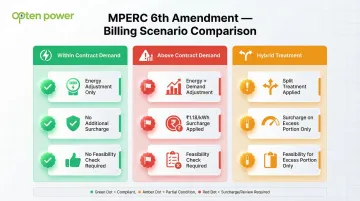
The 6th Amendment (January 2026) introduced a structured demand declaration framework. Consumers must now specify upfront whether they want open access within, above, or as a combination of their contract demand.
| Billing Scenario | Energy Adjustment | Demand Adjustment | Additional Surcharge | Technical Feasibility Required |
|---|---|---|---|---|
| Within Contract Demand | 15-min blocks | No adjustment | Waived | No |
| Above Contract Demand | 15-min blocks | 15-min blocks | ₹1.18/kWh (except captive) | Yes |
| Hybrid (Within + Above) | 15-min blocks | Only for excess portion | ₹1.18/kWh on excess only | Yes (for excess portion) |
Scenario 1 — Within Contract Demand:
Only energy is adjusted in the billing meter — no demand adjustment, no surcharge, and no technical feasibility clearance. For C&I consumers looking to minimise cost and approval time, this is the most straightforward path into open access.
Scenario 2 — Above Contract Demand:
Both energy and demand are adjusted in 15-minute blocks, and a technical feasibility assessment is mandatory before approval. The ₹1.18/kWh additional surcharge applies — unless you qualify as a captive consumer. Any demand exceeding the combined contract and open access quantum is billed at the DISCOM retail tariff.
Scenario 3 — Hybrid:
The hybrid scenario splits treatment by band: the within-contract portion gets energy-only adjustment with no surcharge, while the above-contract portion attracts both demand adjustment and the ₹1.18/kWh levy. Separate metering and settlement tracks are maintained for each portion.
Understanding which scenario applies to your load profile determines both your cost exposure and your approval timeline. Act on this before your next billing cycle.
Compliance action: MPERC applied this framework retroactively to all existing open access consumers. If you have an active open access arrangement in MP, realign your demand declaration with your DISCOM now to comply with the new billing regime.
Common Misconceptions and When Solar Open Access in MP May Not Be the Right Fit
Misconception 1: Open access eliminates all DISCOM charges
False. CSS (₹1.49/kWh), wheeling (₹0.17–₹0.69/kWh), and transmission charges (₹0.46/kWh) still apply. If your PPA tariff isn't competitive, these network charges can erode savings entirely.
Misconception 2: Approval is automatic and fast
Reality: Feasibility assessment, ABT meter installation, and SLDC coordination can add weeks to months. For open access above contract demand, feeder-level congestion can trigger outright rejection, as seen in the JK Minerals APTEL case (Appeal 375/2019), where technical unfeasibility on a 33 kV feeder led to years of litigation.
Misconception 3: Additional surcharge always applies
Under the 6th Amendment, AS is waived for open access within contract demand and for captive consumers entirely. This materially changes the economics of demand structuring.
Not every C&I consumer benefits equally. Here's when open access is likely to fall short:
When open access may not deliver sufficient ROI:
- Demand below 1 MW threshold (ineligible for third-party OA)
- Highly variable or low load factors — solar only generates during daylight, so mismatch risk is high; standalone solar typically offsets only 30–35% of 24/7 facility load
- Areas with grid congestion where feeder-level feasibility may be rejected
- Short operational timelines that can't justify 15–25 year PPA lock-in
Opten Power's real-time IRR, payback, and regulatory analysis tools help C&I businesses in MP model these scenarios before committing to a PPA, so you enter the approval process with a clear view of net economics.
Frequently Asked Questions
What are the open access charges in Madhya Pradesh?
Open access consumers in MP pay transmission charges (₹0.46/kWh), wheeling charges (₹0.17–₹0.69/kWh by voltage level), cross-subsidy surcharge (₹1.49/kWh), and — where applicable — an additional surcharge (₹1.18/kWh). The 6th Amendment waived AS for open access within contract demand and for captive consumers.
How much subsidy on solar panels in MP?
Subsidies on solar panels in MP apply only to residential rooftop solar under the PM Surya Ghar scheme (up to ₹78,000 for systems 3 kW+). C&I open access procurement is a commercial transaction with no direct panel subsidies — savings come from tariff arbitrage, not capital grants.
What is the minimum load requirement for solar open access in Madhya Pradesh?
Consumers must have a contracted demand of 1 MW and above to qualify for third-party or group-captive open access. The 1 MW threshold does not apply if you're setting up a pure captive generating plant for your own use.
What is the difference between open access within and above contract demand in MP?
Within contract demand: you draw solar power up to your sanctioned load with energy adjustment only — no additional surcharge applies. Above contract demand requires technical feasibility clearance, attracts ₹1.18/kWh additional surcharge (except for captive), and triggers both energy and demand adjustment in billing.
Are captive power consumers exempt from the additional surcharge under MP open access?
Yes. Captive generating plant consumers are exempt from the ₹1.18/kWh additional surcharge under MPERC regulations, making the captive model financially advantageous for large industrial consumers who hold equity ownership — individually or through a group captive structure — in the generating plant.
How long does it take to get open access approval in Madhya Pradesh?
STOA approvals follow a fixed calendar: DISCOM consent by the 22nd, SLDC approval by the 27th. LTOA timelines are 30–90 days depending on technical feasibility and ABT meter installation — longer if above-contract-demand feeder clearance is needed.