Introduction
CFOs in energy-intensive industries face a pricing environment that resists reliable forecasting. In steel, energy constitutes 20-40% of total manufacturing costs. Data centres spend 60-70% of their operational budgets on electricity. Grid tariffs, open access charges, and Discom pricing shift constantly across states—industrial 11kV tariffs range from ₹3.85/kWh in Arunachal Pradesh to ₹11.74/kWh in Chhattisgarh, an ₹7.89/kWh spread that makes confident, fixed-price budgeting across states extremely difficult.
Most CFOs recognize energy as a major cost lever, yet few have the structured market intelligence to act on it proactively. Decisions end up reactive—built on outdated benchmarks or incomplete vendor comparisons. Procurement intelligence platforms change that, giving CFOs the visibility and speed to manage energy costs before costs manage them.
Key Takeaways
- Procurement intelligence platforms centralize real-time tariff, developer, and regulatory data for accurate benchmarking
- Automated RFP tools cut sourcing cycles from 40 days to 20 and reduce manual effort by up to 80%
- Portfolio dashboards let CFOs track energy investments, model IRR, and drive forward-looking budget decisions
- Fragmented market data and slow procurement cycles cause organizations to chronically overpay
- Platforms embedded into ongoing financial planning deliver measurably better cost outcomes than one-off sourcing tools
What Is a Procurement Intelligence Platform?
A procurement intelligence platform aggregates real-time market data, supplier offers, and regulatory pricing into a single interface so organizations can make faster, more informed buying decisions. In the context of energy procurement, this means three critical data streams — all in one place:
- Live tariff rates from current market offers across developers
- Developer capacity availability matched to your load profile
- State-level Discom charges updated in real time across jurisdictions
These platforms sit between a CFO's financial planning function and the sourcing/procurement team, acting as the intelligence layer that connects market reality to internal cost targets. That connection is what makes them useful to finance leadership: instead of waiting on a procurement team to compile quotes and regulatory data manually, CFOs get a consolidated view of actual landed costs before a decision reaches the table.
Key Advantages of Procurement Intelligence Platforms for CFOs
The three advantages below focus on measurable, operational impact: cost reduction, decision speed, and financial predictability—outcomes CFOs track in quarterly reviews. Each advantage represents a shift from reactive to proactive cost management, which is where real margin improvement happens.
Advantage 1: Real-Time Market Visibility Across Tariffs and Developers
Instead of relying on broker quotes or outdated benchmarks, CFOs get standardized, live pricing across multiple energy developers and Discom landing rates across states—all in one view. The platform creates this advantage by aggregating and normalizing data from power producers, state Discoms, and open access markets so comparisons are apples-to-apples.
Why this matters:
Pricing opacity is the single biggest reason industrial buyers overpay for energy. Without a market benchmark, any rate a developer quotes looks reasonable. Industrial consumers using open access solar can save up to ₹2/kWh, while commercial consumers can save up to ₹4/kWh compared to grid tariffs. Real-time intelligence eliminates that information asymmetry.
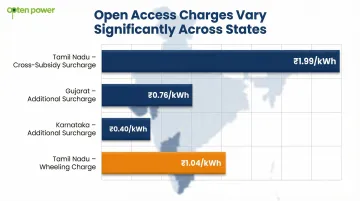
Open access charges vary dramatically across states, adding another layer of complexity:
| State | Charge Type | Rate (₹/kWh) |
|---|---|---|
| Tamil Nadu | Cross-Subsidy Surcharge (HT Industry) | 1.99 |
| Gujarat | Additional Surcharge | 0.76 |
| Karnataka | Additional Surcharge | 0.40 |
| Tamil Nadu | Wheeling Charge (HT Consumers) | 1.04 |
When live tariff data feeds directly into cost models, budget assumptions become more accurate and contract negotiations carry more weight. CFOs operating across multiple states gain the ability to compare true landed costs, not just headline tariff rates.
KPIs impacted:
- Energy cost per unit (₹/kWh)
- Procurement cycle time
- Negotiation savings vs. market benchmark
- Budget forecast accuracy
When the impact is highest:
Particularly high-impact for businesses operating across multiple states, where Discom rates and open access charges vary significantly. Also critical during contract renewal windows when locking in rates for 1–3 year terms. Platforms like Opten Power provide standardized Discom intelligence across 16 states, making continuous monitoring operationally feasible.
Advantage 2: Automated Sourcing That Compresses Decision Timelines
Procurement intelligence platforms replace manual RFP drafting, vendor outreach, and bid comparison with automated tender engines. These engines generate structured RFPs, distribute them to pre-qualified developers, and consolidate responses in a comparable format.
Modular RFP templates, pre-approved contract structures, and a developer marketplace mean a CFO's team can move from intent to shortlist in days rather than weeks. Organizations using formal procurement orchestration programs reduced their source-to-contract cycle time from 40 days to 20 days, with top performers reaching 15 days.
Why it matters:
Slow sourcing cycles are a hidden cost driver. When procurement takes months, organizations stay locked into existing tariffs longer than necessary, often at above-market rates. Speed directly translates to earlier cost savings realization.
The average RFP response consumes 20-40 hours of team time across multiple resources. Automation platforms drive 30-40% reductions in response times and up to 80% cuts in manual research and analysis effort. That administrative burden compounds across multiple energy contracts annually.
Longer decision windows also increase exposure to regulatory changes and tariff volatility. Automated sourcing reduces that window.
KPIs impacted:
- Time-to-contract
- Number of bids evaluated per sourcing event
- Procurement team capacity freed for strategic analysis
- Cost savings realization timeline
When the impact is highest:
Most valuable during peak procurement seasons, when multiple contracts are up for renewal simultaneously, or when an organization is expanding to new states and needs to quickly evaluate developer availability and pricing. Opten Power's platform covers 4+ GW of capacity across 16 states, meaning CFOs can access a ready marketplace rather than building a developer network from scratch.
Advantage 3: Portfolio-Level Financial Control and Forecasting
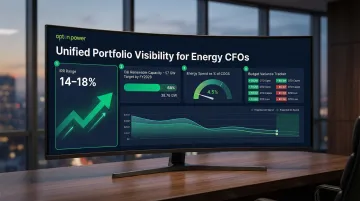
Rather than managing energy contracts as isolated line items, a procurement intelligence platform gives CFOs a unified dashboard that tracks all active and pipeline energy investments—including IRR, payback period, regulatory exposure, and spend vs. budget—in one place.
The platform connects procurement data (signed contracts, committed volumes, tariff rates) to financial modelling tools that automatically calculate returns and flag deviations. CFOs no longer have to reconcile scattered spreadsheets to understand their energy portfolio position.
Why it matters:
Energy cost management without portfolio visibility mirrors running a capex programme without a project tracker: individual contracts may look fine while the aggregate picture is deteriorating. Unified visibility allows early intervention.
As a proxy for the financial impact of poor energy cost visibility, 205 energy projects in India are currently facing cost overruns totalling ₹1.34 lakh crore. Without centralized monitoring, tariff escalations and regulatory changes accumulate quietly across contracts, surfacing only in budget reviews after the fact.
When IRR and payback data are automatically generated for each contract, CFOs can model the impact of adding new renewable capacity (Corporate PPAs, solar, wind) on overall energy cost and report to the board with confidence. The C&I segment is expected to see renewable energy capacity rise to 57 GW by fiscal 2028, with project IRRs currently ranging from 14–18%.
KPIs impacted:
- Energy spend as % of COGS
- IRR on energy investments
- Payback period accuracy
- Budget variance on energy line items
- Renewable vs. grid cost ratio
Who benefits most:
Critical for organizations with 24x7 operations (data centres, hospitals, process industries) where energy is a continuous, high-volume cost driver. Also essential when evaluating long-term Corporate PPAs where a 20-year IRR calculation needs to account for grid escalation, regulatory changes, and capacity factors.
What Happens When Procurement Intelligence Is Missing or Ignored
Without a procurement intelligence platform, industrial CFOs manage energy costs reactively. Benchmarking is informal, and decisions depend on whoever the procurement team last spoke to. The problem isn't effort — it's the absence of a system that surfaces the right data at the right time.
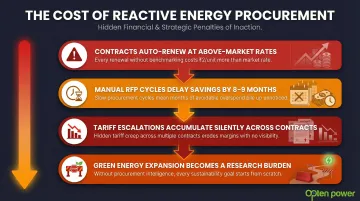
The consequences follow a predictable pattern:
- Contracts auto-renew at above-market rates with no benchmark to flag the gap. Exchange-procured power costs approximately ₹2 per unit less than industrial Discom tariffs in several states — a gap that goes unnoticed without real-time market data.
- Manual RFP processes stretch sourcing cycles by months, keeping organizations on expensive grid tariffs. PPA signing delays of 8–9 months after project award are common in India's renewable sector, compounding the cost of inaction.
- Tariff escalations, Discom charge revisions, and regulatory changes accumulate across contracts without anyone tracking them. They only surface during budget reviews — after the fact.
- Expanding a green energy portfolio without a platform that maps available capacity across states turns every procurement decision into a research project, slowing adoption and increasing execution risk.
How to Get the Most Value from a Procurement Intelligence Platform
A procurement intelligence platform delivers lasting value when it is embedded into the CFO's financial planning rhythm—used as a continuous intelligence layer, not a one-off sourcing exercise.
Three practices determine how much value you extract:
- Run every contract renewal, capacity evaluation, and tariff comparison through the platform so benchmarking becomes a standard financial discipline—not an occasional check.
- Validate existing contracts against real-time market data and flag renewals 6–12 months before expiry. Opten Power's live Discom intelligence covers landing prices across all states, making this continuous monitoring operationally feasible.
- Act on what the platform surfaces—renegotiate above-market contracts, accelerate renewable adoption where IRR justifies it, and consolidate sourcing across facilities to strengthen your negotiating position.
Conclusion
For CFOs in energy-intensive industries, procurement intelligence platforms are operational infrastructure for cost control, not an optional add-on. The advantages—market visibility, sourcing speed, portfolio oversight—compound over time when consistently applied.
The platforms shift energy procurement from a reactive, relationship-driven process to a data-driven financial discipline—and that shift is where the meaningful, sustained cost reduction happens.
India's energy market is growing more complex, not less. With over 37,558 applications for Green Energy Open Access approved and Corporate PPAs now mainstream, the procurement landscape demands structured decision-making.
During FY 2024-25, 35 different States/UTs issued tariff orders, making regulatory complexity a permanent feature CFOs must account for. Those who build procurement intelligence into their operating model will carry a structural cost advantage into every budget cycle.
Frequently Asked Questions
What strategies do you use to reduce procurement costs?
The most effective strategies combine real-time market benchmarking, competitive sourcing through structured RFPs, and portfolio-level monitoring to catch cost drift early. Centralizing spend data is the foundation—without it, benchmarking becomes guesswork and cost monitoring stays reactive.
How can AI help CFOs?
AI helps CFOs by automating repetitive tasks like RFP drafting and bid analysis, generating instant financial models (IRR, payback, regulatory impact), and surfacing patterns in spend data that manual review would miss. The net effect is faster, better-informed decisions with less team effort.
What is a procurement intelligence platform?
A procurement intelligence platform is a system that aggregates real-time market data, supplier offers, and regulatory pricing into a single interface to enable data-driven buying decisions. In energy procurement, this includes live tariff rates, developer capacity, and Discom charges across states.
How does a procurement intelligence platform reduce energy costs for industrial businesses?
It reduces energy costs by eliminating the information asymmetry that causes overpayment. When CFOs can compare live developer offers against benchmark tariffs instantly, they negotiate from a position of market knowledge rather than relying on a single quote, typically unlocking savings of ₹2-4/kWh.
What is a Corporate PPA and how does it help CFOs save on energy?
A Corporate PPA is a long-term contract (10–25 years) between an industrial buyer and a renewable energy developer that locks in below-market energy rates. Procurement intelligence platforms let CFOs compare offers across multiple developers in real time, identifying the best IRR and payback before signing.
How do CFOs measure ROI on a procurement intelligence platform?
ROI is measured through energy cost savings versus pre-platform benchmark rates, shorter procurement cycle times, and improved forecast accuracy on energy line items—with additional value accruing from avoided cost escalations caught through continuous monitoring.