Introduction
India's commercial and industrial electricity tariffs have risen steadily over the past decade, with large consumers in states like Maharashtra and Tamil Nadu now paying ₹8–10 per unit from the grid. For manufacturing plants, data centres, steel mills, and hospitals running round-the-clock operations, that cost compounds fast. Add tightening carbon disclosure requirements, and switching to solar has shifted from a cost-saving option to a business-critical decision.
At 1 MW and above, the margin for error shrinks considerably. A mismatched EPC partner or poorly structured PPA can mean months of commissioning delays, generation shortfalls, and regulatory headaches that cut into returns for years. This guide evaluates India's leading commercial solar companies for large-scale projects — covering their capabilities, track records, and what sets them apart for high-load industrial buyers.
Key Takeaways
- India's large commercial solar projects require developers with proven multi-MW capacity, DISCOM expertise, and solid O&M infrastructure
- Top companies include Adani Green Energy, ReNew Power, Tata Power Solar, Greenko Group, and Sterling and Wilson Renewable Energy
- Prioritize C&I track record, financing flexibility (PPA vs. CAPEX), state regulatory experience, and post-commissioning performance over brand name alone
- Group-Capex and corporate PPA models can deliver ₹3–5/unit savings with double-digit IRRs for medium-to-large industries
- Opten Power lets you compare developers across 4+ GW of capacity with instant IRR analysis and automated RFPs
Overview of Commercial Solar for Large Projects in India
In the Indian renewable energy landscape, a "large" commercial solar project typically begins at 1 MW and above. That scale demands far more than basic installation expertise.
Projects at this magnitude require developers with full EPC (Engineering, Procurement, and Construction) capability, deep experience in grid connectivity and open access approvals, and long-term O&M (Operations and Maintenance) infrastructure to sustain performance over 20-25 year lifespans.
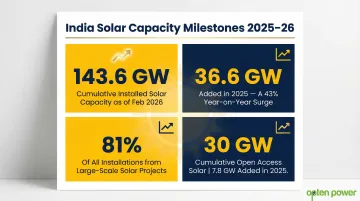
The scale of India's solar expansion makes this one of the most active procurement markets in the world. Key figures from 2025-26:
- India's cumulative installed solar capacity reached 143.6 GW as of February 2026
- Calendar year 2025 added a record 36.6 GW, a 43% jump over 2024
- Large-scale projects drove 81% of those installations; open-access additions accounted for 26%
- Cumulative open access solar capacity crossed 30 GW by December 2025, with 7.8 GW added during the year
Procurement Models for Large C&I Buyers:
Large buyers in India typically choose from three commercial structures:
- CAPEX (Own and Operate): Full equity deployment with debt financing, offering complete asset control, depreciation benefits, and strong returns for cash-rich enterprises
- OPEX/PPA (Power Purchase Agreement): Zero upfront capital; developer owns and operates the plant while buyer purchases power at pre-agreed tariffs (typically 15-25 years), ideal for businesses prioritizing off-balance-sheet solutions
- Open Access Solar: Buyer sources power from a solar plant connected to the state grid via transmission infrastructure, requiring DISCOM approvals and regulatory compliance but offering flexibility without on-site land requirements
Choosing between these models shapes every downstream decision, from developer selection to contract structure — which is why evaluating solar companies starts with understanding which model fits your financial profile.
Top Commercial Solar Companies for Large Projects in India
These companies were evaluated on total installed capacity, large-project execution experience, financing flexibility, regulatory expertise across Indian states, and verified post-commissioning performance.
Adani Green Energy
Background:
Adani Green Energy is India's largest renewable energy company and one of the world's biggest solar power producers. As of March 2025, AGEL reported an operational capacity of 14.2 GW with an additional committed capacity of 7.4 GW. The company is developing the world's largest single-location renewable plant at Khavda, Gujarat, targeting 30 GW.
Differentiators:
AGEL operates a vertically integrated model spanning development, construction, and long-term operation. Their access to low-cost capital enables competitive long-term PPAs for large C&I consumers. The company is strategically shifting 25% of capacity toward merchant, C&I, and Contract for Difference markets by 2030. Recently, they signed a 61.4 MW dedicated C&I agreement with Google for data center operations in India.
| Criteria | Details |
|---|---|
| Project Scale | Minimum C&I engagement typically 50–100 MW; portfolio includes multi-GW utility projects |
| Key Offering | IPP with long-term PPA; open access solar supply; merchant power options |
| Notable Strength | Largest solar capacity in India; pan-India state presence; strong DISCOM relationships |
ReNew Power
Background:
ReNew Power operates across 10 Indian states with a commissioned capacity of 11.4 GW (5.8 GW solar, 5.4 GW wind) as of November 2025. The company has a dedicated C&I portfolio of 3.1 GW (2.4 GW commissioned), making it one of India's leading Independent Power Producers for corporate buyers.
Differentiators:
ReNew pioneered hybrid and Round-The-Clock (RTC) renewable solutions critical for heavy industries requiring 24x7 power. Their flagship 1.3 GW RTC project integrates 900 MW wind, 400 MW solar, and 100 MWh battery storage, delivering firm power to industries that cannot rely on intermittent solar alone.
That said, tech giants Amazon, Microsoft, and Google account for approximately 48% of ReNew's contracted C&I offtake, meaning traditional industrial buyers must offer credible long-term commitments to secure allocation.
| Criteria | Details |
|---|---|
| Project Scale | Minimum C&I engagement typically 25–50 MW; total portfolio exceeds 11 GW |
| Key Offering | Corporate PPAs; hybrid energy solutions (solar+wind+storage); RTC power supply |
| Notable Strength | 24x7 renewable power capability through hybrid projects; strong C&I client base |
Tata Power Solar
Background:
Tata Power Solar operates as both an EPC contractor and a developer, having crossed 10 GW of cumulative EPC execution (9.7 GW solar, 290 MW wind) as of 2025. The company serves a broad spectrum of industrial verticals and benefits from the Tata Group's brand credibility in securing project financing.
Differentiators:
Tata Power Solar's dual role as EPC and developer offers flexibility for buyers choosing CAPEX or OPEX models. Their 4.3 GW solar cell and module manufacturing plant in Tamil Nadu insulates projects against ALMM List-II supply chain disruptions starting June 2026. Their established O&M network ensures long-term performance reliability, a prerequisite for bankable project execution.
| Criteria | Details |
|---|---|
| Project Scale | Handles projects from 1 MW rooftop to multi-hundred MW ground-mount installations |
| Key Offering | Turnkey EPC for ground-mount and rooftop; OPEX/PPA model for C&I customers |
| Notable Strength | In-house solar module manufacturing; Tata Group brand trust; comprehensive O&M support |
Greenko Group
Greenko Group operates over 10 GW of near-term operational capacity and is pioneering energy storage integration in India. Their flagship 1,680 MW Pinnapuram Pumped Hydro project in Andhra Pradesh is expected to commission by September 2025, making them one of the few developers offering fully dispatchable renewable power.
Greenko's unique strength lies in integrating Pumped Hydro Energy Storage (PHES) with solar and wind, delivering firm, Round-The-Clock power for industries with 24x7 operations like steel, cement, and data centres. They signed a 100 MW RTC agreement with Hindalco's Odisha smelter backed by 375–400 MW of solar/wind plus Pinnapuram hydro storage, and a 975 MW RTC project with ArcelorMittal.
| Criteria | Details |
|---|---|
| Project Scale | Typical C&I projects range from 100 MW to multi-hundred MW RTC solutions |
| Key Offering | Integrated solar + pumped hydro storage; long-term PPAs; firm/dispatchable renewable supply |
| Notable Strength | Energy storage integration for 24x7 supply; strong institutional backing; large project pipeline |
Sterling and Wilson Renewable Energy
Sterling and Wilson Renewable Energy (SWREL) is India's largest solar EPC company by executed capacity. As of 2025, they hold an EPC portfolio of 24.4 GWp with 11.6 GW commissioned and 12.8 GW under construction. India accounts for 84.5% of their focused order book.
SWREL's pure-play EPC strength makes them the premier choice for large buyers preferring to own their solar assets via the CAPEX model. They handle turnkey project execution from 1 MW C&I rooftops to multi-GW utility parks, including the 1,177 MWp Noor Abu Dhabi plant and a 300 MWac order for NTPC in Khavda. Post-commissioning, they manage a substantial O&M portfolio of 9.1 GWp.
| Criteria | Details |
|---|---|
| Project Scale | Projects range from 1 MW to multi-hundred MW ground-mount installations |
| Key Offering | Turnkey EPC for ground-mounted solar; international project capability; comprehensive O&M services |
| Notable Strength | India's largest solar EPC by executed capacity; strong project management for large CAPEX buyers |
How We Chose the Best Commercial Solar Companies
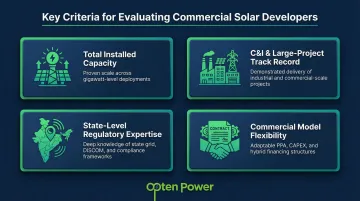
Our evaluation framework assessed companies on four critical dimensions. Each criterion reflects what actually separates capable large-project developers from those better suited to smaller deployments.
Total Installed Capacity: Developers needed multi-GW operational portfolios to qualify. Companies with less than 5 GW of commissioned capacity were excluded from consideration for large C&I projects.
C&I and Large-Project Track Record: We verified specific experience with commercial and industrial projects — not just residential or small rooftop — examining client verticals, project sizes, and contract structures. Developers with documented multi-MW C&I agreements received higher rankings.
State-Level Regulatory Expertise: India's regulatory landscape varies dramatically by state. We evaluated track records with DISCOM compliance, open access approvals, and navigation of state-specific banking rules. Karnataka's strict monthly banking cycle, Maharashtra's Time-of-Day restrictions, and Rajasthan's BESS mandates each require specialized knowledge.
Commercial Model Flexibility: The best developers support multiple procurement structures — CAPEX, PPA, Group-Capex, and open access — so buyers can choose based on financial strategy rather than developer limitations.
Understanding these criteria also exposes where procurement decisions tend to go wrong. Common mistakes large buyers make include:
- Choosing developers based on brand reputation alone without verifying their specific C&I or large-project track record
- Ignoring post-commissioning O&M quality, which directly impacts 20-25 year performance and ROI
- Not comparing tariffs across multiple developers before signing a PPA, leaving ₹0.50–₹1.00/unit on the table
- Failing to conduct granular load-matching analysis before sizing projects, especially given new state banking restrictions
Buyers who evaluate multiple developers simultaneously close deals faster. Opten Power's marketplace gives procurement teams real-time tariff comparisons, automated RFP templates, and IRR/payback analysis across pre-vetted developers — cutting the time from discovery to contract by up to 50%.
Conclusion
For large commercial solar projects in India, the choice of partner is a long-term strategic decision that will shape your energy costs and emissions obligations for two decades or more. The right company must align with your energy consumption profile, preferred commercial model (PPA vs. CAPEX vs. Group-Capex), state-specific regulatory requirements, and scalability needs as your operations grow.
When evaluating developers, look beyond upfront cost or brand reputation. The factors that matter most over a 20-25 year PPA are often invisible at the proposal stage:
- O&M track record across existing commissioned projects, not just pipeline claims
- Contract flexibility that accommodates changing business needs, load profiles, or ownership structures
- Financial stability of the developer — long-tenure PPAs require counterparties that will still be operating in year 15
- DISCOM approval experience in your specific state, particularly given tightening banking rules in Karnataka, Maharashtra, and Rajasthan
Comparing developers across these dimensions — tariffs, O&M terms, DISCOM track record, and contract structure — is time-intensive when done manually. Opten Power addresses this directly: the platform gives C&I buyers access to 4+ GW of pre-vetted solar, wind, and hybrid capacity across 16 states, with real-time tariff comparison, IRR and payback analysis, and standardized RFP tools that cut procurement timelines by up to 50%.
Frequently Asked Questions
What is the best solar system for commercial use?
For large commercial use in India, ground-mounted solar (either captive or open access) combined with a long-term PPA or CAPEX model typically delivers the best ROI. The optimal choice depends on your load profile, land availability, and financial preferences—cash-rich manufacturers often prefer CAPEX for asset control, while businesses prioritizing off-balance-sheet solutions choose PPAs.
What is the minimum project size for commercial solar in India?
While rooftop solar can start at a few kW, large commercial and industrial solar projects typically begin at 1 MW and above. For open access solar, the minimum contracted demand threshold was reduced to 100 kW under the Green Energy Open Access Rules, which has been adopted by major states including Karnataka, Maharashtra, and Rajasthan.
How does a Corporate PPA work for large solar projects in India?
A Corporate PPA is a long-term contract where a solar developer builds, owns, and operates the plant, and the buyer purchases power at a pre-agreed tariff—typically ₹2.50–4.50/unit, below grid rates—for 15–25 years. The buyer contributes zero upfront capital, and all O&M responsibility sits with the developer.
What certifications should a commercial solar developer have in India?
Look for MNRE empanelment, ALMM List-I compliant modules, and BIS-certified equipment meeting IS/IEC 61730:2023 standards. Also confirm ISO quality certifications and a track record of projects approved by state DISCOMs or SERCs for open access.
What is the difference between captive and open access solar for large industries?
Captive solar means the buyer owns or co-owns the plant, gaining maximum control and depreciation benefits but requiring upfront capital. Open access lets a buyer purchase power from a remote plant via the state grid—no land or capital required, but DISCOM approvals and wheeling/transmission charges apply.
How long does it take to commission a large commercial solar project in India?
For 1–10 MW projects, expect 6–12 months from contract signing to commissioning, depending on land availability, DISCOM approvals, and grid connectivity. Projects in the 1–5 MW range can close in 4–5 months when land and approvals are pre-secured—an experienced developer with existing state relationships cuts this timeline further.