Introduction
Indian Commercial and Industrial (C&I) businesses face mounting pressure to source renewable energy as Renewable Consumption Obligations (RCOs) climb to 33.01% for FY2026. Yet many lack the infrastructure or capital for direct physical renewable projects.
State-level open access charges make physical PPAs expensive to execute — in Maharashtra alone, combined wheeling and cross-subsidy surcharges add nearly ₹2.87 per unit to landed costs.
Virtual PPAs (VPPAs) are emerging as a regulatory-approved financial tool that lets companies claim green energy benefits without owning or receiving any physical power. In May 2025, CERC released Draft VPPA Guidelines that classify these contracts as Non-Transferable Specific Delivery (NTSD) instruments under CERC's jurisdiction, resolving a decade-long dispute with SEBI.
This guide covers:
- How VPPAs work and how they differ from physical PPAs
- What the May 2025 CERC Draft Guidelines change for C&I buyers
- The financial mechanics, risks, and compliance benefits
- Whether a VPPA fits your business's energy strategy
Key Takeaways
- A VPPA is a financial contract between a renewable generator and corporate buyer — no physical electricity changes hands
- Parties agree on a fixed strike price; price differences vs. market rates settle financially, with RECs transferred to the buyer
- CERC's May 2025 Draft Guidelines place VPPAs under CERC jurisdiction as OTC derivative contracts
- VPPAs help C&I businesses meet RCO compliance, hedge energy price risk, and support ESG goals without building RE assets
- Key limitations: non-tradable RECs, restricted buyer categories, and no internationally recognised I-REC(E) certificates under current draft rules
What Is a Virtual PPA and How Does It Work in India?
The Core Definition
A Virtual PPA (VPPA) is a bilateral financial contract between a renewable energy generator and a corporate buyer where no physical electricity is delivered. The generator sells power into the open market through Day-Ahead Market (DAM) or Real-Time Market (RTM) segments on power exchanges, while the associated Renewable Energy Certificates (RECs) are transferred to the buyer.
The Contract for Differences Mechanism
VPPAs operate as Contracts for Differences (CfDs). Here's how the financial settlement works:
Example: You agree to a strike price of ₹3.50/kWh with a solar generator.
- Market price rises to ₹4.00/kWh: The generator pays you ₹0.50/kWh
- Market price falls to ₹3.00/kWh: You pay the generator ₹0.50/kWh
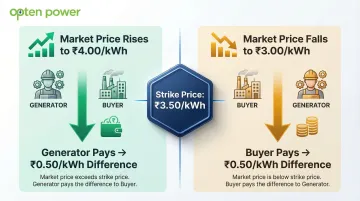
This mechanism locks in predictable energy costs regardless of wholesale market volatility. Because the structure differs from conventional energy contracts, VPPAs are frequently misunderstood — here's where the boundaries sit.
What a VPPA Is NOT
- No electricity flows to your premises — this is a financial settlement only, not a physical supply arrangement
- VPPAs are non-tradable and non-transferable under CERC's draft rules, unlike exchange-traded instruments
- These are long-term bilateral agreements (typically 10–25 years), not short-term supply contracts
The Role of RECs in Indian VPPAs
Under CERC's Draft Guidelines, the RE generator receives RECs from the National Load Dispatch Centre (NLDC) and transfers them directly to the buyer. You must extinguish these RECs through the REC registry for RCO compliance — they cannot be resold or traded.
Who Qualifies as a VPPA Buyer?
Eligible buyers under the current Draft Guidelines include:
- Consumers as defined under the Electricity Act
- Designated Consumers (DCs) under the Energy Conservation Act — energy-intensive industries such as:
- Steel and cement manufacturers
- Fertiliser plants
- Data centres
- Large commercial complexes
This restriction currently excludes foreign entities and some voluntary green buyers — a gap industry stakeholders have flagged for revision in subsequent guidelines.
India's Regulatory Framework: CERC's 2025 Draft VPPA Guidelines
The Decade-Long Jurisdictional Dispute
VPPAs reached regulatory clarity after a protracted jurisdictional battle between SEBI and CERC. The Supreme Court's October 2021 order in Power Exchange of India Ltd. vs. SEBI established that CERC regulates physical delivery-based forward contracts and NTSD contracts, while SEBI regulates financial and commodity derivatives.
On January 31, 2025, SEBI issued an official opinion to CERC classifying VPPAs as bilateral, non-tradable, and non-transferable OTC contracts. This confirmed they fall outside the Securities Contracts (Regulation) Act and placed them firmly under CERC's jurisdiction.
Key Provisions of the May 2025 Draft Guidelines
CERC's Draft Guidelines for Virtual Power Purchase Agreements establish:
- VPPAs are defined as NTSD-based OTC contracts structured as CfDs
- VPPA pricing can be agreed directly between parties, through a licensed trader, or via an OTC platform
- RE projects must be registered under the 2022 REC Regulations
- RECs issued under a VPPA are transferred directly from generator to buyer and must be extinguished for RCO compliance — not traded
RCO Compliance: The Primary Driver
Renewable Consumption Obligations (formerly RPOs) under the Energy Conservation (Amendment) Act 2022 require Designated Consumers to source a minimum percentage of power from non-fossil sources.
Current RCO Targets:
| Financial Year | Mandatory Non-Fossil Energy Target |
|---|---|
| FY2024-25 | 29.91% |
| FY2025-26 | 33.01% |
| FY2026-27 | 35.95% |
With targets rising nearly 3 percentage points annually, C&I consumers must scale renewable procurement faster than most existing PPA pipelines allow — which is precisely where VPPAs fill the gap.
Critical Gaps in the Draft Guidelines
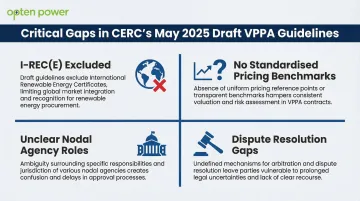
The draft establishes VPPAs as a viable compliance pathway, yet several unresolved gaps could limit their practical adoption:
- I-REC(E) excluded: Only statutory Indian RECs under the 2022 REC Regulations qualify — not internationally recognised I-RECs. FICCI, AMCHAM, and the Clean Energy Buyers Association have each recommended including I-RECs so multinationals can satisfy global ESG standards such as RE100.
- No standardised pricing benchmarks: India lacks unified power market price references across exchanges, making VPPA return assessments inconsistent.
- Unclear nodal agency roles: The draft designates no nodal agencies and provides no incentive framework for VPPA implementation oversight.
- Dispute resolution gaps: Conflict resolution relies entirely on bilateral contract terms, with no binding CERC arbitration mechanism available.
Guidelines vs. Regulations: What It Means
CERC issued these as "guidelines" rather than "regulations." That distinction has direct consequences: guidelines carry advisory weight, not binding legal force. In practice, this means counterparties cannot invoke CERC enforcement for contract breaches — they must rely on civil courts or whatever dispute terms they negotiate bilaterally. Until CERC elevates these to formal regulations, buyers and developers should treat contract drafting as their primary legal protection.
Key Benefits of VPPAs for Indian C&I Businesses
Price Certainty and Energy Cost Hedging
VPPAs shield buyers from India's volatile wholesale electricity prices. According to CERC's Annual Report on the Short-Term Power Market (2023-24), price volatility in the Day-Ahead Market was 14.94%, while the Real-Time Market experienced 20.71% volatility.
By locking in a strike price over 10-25 years, C&I companies with high and predictable power consumption — steel plants, cement factories, data centres, and process industries — can forecast energy costs with far greater accuracy.
RCO Compliance Without Physical RE Infrastructure
VPPAs allow companies to meet mandatory Renewable Consumption Obligations by receiving RECs, even if they cannot directly procure or generate renewable power at their facility. This is especially valuable for businesses in locations where open access RE procurement is constrained by:
- High state-level wheeling charges
- Banking restrictions
- DISCOM reluctance to grant open access
ESG Credentials and Decarbonisation Support
Beyond compliance, VPPAs support Scope 2 emissions reduction under the GHG Protocol — enabling credible green claims to investors, export customers, and sustainability rating agencies. Large Indian exporters targeting climate-conscious markets in Europe or the US can use VPPAs to demonstrate verifiable clean energy procurement across their supply chain.
Key ESG benefits include:
- Supports Scope 2 reduction targets under the GHG Protocol
- Provides verifiable REC documentation for sustainability disclosures
- Strengthens green supply chain credentials for export markets
Current limitation: Indian VPPA RECs cannot be used for international I-REC(E) claims under the draft guidelines, which limits their utility for multinationals.
Supporting Additionality and New RE Capacity
Unlike purchasing unbundled RECs from existing projects, VPPAs are typically structured to finance new RE projects — meaning corporate buyers directly enable incremental green capacity addition.
India has committed to achieving 500 GW of installed non-fossil fuel capacity by 2030. As of February 2026, installed non-fossil capacity stands at 275.46 GW — a gap of roughly 224.5 GW. Widespread VPPA adoption accelerates progress toward that target while giving corporate buyers a measurable impact story to share with stakeholders.
Challenges and Limitations to Know Before Signing a VPPA
Financial Settlement Risk and Market Price Exposure
If market prices remain persistently below your agreed strike price, you must pay the difference to the generator for the contract's full duration — potentially 15-25 years. Before committing, C&I companies should complete:
- IRR and payback analysis across multiple price scenarios
- Stress-testing against sustained low-market-price periods
- Sensitivity modelling for exchange price volatility
India lacks standardised price benchmarks across power exchanges, which makes this return analysis harder than in more mature VPPA markets.
Restricted Green Certificate Options
Under current CERC Draft Guidelines, only statutory RECs under India's 2022 REC Regulations can be transferred — not internationally recognised I-REC(E)s. Multinationals requiring globally accepted certificates for cross-border ESG reporting or RE100 commitments cannot currently rely on Indian VPPAs alone to meet those obligations.
Contractual Complexity and Negotiation Burden
Beyond certificate limitations, the legal structure of Indian VPPAs adds another layer of complexity. Each VPPA is a long-term, bespoke financial contract requiring careful drafting of:
- Pricing terms and adjustment mechanisms
- Accounting treatment
- Force majeure provisions
- Change-in-law clauses
- Construction delay protections
India has no standardised VPPA documentation framework — unlike the ISDA Master Agreements commonly used in US deals — which increases legal costs and negotiation timelines, particularly for first-time buyers.
VPPAs vs. Physical PPAs: Choosing the Right Renewable Energy Structure
The Fundamental Difference
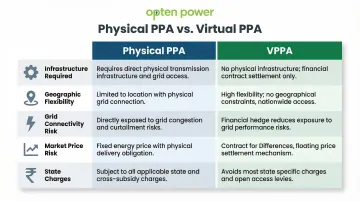
Physical PPA: Actual delivery of electricity from the generator to your premises or meter point, typically through the grid using open access arrangements.
VPPA: No physical power delivery — you continue to draw power from the grid/DISCOM while receiving RECs and financial settlements.
Key Decision Dimensions
| Factor | Physical PPA | VPPA |
|---|---|---|
| Infrastructure Required | Open access infrastructure, metering, scheduling | None — purely financial |
| Geographic Flexibility | Limited by proximity and state regulations | Unrestricted — project can be anywhere |
| Grid Connectivity Risk | High — subject to scheduling and wheeling | None — no physical delivery |
| Market Price Risk | Lower — you receive actual power | Higher — exposed to settlement volatility |
| State Charges | Wheeling + cross-subsidy surcharge (e.g., ₹2.87/unit in Maharashtra) | None |
Simple Decision Guide
Consider VPPAs if you:
- Have multiple locations across different states
- Operate in states with high wheeling/banking charges
- Primarily need ESG compliance without operational RE management capacity
- Prefer asset-light renewable procurement
Consider Physical PPAs if you:
- Have a single large industrial site with high load factor
- Can manage grid scheduling and open access infrastructure
- Want direct control over power delivery
- Have the operational capacity for direct RE management
Once you've identified the right structure, execution speed matters. Opten Power gives C&I buyers access to 4+ GW of solar, wind, and hybrid projects across 16 states — with real-time tariff comparisons and automated RFP tools that cut deal timelines significantly.
How to Get Started with a VPPA in India
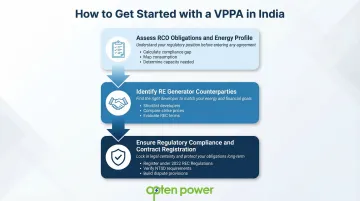
Step 1: Assess Your RCO Obligations and Energy Consumption Profile
Calculate your current RCO compliance gap — the difference between your mandatory non-fossil energy percentage and your current RE sourcing. Map your annual electricity consumption, peak load patterns, and multi-site footprint to determine how much VPPA capacity you need and for what duration.
Step 2: Identify Suitable RE Generator Counterparties
Shortlist RE developers with registered or eligible projects, assess project viability, and compare strike prices, REC delivery terms, and contract durations.
Opten Power streamlines this step with tools built specifically for C&I buyers:
- Access to 4+ GW of pre-vetted renewable projects across solar, wind, and hybrid
- Real-time tariff comparisons with instant IRR, payback, and regulatory analysis
- Automated RFP creation using modular templates
- Pre-approved contract frameworks that close deals 50% faster
Step 3: Ensure Regulatory Compliance and Contract Registration
CERC's Draft Guidelines set clear requirements before a VPPA can go live. Key compliance actions include:
- Register the VPPA contract and the underlying RE project under the 2022 REC Regulations
- Verify contract terms against NTSD OTC contract requirements
- Engage legal counsel with CERC power market experience
- Build dispute resolution provisions into the agreement from the outset
Frequently Asked Questions
What is a virtual PPA for renewable energy?
A Virtual PPA is a financial contract between a renewable energy generator and a corporate buyer where no physical electricity is delivered. The buyer receives RECs and financial settlement based on the difference between an agreed strike price and the real-time market price, helping companies claim green energy benefits and meet RCO compliance obligations.
What is the cost of a virtual PPA in India?
VPPA pricing is based on a mutually negotiated strike price between the buyer and generator, expressed in ₹/kWh. Because VPPAs are bilateral OTC contracts, strike prices are confidential and not publicly disclosed. The overall cost impact depends on the difference between the contracted strike price and prevailing power exchange prices over the contract term.
What is a 20-year virtual PPA?
A 20-year VPPA locks in financial settlement terms between a buyer and generator for the full contract duration, offering price certainty and supporting RE project financing. The trade-off is extended market price risk if wholesale electricity prices consistently fall below the agreed strike price.
How is a Virtual PPA different from a physical PPA in India?
A physical PPA involves actual delivery of electricity to your facility via open access infrastructure, while a VPPA involves only financial settlement and REC transfer with no physical power flowing to you. Under a VPPA arrangement, you continue to purchase power from your DISCOM or other source separately.
Who can enter into a VPPA in India under CERC guidelines?
Under CERC's May 2025 Draft Guidelines, eligible buyers are Consumers under the Electricity Act or Designated Consumers under the Energy Conservation Act — covering energy-intensive sectors such as steel, cement, fertilisers, and data centres. Generators must be registered renewable energy producers.
Can VPPAs be used to meet RCO compliance in India?
Yes. RECs transferred through a VPPA can be used by Designated Consumers to meet mandatory non-fossil energy targets under India's Energy Conservation (Amendment) Act 2022. However, the current draft guidelines prohibit these RECs from being traded or used for international green certificate claims.