Introduction
Industrial businesses face a fundamental tension: renewable energy delivers significant cost savings and sustainability gains, but 24x7 operations in steel, cement, data centres, and hospitals cannot tolerate power interruptions. Unplanned outages cost the typical Indian industrial business approximately ₹7 million per hour, making reliability non-negotiable.
Modern hybrid architectures, battery storage, and strategic procurement have shifted that calculus. Businesses operating across India's grid can now structure renewable supply that meets 24x7 load requirements — without defaulting to fossil fuel backup as the only safety net. This article breaks down the intermittency challenge, the pillars of reliable renewable systems, India-specific grid realities, and what smart procurement actually looks like in practice.
Key Takeaways
- Renewable intermittency (variable solar and wind) is a design challenge, not a fatal flaw
- Hybrid systems — solar, wind, battery storage, and backup — sustain power through generation gaps around the clock
- Grid-scale batteries convert intermittent generation into dispatchable power, covering overnight and low-generation periods
- India's diverse resource mix gives industrial buyers an advantage when diversifying across energy types
- Corporate PPAs lock in long-term clean energy at fixed tariffs — cutting energy costs by up to 40% for industrial buyers
The Reliability Challenge: Why Renewable Intermittency Matters for Industrial Operations
Intermittency means solar panels generate nothing at night and less on overcast days. Wind turbines can drop from full output to near-zero within hours based on weather. Unlike coal or gas plants that dispatch on demand, renewable output fluctuates with natural conditions.
That variability hits 24x7 operations hardest. For manufacturing lines, data centres, cold-chain logistics, and hospital systems, even brief supply disruptions translate to production losses, equipment damage, and contractual penalties. 88% of Indian industrial businesses experience unplanned outages at least once a month, with each hour of downtime costing close to ₹7 million.
The Duck Curve Problem
Solar floods the grid midday when industrial load is partially met, then drops steeply in the evening when factories and commercial complexes hit peak demand. This mismatch creates a "duck curve" where grid operators must ramp dispatchable generation at extreme speed — India's power system now requires evening ramp-ups of about 60 GW, at 250–500 MW per minute. Standard grid tariffs and open-access arrangements don't always resolve this timing gap.
Seasonal and Weather-Driven Compounding
Wind and solar don't always fail independently — extended weather events can suppress both simultaneously across entire regions. The compounding risks include:
- Monsoon and cyclonic weather reducing solar irradiance and wind speeds across wide geographies at once
- Back-to-back low-generation days that exhaust short-duration storage reserves
- Seasonal deficit clusters concentrated in November–December, often persisting for over a week
Intermittency is a system design challenge. With the right mix of generation sources, storage, and procurement structure, industrial operations can meet reliability requirements without falling back on fossil fuel backup.
Building Blocks of a Reliable Renewable Power System
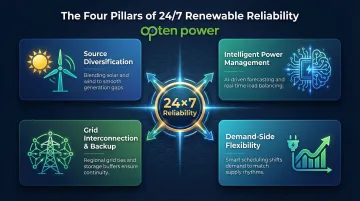
Diversification Across Energy Sources
Wind and solar generation offset each other's weaknesses — wind typically peaks during hours and seasons when solar output is lowest, creating built-in complementarity that standalone projects can't match.
In India:
- Wind speeds increase during and after sunset, compensating for solar's evening drop
- Summer monsoons reduce solar but boost wind; pre-monsoon summers peak solar while wind slows
- Co-locating wind and solar PV into hybrid plants reduces output variability compared to stand-alone plants
A 2024 NREL study found that overall electricity system costs drop by roughly 1–2% with solar-wind hybridization.
Intelligent Power Management
Once you've diversified your sources, keeping them coordinated requires an intelligent Power Management System (PMS) — the operating brain of any hybrid setup. It continuously monitors:
- Load demand in real time
- Available renewable output
- Storage levels
- Backup capacity status
The PMS automatically prioritizes the lowest-cost, cleanest available source, maximizing renewable penetration without sacrificing uptime.
Grid Interconnection and Backup Capacity
Even well-managed hybrid systems need a fallback for extended shortfalls. Grid interconnections and pre-arranged backup capacity serve that role. Key elements include:
- Grid tie-ins that draw from DISCOM supply when renewables fall short
- Gas peakers or backup DG activated only under defined threshold conditions
- Procurement contracts that specify exact trigger conditions, keeping both cost and emissions in check
Demand-Side Flexibility
Demand response is the fourth lever — shifting energy-intensive loads to periods of peak renewable generation and low tariffs. Common applications include:
- Compressors and cooling systems scheduled during midday solar peaks
- EV charging timed to off-peak or high-wind periods
- Smart load controllers paired with time-of-use pricing to automate the decisions entirely
Energy Storage: The Backbone of Round-the-Clock Renewable Power
Grid-scale battery storage (primarily lithium-ion today) converts intermittent renewable generation into dispatchable power. Batteries store surplus midday solar output and dispatch it during evening demand peaks.
Recent cost declines make this technology increasingly accessible:
- Lithium-ion battery pack prices dropped 45% year-over-year to a record low of $70/kWh (globally) in 2025
- Utility-scale BESS costs fell 93% from 2010 to 2024, from $2,571/kWh to $192/kWh (USD, global benchmark)
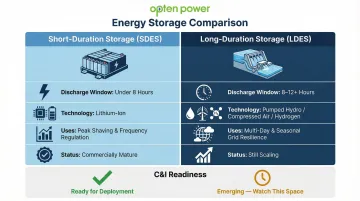
These falling costs raise a practical question for C&I buyers: which type of storage fits your operational profile?
Short-Duration vs. Long-Duration Storage
| Short-Duration (SDES) | Long-Duration (LDES) | |
|---|---|---|
| Discharge window | Less than 8 hours (typically 2-4 hrs for Li-ion) | 8-12+ hours continuously |
| Technologies | Lithium-ion batteries | Pumped hydro, compressed air, hydrogen |
| Primary uses | Peak shaving, frequency regulation, sub-daily energy shifting | Multi-day resilience, seasonal load shifting |
| C&I readiness | Commercially mature today | Still scaling for widespread deployment |
Financial Benefits Beyond Reliability
For industrial buyers, Battery Energy Storage Systems (BESS) paired with on-site or contracted renewable generation reduce peak demand charges from DISCOM grid supply. A 2025 CSTEP analysis found that consumers can reduce electricity bills by up to 75%, with the life cycle cost of energy for behind-the-meter battery storage with rooftop PV calculated at INR 11/kWh — more cost-effective than diesel generators at INR 16–18/kWh.
India's Renewable Energy Landscape: Grid Realities and Opportunities
India offers a genuine renewable resource advantage: some of the world's highest solar irradiation levels (particularly in Rajasthan, Gujarat, and southern states) and significant wind corridors in Tamil Nadu, Gujarat, and Karnataka. A geographically diversified portfolio of solar and wind assets can meaningfully cut combined output variability — pairing, say, Tamil Nadu wind with Rajasthan solar reduces the risk of simultaneous generation shortfalls.
Current scale:
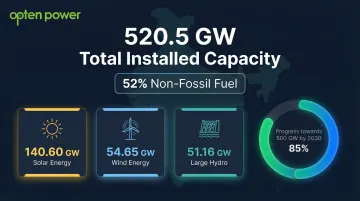
- India's total installed power capacity reached 520.5 GW as of January 2026, with 52% (271.96 GW) from non-fossil fuel sources (CEA, April 2026)
- This includes 140.60 GW of Solar, 54.65 GW of Wind, and 51.16 GW of Large Hydro
- India's official target is 500 GW of non-fossil fuel capacity by 2030 (PIB)
DISCOM Complexity as a Reliability Variable
DISCOM regulations vary significantly across India's 28+ states. The key variables that shift from state to state include:
- Transmission and wheeling losses
- Open access charges and surcharges
- Banking regulations for surplus energy
- RPO (Renewable Purchase Obligation) compliance frameworks
- State-level approval timelines
A procurement structure that performs well in Maharashtra may produce entirely different reliability and cost outcomes in Telangana. Businesses operating across multiple states need procurement approaches that account for this regulatory patchwork — not a one-size-fits-all PPA.
Round-the-Clock Renewable Tenders
The Solar Energy Corporation of India (SECI) issues hybrid and round-the-clock (RTC) renewable tenders that bundle solar, wind, and storage to guarantee a minimum supply at all hours. These are structured specifically for industrial consumers who cannot tolerate supply gaps.
A typical RTC tender package includes:
- Defined minimum generation guarantee (e.g., 80-85% plant load factor)
- Storage component (usually battery or pumped hydro) to cover off-peak gaps
- Fixed tariff locked over the contract term (usually 25 years)
- Developer-side responsibility for managing dispatch variability
For steel plants, data centres, hospitals, and other 24x7 operations, RTC tenders represent one of the most direct paths to reliable renewable supply without grid dependency. Platforms like Opten Power list active SECI and state-level RTC opportunities alongside demand-side analytics, helping industrial buyers match their load profiles against available tender structures before committing to a procurement route.
How Businesses Can Build a Reliable Renewable Energy Portfolio
Building a reliable renewable power strategy starts with structured procurement:
Identify the right mix:
- Energy sources (solar, wind, hybrid)
- Contract structures (captive, group captive, third-party open access, Corporate PPAs)
- Tenors that match load profile and risk appetite
Of these, long-term PPAs deserve particular attention. They fix energy prices and create supply certainty — a critical hedge for energy-intensive industries exposed to volatile grid tariffs.
Compare Before Committing
Evaluate multiple developers and projects before signing. Critical factors:
- Technology mix (solar-only vs. hybrid)
- Project location relative to DISCOM landing prices
- Storage integration
- Developer financial health
Businesses that issue structured RFPs and evaluate standardized proposals make better procurement decisions than those relying on single-developer negotiations.
Opten Power: India's Unified Clean Energy Marketplace
Opten Power gives C&I businesses access to 4+ GW of renewable projects across solar, wind, and hybrid technologies, with real-time DISCOM intelligence standardized across 16 states.
Platform capabilities:
- Compare tariffs, savings, and ROI across developers in real time
- Run automated RFP processes with modular templates
- Manage entire renewable energy portfolio from a single dashboard
- Close deals 50% faster with pre-approved contracts
- Access instant IRR, payback, and regulatory analysis
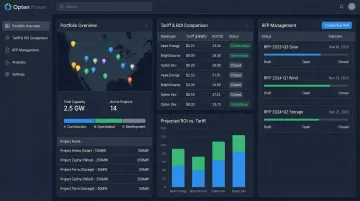
For C&I buyers evaluating multiple projects across states, this level of visibility directly reduces the risk of locking into unfavorable terms.
Plan for Portfolio Evolution
Reliable renewable power strategies need built-in flexibility. As storage costs decline and round-the-clock products mature, businesses with modular contract structures can upgrade their energy mix over time — without renegotiating from scratch.
Frequently Asked Questions
What is renewable energy intermittency and why does it matter for businesses?
Intermittency refers to the variable output of solar and wind power due to weather and time of day. For industrial operations requiring continuous power, this variability must be managed through storage, hybrid systems, and smart procurement — not treated as an inherent reliability failure.
Can heavy industries run entirely on renewable energy?
While 100% renewable supply is technically achievable with sufficient storage and hybrid sourcing, most industrial buyers pursue a high-renewable-fraction strategy supplemented by grid backup as the most cost-effective path. Round-the-clock renewable products are increasingly available through structured tenders.
What is a hybrid renewable power system?
A hybrid system combines multiple generation sources — typically solar, wind, and battery storage, sometimes with grid or genset backup. An intelligent power management system automatically prioritizes the lowest-cost clean source and switches to backup only when needed.
How does battery storage improve renewable energy reliability?
Batteries store surplus renewable generation (such as midday solar) and dispatch it when generation drops (such as in the evening), effectively decoupling when energy is produced from when it is consumed. This converts intermittent generation into consistent, dispatchable supply.
What is a Corporate PPA and how does it ensure reliable clean energy supply?
A Corporate PPA is a long-term contract between an industrial buyer and a renewable energy developer that locks in the energy price and guarantees supply from a specific project. It delivers price stability and supply security over the contract period, typically 15–25 years.
How do DISCOM regulations in India affect renewable energy reliability for C&I buyers?
DISCOM rules on open access, banking, transmission charges, and RPO compliance vary significantly by state and directly affect how reliably and cost-effectively a business can draw power from renewable sources. State-level regulatory intelligence is a critical input in any Indian renewable energy procurement decision.